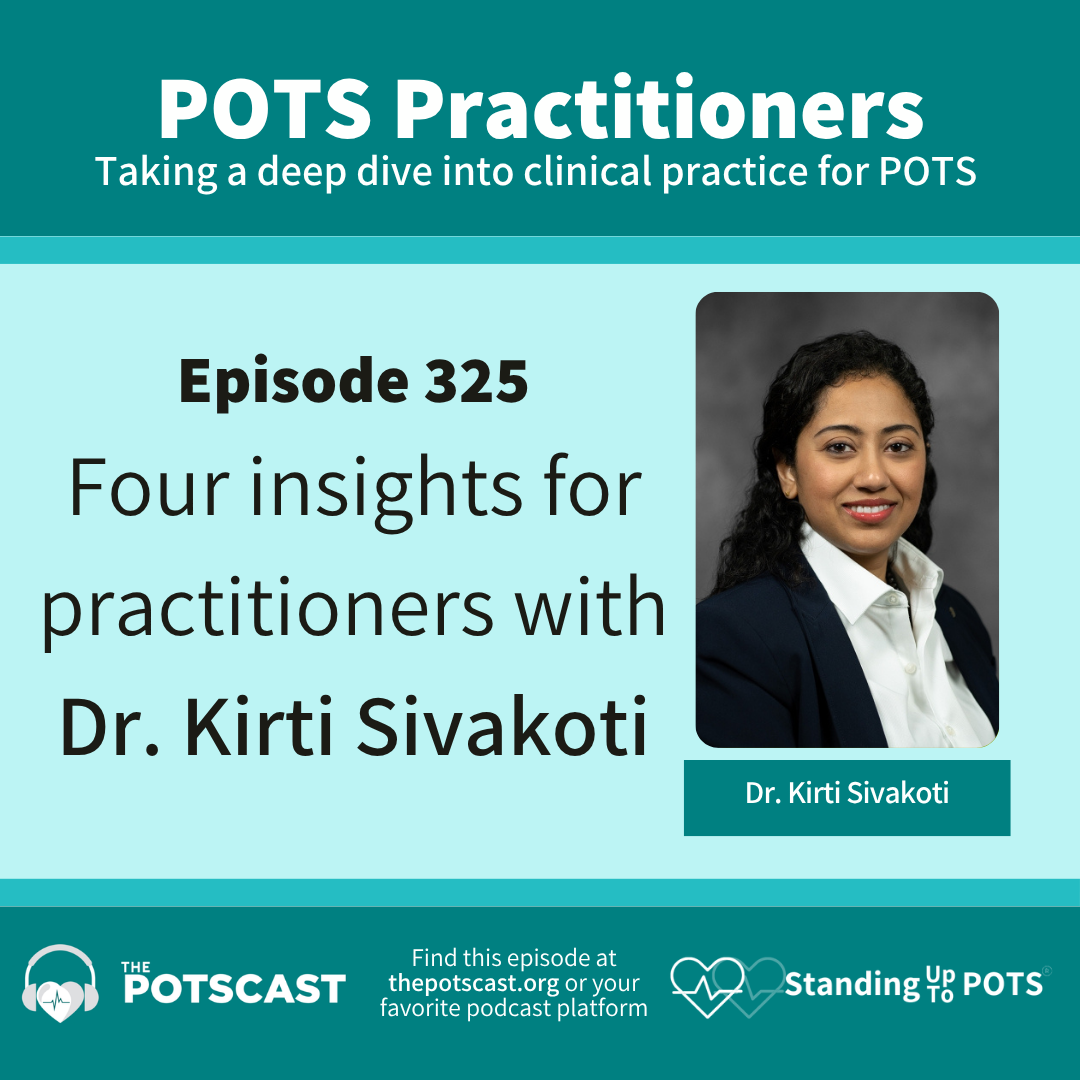
Four Insights for Providers with Dr. Kirti Sivakoti, MD
August 30, 2026
Pediatric dysautonomia expert Dr. Kirti Sivakoti, MD, is a pediatrician specializing in complex chronic illness, Associate Professor of Pediatrics at University of Utah, and Associate Medical Director of the Pain and Autonomic Symptoms Evaluation (PAUSE) Program at Primary Children's Center. In this episode she shares findings and lessons from one case report and 3 recent research publications:
Impact of Excessive Postural Tachycardia on Disability in Youth with Orthostatic Intolerance, in Journal of Pediatrics — In this study, they found that functional disability was the same between patients with chronic orthostatic intolerance, regardless of whether their heart rate increase on the tilt table test or active stand test met the POTS criteria of 40+bpm.
Autonomic Dysfunction and Postural Orthostatic Tachycardia Syndrome: What Every Frontline Clinician Needs to Know — This article educates frontline clinicians on how to recognize POTS and initiate treatment, what other diagnoses to rule out and when a referral to specialists is appropriate. It is intended to help PCPs and other frontline clinicians learn to manage POTS to reduce delays in care.
Parent-Child agreement on functional disability in chronic orthostatic intolerance — In this study, parents and children had a high correlation of rating of the child's functional disability, suggesting that that they are largely interchangeable for clinical or research purposes.
More information about Dr. Sivakoti and her practice is here.
Episode Transcript
[00:00:00]
Jill Brook: Hello, fellow POTS patients, and beautiful people who care about POTS patients. I'm Jill Brook, your horizontal host, and today on the podcast, I'm joined by the amazing Dr. Kirti Sivakoti, Assistant Professor of Pediatrics at the University of Utah and Associate Medical Director of the Pain and Autonomic Symptoms Evaluation and Support or PAUSE program at Primary Children's Hospital.
Her research is aimed at addressing some of the major evidence gaps in pediatric dysautonomia, and she is a prodigious publisher. We are discussing three new articles that she has published since her last appearance here, plus one case study in order to explore four key insights for providers. So Dr. Sivakoti, thank you so much for being here today.
Dr. Kirti Sivakoti: Absolutely. Thank you for having me that. A great introduction.
Jill Brook: Well, so you were here last time talking about fatigue and hypersomnia [00:01:00] and just what a common symptom that is. And during that episode you had talked about a patient of yours who had hypersomnia and that kind of related to one of your clinical insights today having to do with recognizing rare findings in atypical presentations.
And so listeners may recall that that was an amazing episode. And you, you talked about a patient who presented with hypersomnia and then on follow up you noticed something else having to do with his coordination. Do you, do you wanna kind of remind us what that patient was like and what ended up happening?
Dr. Kirti Sivakoti: Absolutely. Yeah. So this patient, whom I've known for about couple years now, so when I saw him initially was a, a male teenager who came into my clinic with fatigue. And the biggest thing was hypersomnia. So he would easily sleep for about 13, 14, sometimes 18 to [00:02:00] 20 hours a day. And there were a few intervals between that that would be fine in terms of functioning okay. He could go to the gym, lift weights and do everything. So, the hypersomnia piece was definitely atypical. A lot of our patients do present with fatigue, but more of the fatigues and sense of they come back home from school, they have to take a nap, they get up and then they'll go to bed later.
There's this daytime sort of feeling like the flu has come on. But for this patient, it was really atypical in that he was very athletic, a lot of our patients are, but he continued to be athletic, but during some intervals he would just sleep for 18 to 20 hours. And we, we had sleep study as a huge part of that because we wanted to look at what is the underlying sleep structure?
Is there something else happening? So we involve sleep clinic and, and after that, I think for a few months I, I didn't get to see him. But then he was referred back to our clinic [00:03:00] at dysautonomia clinic and at that point he didn't have the sleep study done yet. But what was new during this most recent visit, and this was I wanna say a few months ago, what was new with this recent visit is there were newer symptoms that developed. Symptoms with regards to coordination and symptoms with regard to, I just feel like my vision's too blurry and I feel like I'm missing things.
So I think that newer development sort of prompted us to look further into what might be happening rather than just be like, okay, we know that you have this going on for a while. But we ended up getting imaging and we found cavernoma. So there were cavernous sinus findings and we refer to neurosurgery for sort of further interventions and to sort of like get them as part of the team.
Jill Brook: Can you say what cavernoma is, what does that mean?
Dr. Kirti Sivakoti: Yeah, so [00:04:00] it's sort of like a collection of vessels in the cavernous sinus. So, sometimes it can lead to bleeds and it could be very subclinical. And it's almost like there's a bleed and the body reabsorbs it. And for some it's, it's a lot more. Now the question then becomes is that leading to his symptoms?
And it's so hard to think that it would not, but also I think it's hard to, to determine causality here. I think that is where involving neurosurgery team and thinking about, well, is there any way that we can look into are there any signs of previous bleeds that we can find from the MRI findings that we can comment on?
So I think where that led us to, I think eventually, and the lessons from that situation really was that when we have patients who are as complex as this and we're trying to come up with answers or thinking about how do we help move the care of this [00:05:00] patient forward, I think it's important to take newer symptoms seriously, things that could change our management and then work on that rather than just sort of attribute everything to, well, we know this patient has dysautonomia, so the impaired coordination could be coming from that.
So I think it's important to have that open mind because presentations can change. We have patients who have had POTS one year and POTS symptoms got better and pain became their more pressing symptom the next year. So now we are working on their pain symptomatology. So, so things can change and I think it's so important to think about new symptoms from a perspective of, well, yes, this is what we know where the patient was, but does this new symptom fit into that or does this need more evaluation?
Jill Brook: Yeah. For, for patients who don't have somebody like you and your team, [00:06:00] who is so great about listening and believing them and noticing new symptoms and caring about new symptoms, do you have any suggestions for patients about when a new symptom is something worth kind of pushing for more looking into versus saying, oh, I should let that one slide? Because I can just kind of imagine a lot of parents right now are saying, oh my gosh, you know, my aging child has three new symptoms every six months, and if I push on all of them, then the doctors are gonna think that I'm just so annoying.
How, how do I preserve the relationship but push when it counts? Like, are there any like little ways to kind of figure out which symptoms are the ones to focus on for, for more, I don't know, testing.
Dr. Kirti Sivakoti: Yeah, that's a great question. And, and I would think of this in terms of two cohorts. One is patients who have been diagnosed or who have been [00:07:00] evaluated by the medical team and we have plugged them into, we have that initial treatment plan in place, in terms of let's try the volume expansion, let's try compression and physical therapy and medications, if there's a role for that.
So, so when these patients are not improving, sort of in the timeline that you would expect improvement, so, so let's say with all the first line interventions, within three to four months, if they're able to implement a lot of those, you should be able to start seeing improvements. With physical therapy, sort of four to six months is the timeline where you can start expecting improvement too. But with that being said, I know it's hard to be optimized on some of the first line things. It's hard when we ask our patients to drink crazy amounts of water or crazy amounts of salt or be physically active for so long when they are, they have barriers to that, whether that's pain, [00:08:00] which makes them take a few steps back or whether there's GI symptomatology, celiac disease, or something else that prevents them from, from optimizing their, their volume expansion treatment plan.
So, so I think when we put that initial treatment plan in place, a good way to think about it as we are starting the high level treatment, the umbrella treatment for most of our patients, and for somebody who has more typical symptomatology, we would expect improvement. But within three to four months or max about four to six months, they're not improving, then brainstorming with the family about what are the barriers, like is it an access barrier? Or is it an implementation barrier? Or is there pain flaring or are they hypermobile? Like what's happening that's preventing them from, and, and addressing, I think, our next steps based on that, thinking about if they can't drink or [00:09:00] their GI symptoms are flaring, do we need to test them for celiac disease?
Do we need to send them to GI for a scope or thinking about motility disorders, autonomic dysfunction of the gut. If they're not improving with physical therapy, thinking about what are specifically the barriers there? Is there post exertional malaise that's stopping them from progressing? Do we need to pace and restructure physical therapy differently?
So I think with, with that, the initial cohort, when we are starting treatments, it's almost like their response to treatments can help decide, okay, is this a more of a typical presentation or is this atypical in terms of they need more investigations or maybe more referrals. Maybe they now need a tilt table testing or an appointment with an autonomic neurologist for antibody testing and whatnot.
The, the second cohort that I think about is more so in terms of patients [00:10:00] who come in with atypical symptoms right from the start. And I think these are more challenging. So these are those who fall outside the phenotype of the POTSie patients, orthostatic intolerance patients. So, anytime there is somebody who is premenarchal, so an 8-year-old, 9-year-old in that age range or not close to puberty, that's always a red flag that is there something else going on that they need more in investigation for?
And there's some literature out there that talks about with hypermobility symptoms could happen earlier, but outside of that context, thinking about is there familial dysautonomia, do they need autonomic testing if there are specific things that don't fit the pattern? For example, patients who have, who sweat abnormally or they don't sweat at all, or they have abnormal patches where they tend to sweat. Hyperhidrosis, [00:11:00] anhidrosis, I think all of those are definitely red flags that should prompt referral to an autonomic neurologist, and more detailed autonomic testing. Thinking about urinary symptoms, urgency, frequency, things like that. If there are menstrual symptoms, pelvic congestion type of symptoms.
And then one, one category that I think about a lot is neurodivergence when it happens with POTS, right? Autism, if there are sensory issues, if there's ADHD, all of these, they tend to make the management of POTS really hard. So in terms of if somebody has ADHD that's not well managed, most of the things that we talk about relates to, you have to remember to do this, drink this much and this much salt and compression.
And frequently patients would be like, I forgot to do that. Or I forgot to put on my compression leggings. And I didn't, I didn't drink water all day [00:12:00] in school. I was so focused on other things. So, with autism, I think that the understanding body's cues, sometimes that seems to be challenging. Or regulating, body regulation seems to be challenging.
So, so I think knowing if a neurodivergent patient, neurotypical patient with dysautonomia, that can also influence our, our management, looking at some of the atypical signs. And one other category that we run into, not very commonly, but enough times, is the patient who declines suddenly. So those patients who have POTS and who have been doing okay in terms of managing their symptoms, and all of a sudden they just decline suddenly. Maybe they, they faint 40 times a day and after that they have a hard time just getting out of bed.
Why sudden functional decline happens, we don't know for sure, but that is another, I think, [00:13:00] population to really investigate. Is there's something else going on, do we need to look into their cortisol levels? And so long answer, but yeah.
Jill Brook: Yeah. Yeah. Well this ties so well into one of your publications 'cause I realized that a lot of my follow-up questions for you actually have to do with one of the new papers that you have out, which is about what frontline clinicians need to know about autonomic dysfunction and Postural Orthostatic Tachycardia Syndrome.
So you had this published in the Pediatric Annals in March of 2026, and it was a beautiful article and it was reviewing POTS and autonomic dysfunction and kind of emphasizing that frontline physicians should be able to do a certain amount of recognizing and treating these, these [00:14:00] disorders, right? And so maybe you can talk about that.
Dr. Kirti Sivakoti: Absolutely. You're right. And this paper was really sort of, targeting the frontline clinicians, the community providers. And the reason that I, I really wanted to do this paper also is because I was one of them a few years ago. I was at the frontline, a community clinician in private practice before I transitioned to academics.
And these were all the same barriers that I ran into, which is I have a feeling that this patient could have POTS. I just don't know what to do next. How do I fit things in within the timeframe that I have in a very busy schedule? So I think laying down, just having an algorithm of the basic workup that could be done in patients is so valuable.
And the expectation from frontline clinicians, it's definitely not to [00:15:00] identify the atypical presentations or be responsible for managing the atypical presentations, but it's more so about are we able to streamline the patient who is very typical in how they're presenting to the right resource.
Have we done the basic workup and let the specialist take over from there? But are we bridging that time from when the patient is seeing their pediatrician to when they get into a dysautonomia center, which could be a good nine months to a year, are they doing the things to support these patients, right?
Because that's enough time for them to decline functionally, lose a lot of what they already have. So, so I think that is an area where community clinicians and pediatricians could be doing so much more.
Jill Brook: Yeah. So what do you think are the steps that a community clinician or a a primary care provider could do, and at what point should they [00:16:00] hand somebody off to a specialist? Like what, what do you consider the bread and butter for a frontline physician versus what should be passed on to somebody who specializes in it?
Dr. Kirti Sivakoti: So the bread and butter should definitely be doing a very focused history and physical exam. So sort of identifying the phenotype. And I think we have a sense of that already. So one question that can really help hone down into this phenotype and cut through a lot of noise is asking the postural question, right? So, are symptoms worse when you stand, when you're upright? And are they better when you're laying down? And these symptoms could be multisystemic, right? These patients can talk about brain fog and headaches and abdominal issues, nausea, pain, feel crummy. So all of these, and with POTS, orthostatic intolerance, we do see that there's a postural component to it.
We do have a subset of patients too, who don't have the postural component, and we can talk about that later. But a lot of [00:17:00] these patients have that postural component. So I think asking that one question can, can take us faster to, okay, so there's a postural component to your symptoms. Now let's think about, are you meeting the phenotype in terms of, are you around 14 years or are you around the age range of 12 to 18 when the time off onset is the highest. The peak age of onset is 14 years, so are you within that time range? Are you pre pubertal? And then is it's, it's a predominantly female population.
So is it a female versus a male? And if it's a female that we can probably lean into the diagnosis a lot sooner. With males too, but probably a lot sooner with females. And, and streamlining the history and physical in terms of thinking about how we would run a hospice type of visit, like in terms of a care goal focused visit.
And what I mean is what are some of the things that you [00:18:00] wanna do that you can't do right now? Where are your symptoms? What is it stopping you from doing? So is it going to school, is it swimming? Is it meeting with friends? And what are your goals? So I think that will really help streamline what our next steps are gonna be and what we wanna do.
And I think for all of these patients, having a baseline workup, right? CBC, chemistry, thyroid testing, ferritin level, all of those can help identify some of the commoner causes of tachycardia. So we wanna make sure that we're not sitting on somebody who's very anemic or they have Hashimoto's or something like that, which has happened in the past.
We have had patients who came in with hemoglobin of seven, and I'm like, well, we need to work on that. So, so we wanna make sure that there has been that basic workup to rule out some of the things that could do it, that could cause these symptoms, but we definitely don't have to go into a very [00:19:00] crazy type of rare disease testing looking for mold or heavy metals or that type of stuff.
And for these patients, an EKG definitely is also very valuable. And most patients have normal EKGs, but at least it can help rule out if there is any underlying rhythm disorder. And referral to cardiology could be based on do we still feel uncomfortable with their heart rates?
There are some patients who will talk about, well, my heart rate gets up to two hundreds when I'm running or maybe walking, and that makes me uncomfortable. We would wanna rule out a rhythm disorder, so, routing them to cardiology for a, for an event monitor or a Holter. And if there's a strong family history of cardiac issues, sudden cardiac deaths or something like that. Or if you're worried about vascular EDS, Ehlers-Danlos then referring to cardiology to rule out any structural issues. So an [00:20:00] echocardiogram would be helpful. But most patients and this is based on clinical information, a clinical experience, and this is actually a project in the works right now where we're looking at patients with POTS who have had EKGs and new cardiac diagnosis.
And our hypothesis is the new cardiac diagnosis is pretty low. So I think that EKG, along with patient symptomatology can guide us, okay, does this patient need to go to cardiology or not? Or can this patient go just to the dysautonomia center? So yeah, those would be some of the things to focus on.
Jill Brook: And so just to make it really specific for the providers who are listening right now, so let's say that a 16-year-old female comes into their office and says, I'm so dizzy all the time when I'm standing and, you know, I'm nauseous. What are the things that that provider should be able to do or recognize [00:21:00] or like, should they do a stand test or a NASA lean test? Are there sort of any like specifics that you, in your, in your dream scenario, what would a frontline provider be able to do for this patient before they make them wait a year to see you?
Dr. Kirti Sivakoti: Yes, absolutely. That's a great question. And so the three big things are gonna be, you're absolutely right, some form of either active stand, a lean test, or tilt. Tilt we know it's a super long wait time and not all patients need to do a tilt, so that makes it challenging. Active stand, which we also call Poor Man's Tilt Test.
So active stand is the best route to go. The difference between active stand and the lean test is that with lean test, they're sort of using support of a wall. So the, the replicability I think of the results, that is a little different when we look at just somebody who's standing compared to, because somebody could be just leaning.
Somebody could be entirely [00:22:00] leaning on a wall. So I think that introduces a little bit of variability in the results. With active stand test, because they're not leaning onto anything, they're just standing by themselves. I think we tend to get a more, a closer answer to what their physiology is actually doing.
With that being said, there's not a lot of active stand validation right now. The gold standard right now is the tilt table testing, where we get rid of even how teenagers, how, how patients are engaging their muscles differently, because when somebody's standing, there's also a difference in how they engage their core muscles and leg muscles that can change the heart rate numbers.
But with tilt table, we're just strapping them and tilting them. So, there's no element of them using their muscles. So I think the results are probably the most accurate with tilt table, but I think most real life results are with active stand test. And yeah, although it's not validated, I think we see there actually has been [00:23:00] a study that came out recently, it's a small sample size is about, I believe, 20 or 25 patients where they did a ROC analysis of active stand compared that with tilt table testing. And what they found is with sort of sensitivity and specificity that being high for a POTS diagnosis, the heart rate cutoff was 28 on active stand.
It's way lower than tilt table testing, which is interesting. It's a small study, but I mean, future direction is definitely to do this on a larger scale, which makes us think that, are we missing most of our patients who have these heart rate elevations on active stand test?
Jill Brook: Yeah, can I just take a moment to highlight what you just said so in case anybody missed it, this is like a perk up your ears 'cause this matters. Right?
Dr. Kirti Sivakoti: Yes.
Jill Brook: I think that what you just said is that if somebody does not have access to a full autonomic tilt table test and they have to do the [00:24:00] poor man's test or the active stand test, the heart rate cut off that might be equivalent to 40 beats per minute on the tilt table test is just 28.
Dr. Kirti Sivakoti: That's right. It's just 28, right? It's, it's mind blowing. So, yeah, it's a small study, but I'm like, they had results, right? Even with a small sample size, if we see results, if there's statistical significance, right, that's enough for somebody to be like, okay, this means something. I mean, of course we'd love to see larger studies, but yeah, I think that study was interesting.
It definitely makes us question about what are active stand thresholds? Probably way lower than tilt table testing. But to answer or finish off the, the question from before. So one is active stand test in clinic that pediatricians strongly, strongly recommend them to do. The second one is the blood work, CBC, chemistry, thyroid testing, ferritins, sort of basic panel.
Don't have to go [00:25:00] get into anything crazy. And the third is an EKG. So getting those with a good history and physical is enough for us to make a diagnosis of POTS if the symptoms have been chronic enough and active stand shows. I mean, I hesitate to just call it 28 right now, but. So far, the diagnostic criteria has at 40 so 40 for POTS.
And if they have orthostatic intolerance, which is they stand and they have symptoms, even if their heart rate's less than 40, they are entitled to the same amount of treatment, the same referrals, which is my next paper. But, but they should be treated the same way.
Jill Brook: So let's talk about that next paper, because that one, that one is so important and I think that paper, so, so I should just say it's, it's based on research that you published in the Journal of Pediatrics.
Dr. Kirti Sivakoti: Yes.[00:26:00]
Jill Brook: It has to do with the official diagnostic criteria for POTS, which currently involves a number of things, but one of them is that you have to have a heart rate increase when going from supine to standing of at least 40 beats per minute. And your paper says, what about all those patients whose heart rate doesn't go up enough, but they otherwise still look like the POTS patients? Can you, can you talk about those patients?
What do you see at your clinic? How many are there?
Dr. Kirti Sivakoti: Exactly. Yeah. I think what really led to that study is we see more patients with orthostatic intolerance, so those who don't meet the criteria for POTS, more than the ones who meet criteria for POTS. So, and that is really what led to this study, which is if we think about our, our patient cohort just in our dysautonomia center, probably 75% to 80% are the ones [00:27:00] with orthostatic intolerance and a lesser amount are those with POTS.
So think about what's happening in real life. A lot of these patients aren't being treated. We think that POTS is hard to diagnose and patients with POTS are not getting the recommendations and the treatments. This cohort is entirely forgotten. I have multiple providers who reached out to me, who, who've, who have talked about in their messages and our, our conversations, well that this patient didn't meet the criteria for POTS, so I didn't know what to tell them. So we just left it at that. And very frequently we get referrals where patients don't meet the criteria for POTS and there has been no treatment that was recommended to them. So that is, I think, really what led to this paper. And what we did is we looked at the textbook criteria of POTS and chronic orthostatic intolerance.
So we had about 46 in each cohort. And this study was conducted in [00:28:00] 2025. So we started with our most recent patient visit, and then we went back. So it was a retrospective study. We had to go back longer to do chart reviews for POTS patients because the numbers were lower. So, we ultimately had about 46 in each cohort, and we compared the functional disability inventories, which is a questionnaire for functioning in patients. It is validated in chronic pain population, not currently validated in the POTS population, but we know that the overlap between chronic pain and POTS is almost 80%. So we used FDI, something that we use in our routine clinic workflows. And the means were almost similar. There's no statistical difference between the two groups. So our two groups were the POTS, the COI, chronic orthostatic intolerance. So the FDIs that were reported by patients, or self-reported FDI, the [00:29:00] child reported FDI means were 22.9 for the COI group and 22.4 in the POTS group. And the ones that parents reported, it's 23.1 in the COI group and 22.3 in the POTS group. It's all very close and there's no statistical or clinically meaningful difference. And clinically meaningful difference in an FDI entails seven points of difference. So this is all clustered together, the same number or all clustered within a point of each other. So, so yeah, and, and that was a finding and I think it really supported what we see in our clinic, that functional disability in these patients are not different.
They're very similar patients who don't meet the heart rate criteria, struggle just the same and they're entitled to the same treatments, the same referrals. The only thing I would say, the, the key distinction I think is probably I would reach out [00:30:00] less for heart rate reducing medications in patients who have COI compared to those who have POTS just because of their heart rate elevation is way larger.
But outside of that, I think their treatment should be exactly the same, whether it's identification, recommending the fluid, the salt, compression, referral to physical therapy. They're not getting any of that right now. So, yeah, so, so I think these patients should be identified. It's, I think, a large part of our community that's going undiagnosed and untreated.
Jill Brook: Wow. Wow. And so I know that you are saying that these patients who do not meet the heart rate criteria for POTS deserve all the same treatment and care. Is that what all doctors think? Like what? What do insurance companies say? Do we need to work harder, like us as a nonprofit Standing Up to POTS to get the word [00:31:00] out on this?
Because if I'm hearing you correctly, this is a really big deal. What I'm hearing is that something like a majority of patients with chronic orthostatic intolerance do not meet the heart rate cutoff to get the very diagnosis that they need to get people to believe them and help them, and maybe for their insurance company to help pay for their treatments.
Dr. Kirti Sivakoti: I would completely advocate for that, right. I think that is what's happening. Also, if you think about the numbers of these patients, I think clinically, like what we have seen in our clinic. OI patients are way larger. It's almost like an iceberg where tip of the iceberg's POTS where their physiology is out of place where we are seeing the exaggerated heart rate response, but that does not necessarily mean that patients who have not reached the place of exaggerated heart rate response don't have functional impairment, right. So, so it's sort of that those patients who are sitting just below that tip of the iceberg. Again, it's a [00:32:00] larger number.
And I think another way to think about it is it's a spectrum. These patients are on a spectrum and we decided to put this heart rate, this cutoff criteria, and we are splitting these patients into these two groups who are essentially the same. But on the day that we are testing them, and we know heart rate has so many different things that could change it, if we do it in the morning versus in the evening, heart rate's gonna be different. Or if they are, they have drank, let's say, a liter of fluids that's gonna change their heart rate. Or if they're on medications that will change. If they're on the period or coming out of an acute illness that will change it.
There's so many confounders. So using an imperfect tool to sort of split this group into two, and now not treating the group that does not meet the heart rate criteria, it almost seems like we we're not doing justice to this population. And some groups might argue that, well, we [00:33:00] need defined criteria. And yes, we do need something to define so it doesn't sound like a blob of, like, what are we dealing with here?
Because then it will be too diffused and there'll be more confusion about what to do. But probably moving towards a place where heart rate is a criteria, but one of the criteria for a diagnosis, right? A system where we are also looking at what is their functional impairment. I think that is where we are lacking right now, where we are just not looking at how functionally disabled is this child.
Are they going to school? Are they meeting their friends? Are they like napping for three, four hours after coming back from school? So I think we, we definitely need to pay attention to this group, advocate for them. And my clinical suspicion is the numbers for these patients are way larger because they're just not enough for them to be diagnosed.
So they're out there not getting any help.
Jill Brook: Wow, that is such a big deal and it's so [00:34:00] wonderful that you're publishing on this. And it's interesting 'cause I know that there's one other pediatric cardiologist in the POTS space, dr. Jeffrey Boris, who is also saying the same thing and saying, we're missing these patients. We need to treat them. So it makes me really happy that you guys are on the same page and I feel like your voices together might really help raise some attention here.
Dr. Kirti Sivakoti: Yes, Dr. Boris. So Jeff Boris, he published a similar paper, and this was looking at their symptoms between patients who had POTS and orthostatic intolerance. And this was years ago. I don't remember exactly the year that he published this in, but he looked at the symptomatology, I believe, and these two groups were essentially the same. So, yeah.
Jill Brook: Yeah, yeah. And it's so, I guess, fascinating to me just thinking about how POTS has like kind of lived or died by this heart rate number for so many years and you know, you kind of, at least like for [00:35:00] me, every few years, for a while I was getting a tilt table test and I thought that if my tilt table number went up or down, it meant that my POTS had gotten more or less severe.
And I always thought that was weird because it didn't correlate with how severe it felt. And so I guess that's sort of a question for you. When you see somebody who has a really big heart rate change, you know their heart rate goes up 60 or 80 beats per minute, are they necessarily more functionally impaired than somebody who's heart rate only goes up 35?
Dr. Kirti Sivakoti: That's a fantastic question. I think there are two pieces to this answer. I think one is thinking about most of the patients that we see, I think the, the, the challenges between somebody whose heart rate goes up 35 versus somebody whose heart rate is going up about 41, 42. The difference is not huge, but we are somehow seeing these patients very differently.
So, and I'm like 38 on one day and 42 on the other day. It's [00:36:00] essentially the same number. So, so I think that is part of the, the challenge with splitting these patients into two populations. I think they definitely need to, we definitely need to pick up more of these patients. The difference though, like I think there's an element of truth to yes, and this is just based on few patients, clinical experience. I think heart rate elevation and improvement in that could correlate with functioning when it's excessive. I've seen a few patients whose heart rate went up, let's say 70 to 80 on some of their stand tests a couple years ago, and we did all the things and the treatments and the, the therapies and, and the next year they came back, their functional scores were also lower, they improved, and their active stand also showed a lower heart rate increase, maybe 40 or around that range.
So I think there's a truth to that [00:37:00] exaggerated heart rate response, but right now, I think at a community level, when somebody sees somebody with a 70 beat increase in their heart rate, they, they are confident. This is POTS, you go to the dysautonomia center, we'll do all the things. But the challenge comes down to when they're around 30, 25, 35, 38, what do we do?
And, and these phenotypes, I think are something that we need to study more. Where I think there is definitely a phenotype where they have symptoms, but they're not very worse, despite exaggerated heart rate response, they are struggling. There are other things that could be contributing, whether that's neurodivergence, like we were talking about, sleep issues, or is it mild anemia, menstruation, all of these other factors.
But I think there's a phenotype of patients who are really worse and then we rehab them and they show improvement and their heart rate seems to correlate too. So yeah, I don't know if that's helpful, but yeah.
Jill Brook: Yeah, no, that [00:38:00] is helpful and it makes complete sense that, yeah, a few beats per minute difference should not be the difference to somebody between getting help or not. Oh, that's so important. And I really appreciate that now, this is your third paper that you've published since we've spoken to you, is also kind of getting at this practical side of how to best measure and help people.
And it had to do with parent and child agreement on the functional disability inventory in adolescents with chronic orthostatic intolerance. And so, do you wanna talk about that? And I, I'm assuming that that's really important because you need to know how functionally disabled are, are the adolescents and do you trust the parents or the kids?
Dr. Kirti Sivakoti: And this, this study was born out of the last one where we, we realized the importance of focusing on their functioning and treating patients based off of [00:39:00] that. So we implemented a practice in our in our clinic where we triage patients now based on FDI. So, so we started that process and I think one question that came up and nurses, everybody started asking this question, where, well, should we send parent FDI or the child, FDI, and what is the degree of correlation between the two?
Do they correlate? Can we use them interchangeably or not? And there's nothing that's published on that. We know that there are two functional disability inventories, one which parent fills out and one that child fills out. But there's nothing that looked at the agreement. So, so this study was then born out of that need, looking at like what is the degree of correlation between parent FDI and the self-reported FDI and what sort of roles can that fill?
Like can we use it only for triage for dysautonomia centers, or are we so confident that we can use that interchangeably? Can we do that at an individual [00:40:00] level or can we do that at a group level? So yeah, that is what the, the third paper is about. And what we looked at is 92 dyads. So these are parent and child FDI dyads.
So we looked at them together and the means were almost identical when we looked at all of them. It's like 22.7 for child and parent FDI. But what we found, so we did Pearson Correlation, there's a very strong correlation. It's 0.7. And we also looked at what we call intraclass correlation coefficient.
So that looks at what is the likelihood that each dyad is matched. So Pearson Correlation looks at the whole group, sort of like a group level data, and the intraclass coefficient is to look at the individual numbers. And what we found is at the group level, the correlation is excellent. It's 0.7. They go together.
So for anything that needs group level data, so let's say a [00:41:00] dysautonomia center has to present on their outcomes, or we need to look at triage or research purposes, these two could be used interchangeably. At an individual level the, the max variation that we found is about 15 points between the parent and child.
And when we look at 15 points, yes, it could mean some dyads went into a realm of statistically significant difference. So what we ended up doing is with FDI, there are three categories. There is mild functional disability, so those who score less than 13. Moderate functional disability, so about 13 to 26. And severe functional disability. So those who are over 26. So we also looked at the dyads in these groups, and we found that 71% have the same category. So even if we are off on numbers, we are in the same category. 24% differed by one category. So let's say if the [00:42:00] parent said there's moderate functional disability, the child said it's mild or the other.
So only five percent were off by two categories. So I think overall what I would say is they could be used interchangeably, definitely for triaging, research purposes. But when it comes to individual numbers, we can use it, but sort of knowing that it could be off maybe one category 24% of the time, so.
Jill Brook: Okay. Yeah. Well that's so helpful to everybody doing research in that area.
Dr. Kirti Sivakoti: Yeah. Or, or clinic operations. If somebody is coming up with a, a dysautonomia clinic and if they're planning on using this as a tool, they could use it interchangeably. So if the adolescent is busy at, at school and parent gets all the questionnaires, they are fine. We can use parent questionnaire as a proxy for the child.
Jill Brook: Right.
Dr. Kirti Sivakoti: And vice versa. Yeah.
Jill Brook: Right. And what I appreciate so much about you is that you're looking at all of these different areas of care and you're [00:43:00] finding that here's one place where maybe you can simplify things by using either the parent or the child functional disability score. And you can use that time that you've just saved to look closer at maybe their atypical presentations or may taking a closer look at their, you know, symptoms when they don't meet the 40 beat per minute heart rate.
So you can, you know, basically zoom in when it matters and and really see the patient more fully and know, you know, when you can save a little time on other things.
Dr. Kirti Sivakoti: Absolutely. And I think with this, this population and, and with these patients. The navigation is so complicated. The healthcare system seems so divided and most of the burden seems to fall on parents, on family. So, so I think the more we are able to simplify processes for them, have easier streamlined workflows, it will make things so much more simpler, whether in terms of access to clinics or [00:44:00] whether it's in terms of clinic operations, for clinics to operate more smoothly.
I think the more we do to streamline things, it'll be easier for them.
Jill Brook: Yeah. Well, you do so much. I thank you so much for coming and sharing your new insights with us, and I feel like this is one of those episodes where people might wanna listen twice and make sure they caught everything. But what's funny is that I know that you've actually, like, you do so much and you've been busy since these these publications came out.
Can I just ask you, is there anything that makes you optimistic for this population? Anything new in the research or treatments or anything at all? What, what are you excited about these days?
Dr. Kirti Sivakoti: There are just so much to be excited about, and I think it's, it's similar to what we were talking about is moving more so towards an inclusive criteria for these patients, like what Jeff's, Jeff has been talking about and then this paper. And I think there is definitely more recognition. We recently worked on a [00:45:00] consensus, like a guideline paper on on, on patients with dysautonomia with POTS, and, and we have a, it's a Delphi consensus, so we have about 40 experts who have their opinions that we voted on statements. So that I'm hoping will come out pretty soon. So I'm excited about that as well because I think that consensus guidelines and that will be more it will give more direction to community level clinicians of what should we be thinking about, right?
What, what are the experts thinking in the field? So I'm excited about that. And I think there is definitely a movement towards how do we actually build these criteria, right? Not just like thinking about it, but how do we actually move to a place where we, we absolutely retain the heart rate criteria because we don't wanna lose something that's giving us boundaries and definition, but how do we also not make that [00:46:00] the whole story?
How do we make it inclusive? So functional impairment, fatigue, all of these other things also get weighted when we are treating them. And I think it's also important for trials, right? Clinical trials, if you think about clinical trials and enrolling patients we are thinking so, so sort of like binary way for, for these patients, right?
They meet heart rate criteria, 40 one day you're in a trial. You don't meet the criteria the other day, you're not in a trial. When we know that heart rate in itself could fluctuate so much. So, so I think moving in that direction will help build research within this field. And I'm hoping that will build a lot more resources and a lot more medications.
I'm hoping that this will really move the field forward.
Jill Brook: Yeah. So thank you so much for everything you do and gosh, I mean, all the hats that you wear and you put out so much incredible work and you have such a capacity to care. [00:47:00] And we just appreciate you so much and we're very, very grateful to have you in our community. And thank you for being here today.
Dr. Kirti Sivakoti: Thank you for having me. This is exciting. This is an amazing platform.
Jill Brook: Well, well, we love your energy and your optimism and you're doing so much good work for us. We're just so grateful. But I know you need to get going, so I will let you get off to your next thing, and okay, everybody, that's all for today. Thank you for listening. Remember, you're not alone, and please join us again soon.