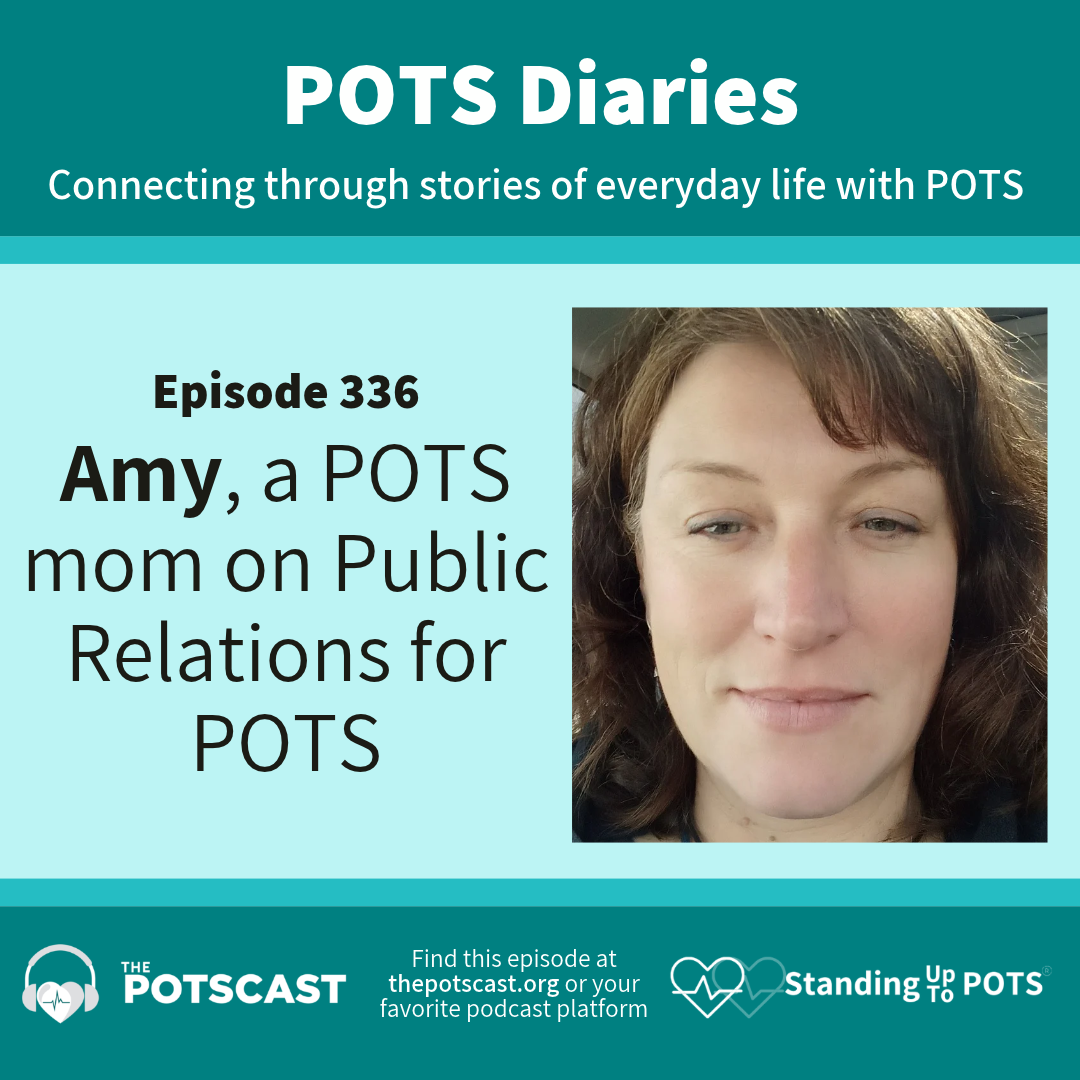
Amy, a POTS mom using Public Relations expertise to help her child
November 14, 2026
When Amy's POTSy child struggled with the (all-too-common) problem of doctors, schools, family and friends not understanding POTS, Amy realized that POTS needed a Public Relations Manager. Since she was in a Master's Degree program for Public Relations, she came up with a solution. In this episode, Amy describes the document she created to help her son's school, medical team, family and friends better understand him, his situation, and how to help.
The short videos explaining POTS that Amy put in her document (via links and QR codes) are here, here, and here.
Episode Transcript
[00:00:00]
Jill Brook: Hello, fellow POTS patients and magnificent people who care about POTS patients. I'm Jill Brook, your horizontal host, and today we have an episode of The POTS Diaries with Amy, who is the mother of a POTS patient. Amy, thank you so much for being here today.
Amy: Thanks for having me, Jill. Thanks for doing this podcast.
Jill Brook: Oh, it was my pleasure, and we're excited to hear from you, and maybe do you wanna just start by telling us a little bit about you or your family or whatever you think would be good for us to have as sort of background information on you?
Amy: Sure. So my name's Amy. I live in Calgary, Alberta, Canada, and I have a family of four. I have two sons and my husband, and we have a dog. And I would say before all this, we were capital N normal, and right up until probably January 2024, where we were, you know, had two boys, they were doing activities and sports and friends and school and, and all that type of thing.
And then we [00:01:00] went to Mexico. It was very exciting. Came back. All of us got sick. Four of us got sick, three of us got better. That was in January 2024.
Jill Brook: Okay. Yeah. So what kind of sick did you get, and what happened with, was it your son who didn't get better? What, what happened there?
Amy: Yeah. So four of us got sick. We really don't know. There was a big strain of COVID going around. The flu was going around. And he tested positive for COVID, flu, and Epstein-Barr, which is the mono kind of virus. And it was really hard to know, you know, what caused it. And so four of us got sick for a week.
Three of us got better. My son, who ended up having POTS, was really ill and just didn't recover, so he was sleeping kinda 23 hours a day, barely functioning, missing school, not able to eat very well, lots of headaches, lots of dizziness. He couldn't read, which now we call brain fog, but he couldn't read, which he loves doing.
[00:02:00] He couldn't even watch TV, so you know, it was like if anyone had COVID or the flu, it was like he had the flu still. And that went on for weeks and weeks and weeks. And of course we went to the doctor, you know, and we just thought, "Oh, it's just a virus. It's just a virus." But then it turned into months, and so then we started to really, you know, we were referred to pediatricians, and then we went to a clinic and saw three different doctors and had three different diagnoses.
So first it was long COVID. The second doctor thought, "No, no, no. It's not that. It's mono." The third doctor said, "Oh, no, no, no. It's not mono. It's stomach migraines." And that was frustrating until I started to learn more about POTS, and it's a process of elimination, right? And then very slowly, he missed about six months of school, I would say. That was in grade seven, so that's a big year.
Jill Brook: Wow. Wow. And you know, I think a big part of this story, at least as I've come to know a little bit about you, is that you are also, in addition to being a mother, you are pursuing a master's in public relations. Is that right? 'Cause I, I feel like that's [00:03:00] gonna, that's gonna come out as kind of an interesting part of this.
Do you wanna say a bit about that?
Amy: Sure. So I would say, so I am getting a, I've always worked in communications for my whole career, and now I'm getting a, a master's degree in public relations. And so public relations shines a light on invisible things. And I would say if ever there was an illness that needs public relations, it's POTS. Because it's, you know, the more I've learned about it, it's, it's not uncommon.
It's actually very common. And a lot of people have it, and it's invisible, right? People don't know about it. So even doctors don't know about it. Schools don't know about it, even though it impacts a lot of female teenagers and adolescents and things like that. And a lot of women, right? So if you're a woman who's, you know, a teenager or, you know, in your early adulthood and you're trying to work and have a family and things like that, it's extremely debilitating.
So the more that I think people can shine a light on it, it's actually not that hard to learn about. It's not that hard to even figure out what [00:04:00] the treatments are and to figure out what works for you. It just seems like, you know, I started to do research on it, qualitative research on a public Facebook group, looking at people's experiences and looking at, you know, what did they say?
Why did they say that? What did other people respond? And what was sort of the bigger context around it? And the bigger context around it was that literally no one had ever heard of it, or they dismissed it, or they kept saying it was a mental health problem which I am constantly having to fight back on with my son.
Like, you know, is he anxious? Yes. It's kind of, I, I, they keep wanting to send a counselor over to my house, and I'm like, you know, it's like our house is on fire. Could you send the fire department first, and then we'll see a mental health counselor? But please don't, while my house is burning down, don't stand there asking me if I'm nervous and anxious, because yes, I am.
And seeing a counselor is not going to fix that. Like, we need to address the fire, and then we can talk about the mental health part, 'cause that is a part of it. And I'm grateful that mental health is really an awareness piece because but POTS is not a mental health problem, right?
[00:05:00] It's, it's a physical problem, and mental health is related to it. But you can't solve it with a counselor. You have to solve the physical part first. And being told over and over again, "You're lazy. You're a truant student. You know, you're just not trying hard enough. You're like an old man. You're not eating." You know, all this type of thing, that is not helpful for your mental health.
Jill Brook: Yeah, and I know that, that you had shared something with me that you had created that just seemed brilliant. Do you wanna kind of talk about what you saw from your perspective in public relations and what you did about it, and how that helped?
Amy: So every time I had to keep going to the doctors and things like that, I really felt helpless as, like, as a parent. But in my career, my job is to answer tough questions and prepare, like, the CEO or, or executives or, you know, to prepare for tough questions, to write key messages and all this type of thing.
And so in the fall, I had to take a, a research class for my master's degree, and I started doing POTS. And all of a sudden, I started looking at POTS through my, my PR hat, and all of [00:06:00] a sudden I knew exactly what to do. I was like, "Oh, well, I do this all day. Like, duh." So I wrote out just a really quick one-pager of my son's story because for me, kind of going into the doctor's office or the school or, you know, I have a friend who calls it the what's your problem list, like, and where you have to suddenly start explaining yourself.
You know, I've been in the principal's office. And so as a child, I never went to the principal's office. As a parent, I've never been in the principal's office more. I've had to explain our family, right? And so to write it out in just, like, a quick one-pager but then also write out just a little sort of POTS 101 page, like what is it.
And in our city, we have an expert, an autonomic expert, whose name is Dr. Satish Raj. We unfortunately can't see him yet because you have to be 18, but one day, or maybe they'll expand. But he's got a lot of information out there, and he does a lot of videos and lots of materials. So I just started to collect some of his work and present it to the doctors, 'cause I'm in the same city, so some of those [00:07:00] doctors even know this doctor personally.
So quoting him has been very helpful. But just explaining, you know, what's the quality of life like? What are the three big problems? Because in the research that I did, but also in our life experience, there's three problems. One is the illness itself, which is really a doozy, right? Like, it's, it's a lot.
So dizziness, fatigue, headache, you know, all those things. But the second one is navigating all the systems, right? So getting in to see the pediatrician, and the pediatrician who knows what POTS is, 'cause this is our fourth pediatrician, and this one knows. He knows what it is. He knows how to treat it.
And getting into the neurologist who's got a kind receptionist, like, it's just little things like that who sorta gets that you're having a hard time and is just kind about it. And that doctor is kind to you in the appointment, right? And then they know about POTS as well, and we're waiting for a cardiologist, right?
So sort of navigating all that stuff, but also for me at school, right? So it's been brought to my attention repeatedly that legally my child should be in school. [00:08:00] Legally I could be fined $100 a day and put in jail. Like, that's, that's helpful. Thank you for sharing.
Jill Brook: Wait, I mean, that even applies when you have a child who's sick?
Amy: I said, "So if my child was working, he'd, he would be on disability, okay?" It's not that I don't believe in school. My husband, my son's father, is a teacher. I'm doing a master's degree. I believe in education, but like I said, my house is on fire . I need not the school counselor, I need the fire people to come and put it out, and then we can talk about school.
But I can't talk about school when my kid can't function and get out of bed and eat and is crawling around on the floor because he might fall down the stairs. And I just find it's very, very hard to explain. And that's the second one, right, is sort of navigating all that stuff. And then the third one is, like, family, friends, doctors, schools, and validation.
There's a stigma to it, right? Well, you know, if it was me, I would do this, and, maybe you should do this, and, perhaps it's lupus. You know, someone was saying, "We'll put hands on him and pray over him." I'm like, please don't. Someone else wanted to [00:09:00] inject him with baking soda.
I'm like, oh my God, no. You know, I've, I've been that person before when I, I've had friends who've had serious illnesses that I didn't understand, and it was like, "Oh, well, if I were you, I'd do this." And, you know, maybe that's karma for me. It's, it's very humbling.
In my family eating is a big deal, right? So people love to feed other people, and if you don't eat the food, it's a big deal. So at Christmas dinner, if your child's struggling with a very special dish in front of, like, 20 people, that's a huge problem.
So I sent this package out. Not all of it, not everyone kinda deserves to hear the story and, and not everyone needs to, and there's a lot of private medical things in it. My kid's a teenager, so I get his consent. But I do send it to, like, I sent this package to the school, so I gave it to the pediatrician.
The people most receptive to it were, like, the acupuncture and the physiotherapist people. Like, kind of the alternative medicine people were actually really interested in it, read it thoroughly, understood it fully, and got it right away . And I thought that was really interesting to me, whereas other people, I had to force it on them.
And then at some point, there's, there's a little video that I use. I'm [00:10:00] like, "Please watch this video. Like, if you have questions, please watch this video, and then I'll talk to you. But I, I'm not gonna talk to you before you watch the video because you're gonna ask me, 'What does he do all day? Well, is he playing video games? Is he doing this?'" And I need you to understand the whole part of it, right? So I sent it to family and friends before Christmas.
Jill Brook: So if I could just clarify, just to make sure everybody understands what we're talking about is, so you actually typed up a six-page little almost just like a, a little report on your son. And what I, what I really liked about it was that it started with who is my son, and you really humanized him.
That, you know, here are his hobbies, here's what he loves to do, here are some of his hopes and dreams. And you reminded everybody that this is a human being, this is a, a young boy. And then you talked about the the illness of the whole family, and how everybody got better, but not him. And you talked about some of his symptoms, and what he struggles with, and his diagnoses. And I think you, you talked about a lot of things, and you [00:11:00] included photos. And I think you know, there's, I think, a lovely photo of him at, like, a climbing wall, just, again, humanizing him.
And I, I think you helped people sort of understand this is what has happened and what we're dealing with. And do you wanna kinda talk more about the sections you put in there, and why, and, 'cause I'm sort of almost using you for your, for your PR expertise to help give this idea to other parents who might benefit, 'cause I think, I think receiving this and hearing the story before meeting the child probably has a huge impact. I could see it helping so much.
Amy: It does. So yeah, so it's a little I call it like a patient advocacy package. So it's, it's a one-pager. It starts with who my child is as a human being, and what was he like before he was sick? So he's not a lazy person. Here he is in Mexico playing on the beach. Here he is with his friends.
He's not antisocial. Here he is rock climbing, which is what he likes to do. [00:12:00] By the way, he wants to be a lawyer, so it's not that he doesn't wanna be in school. And then, you know, you can sort of see his healthy pictures. That's what I call the before. Then there's the during, and I have a picture of him, he's sitting with my husband, and this to me is exactly what POTS is.
He's just listless. He's, he's horizontal. He's laid sideways. His hand is not even, you know, like, he just looks ill. That's what he looks like ill. So it's sort of showing it to people, and it's just a brief, you know, one-pager of the last two years of this journey. All the doctors we've seen, what helps, you know, when he gets a viral illness, we notice he gets set back. So, we know that now. Periods of recovery and things like that, but then also where we are today. And my son's really into Percy Jackson, so he likes Greek and Roman gods, so we've been talking about, I actually can't remember what the guy's name is, but he has to push a boulder uphill every single day. And every single day it rolls back down, and he has to push it up again.
I started using that, like, as a parent's perspective kind of with the idea, like, are you helping us push, or are you part of [00:13:00] the boulder? Are you making the boulder bigger, or are you pushing with us? Because we need you to push with us. And I'll tell you, schools don't wanna be part of the boulder.
Nobody does, actually. The doctors do not wanna be a bigger piece of a boulder, and neither do the schools. So that little analogy seemed to really help. And then I've got, yeah, just our doctors are always asking for data, so we started having a dysautonomia journal and just writing out the symptoms, the mood, the, you know, exercise, food, bedtime, all this type of stuff that they ask us all the time.
And then I just put his main symptoms, and, like out of 10, where are we at every single day? Just so people at a glance could figure out, like, how bad is this? You know, is he faking? Is he depressed? Like, what's going on? So they could just sort of at a glance see what he struggles with every single day.
And then I got him to just, I wanted him to write something but he couldn't, so he just told me, you know, "Some days are good, some days are horrible. Some days a portion of a day is good, some days a portion of a day is horrible. Most days have some piece of horrible in them." So that's his own words, right?
Then we just had a [00:14:00] little piece about POTS 101. What is it? You know, a little video clip to show people. A picture of another teenager. His name is Cole. It's in a little movie called PCARES that just got released, and that was the most similar one to Diego, who's my son. And they've gotten that maybe, you know, right from people in a wheelchair who can't function to people who are fully functional, and we're, we're not, we're sort of, like, this one child.
And then we had, like, what helps and what hurts. So what helps is when people show up non-judgmental, listen, accept. They don't have to believe it. But what doesn't help is when they invalidate it, say, "He looks fine. What does he do all day?" "Maybe it's a mental health problem." "Oh, it happened to me one time."
Like, like, that kinda stuff does not help. And then I put down Diego's boundaries. He actually hates talking about it. He likes to talk about movies. He likes to talk about travel. He likes to talk about books, ideas, and things like that. He does not like to talk about what's happening to him. He also doesn't [00:15:00] like it when, you know, if we're eating together in a group, which is social, he does not like to have people descend on him for what he's eating and why and how and how come and, and that type of thing.
So we just wrote that down, and I think that was really helpful for relatives and family. We work with a, a wonderful woman, Maribel, she's a, like a family counselor, and so sometimes when I get really mad, like if people phone me up and are aggressive, and it's like, you know, "Your kid's been missing, and he's truant," and this type of thing, Maribel's like, "First you have to educate them."
And so she inspired me to, to make this package. And then I send it ahead of time, and then it reduces the amount of times I have to tell the story over and over again. And it helps people understand and have some time to process it. And then there's a, there's a spoon theory. So October was dysautonomia month, and so I found a lot of information online, and I saw that Dysautonomia International had shared the Spoon Theory by Christine Miserandino, and it's just a way of explaining to people who are healthy what it's like to have a chronic [00:16:00] illness.
So let's say a normal person has 30 spoons a day. You get to go through your day, do everything, it's no big deal. But someone with chronic illness might have 12 spoons, or they might have six. What are you gonna spend them on? So it might take you, you know, if you have six spoons, getting out of bed, eating breakfast, and getting dressed might take up four of them, then you only have two left, and maybe school takes four spoons.
So you have to sort of figure out, what are you gonna spend your energy on today? And if you overdo it, the next day you're gonna have less energy. In teenager terms, my son describes it as being like a video game life where he suddenly just runs out of battery, and there's no warning. He just hits the wall, and that's it.
Jill Brook: Yeah, I think that's so smart. And you even put in the graphic, and so I mean, you made this thing quite lovely. It's colorful. And, and then another thing that you had even was a QR code and a suggestion where people could watch just a couple minute video to learn what POTS [00:17:00] is from some experts, and I thought that was genius.
Amy: It comes from, like, sitting in these meetings where I'm trying to explain and people cut me off, and they're like, "No, no, no. What is it like in the morning? Okay, tell me what he eats for breakfast." I'm like, no, that's not what we're talking about. So I will then scan it on my phone while we're sitting together in the meeting.
I'm like, "Let's take four minutes and watch this video." And once they've seen the video, they're like, "Oh." I'm like, "Okay, this is what it is. It's an autonomic nervous system disorder. It's not about did we eat Cheerios or oatmeal for breakfast." Like, and then it suddenly just, it's very quick though, right?
Four minutes, and it's got all the doctors, and it, more specifically for me in my city, it's got Dr. Raj in it, right? So Dr. Raj is the expert, and he's here in Calgary, and I'm in Calgary. So that really works for me in my city, right?
Jill Brook: Well, and he's such a top expert. I think he's a, a good choice for anybody. And if it's okay with you, we'll share the link in the show notes to that video so that people can [00:18:00] copy that idea, if that's okay.
Amy: It's okay for me. Like it's, it's produced by Dysautonomia International, which I found a lot of their health communications ones as well as, right, Standing Up for POTS, the POTS Project, like the Dysautonomia Project, there's a lot of resources that have really good resources for parents, right down to the letter you can send the school that you need your doctor to just fill in.
You don't have to kinda start from scratch all the time. There's a lot of resources.
Jill Brook: Yeah. But I think this is so smart because I guess, I guess what's going through my head is you have figured out in just a few minutes how to get someone to understand that here's a young boy, here's who he was as a person, here's what happened to him, here's what is happening now, here's what he needs from you ideally, here's what would make him worse, and you know, here's the issue with the spoon theory and what he's dealing with.
And if you can take four minutes, please watch this video, [00:19:00] and you send them to the very top video on this. I think that's so smart. So, so how has the, that worked? Does it work on everybody? And, like, how does it work on, I know you mentioned you send it to family sometimes before the holidays.
How does it work with doctors? How many times do people actually look at it?
Amy: Yeah. I'm not sure how much people look at it, but people stop doing all the things they've been doing. So they stop wondering what it is or wondering if maybe taking vitamin C would help. Like, they stop the what ifs, and if I were yous. What I've noticed is there's a period of silence because a lot of people don't actually know how serious it is, or they think it's just feeling tired.
Once they realize it's an autonomic nervous system disorder where it impacts your entire body I think they're shocked. And perhaps even in that little video they show you, you know, if someone had a broken leg or a missing leg, people would be more empathetic. So if you have not been helpful, there's probably a bit of shame in it and a little [00:20:00] bit of recalibrating, like, okay, I'm gonna educate myself. There's clearly a lot of research in this little package, so they don't tend to share more with me or what they think it could be. Is it lupus? Is it Crohn's? Is it celiac? Maybe it's Lyme.
You know, all that stuff stops. And they also start relating to my son a little bit differently, which is really helpful. And most of them care. I mean, most of them care a lot, right? They're trying to help. They mean well. They feel anxious. They don't know what to say. I found it to be a 180 change every time I've used it.
And it took me a year and a half to figure out that I should do this. I wish I had done it two years ago, but I, I didn't know, so that's okay. It has been a game changer, is what I would call it, and it gives me a lot more confidence. And I know what I'm talking about when I go in, and it takes the emotional mother part out of it, right?
It takes the, oh, maybe it's a mental illness or you're too anxious kind of thing out of it. Like, here's a very practical little piece. Read it. [00:21:00] Learn. Once people have learned what POTS is, I think they're actually pretty shocked. And then I've heard a few times from the school, you know, They forwarded on to some bigger region, and they said, "Oh, actually," they said, "There's a lot of kids with POTS."
So actually, everybody watched the video and, and that's helpful. So they said, "You're kinda helping pave the way for other people who maybe couldn't do this." And I just feel like not everyone has to do this by themselves, right? We don't need to reinvent the wheel with every kid who has POTS. So that's in some way helpful. So that's sort of validating to me, I guess.
Jill Brook: Yeah. Yeah, that's huge. And you know what's funny is I feel like we need somebody like you to take over the PR for POTS 'cause we always joke that POTS is named for one of its least problematic symptoms, and there's so many other symptoms that go with it, but why is it named for the one you know, we know why, it's 'cause it's the one that's measurable.
But, but helping people understand that it is a full body problem is super valuable. Now, one thing that goes through my head as an [00:22:00] adult with POTS is that this sounds great. I would love to have one of these for myself, but I, I would feel, I don't know, it's, it's kinda nice when a parent does it for you, right?
'Cause I feel like as a person, if I were to do this for myself, then I'd come off as overly pushy or whatnot. Like, I don't know. If, if you had POTS, would you make one of these for yourself, and would you do anything differently? Or do you have any sort of like tips for how somebody could make one for themself?
Amy: Yeah. I think it is easier to do it maybe when you're doing it for someone else, and I mean, that is my job. We do this all the time. But I think if you even wrote about yourself in the third person, as though you were a friend helping a friend, and wrote down, you know, so-and-so had this, this, this, here's the little story, here are the symptoms, and it just removes you a little bit, so as opposed to being I, me, if you do it in third person, maybe someone [00:23:00] else wrote this package for you , you know?
Like, so if you sort of put on your patient advocate hat and separate it from who you are and your emotions, because for whatever reason, you know, the second I go into a meeting and start crying, the, the meeting's done. So, to somehow dial down the emotions and put it in a very practical, research-based, factual, you know, went to the hospital on this date, this is what the doctor said, this was the name of the doctor, if you have that stuff. And just write it down, you then don't have to explain it over and over, but that little piece of paper can be your advocate, I think.
Jill Brook: That's so smart. Yeah. And then how often do you update it?
Amy: I've updated it, so I update it all the time. Every time I have a big meeting, before I go into a big meeting with the school or before I go into, like right now we were in a series where we were seeing neurologists, and now we've got a cardiologist meeting. So I'll update it before I see the cardiologist.
And we've just had a big shift where my son's actually doing really, suddenly he's doing great. [00:24:00] He's taking these salt tablets and getting acupuncture, and it was like a, I don't know what happened, but he just suddenly is almost totally himself again in the last two weeks. So, yay.
Jill Brook: Wow.
Amy: But, so I'll update that, right?
And just say, so I immediately updated the school and was like, "By the way, attendance, not a problem 'cause I think we put out the fire or, or at least learned how to manage the fire. Now we can talk about attendance. Now I'm ready," right? So I try to do it with every big shift or every big meeting.
Jill Brook: Okay, and I can just hear everybody wondering, what happened with acupuncture? Do you think that was a big help?
Amy: I have no idea what happened with acupuncture. Yes, it is a game changer. So our pediatrician, his wife is actually a traditional Chinese medical doctor, and she's also a registered nurse. So he had a patient who really improved from that. And, and we did a bunch of other things. So we increased, you know, like there was iron, there was tweaking of medications, 'cause he does take a number of medications.
We started salt tablets, which that and acupuncture, [00:25:00] I think it was like the first time maybe my son felt good in his body in a long time, 'cause it's very relaxing. She was explaining about the ear and things like that, and how it's connected to your vagus nerve. And, you know, I didn't, I, I don't have that medical background, but whatever happened, it really just seemed to, that kind of combination of things really improved his function.
So now we're doing it weekly. It is not cheap, right? But we have health benefits that cover some of it, some of it we don't. But it does seem to be a bit of a game changer for him.
Jill Brook: Wow. Well, I mean, it sounds like you have just taken this on in such a great way and learned and figured out so many things. Do you have any other things that you'd share with other patients or parents? Anything else you wish you had known sooner or have learned along the way?
Amy: Yeah. Like, a lot of other countries are more advanced than us in this, like Australia, the UK. They've got some really good books that are written by doctors where they've got, you know, the Mayo Clinic has a [00:26:00] teen recovery plan that you can just follow. We're not gonna go to the Mayo Clinic, but you could, like, download it and do it yourself at home.
There's a lot of resources out there. I particularly found Facebook support groups really helpful. I think I posted in Thanksgiving and just said, "Oh, I'm really not looking forward to Thanksgiving with all the family coming over and wondering what's going on, and what if my kid can't come to dinner? Then we're gonna have to explain it," you know. And people just reached out, and they have a lot of resources, and that one was in particular for my province in Alberta, so it was province-wide. And then in there you could also say, "Hey, does anyone know a, a good doctor in this city or in that city, or do you know a good acupuncturist? I live here." I found the support group, and just realizing that first of all, I'm not crazy and neither is my kid. Like, this happens to millions of people, and the idea that we're all nuts, that really angers me. And it also diminishes mental health, right? Like, it's, it, there is a physical problem.
It's actually well documented and well known, and I, I don't understand why nobody knows about it. [00:27:00] I would like to change that or help change it. I'm grateful for this podcast. As soon as I saw it, I was like, "What a great idea!"
Jill Brook: Oh. Well, we're really grateful that people like you figure out some of these smart strategies and then share them. So, you know, 'cause what's going through my head is, wow, just imagine if every patient had their little packet like this that they gave out to friends and family and physicians and healthcare practitioners, and, you know, if, if even 10% of those people went and read it and even followed the QR code and saw the video, that would, you know, that would do wonders.
Amy: I think it would help, right? Because when you educate people, you're not, it's not just your family, it's all the families that come behind you or all the, you know, if you're an adult, it's all the other, and often women, right? Like, it's a lot of women and it's understudied. If you do that and advocate for yourself, you're also advocating for everyone who comes behind you.
Jill Brook: Yeah.
Amy: And maybe if it's 10% less painful for them, you've done something.
Jill Brook: That's [00:28:00] great. That's amazing. Well, I know that everybody is wishing all the best to you and to your son and to your family. Is there anything else that you wanna share with your fellow POTS parents or patients or anything?
Amy: I think you're not alone, right? And, like, we're kind of a community, so the more we sort of work together and share, people have shared strategies that worked for them with me. Maybe I share what works for me, and maybe it works a little bit for somebody else. I think we can do this together, right? We're a lot of people. We're not a small contingent. This is big, and I think this is something that really needs a lot of attention, 'cause it's very debilitating, and it doesn't have to be. So I think we could work together and share, and comment even on LinkedIn or your social media posts, you know, and just help other people.
Jill Brook: Yeah. Well, that's great advice. Well, Amy, thank you so much for bringing your wisdom and your experience to us. We so appreciate it, and I'm really excited to share some of [00:29:00] these ideas and the link to the video with people, and we just appreciate you. Thank you for being here.
Amy: Oh, thank you so much, Jill. I appreciate being on. Great work doing this podcast. I saw it on LinkedIn, not even on Facebook, and I was like, "Yes, this is awesome."
Jill Brook: Oh, thank you so much. Okay, listeners, that's all for today. We'll be back again next week, but until then, thank you for listening. Remember you're not alone, and please join us again soon.