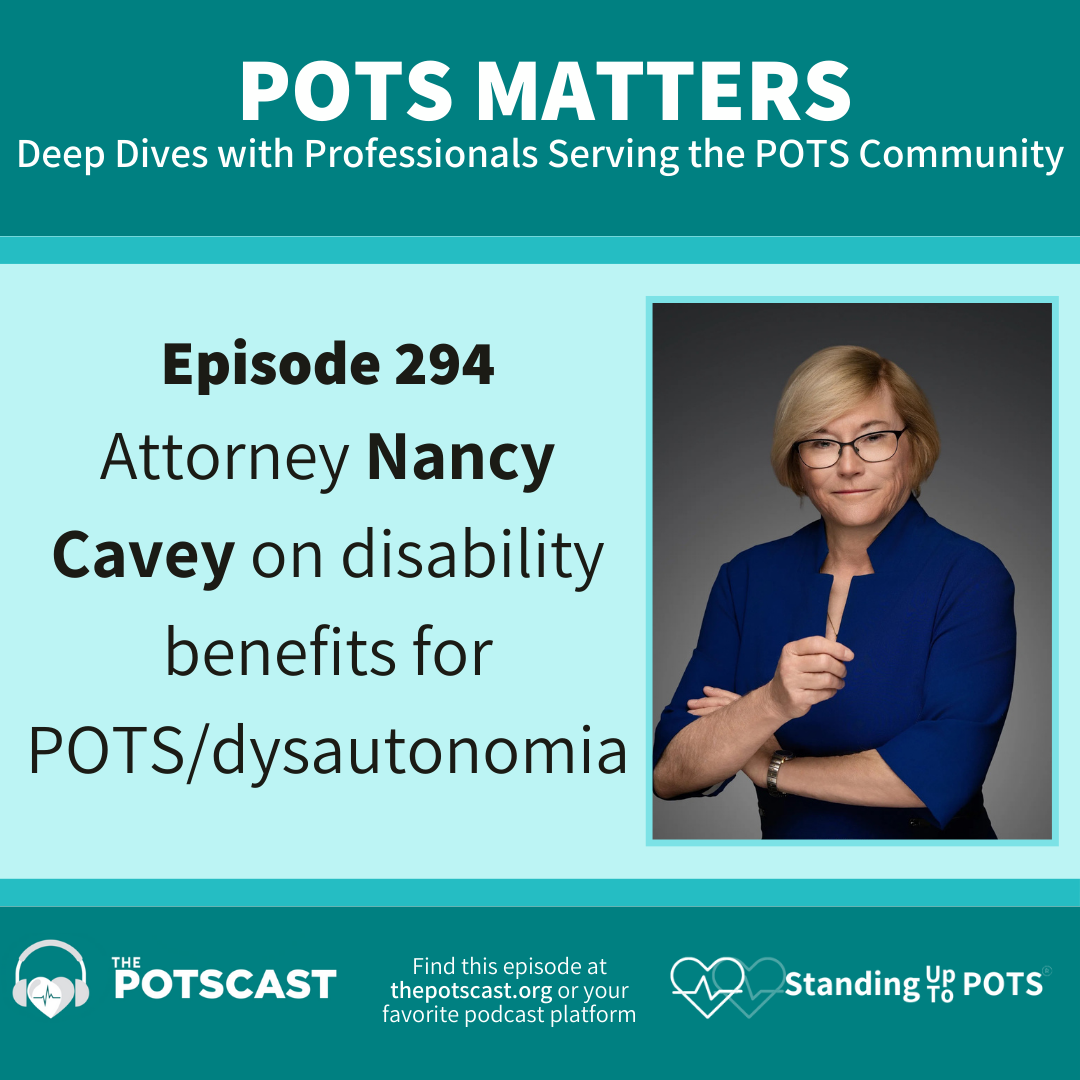
Attorney Nancy Cavey on disability benefits for POTS/dysautonomia
January 27, 2026
Attorney Nancy Cavey has spent 39 years representing people with disabilities all over the U.S., and is an expert in helping people qualify based on POTS, MCAS, hEDS and other invisible illness. In this episode she describes the process, how to maximize your chances of success, common pitfalls, important deadlines and more. We will have a part 2 with Nancy's colleague in a few weeks, to address disability benefits for people under age 18. Nancy's book about disability benefits for POTS is here. Nancy's website is here.
Nancy has also written the following free e-books about:
Long-Term Disability Books
Social Security Disability Books
Medical Booklets / Pamphlets
Episode Transcript
Jill Brook: [00:00:00] Hello, fellow POTS patients, and beautiful people who care about POTS patients. I'm Jill Brook. You're a horizontal host, and today we're talking about what happens when POTS is so severe that working just is not possible.
Research suggests that roughly one in four people with POTS are disabled enough that they cannot work.
And large patient surveys show POTS can profoundly affect daily life, ability to attend work or school and income. And we know this topic can feel very overwhelming. We get lots of requests about disability benefits, so we are gonna do two episodes about this.
Today's episode focuses on adult POTS patients, and in a couple of weeks we'll cover benefits for those under age 18.
Our guest today is disability benefits attorney Nancy Cavey here to walk us through when and how adult POTS patients may qualify for benefits, what the process looks like, what are the requirements, challenges, pitfalls, [00:01:00] practical tips, and more. As always, this is general information, not legal advice. But n,
but Nancy's path to disability law began at home when as a teenager she watched her father navigate leukemia, and she saw
firsthand the emotional and financial toll of disability and filing for benefit.
Since then, she has represented thousands of people nationwide in social security and long-term disability cases, including clients with POTS, other forms of autonomic dysfunction, and other invisible illnesses. Nancy has written consumer friendly guides like the disability insurance Claim, survival Guide for professionals.
And your rights to Social Security disability benefits. She is a member of the National Organization of Social Security Claims representatives. She practices nationwide with licenses in Florida and the District of Columbia. She [00:02:00] hosts the podcast, winning Isn't Easy, navigating Your Social Security Disability Claim, and she has presented at the most recent Dysautonomia International Conference.
She also works with a colleague who specializes in disability claims for younger patients who will join us in an upcoming
episode.
Nancy, thank you so much for being here.
Nancy Cavey: Well, it's my pleasure and thank you for having me and the work that you do in the POTS community.
Jill Brook: So can we ask, what first drew you to working with clients that have conditions like POTS or dysautonomia?
Nancy Cavey: Well, one of my first cases many years ago was an emergency room physician in Naples who had POTS, could not find a lawyer who would represent him in his ERISA disability case or his social security case.
And I always love challenging cases, so I said, sign me up. And he introduced me to Dr. Grubbs in Toledo. And so that was my first involvement with a POTS case and fortunately it was with a [00:03:00] physician who was able to educate me about POTS, but also his experience with the POTS disease and the impact it had on his ability to practice medicine.
Jill Brook: Wow. Wow. I'm always surprised at how when we get somebody great in the POTS community, they always found their way in by just meeting that one person who made an impact on them. And oftentimes it's like a child or a loved one. But yeah, nobody's finding this area because it was just like taught to them in school or something like that. So we're glad you're here. Can you share a bit about what kinds of disability cases do you typically handle, and then how POTS fits in?
Nancy Cavey: Sure. Our practice is a disability practice, so we handle cases for people who are looking for social security disability benefits and who may have bought a disability insurance policy through their employer or on their own.
And so that's how we are involved in the POTS community.
Jill Brook: Okay. And from your experience, what makes representing clients with the [00:04:00] invisible illnesses like POTS and fibromyalgia and all that stuff different from the other cases?
Nancy Cavey: Well, as you pointed out, it's invisible, but it's real. And many times I hear from clients that, they can't even find a physician who believes in POTS, who believes their complaints, though that's changing. And certainly for a long time they could not find a lawyer who understood the different types of POTS, its presentation and how to basically present a winning case to either a social security judge or to a disability insurance carrier.
Jill Brook: Yeah, and maybe you can talk more a little bit about the different kinds of disability claims that might be relevant to adults with severe POTS, 'cause you've mentioned ERISA disability claims, you've mentioned social security. Can you like paint the bigger picture for us?
Nancy Cavey: So when you work and you contribute to the social security system, by virtue of those FICA withholdings, and [00:05:00] you work, you can become insured after you have worked basically 20 out of 40 quarters. Basically five out of 10 years. So you become insured for social security disability purposes. That insurance status ends generally after you've stopped working for five years. And if that happens or you haven't worked 20 out of the last 40 quarters, you might be eligible for another type of benefit called supplemental security benefits, SSI. The problem with that is it is asset based, not only your assets, but those of the spouse. On the other hand, your employer may have offered you as an employee benefit group health insurance, a pension benefit, life insurance, and disability benefits. So you have purchased through your employer, generally through a payroll deduction, a shorter long-term disability policy. But you can also go out into the private market and find a an individual disability insurance agent and buy a policy, and that's quite [00:06:00] frankly preferable, but you, you are generally paying for it and you're paying more than you would be paying it for a, an ERISA disability policy that your employer is either charging you for or you're paying for. So those are the four different kinds of disability benefits, if you will. Social Security Disability, SSI, ERISA disability through your employer, or an individual disability insurance policy.
Jill Brook: Okay. And how do you determine if somebody with POTS has a strong case for any of those?
Nancy Cavey: So, let's take the ERISA issue. There is no uniform disability insurance policy or plan in the United States. So each has their own standards, their own definition, if you will, of disability, their own definition of occupation, their own difference in terms of proof requirements. And so when someone who comes to us who has a disability insurance policy or plan, the first thing I say to them is can you get me a [00:07:00] copy of the policy or the plan? Because we need to understand what it is we have to prove, but we also need to understand policy limitations. There are two very important policy limitations that we'll see in a disability insurance policy, and that is something called the Subjective Medical Condition Limitation policy, and the other is called the Mental/Nervous Policy Limitation. And disability carriers will try to shoehorn POTS clients, policy holders, into those policy limitations if they exist, so that they only have to pay two years of benefits. So what we have to prove, how we have to prove what benefits they're eligible for is really policy or plan dependent. On the other hand, we have Social Security Disability, and that's a pretty uniform test. It's a five step sequential evaluation test. So in Social Security, the first question obviously they're gonna ask is are, are you insured or not insured for Social Security Disability? [00:08:00] Or is is this SSI? But then the next question becomes, have you been out to work for a year or do you have a medical condition that would keep you out of work for a year? And the answer clearly in most POTS cases is yes. The second question they ask is sort of a medically determinable impairment, severity type question. Is this temporary? Is it permanent type situation? And unfortunately most POTS cases are progressive and most people who have POTS present with other immunological issues. So, we then go on to step three and step three is a kind of a weird test. And the question is, does your medical condition or conditions meet or equal a medical listing. So we open up a medical listing book. There is no listing for POTS. There's no listing for some of the conditions I see like mast cell syndrome. There is a listing for Ehlers-Danlos. There is no listing, if you will, for long COVID. Back [00:09:00] before COVID, if you will, I would see a lot of pure POTS cases. Post COVID I am seeing POTS and combinations, you know, long COVID with POTS, POTS with ME/CFS, POTS with mast cell syndrome. And what's important at step three is, you know, do you meet a medical listing? Well, back in the old days, there is no listing generally for any of that except for Ehlers-Danlos.
We would try to use the cardiovascular listings at step three, but it was really difficult and it is very difficult to meet a listing. 90% of people don't meet a listing. So folks need to understand that for social security, where the case is decided is really steps four and five. Step four is, can you go back to the lightest and simplest job you held in the five years before your claim has been decided? And step five is a crazy cockamamie test, and it depends on your age. If you're under 50, the [00:10:00] test is, is there other work in the mythical, hypothetical, not real-world, national economy that you wouldn't wanna do, does not pay a living wage, in view of your age, your education, the skills you've learned, and whatever your restrictions are? Now that translates in English to an inability to do dumb jobs like being a surveillance system monitor, sorting nuts and bolts, or addressing envelopes all day. At step five, if you're over 50, there's another way, and that's called the grids. And it really depends on your age, your education, and your skills. So that's the comparison and contrasting of the social security test and an ERISA disability, individual disability test.
Jill Brook: So am I understanding correctly that if you're functional enough that you could sort bolts while lying in bed, that theoretically they'd want you to get a job doing that?
Nancy Cavey: Well, so you made a very important [00:11:00] point. I think it is very crucial to develop a person's physical, cognitive, and psychological restrictions and limitations. The way that we do that is we social security lawyers and some doctors who were really on the forefront of it like Dr. Trevino in Clearwater, developed what's called a POTS residual functional capacity form. A residual functional capacity form is a form that no one will tell you about except for doctors like Dr. Trevino and lawyers like myself. You wanna get filled out by your physician, and we use them by the way in social security cases and as an adjunct to physician statement forms in a ERISA case. But it asks the right questions about your presentation for POTS, because there's a physical manifestation, there's a cognitive manifestation. We also have psychological residual functional capacity forms because unfortunately, depression and anxiety is something we commonly see. [00:12:00] But we've also developed residual functional capacity forms for mast cell syndrome, for Lyme, for ME/CFS, for, if I didn't mention it, Ehlers-Danlos, mast cell syndrome. So the goal here is to have a physician or physicians complete the applicable residual functional capacity form, so that we can argue you don't have the functional capacity, and of course it's not really realistic that you do something in bed. So it really is a product of developing through these residual functional capacity forms the person's ability to do or not do, because ultimately the argument is, is gonna be, look, you can't do work on a full-time sustained basis. Fill in the blank. Why? Well, you know, here's all the laundry list of reasons can't. But what's also important is it has to be corroborated by your medical records. Social security and judges will sometimes minimize the POTS [00:13:00] findings and well, lemme back up, sometimes they don't even understand what POTS is and think just because the person has normal cardiological studies, that they don't have POTS or that they have an equivocal tilt table test, they really aren't disabled. So it's really important for the patient, the client, to give a very good interval history of what their symptoms are and how those symptoms impact their ability to function. Because at the end of the day, social security and even an ERISA disability carrier is looking at consistency between the person's complaints, exam findings, such as they are, and that residual functional capacity form. So the medical records have to tell a medical story, but the story of the person's functionality.
Jill Brook: Okay, so that sounds like a lot of documentation that your doctor would have to try to supply. And then are there certain like specialist notes or test results that [00:14:00] tend to carry more weight?
Nancy Cavey: Yes. Obviously social Security wants to see medical records from a specialist. Now, I know that finding a specialist has been a hard time. But fortunately now, you know, we have physicians who actually specialize in POTS and all the ancillary conditions, we have centers of excellence, so it's become far easier than it was five years ago to find specialists. Back then, it was very, very difficult. There were, I would say, maybe a dozen, two dozen doctors across the United States. Now though, it's difficult to get in, there are more physicians who understand, specialize, and treat POTS patients. So specialized treatment is really crucial. One of the key tests in, in a POTS case is that tilt table test, or the Valsalva maneuver. I recently gave a speech to disability lawyers about the necessary proof that's needed particularly in a, a disability insurance claim. And I will tell you that's [00:15:00] one of the first things that both social security and judges will look for are the results of, of that type of testing. Now another key thing is if you are using your Apple, is to document spikes in heart rate. So actually taking pictures or, or having an ongoing monitor on your phone, I think is a great way to prove both to your physician, to your, your disability insurance company or in your social security claim, that heart rate issue.
Jill Brook: Yeah, and that sounds easy enough. You could just video yourself. I mean, people
share this on Facebook all the time. Here's me laying down. Watch what happens when I stand up. Here's what my watch says. Now, medical records are kind of famously difficult to get, error prone, like can you talk more about what these medical records need to show or what mistakes can be in them that would hurt you?
Nancy Cavey: Well, you [00:16:00] know, that's a very broad topic, probably a whole podcast in and of itself. But medical records need to tell the story on an objective basis of the diagnosis. But it also has to tell a story about your symptoms and functionality, which is why I like my clients to give an interval history of these are the symptoms that I had, and this is how it impacted my ability to function. Doctors are busy. We're using electronic records. So I ask my clients to keep a copy for themselves and ultimately for me, 'cause I wanna file it with social security or the carrier, but give it to the doctor and ask the nurse to make it part of the chart. Now, one of the things that I will tell you is, and I've been reading medical records for many years, is I hate it when I see the, the client patient saying in the, in the records, the patient reported that they were fine. Well, they're gonna seize on that to deny the claim. Or the patient says they were improving. What does that mean? [00:17:00] So please don't use the word fine. But if you're improving, explain how you're improved and why you still are having problems with functionality. I use those kind of, my, my nickname for these are weasel words. Don't use weasel words. Don't use any words that can be construed to mean more functionality than you actually have.
Jill Brook: Right. Right. That makes a lot of sense.
And this also brings up the question like, when should somebody consider hiring an attorney to do this, right, 'cause you don't have to have an attorney to apply for these things, but when should someone consider it? And would you do it from the start of the whole process or wait till you've been denied?
Nancy Cavey: Great question. Now if we're talking about an ERISA disability claim I think that it's really important that you be speaking with an attorney as soon as you're beginning to have problems working. Why? If your employer terminates you and you are working, you're gonna lose your [00:18:00] insurance coverage and the disability carrier will say, hey, you were working while you were disabled. You got fired. You have no insurance coverage. So too bad, so sad. So as soon as a person is beginning to have problems, I think they should be getting a copy of their disability insurance policy or plan, and reaching out to a lawyer to get advice about what the policy or plan says, where they're at in their employment journey, whether they think they're gonna be terminated. Where they're at in their medical journey, how strong their medical records might be, does their physician support their claim? From a social security disability perspective, some lawyers do not take cases until the claim has been denied.
I think that's absolutely ridiculous. Unfortunately, in today's political environment and with the cuts, it is taking over a year to a year and a half before a claims examiner is assigned to look at an initial application. So as soon as we are [00:19:00] having problems working, and as soon as your wages fall, at least for 2025, below $1620 a month, you should be applying for social security and preferably with a lawyer. Why? You heard of some of the things that I do. I want to make sure that my client's medical records are telling the story. I wanna look at those records and say, I don't like this story, we gotta do a better job. By the way, here's the residual functional capacity forms. By the way, we're continuing to update medical. I never trust that social security's gonna get all the medical or read the medical, but my goal in this year and a half timeframe from the time we file to the time we get a claims examiner assigned, is to build the record, to tell the story, to give them every piece of evidence they need on a silver platter so that when they finally look at it, it's hard to deny a claim. Now if the claim's been denied, you're only gonna have [00:20:00] 60 days in which to file an appeal. That's called a request for reconsideration. If it gets denied again, only 60 days in which to file a request for a hearing. And if you blow those deadlines, you get to get back in line.
Jill Brook: Ugh.
Nancy Cavey: So you probably don't have the time, energy, cognition to keep up with those deadlines. And similarly, over here on the ERISA world, if your claim gets denied, you only have 180 days to file an appeal, and that appeal is the trial of your case. No new evidence can be added once the appeal process has been added. So if you think you're gonna be able to submit all sorts of new stuff after the appeal process has ended, that won't happen. So these deadlines are really important and you don't want to make a mistake that either will result in a denial of benefits or even a termination of benefits over here on the ERISA side by blowing these deadlines. So again, I think another reason why you should be dealing with an attorney from the very beginning.
Jill Brook: [00:21:00] This sounds like hell. Are there any other deadlines people need to know?
Nancy Cavey: I mean, you know, having POTS is hell, but going through the claims process is like another level of hell.
Jill Brook: Yeah. Yeah. Goodness. Now I know that we've spoken to people who are in like other areas of like insurance claims and things where a POTS patient might only have three years to file, and the average POTS patient doesn't even have a diagnosis within three years. Like, are there any other deadlines that are relevant to this area that people need to worry about?
Nancy Cavey: So the deadlines from my perspective, really relate to number one from the ERISA standpoint, if you're working and you're having trouble and you feel like you're gonna be fired, that is a, that is not a legal deadline, but that is a real deadline because if you get fired, you're gonna lose your insurance coverage. Anytime you're communicating with a disability carrier and they want information, I consider that to be a deadline. Anytime your claim is [00:22:00] denied or benefits are terminated, that's a hard deadline. Remember in the context of a disability insurance claim, you generally have 30 days in which to put them on notice of the claim and a timeframe in which to file the claim. So there are all sorts of deadlines. Over here on the social security file claim side, you know, once you file the claim, they're gonna be sending you forms, and if you don't fill out the forms timely, they're gonna say too bad, so sad and deny the claim. And again, you only have 60 days to appeal. If you get a hard denial at the initial stage, the recon stage, you got 60 days to file an appeal or you start all over again. So deadlines are crucial. And there generally is not a lot of an excuse or or reasons for either the Social Security Administration or a disability carrier to forgive or forget those deadlines, because it gives them a really good reason to legally deny a claim that will be upheld by courts.
Jill Brook: Okay, so let's talk about other reasons they can legally deny claims. So if we were gonna talk about the ERISA [00:23:00] specifically, what are like common tactics that the insurance companies might use to terminate claims and like what are the gotchas.
Nancy Cavey: Okay, so there are lots of gotchas. And, and I've, in my podcast, I've done a lot of stuff on gotchas. But one of the first gotchas is you're not communicating with them and providing them with the material that you need. Because you have a duty under the policy to cooperate, which means signing forms, answering questions, potentially even going to a not so independent medical examination. That's a gotcha, by the way. If you are told by the carrier they want you to see somebody, you need to call an attorney right away 'cause they're setting you up for a denial or termination. Another one is where the carrier calls you up in a not so friendly call to check on you to see how you're doing, being very compassionate, but taking really good notes that they [00:24:00] will cherry pick about your activity. You know, what do you do on a daily basis? You know, do you have kids? Do you attend your kids activities? Because they're gonna look at what you say and compare that with what's in the notes. The other gotcha is social media. If you're on it, turn it off. Okay? Because I promise you, they are doing social media searches. They're looking at Facebook, they're looking at every form of media. I actually had a client denied who was on a gaming site who said he had trouble because of his POTS looking at the computer screen, turning his head side to side. And they videotaped him on a gaming site.
Jill Brook: Wow.
Nancy Cavey: Okay. Lost. The other thing I would say to you is inconsistencies in medical records. Because they're looking at what are you saying on your activity of daily living form? What is your doctor saying in your medical records? What are you doing? Is there any inconsistency? The other [00:25:00] problem is when there's a change in the definition of disability from an inability to do your own occupation or any occupation, guaranteed they're looking for a reason to deny your claim. Another gotcha, looking at your medical records. Oh, she said she was fine. Or she took a, a vacation. Not that you can't take a vacation. I wouldn't necessarily tell your doctor you're taking a vacation. But that's like inconsistency in activities. So you need to understand that the disability, this is, this is what I call the golden rule. The disability carrier is very happy to collect your gold, okay? But they're also very happy to rule that you're no longer entitled to your benefits. So that's the golden rule. So think about the fact that the disability carrier is not in the business of paying your benefits, and they will look for every opportunity that they can find to deny or terminate benefits.
Jill Brook: You know, it just strikes me that social media is kind [00:26:00] of famous for people wanting to look like they're doing better than they really are. And boy, could that burn you.
Nancy Cavey: Right. I call that curated reality, okay. So, you know, so I really ask my clients don't, don't really be on social media. Don't have your family or friends take pictures of you. But you know, if you're at a, a wedding or a graduation or whatever it is, you need to make sure that this is a curated reality. So you may have paid the price. You know, you, it, it took you days to be able to feel well enough to attend that event and you only attended part of it. Or the next day you, you were miserable. And you were miserable for the next couple weeks. So if you're going to attend something and live your life, make sure that you're keeping a log or a diary about what you had to do to be able to do this event and the price you [00:27:00] paid.
Jill Brook: Great to know. Yeah. Because POTS is famously so full of surprise good days, surprise bad days, and you don't want a good day to be the one that gets reflected in all the bad days not. You had mentioned that social security does not have a listing for POTS. And so it has to evaluate it in some other way. So I'm wondering if you can talk about that and or kind of like if somebody has POTS as part of a whole thing, you know, the Ehlers-Danlos Syndrome, the mast cell activation or other things, how does that change?
Nancy Cavey: So I tried one of the first post COVID cases in front of a judge down in Miami. And this person had long COVID and had developed POTS and another mast cell syndrome. And so the judge said to me, well, Ms. Cavey, this is the first case. Social security doesn't necessarily have any criteria for the evaluation of all these cases. How do you think we should go about evaluating them? [00:28:00] And I said, judge, what I've done in this case is we've looked at the POTS part of this case, and we've got a POTS residual functional capacity form. We've looked at the mast cell and we've got the mast cell. We got an Ehlers-Danlos. Now there are times when I don't have any of them, but the way I'm going about this is to basically take each one of these medical conditions apart. What are the symptoms? What are the functionality? Now, I know there's overlap. But then I say to the judge, let's look at each of these conditions individually, but then look at this in combination. So we're looking at a whole person. And judge, I think they can't go back to their past work because of these reasons. I think they can't do other work because of these reasons. And I'm weaving in to the story each one of these medical conditions, and I think that's the best approach.
Jill Brook: And can we ask are, are judges granting security [00:29:00] benefits for people with long COVID?
Nancy Cavey: Yes, and for POTS and for Ehlers-Danlos. I will tell you however, that it is more difficult for somebody under 40 to get benefits. It's difficult 40 to 50, but it can be very difficult to get benefits, particularly if we're dealing with somebody between 20 and 40. And that's where the records really become important. The support of the doctors become important. The greater the degree of provable disability symptoms and functionality, the more likely it is we're gonna win. And I've won cases at every age, but each case is, is unique. And again, we have to tell that story of symptoms and functionality in a way that establishes they can't do their past work or other work. And that story is different from person to person.
Jill Brook: Yeah. One thing that comes to mind is that a lot of pOTS patients are sort of like perpetually trying to figure out what their other problems [00:30:00] are. And so lots of people, they might have a diagnosis of POTS for the first five years and it takes that long for them to figure out, oh, I also have Ehlers-Danlos Syndrome or something. Does someone get a second chance to apply if they get more diagnoses?
Nancy Cavey: So I, I'm going to reframe that question a little bit, if you don't mind. In the context of an ERISA disability case, you'll see courts say all the time, diagnosis is not disability. Okay? So you don't necessarily have to have a quote unquote label. It's important, however, that we have some sort of objective basis of what the restrictions and limitations are.
It becomes harder when a person doesn't really have a hard diagnosis, and they don't have a hard objective basis of the restrictions and limitations. So that's why in cases we'll use CPET exams or functional capacity evaluations or other objective measures of a person's restrictions and limitations. [00:31:00] So, don't necessarily get over fixated by diagnosis. In the context of social security, remember, if you lose your insured status, you're done. Okay. And it doesn't matter how many diagnosis you have after your insured status ends, you're done. Again, in the context of social security, I'm not necessarily looking for a hard diagnosis, because many times you'll see like a rule out diagnosis. The doctor will say, you know, X, Y, and Z rule out this or that. And there may not be a hard diagnosis, but again, it comes back to what's the objective basis of the restrictions and limitations. Because in both worlds, ERISA disability carriers, IDI carriers, social security don't like subjective medical conditions and restrictions and limitations based on subjective conditions. Which is why in some disability policies you'll see that subjective medical condition limitation. And they'll only pay benefits for two years. And a lot of the symptoms that [00:32:00] people have of fibromyalgia or POTS or Ehlers-Danlos, mast cell syndrome, are subjective in nature. So the disability carrier's gonna start parsing, if that clause exists in the claim, start parsing the medical conditions and say, well, that's subjective, that's subjective, that's subjective. And geez, there's nothing left. So we don't owe you any benefits.
Jill Brook: Okay. Yeah, that makes a lot of sense. So you don't have to wait to have all your answers, is what I'm hearing.
Nancy Cavey: No, no, no. Please, don't wait.
I'd rather have you apply because again, in this context of a social security case, it can take two and a half, maybe three years to get in front of a judge, and even longer. So I want to be developing my client's medical conditions, making sure they're being seen by a specialist, giving that great interval history, hopefully getting the residual functional capacity for 'em, so that longitudinally we can tell that story of the diagnosis or the disabling symptoms objectively [00:33:00] established.
Jill Brook: Okay. This is so much helpful information. Do you think that awareness is getting better in the legal and insurance areas?
Nancy Cavey: Absolutely. But I will tell you, I think awareness in the medical community has improved significantly because many of my clients were very frustrated that they couldn't find a physician who was willing to listen, who understood the disease process, could provide treatment and be willing to support a claim. And I think unfortunately post COVID, because of the number of claims that we're seeing in different combinations, the public has become aware. You know, people, judges, insurance companies have family, friends or relatives who have these medical conditions. So there has become a greater awareness. That isn't to say that these cases aren't difficult to prove because there are inherent difficulties as we talked about. But yes, I think there is a greater awareness among the public, [00:34:00] among the medical community, in the social security claims world, and in the disability world.
Jill Brook: Okay, so what's one thing you wish every person with POTS knew before applying?
Nancy Cavey: That there are doctors and attorneys who understand these claims, who, who find these cases challenging to, to treat, and to represent, but love that challenge and wanna work with you to recover, but also to get the social security disability or ERISA disability benefits you deserve. So you can hear I'm very passionate about what it is I do. And so I think it, it's really important that you understand that there are people who are equally passionate on the medical side and the legal side who wanna help you and your family.
Jill Brook: Well, that's great. We're so glad that there's at least you and the attorney that is also at your practice, Krysti Monaco, who's gonna be speaking with us soon about this for children. [00:35:00] And I think there's not too many of you because I have been literally looking for years for attorneys who could speak about this.
Nancy Cavey: So if I can just explain something to you. We, we were at the POTS International meeting in North Carolina, and Krysti was there and she would have teenagers come up to her and say, you know, I have POTS, I don't know what my future holds. Help me. And we were, we were just, and of course they had the whole track for teenagers and it was like, huh. And we had never really done children's work because it's, it's, it's difficult. But she came back and said, I want to represent children who have POTS. And I said, okay, let's go. Let's go for it. And so I'm sure that your audience, particularly teenagers, will find her, her presentation helpful, because having been in the family of a [00:36:00] person who was disabled as a teenager, I know the impact that it had on, on our family's life and on my life. But, but I wasn't the ill person. And Krysti's mom has MS. So we've, we've been in families where the breadwinner has been disabled. We've not been disabled. So it's, it's a challenge for us to say, okay, well, how can we help this family, help this child maybe see a way forward. And so that's the challenge that she came back to me with and I said, hey, that's something I think we're interested in.
Jill Brook: Yeah. And I know that she's very passionate and sincere about that too. So I'm excited to speak to her very soon. So we'll put in our show notes a link to your podcast, to your website, but where can people go online to find out more about you and all the stuff you do?
Nancy Cavey: Well, if you go to our website, it's caveylaw.com. As you said, we're, we're on YouTube. We post a video a day. We have a [00:37:00] podcast. You can give our office a call at 727-894-3188. We will do an intake because we need to make sure that you meet our case criteria. We don't take every case, but we will generally explain to you why we aren't taking the case. And if we do the intake, you will have a call generally with myself or with Krysti. So you'll get 30 minutes of our time and we'll talk about whether we think you have a case, what it is we think you need to do, whether we can help you, and how we can help you, and what our fees are for doing that. So, we do want people to reach out to us, 'cause if we can help you, we would love to help you.
If we can't, we'll, you know, try to give you some direction and helpful advice that will lead you to a path in, in another direction.
Jill Brook: Yeah, that's wonderful. So I wanna ask if you have any final words for people, but first I wanted to share mine, and I hope yours are more optimistic, because what's going through [00:38:00] my head is that, well, it took me 17 years to get a diagnosis and it took me a long time to find a doctor who would listen and believe me. And I guess, I don't wanna say like, back in my day, it makes me feel old, but you know, the idea was that we would grow out of POTS. And I tried to stay optimistic, and that doesn't actually serve you that well, to just kind of like have that optimism that everything will just turn out okay because the world couldn't possibly be that mean to you. Like there's some urgency to do this and hopefully you will get better and not need it, but if things don't go your way, time's not really on your side. Is that right?
Nancy Cavey: Yeah. That's correct. I, I, I mean, obviously I'm not a psychologist but I, and I've seen a lot in, in my practice and in my life. Life isn't fair. I [00:39:00] mean, it, it isn't. I think that in today's environment, certainly in the medical community, the fact that there are medical providers who understand POTS, who will treat patients with compassion and empathy, is a significant improvement. Because many times I would hear, nobody believes me. Well, people, medical professionals, finding the right one is crucial. Finding one who believes you, finding one who has a passion for treating you, I think is key. And their passion can, can, be helpful to you. It can be inspiring to you. It can give you hope, but hope has to be realistically balanced with, with life. And I, I think that certainly if you have a social security disability claim, there is a way forward potentially with some financial benefits, with medical benefits that gives you a path. It's not the best path. I mean, benefits are, are, are limited. [00:40:00] But it gives you a path to see forward, if you will, a way to support yourself, a way to get medical treatment. And within those boundaries, you, you have to find your way. Be it with faith, be it with, with confidence, whatever your support system is, both internally and externally, you know that that's something that you, you have to rely on. But having a doctor who's passionate, having a lawyer who's passionate about what it is you're doing, hopefully will take some of that stress away from you and hopefully provide you with a path forward, at least in those aspects of your life.
Jill Brook: Well, Nancy, thank you so much for doing this work and for caring about POTS patients and doing so much to educate, and we are excited to interview your colleague. And everybody check out Nancy Cavey's law firm online [00:41:00] if you are interested for more information. And that's all for today. Thank you for listening. Remember, you're not alone and please join us again soon.