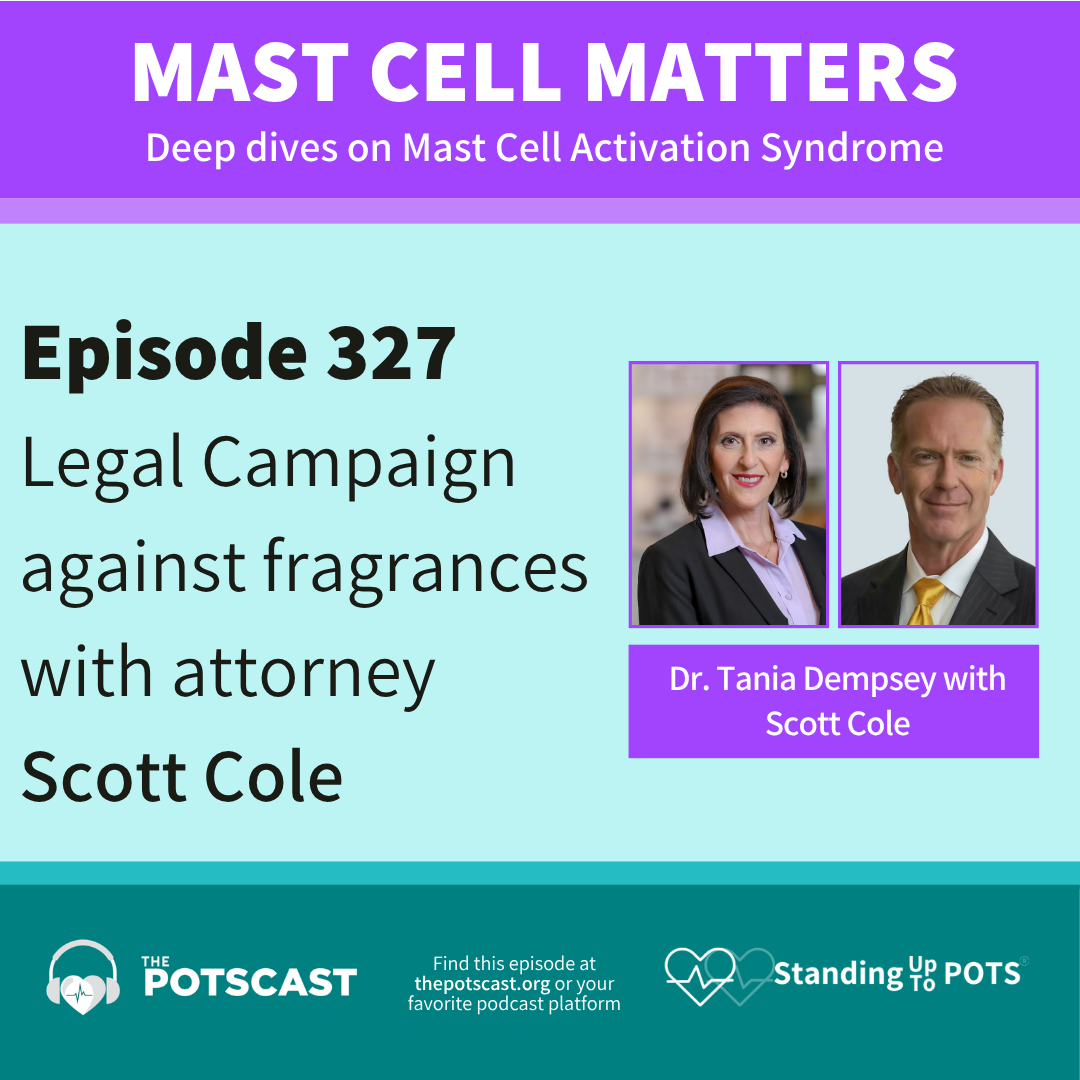
Campaign against synthetic fragrances with Attorney Scott Cole and Dr. Tania Dempsey
September 13, 2026
In this episode, we explore the legal and civil rights issues surrounding chemical and fragrance intolerance, including what happens when people are unable to safely access hotels, businesses, and other public spaces that use synthetic fragrances in their air systems and cleaning (or other) products.
Our guest is Scott Cole, founder of Cole & Van Note, a law firm with more than 30 years of experience in civil rights, consumer, and class action litigation. Scott and his firm are leading a legal effort challenging the widespread practice of pumping synthetic fragrance into public buildings—an issue that can make these spaces difficult or impossible to access for people with chemical or fragrance sensitivities, including many patients living with conditions such as POTS and MCAS.
In this conversation, Scott explains his firm’s current investigation and litigation against major hotel chains and other businesses using synthetic fragrances, why fragrance accessibility may be a civil rights issue, and what patients and advocates need to know as this area of law develops.
Dr. Tania Dempsey shares how synthetic fragrances can be toxic even to those who don't feel symptoms from them, and how MCAS flares initiated by fragrance exposures may last for weeks or months. She also shares statistics showing that fragrance intolerance is not rare.
Anyone interested in participating in the law firm's campaign against fragrances can learn more or submit their information here.
Attorney Scott Cole's book, Fallout, can be found here.
Episode Transcript
[00:00:00]
Jill Brook: Hello, fellow mast cell patients and wonderful people who care about mast cell patients. I'm Jill Brook, and today we have an episode of Mast Cell Matters, Deep Dives on Mast Cell Activation Syndrome, or MCAS, with our incredible guest host, Dr. Tania Dempsey, world renowned expert, physician and researcher.
Dr. Dempsey, thank you so much for being here and which of your fascinating colleagues did you bring with you today?
Dr. Tania Dempsey: Oh, we have a good one today. We have Scott Cole. Scott is a founder of the law firm, Cole and Van Note, and a class action attorney with more than three decades of experience taking on powerful corporations. Scott began his career representing people harmed by refinery chemical releases and fighting for cleaner, safer air.
Today, he's applying that same passion to a groundbreaking legal effort on behalf of people with chemical sensitivities and fragrance intolerance, arguing that businesses [00:01:00] using synthetic fragrances in their air systems may be denying equal access under the Americans with Disabilities Act. We talk about these cases, the legal theory behind them, and what they could mean for people living with mass activation syndrome, multiple chemical sensitivity, and other fragrance triggered disabilities.
Welcome Scott.
Scott Cole: Thank you and thank you for inviting me.
Dr. Tania Dempsey: This is so exciting because this applies, this is something that so many of our audience, so many people in our audience are affected by. And and it is, I mean, I hear stories every day about fragrance, just about every place that people go these days. And so, well, before we dive in I would love to hear a little bit more about your background and, you wrote a book a few years ago and, and so maybe talk a little bit about your early career battles for clean air.
Scott Cole: Sure. Well, and again, thanks for having me on. This is exciting for me as [00:02:00] well. You know, any opportunity I get to get the word out about the work that we're doing. And the, the, the movement as I began to call it recently toward eliminating fragrance at least in public spaces is pretty exciting for me. So, I began my career in the early 1990s. I graduated from law school and began my own practice in 1992. As I'm sure most, if not all the folks listening to this will know, that's right about the time that the Americans with Disabilities Act was enacted.
And so these convergence of events, my, my graduation from law school and deciding what direction I wanted to go in my legal career and the advent of, of the ADA, you know, just, it was perfect timing. And I decided at that point that I really wanted to champion the rights of disabled individuals and all the shapes and forms, right?
And so, I did that. I began my law practice. I launched several cases under the ADA. Was doing a lot of discrimination work back in those days, all on the. [00:03:00] On the plaintiff side, and it was exciting stuff. You know, there wasn't really a well developed body of law around the ADA yet, as you might imagine. New legislation.
But I knew it would be very sweeping legislation, so I knew, you know, we were in for quite a ride. And I think that, that, that bore out to be true. In those days, in addition to the work I was doing under the ADA, I was sort of thrust into, if you will, a situation that I never expected would come my way.
I think you might have touched a, a second ago, if I heard you correctly, on a book that I wrote. That is true. That book that came out, oh gosh, it almost 10 years ago at this point, really was a journaling of events that I experienced as a young attorney back in the years of 1994 through roughly 1997, 1998, at which time I worked with a compendium of attorneys, ultimately. I, I started the, the fight and then others joined in over the years around an environmental catastrophe [00:04:00] that happened in Northern California, close to where my office then was. In short, because I don't wanna be accused of a spoiler here, anybody wants to read the story, it's, it's an, it's a neat story. It was an environmental event where there was a toxic chemical release. And it was a Unocal refinery that was in a city called Rodeo in California. Some folks from the area would know this. And people were heavily damaged by this. Some individuals died as a result.
And it was a, a catastrophic event that went on for 16 days and nights. And the fallout, which is the name of the book by the way, and the repercussions of that were seemingly endless. Those events, my interest in helping disabled, my experience over those early years with this environmental catastrophe, convinced me that, you know, the law is a powerful tool for representing classes of individuals.
Fast forward many years later, past [00:05:00] the book to the present. I have decided to make use of what I learned from those early experiences in my you know, decades of experience since then to champion this cause around fragrance. And so that's, you know, in a nutshell that's sort of encompasses what, 30, 34 years of, of my life.
Dr. Tania Dempsey: Well, we need more people like you for sure. But thank you for doing the work that you're doing. So, yeah, so, so let's talk a little bit about the issue surrounding these fragrances. You know, the way I see it, at least in my, in my practice in dealing with patients is that, you know, there, there are two, two main issues.
There's a lot of issues, but the two main issues are the chemicals themselves are causing the immune system to go awry, and the chemicals themselves are causing damage to the body in addition to just like reactivity that people have. Like, it smells bad and if you're chemically intolerant, you'll react to it.
But, but there are [00:06:00] all these toxic chemicals in synthetic fragrances in addition, that's also doing damage alongside of the reactivity. So, so yeah, tell us a little bit about what, what you're finding and, and what and what you're hoping to achieve through this.
Scott Cole: And good summary, by the way. I, I, I tend to leave the toxicology and the lexicon around MCS and other you know, related conditions to the experts. But the, the complaints, the, you know, so the opening salvo, if you will, in these lawsuits, we have a lot of information in there.
I would, I would encourage, actually, anybody litigation interested or not, to read some of the studies that we have cited in these complaints. You're gonna know 'em backward and forward, but I think a lot of folks that, that don't know about these conditions very well would, would, would experience a good wake up call if they were to see the information that we put in there. Because it's, it is very compelling, right?
The, the body of of literature that's out there and the studies around these conditions is [00:07:00] compelling. So, to your question what are we trying to achieve? Well, fragrance is, I mean, it's ubiquitous, right? People wear it on their bodies. They, they, they use it in facilities, which is the, the, the kind of core issue of our complaints.
Obviously it, it's, it's a concept that's been around for for centuries, but what we're trying to do, at least in the first phases of this campaign, if you will, is, is going to be to eradicate fragrance use in businesses. It, it is and of course the, the, the first response that I get to a lot of folks from that is, well, you know, what about the fragrance industry?
You know, what are we gonna go after them and so forth. To which I would say, wait. You know, we'll get there. Right, I, I'm not saying that I'm, I'm not in favor of that. I'm just saying we're trying to take a stepped approach to this because it is a huge issue, right? I mean, it's, it's, and it's something which has worldwide consequences.
I mean, these, these conditions that you talk about, you know, aren't limited to Americans, right. But, [00:08:00] and yet our, our jurisdiction, you know, rules here in this country, don't allow us to bring lawsuits, you know, in, in France. And so we've gotta focus, first of all, what we can do here under the ADA, which is a, a federal statute well, an act of statutes.
And our goal really is to, first and foremost approach these issues as an access problem. The, the ADA does a lot of things, but one of the things under Title Three in particular of the ADA is that individuals, you know, should have a right to equal access. And there are California laws, by the way, where my office is located, even though we do cases nationwide that go a little beyond this. But the central theme of what I'm trying to do here is I'm trying to, number one increase awareness and make changes, business by business if we have to, to ensure that individuals that suffer from these conditions have the same access, the same privileges as everybody [00:09:00] else.
That, that that can be, if you look at it from that point of view where we're really just trying to equalize access, then these cases really theoretically aren't much different than me asking through a lawsuit for a company to put in a wheelchair ramp, you know, or anything that nowadays people would be like, well, of course they have to do that.
But, you know, 30, 40 years ago it wasn't, an of course. You know, it was, you know, some companies would do it because it's the right thing to do. We can all agree. Others were loathe to do it because it was an expense there. For whatever reason, they didn't do it. And then the law began to require them to do that.
And now it, it's something that we would sort of scratch our heads and, and if a company wasn't doing it and we'd say, you know, this is so obvious that it's required, right? And yet fragrance is still over here in this camp that people don't quite understand and, and they don't put it in the same category as things like the ramps.
And so again, you know, our, our goals in the [00:10:00] litigation are a couple fold. Force certain companies to change it, put injunctions in place for those companies. And again, if it's one by one, we'll do it that way. But I think frankly, the and, and we're only a small part of this, but I think the work that you're doing, the work that we're trying to do, so many organizations are doing, is going to increase awareness generally such that organizations, companies that, that aren't already banning fragrance use in their businesses, even before we come along and maybe focus a lawsuit on them, they're gonna recognize that it's just the right thing to do, right? And so the net of all that, hopefully if we, you know, we're to fast forward a few years, is that we're gonna be a lot, in, a lot better position than we are now, both because we required some companies to do it, but also other ones, you know, that don't wanna get sued to, to, to put it candidly, or just recognize that there are enough people that are impacted by this, that [00:11:00] it's, it's the right thing to do morally. They might increase profits by allowing more individuals to come in to the facilities and on and on.
Dr. Tania Dempsey: So I, I'm curious, how do you identify these businesses? Is somebody reporting them to you, or, or are you doing the due diligence and going around and visiting different buildings? How, how does it come on your radar?
Scott Cole: We're not, we're not going out and, and, and seeking out the names of these companies. Through a variety of, of efforts through social media, through the fact that we just filed the cases that there is this stir that's begun because of it. But the, the net of all that and, and frankly podcasts like yours increasing the awareness and getting our name out there as being a law firm behind this, we are getting a lot of contact from individuals around the nation.
Even some people outside the country. And, and we've gotten, I mean, I can't even tell you the number right now. I know it's in the thousands of individuals that have contact us and said, [00:12:00] you know, either just put my name on something, you know, as part of a larger group, or let me be the one to go ahead and, you know, spearhead this.
And that's really what it, what it starts with. I mean, every, every lawsuit of any kind on the civil side starts with somebody stepping up and saying, I wanna make a change, right? Allow me to be the one to be the spokesperson for this group and the folks that have done that here, we then have a, a vetting process we look at we make sure that their narrative and their circumstances match the goals that we have for the cases. And if all the stars align there, then, then we bring those cases.
Jill Brook: I have a question. I have to laugh because I see that in the background is my air purifier, which is, you know, like one of my key things. I don't go anywhere without my air purifier. But I guess so, so I'm thinking about the different kinds of people and the different kinds of fragrances and I guess I'm, I'm just curious which ones are relevant to your, your work here?
So, for example, there's [00:13:00] hotels who pump fragrance into their air system because they wanna be associated with a signature fragrance. And I assume that that's like the worst 'cause you just absolutely cannot get away from it. And I can't imagine what it's like to be an employee there. And now, Dr. Dempsey, I didn't realize that the chemicals were bad for you, even if you did not notice symptoms. So that was my first question, which is like, I almost wonder if some of us are lucky to get symptoms because if you didn't, you might just expose yourself day and night. And then that's doing its own set of bad things, it sounds like.
So I, so I guess that's my first question. Is that correct Dr. Dempsey?
Dr. Tania Dempsey: Yeah. So, you know what's crazy about synthetic fragrances is that, yeah, they have hormone disruptors. They're often derived from like petroleum products, byproducts. And so they, they have all these other things that they [00:14:00] can be doing to us in the respiratory system, on the skin, in the body, again, affecting our hormones.
Forget actually just even like this exposure outside, I have patients who are using fragrance themselves and I believe what's happening is a masking phenomena. They don't realize, they're very sensitive, they have mast cell activation syndrome, so they're reacting, but they're putting this fragrance on and they don't even realize that they're reacting to it. And, and while they're doing this, they are exposing themselves to all these chemicals. And again, some of these chemicals have the ability to bind to receptors like estrogen receptors and other things that can disrupt reproduction, they can, they can disrupt their menstrual cycle, they can disrupt all these other things. And they have no idea because, you know, for some people they're just putting it on and wanna smell good. And some people, they know they may be something bad, but they don't realize that they're actually sensitive to it.
That's the point I'm making with [00:15:00] synthetic fragrances. You can be not sensitive to it and tolerate it, but it's damaging the body. Or you could be sensitive to it. And I do think, like you, that it's probably good to be sensitive to it in a way, although it does make life very difficult. Because you're already gonna avoid it and probably be healthier that, you know, for that.
But it is annoying because fragrance is every everywhere. So that's, that's the, that's the big problem.
Jill Brook: Yeah, So I guess that's the first part of my question. And the second part of my question was for, for you, Scott, which was, in order for people to be a good candidate to work with you and bring this on, do they need to be somebody who has been necessarily harmed and has documentation of that with a physician?
Or do they have to be like an employee of a, an establishment that puts it in the air system so that they can't get away without losing their job? Or do they just have to be somebody who wants to be able to access this place but can't go there because [00:16:00] of their reactions? Or I guess kind of what is the range of experiences somebody has to have with fragrances in order to be a good candidate for your campaign?
Scott Cole: Sure, good question. So there's a little bit to unpack there. So lemme see if I can, I, I put it this way. There, there is what the law requires and then there is a threshold that we as a law firm right now, given the, you know, in infancy of this line of cases we're filing, that would be important to us before we bring certain lawsuits.
So let me explain what I mean by that. So, to your question about, and I'll, I'll put aside issues about the kinds of fragrances and all that, because that's a, that's a big topic. Maybe we can get to it later in the podcast. With regard to the individuals we are looking primarily for individuals that have visited these locations. Again, I don't wanna, I don't wanna come across like I'm saying that is required under the law because I don't think that it actually is necessarily. Again, this is an [00:17:00] access issue, and if somebody literally can't walk into a building, then one would argue theoretically, well, that's a, that's a problem.
Putting that aside for the moment, because that's gonna, that's an issue that's gonna have to work its way through the courts a little bit on some legal challenges that we're getting right now in some of our cases. So I don't wanna go too far in, in trying to forecast what those courts might do, but I will say that at least for us right now, the law currently I think would favor individuals that have, have visited the locations. As far as employees versus guests, like in a hotel situation, to us, it doesn't make a lot of difference there. There are issues that we could talk about involving things like arbitration agreements and whether that's gonna limit individual's rights that might work, you know, within a business as opposed to visiting it.
But again, putting that sort of thing aside, it doesn't really matter a whole lot to us what their circumstance is as far as why they went to these businesses. If they went there and they had a reaction of some kind, that's generally going to [00:18:00] be good enough for us, you know, all things remaining equal. So, but there, but there really are a lot of factors.
I mean, I, I think one of the important things that goes back to my comment, I call it the narrative. These are issues that I think all of us recognize are not well understood by individuals that don't suffer from these conditions. Am I right? Okay. So if that's true and I believe that is true, then the most important thing I think that comes from the net of all this is that increased awareness I spoke about earlier.
The idea that I can present to a court a very compelling argument about somebody who, you know, maybe traveled across the country and wanted to stay at a hotel. Maybe we can, we can build a, you know, a, a nice story around this. The closer I get to that, that, that story, that a dream I look at and be like, wow, I can really understand how this would be a horrible experience for this person to travel so far to visit her, her, you know, her long lost daughter and dah dah [00:19:00] da, you know, you, you get the, the, the, how a movie would, would, would, would be made out of this sort of fact pattern.
The closer I can sort of get to that, right, the better, because that, that makes, that makes for a compelling story. If I have to present that to a jury or a judge, it, it just, it just sells better, right, to to, to almost put it crudely. But, but that's part of what you're doing when you're an advocate, right?
You're, you're trying to create a compelling story. And so when I look at the different circumstances of people that are coming forward and asking to bring these cases, there, there is some vetting that we have to do you know, in, in light of that narrative. Having said that, I don't wanna say anything that's gonna make anybody feel like, oh, well that's not me.
You know, I, I, I'm not, I don't have the story that's gonna be compelling enough. I would say, let us take a look at that. That's what we do here as a firm. And I don't want anybody to feel like because their facts aren't good enough or because they [00:20:00] weren't damaged enough, whatever that means, that they should sort of self exclude, right? We wanna connect with people no matter what happened to them and, and make them know that, you know, we're, we're here for them. And if we can take on their claim and try to make a case out of it, it may change. That's what we're gonna do.
Jill Brook: So if I could, can I put out a couple examples and you just say yes or no? That is sort of what we're talking about?
Scott Cole: I'll try, I'll try it. Things aren't really that simple, but give it a shot.
Jill Brook: There's so many patients out there who have this issue that I'm just, I'm thinking about what all the patients are thinking about right now.
And in fact, just last week, our podcast featured a woman who she was reacting to a lot of different excipients related to dental surgery. So she had to travel outta state to see a special dentist to get that dental surgery. But because of the fragrances and, and some other exposures having to do with the place that she stayed, she [00:21:00] ended up in the hospital with anaphylaxis before she was even able to get to the dental surgery.
And so I guess that's kind of an extreme example. And you know, I, I imagine another extreme example is somebody who wants to take a job, for example, at a hotel, but can't because the, the fragrance would get to them too much. But even like if I wanted to attend my best friend's wedding, but I can't because it's in a hotel that's fragranced.
Is, is that the kind of thing that you're talking about?
Scott Cole: Jill, I think you know exactly what I'm talking about. The fact that you're, the fact your, your stories, you know, we, where you paint things like an individual have, having to travel some distance, right? Or wanting to attend an event that's personally very important to them. I mean, I, I think we all sort of understand, you know, at at, at our core what makes a good story, right? And so again, those all sound like good examples. There's probably a lot of other facts that I would need to examine. So I, I, yeah. I can't in a, in a podcast say that's the case I would take or not, [00:22:00] but I, but you're on the right track, right? It's, it's those kinds of things. And I, and I, and I actually do hear stories very much like those almost every day. Imagine an individual that is looking for an apartment, right, in, in a particular city. And goes, you know, to a number of places and, and they all use fragrance in common areas and so forth.
And, but moved, you know, to, to this, you know, metropolitan area you know, for a job. And, and literally has to go day after day after day trying to find someplace to live, right, so they can take on this job. But, but can't seem to find it because in that particular venue that, that that state and area they tend to fragrance more than, than the average city might, right?
I don't wanna get into much about what city is and so forth. The person might know what I'm talking about. But you get the idea there, right? So those, those, those experiences where somebody has to really, you know, go the extra mile to avoid fragrance, you know, are, are, are pretty compelling fact patterns.
And so, you [00:23:00] know, obviously we will weigh our decisions heavily in favor of those folks that have those stories.
Dr. Tania Dempsey: What I'm curious about that, that's, you know, so helpful to understand. So what I'm curious about is, is I travel a lot, so I stay in a lot of hotels. And I notice several different patterns. I stayed at a hotel in Austin not that long ago. The, the fragrance was pumping, like I've never, never smelled before.
And while I was not sensitive to it, I just kept thinking about how toxic it is. I kept thinking about all the other people who, you know, are gonna be affected by it. But it was so strong. So I, I think about like hotels like that. But I also stay at hotels where it may not be that noticeable in the lobby, but you go to the rooms, and the rooms have this, may be the cleaning products that are fragranced.
There may be other things. So I'm curious about that kind of thing and how that applies to like the, is that something that you also work with?[00:24:00]
Scott Cole: Yes. So you're, I mean, you're presenting a couple of different scenarios and all, all of which would be on their face, viable situations for us to, to bring litigation over. And I think that your experience with this is very common. There are certainly large hotel chains, for example other, other, you know, chain businesses that will go out and have some companies sort of bespoke a signature scent for them.
Right, I'm sure you know some examples of this. Some are involved in litigation that were currently waging. And it's, it's generally a policy where they'll have that same fragrance either in a number of the facilities or across the entire chain, depending on, you know, what their, what their goals are.
So, those, you know, that's, that's the most sort of obvious example, the pumping in through the HVAC system. Everybody in common areas and otherwise, you know, the gym, hotel rooms is gonna be affected by this. Or it is more noticeable in some areas because the air isn't [00:25:00] moving, you know, as much through those, those areas like a room versus like a lobby, for example. That's the kind of classic example of, of, of where big businesses are fragrancing. We all understand this. Okay. So then you've got the, the more granular examples of where maybe because of the way they've tooled the HVAC system, they don't have the the signature scent as strong in the common areas, but then you go to the hotel rooms and it's, it's right there.
Or it's on the fabric on the bedspread, or otherwise. And I think we all know well enough about how fragrance is synthesized to understand that these droplets, you know, these, these little, you know, two, three micron droplets, you know, are emanating this smell, right, and, and, and the chemicals that make that smell, for a period of weeks sometimes.
And so you get to areas like a, like a hotel room, for example, and the bedspread just stinks of the fragrance. Or the furniture, you know, is, is gonna have a coating on it from the fragrance. And some of it gets wiped [00:26:00] down between guests and some doesn't. So we look at all that and, and that, and that gets down to sometimes just the cleaning products.
And, and the, the irony of this is that in, in some of the situations that we've examined, you know, it, it seems so easy for these companies to just change the products. I'm not here to promote any particular product and I'm staying far away from that because I don't want our message to be diluted by that sort of, you know, commercial goal.
But it seems that those are the, the, the companies that would have such an easy time stopping fragrance use 'cause all I gotta do is change out the product. And, and yet that seems to be sort of the least understood version of fragrancing. So whatever their understanding is, however it's being employed, our goal is kind of the same at the end of the day.
Every one of these organizations should be looking at, at what it is that they are presenting to their customers. And I say presenting in the sense of is it [00:27:00] cleaning products that are, that are, that are toxic? Is it something in a mobile atomizer or in the HVAC system that's pumping out fragrance? And it doesn't really matter to us as much how they're employing the fragrance 'cause there are a dozen different ways they can do that from reed sticks on a desk, you know, to a very elaborate HVAC system.
The goal is that we want these organizations to be looking how they're doing that and looking at it responsibly, the same way that they would, back to my wheelchair ramp example. It isn't just at the front door that you should have ramps. Between floors you should have that or an elevator or what have you.
And there are other ways of course, that, that access is made available to people with different disabilities. That sort of granular examination, if you will, I, I think should be done with fragrance as well. And so specifically to your question we expect these organizations that we're bringing suits against to be looking at all shapes of, you know, [00:28:00] their, their environments and making sure there's not toxins.
Dr. Tania Dempsey: Now, this may be a little bit off topic, but, but I'm also curious about whether they're using fragrance, not just because of the signature scent, but also to cover up some other issue. Okay. So a lot of these hotels have major mold problems, I can tell you, because I've stayed in a lot of hotels lately with mold.
Very detectable. I mean, somebody who, who treats a lot of patients with mold, I can pick it up pretty quickly. But then you have the, the scent over on top of the smell of mold to cover it up. And so I'm just wondering like how much you deal with that issue. I know mold is a whole other world, and so I'm sure you don't deal with it directly, but I'm curious about what you've heard in this, in this circumstance.
Scott Cole: I've heard exactly that. I, I, I would love it if somebody would do a study someday about, you know, mold levels, for example, and the use of fragrance [00:29:00] in, in businesses. But, but to your point specifically yes, that, that is a story I've heard quite a bit. And it, it's just, it's common sense.
Not a lot of businesses can afford to hire a company to manufacture a signature set. So what, what do they do, right? They use cleaning products that have smells in them and so forth. I mean, I think we all understand that fragrance is not something that does the cleaning. I think of it in terms, as I describe it, in terms of sort of like an icing or a layer on top of it.
I know that's a not an accurate depiction of what we're talking about here, but the idea of of, of fragrance is that it's not necessary. There are cleaning products that don't have fragrance, lots of them. There are lots of businesses that are, that are squeaky clean right in, in terms of presenting their, their, their guests, for example, with sterile experience, but they don't have smells that emanate from them. They don't use fragrance in those products or pump it out of the HVAC system. So we understand that fragrance is not [00:30:00] necessary to have a clean facility. And so we look to the reasons, right? And, and one of the reasons we talked about is to create that branding, right?
To, to be able to say, well, you know, we have, and we'll sell it on Amazon or otherwise, and we know they do, we'll put out a, a signature scent. And then, you know, we, we'll, we'll have a secondary market for that, or we'll sell it to people so they can sort of relive that experience when they traveled to some, you know, high end hotel in the past.
Whether that really works or not, we don't know. I, I'll, I'll get some stats on that at some point, I'm sure as well. But in addition to that, yes, to, to cover up certain smells, or just kind of create just a sort of general, you know, sort of light feeling, right? I've read so many, I'm sure you have too, websites from these signature scent companies that talk in these very poetic terms about how they're going to, you know, studies show, probably their studies, studies show that you know, guests have a a better experience, you know, will [00:31:00] view their facilities as being not only clean, but also welcoming, inviting, whatever, if they have these certain smells. And, but whatever the branding message is, it all comes down to the same thing, right?
They're either masking something or they're, or they're offering something that they will then tell you is going to enhance the guest experience. And yes, I, I heard the story many times. Not story, but yeah, the, the, the information from a lot of people, how they have visited, and usually it is hotels, motels, that kind of thing, as opposed to, you know, retail stores, what have you, where they've, where they've gone there, or it's an older facility, they can tell because they could see the mold or, or they're attuned to it.
And yet they've got, you know, a bunch of you know, vases in, in the lobby and so forth with reed sticks. And it's obvious that, that the, the goal there is basically to, to mask what is really a deeper problem.
Jill Brook: Oh, that's so bad. Oh man.
Scott Cole: I have no fundamental problem if, if [00:32:00] a hotel wanted to for, we can talk about hotels here, if a hotel, for example, wanted to place some sort of fragrancing unit or reed sticks or whatever in, in hotel rooms and told people, this is what you're gonna have, these are the problems. You know, here's, it's like, you know, it, we still sell cigarettes even though we understand it's a problem, right?
I really don't have a fundamental problem as long as there is honesty and authenticity. We're telling people what they're getting. If they were to go into particular hotel rooms, I mean, gosh, for all I care, they could put it on their websites and they could say, for an extra five bucks, we'll give you a fragranced room.
And as long as they're being honest about what's in those chemicals, I'm honestly not sure, maybe I'll, maybe I'll hate myself and I'll be cited for saying this five years from now, but at this point in time, that doesn't seem fundamentally like necessarily a bad thing. As long as they're being honest and people are [00:33:00] making an informed choice.
Now, I'm sure I'll get some blowback from saying that from some people that I represent, but that's, but that's where my, where, where I come from. I, I, I don't wanna take away choices from people. And, and I don't wanna say you can't experience, you know, whatever. I, I, I just want honesty, right? And I want people to, to understand what they're up against when they are dealing with fragranced environments.
And for the companies that are forcing, you know, that experience on people, that's where I draw the line.
Dr. Tania Dempsey: No, I think it's a good point. And, and yes, it may be a little controversial, but honestly what, what you're saying is really that people should have a choice. And if you are intolerant to fragrances or you're worried about the toxicity of it, you should be able to stay at, at a hotel, book a room that is fragrance free.
And and the lobby should be free of fragrance, but maybe there will be some rooms that are available for the people who really enjoy that and they, and they stay there at their [00:34:00] own risk potentially. You know, I, I mean, you know, it kind of makes, it makes sense, right? So we're not, I think it, it just sort of equals out, you know, the, the, the, the issue a little bit.
Scott Cole: Yeah, I think that's right. I mean, I, I I'm aware that there are hotels in, in, in some places that allow smoking sections. I, I think the world understands that there are dangers in smoking, for example. And yet these facilities still allow that in certain areas as long as that smoke isn't wafting into other areas where people don't want it.
I, I think that is analogous to what I'm trying to say about the, about the fragrancing.
Dr. Tania Dempsey: Yeah.
Jill Brook: So could I just ask, so I think that you have sued some hotel chains so far, right? I'm wondering if you could talk about that and also like what is their reaction? Are they surprised? Do they say, oh, we thought everybody loved our fragrance, or do they know that it's toxic? Or what is the response and what do you, what do you think they [00:35:00] think when they hear from you?
Scott Cole: That's gonna be a delicate one because you know, I, I can't get too far into litigation on these? I would say you have to understand that I'm, I'm, I'm dealing with attorneys that are working for the companies, right. That, that, that, that's the, that's my audience. So it, it would be difficult for me to tell you what's happening behind the scenes in those conversations as you might imagine.
I, I think that given the novelty of the issues that are being presented in these cases it's, it's not a surprise that we're getting challenges, legal challenges to the lawsuits that we're filing, right. And it's, it's, it's just too early to tell how that's going to shake out. I mean, I feel very confident. I, I think that when you've got facts on our side, like we do, I, I, I, I respect the law. I, I think the law you know, as a concept, you know, does its best if you will to obviously create fairness, right, to great justice. And, and the idea is [00:36:00] if you've got individuals, you know, back to the narrative, you have individuals that literally, you know, can't walk into a facility that, that their neighbor can on, on the most fundamental level, I, I just feel that's morally wrong.
Has the law completely caught up to my point of view on that? Probably not, right. But but not because it won't get there or it shouldn't be there now, but just because these issues need to be flushed out with some fact patterns like we've talked about here. So, you know, without getting into any particular case or, you know, what their responses might be or what I've been told that they are, I wouldn't say that I've been met with a lot of surprise.
I would say that the, and any conversations that I've had, if I could sort of, you know, amalgamate all these has, has been questions about, well, you know, what could we do differently, right? Assuming we don't want to [00:37:00] fight this case, you know, what might my client do differently? And so a lot of the, the, as as a theme, a lot of the interactions I've had in these cases in total has been more sort of exploratory, if you will. Not so much like you're gonna lose, you're gonna lose sort of, you know, combative. Which is nice, right? I mean, I, I, I think our job as advocates is, is, is not to, to bicker over things if we can, but it's to problem solve. I mean, that, that's how I look at, at, at our profession, frankly.
And so if you come at it from that, with that lens, then, then it's easy to become exploratory and have conversations about what might they do differently. How might an organization you know, a, a, a allow fragrancing in certain areas or, you know, what, what, what products might be available. Again, I shy away from that.
Or, you know, would it, would it be enough if we sort of sunset, you know, these practices that that we're engaging in. So it's, it's, those [00:38:00] sorts of conversations without being more specific about what I said to any particular other council I've been happy to have those interactions where I get to educate them about my views on fragrancing and how widespread the problem is that people can't stand to be around it. And I like the fact that they, that I, or my cases or the work that you're doing, for example can provide, you know, new information to people because that is really the genesis of change, right?
Dr. Tania Dempsey: Yeah, exactly. A hundred percent. It's about, it's about educating, educating, educating. Just keep talking about it because the reality is that I think a lot of people think that, that this is really affecting a small population. You have some great statistics on your website, which I'm going to, I'm going to quote, but just even in my own work and, and the work that you know, Jill's involved with as well.
I mean, we know that close to 20% [00:39:00] of the population has this condition known as mast cell activation syndrome. One of the studies that we published on something called toxicant induced loss of tolerance, which is a chemical intolerance is, is something like over 60% of those patients had mast cell activation syndrome.
And I think it's probably even higher than that. And so, you know, this is not, we're not talking about small numbers, right? And, and when we look at the statistics that, that you've quoted on your website, 34.7% of Americans report immediate adverse health effects when exposed to synthetic fragrance, right?
And the number's growing. 26% of adults suffer from asthma, and then 57.8% of asthmatics suffer from adverse health effects due to synthetic fragrance. 21.2% of adult Americans suffer from chemical sensitivity. That's in line with actually our mast cell diagnosis. So it's about the, about the [00:40:00] same. 81% of those report adverse health effects due to synthetic fragrance.
And, and, you know, the, the numbers go on, a hundred percent of the population knows someone with fragrance sensitivity limiting social and business interactions and opportunities for all. And then we, we published a another study, it was a survey on neuropsych symptoms in 550 MCAS patients that showed 69% of females and 40% of males with MCAS reported having odor hypersensitivity.
So the numbers are actually fairly large in my, in my world. I mean, this does, we're not talking about small numbers, right? So, so I think this is something that is affecting more people than we can imagine.
Scott Cole: Yeah, I think that's true. And, and one of the last numbers that you cited there, the a hundred percent is the one where people really step and take notice. And, and, and I have talked to a number of people, not just with a condition, but spouses, you [00:41:00] know, family members, friends and so forth.
Everybody knows somebody that has a reaction from fragrance. But if you think about the fact that and I, and I, I know people beyond my clients that have these conditions, and it, it becomes difficult to make an agreement on where you might go to dinner. If you wanna engage in, you know, I, I, I'll tell you a, a personal story.
I was in the UK a few months back and a member of my family has this condition. And over there in London in particular, they heavily fragrance, as I'm sure you might know. And so it was extraordinarily difficult to find places to eat to, if we wanted to go into a museum, for example.
Shockingly, I, I wouldn't have thought that these museums, I mean, many of which have been, you know, around for quite some time and just don't seem to me, at least, didn't seem to me you know, prospectively as, as places that we might find fragrance. And yet they had it, and it [00:42:00] was, and it was heavy, you know, and noticeable.
I don't personally have a reaction to, to those in that way. Although I, I, I think my nose has become somewhat sympathetic because I, I can, I can pick up these things more now than before because of experiences with folks that I know. But it shocked me how widespread the use was there, even more than I experienced here, anywhere in the States, frankly.
And so the, the idea that it changes the way we, me, people interact with those that have these conditions. It affects us too. It makes, it makes social interactions more difficult. If you go to look for a job, for example, and the company that you're applying for uses fragrance, I doubt you could stay in the lobby long enough for the interview.
We talked about the hotels already because that's, you know, obviously a, a, a easy example to understand from most people. But list goes on and on, as you might imagine. And in the complaints that we filed, of course we have sections in [00:43:00] there which sort of give that background. So the courts that might be reading about these things for the first time or not fully understand the science behind it, I hope anyway, we'll sit back and sort of scratch their heads a bit and go, huh, you know, I, I didn't, I didn't really consider that. And that was one of the reasons why we wanna have so much data in these pleadings that we filed, because I didn't, I didn't think that it was frankly enough just to say, it's a problem for my client.
We should fix this. I really wanted these courts and, and, and the media to the extent that they picked up on these sorts of things to, to really get the word out there about your statistics because those are the right numbers and, and they're just, they're shocking, right? How many people actually have an impact from these these toxins?
So anyway big numbers, right? As you know, probably better than anybody.
Dr. Tania Dempsey: Huge, huge.
Jill Brook: It's not just an inconvenience. One, one thing that comes to my mind is that one of Dr. Dempsey's colleagues in the International [00:44:00] Society for MCAS had made a point at one point that, upon smelling fragrances when somebody gets that headache or when somebody gets that nausea, that is an indication of something really, you know, kind of damaging sometimes happening in the body.
And her example that her children experience was intracranial hypertension that had been measured upon fragrance. And so it's, it's not just a headache. So to people out there who are saying, oh, come on, get over it, it's just a headache for a few hours.
Dr. Tania Dempsey: Right. And some people like, to your point, Jill, some people are having, you know, that exposure and then it's months of flares getting out of it. So it's like the, the scent set off these mast cells, their immune cells, and then all this other stuff is happening, and so the fragrance is gone, but now the, now the body has to heal.
So I don't know if you see cases like that, Scott, but those are, those are cases that I see where there's just one, [00:45:00] you know, what, what some people would consider a small trigger. It's not so small. And and it's a short exposure that then leads to, to weeks or months of debilitating symptoms that we have to unwind.
Scott Cole: It's horrible. I, I'm just, I, I'm shocked regularly by individuals that don't even realize they have these conditions. And then you begin talking to 'em about the fact that they work in, I mean, speaking to my story earlier about traveling, we had such an experience at a hotel restaurant with individual who was serving us was surprised that when we said we had to leave because of the fragrance and a conversation started, as you might imagine.
And you know, I, I tend to be a little bit chatty and, and it turns out that this person felt fine when she wasn't at work. And then she comes to work and within minutes of of studying her shift, she gets the headache, she gets what was it, some I think it was itchy skin. There's a third thing which I'm forgetting right now. But, but clear [00:46:00] examples of something and, and to me it just, it just seems obvious. I mean, what, what, what is the thing that we do so often in life? We breathe air, you know? And, and the fact that, that she's in this environment where the air is polluted with this, to me, knowing what I know, I looked at it like, clearly you've got a, a, a reaction to what this this hotel is doing.
And, and told her, yeah, you should look into this. And then when she started putting two and two together, even during the conversation, I saw the light bulb go off. And I, I just, I sort of personally hoped she left that position. But you know, it, it, it's tough to leave a job until, you know, it gets it gets bad enough. So, but the point is, on a small scale there, you know, one more person maybe has learned something from, you know, the experience. And to me, that's a success.
Dr. Tania Dempsey: No, absolutely. And I see that a lot too. I think people don't even realize, right? They can't, they, they know that something happens when they come to work or they [00:47:00] go into a certain environment, but they, they haven't been able to, to put together what, what it is. And so, you know, the work that you do, the work that I do, I mean, hopefully we educate more and more people and more people are aware.
The more people that are aware, hopefully there's more movement to change, right? That's what we want.
Scott Cole: For all these people out there, whatever you do, get, get involved, right? I mean that's, I, I think that's the takeaway from all of this. That, that increased awareness. And I, I really do think it's gonna, it, it sounds so boxy, but I, the more people can get involved, even if it's just spreading the word to other people and, and creating that awareness, they can see the connections between their symptomology and the environments that they find themselves in independent of, of litigation or anything else that, that we, we all might do.
That, that seems to me to be the, the, the root of, of, of change. And so, you know, hopefully we can, you know, be a, a catalyst for that kind of thing.
Dr. Tania Dempsey: What about the [00:48:00] petitions that go out? I know I signed a petition recently. I think they were going to there was a, a ruling or, or, or some kind of some, some message about maybe it was in New York City. They were gonna start pumping fragrance, and I can't remember if it was the subways or somewhere. Somebody reached out to me knowing the work that I do, and they, you know, I signed the petition and we were trying to spread. What, what happens with those things. I hope like that went somewhere and to someone like you who then, you know, can help champion this.
Scott Cole: Yeah, well, it, it really would depend on the organization that is you know, sort of, you know, grassroots organizing this petition signings. I've heard a number of examples like that. One was instrumental in getting, I think it was the Atlanta Airport to stop using fragrance.
There had been a couple other ones that were getting folks to sign petitions and. Where those go, again, it's gonna depend on the organization, but you know, it would go, it would go, you know, typically to a [00:49:00] legislator.
And the idea being that they want to either if it's, if it's someone that's got the ability to make change in, in public services and so forth, you know, they would introduce sub legislation there. But there are a hundred ways that can be beneficial. I, I think the, I think the, the most important part of all that is, is again, just the activism. You know, people getting involved. And of, you know, presenting the petitions or, or, or signing them.
And, you know, I, I think that like the cases that we're doing, we really need just to, just to rack up some wins, right? I mean, you know, if, if, if we have more people that are out there getting petitions signed and they're presenting those to the, the, the people they put in office and they're talking about that on, on debate floors.
If, if they're, you know, discussing this in the media. I mean, and I don't, I don't just mean the traditional media, but social media. I think that is in, in a lot of ways that's gonna help the kind of change we talked about. So, you know, I don't, I don't look at our [00:50:00] cases as, as being anything except just, you know, one more way of getting people to pay attention. And hopefully on, on a case by case basis, having boardrooms and, and, and people that are running these companies take notice, you know. And, and gosh, you know what a great example it would be if through maybe these cases or the other kind of activity we spoke of, we could you know, have an organization say, you know what, we're gonna stop using fragrance in our business corporate wide, right? Maybe we're going to put a fragrance, free workplace policy in effect. Maybe we're going to even, you know, if they want to use that as a, a, a way of creating a different kind of branding, maybe being the fragrance free hotel or the fragrance free retail chain, great.
You know, it's, we can create win-win scenarios here. They don't have to be the zero sum games where we win, they lose, right? If they wanna rebrand themselves as, as being [00:51:00] the fragrance free establishment, I fully support that because it's getting the same message out there that fragrance is dangerous.
And, you know, that's what we're all talking about here.
Dr. Tania Dempsey: Absolutely. Thank you so much, Scott. This has been incredible. I'm so happy to have been able to, to talk to you today and thank you for the work that you're doing and keep, keep doing it.
Scott Cole: Thank you. Yeah, we're we'll keep at it. You too. Hey, listen Jill and Tania, I, I, I really appreciate you inviting me on and if you ever need anything else from me, you know where to reach me.
Dr. Tania Dempsey: Thank you.
Jill Brook: Thank you so much. We will put your website in the show notes so that people can find it. You have an FAQ section and a section where people can sign up to get involved and just more information. We'll also put a link to your book Fallout, and we will hope that people will get inspired to participate or at least speak up when they're unhappy about fragrance, 'cause boy, I'm happy to realize that we're not alone. I think we've all been sitting here quietly, politely tolerating it and I'm so thrilled to know there's people [00:52:00] out there like you guys raising raising awareness.
Scott Cole: I echo that. Thanks.
Jill Brook: Thanks a million. I'll let you go. Okay, listeners, that's all for today, but we'll be back with another episode soon. Until then, thank you for listening. Good luck managing those mast cells and please join us again soon.