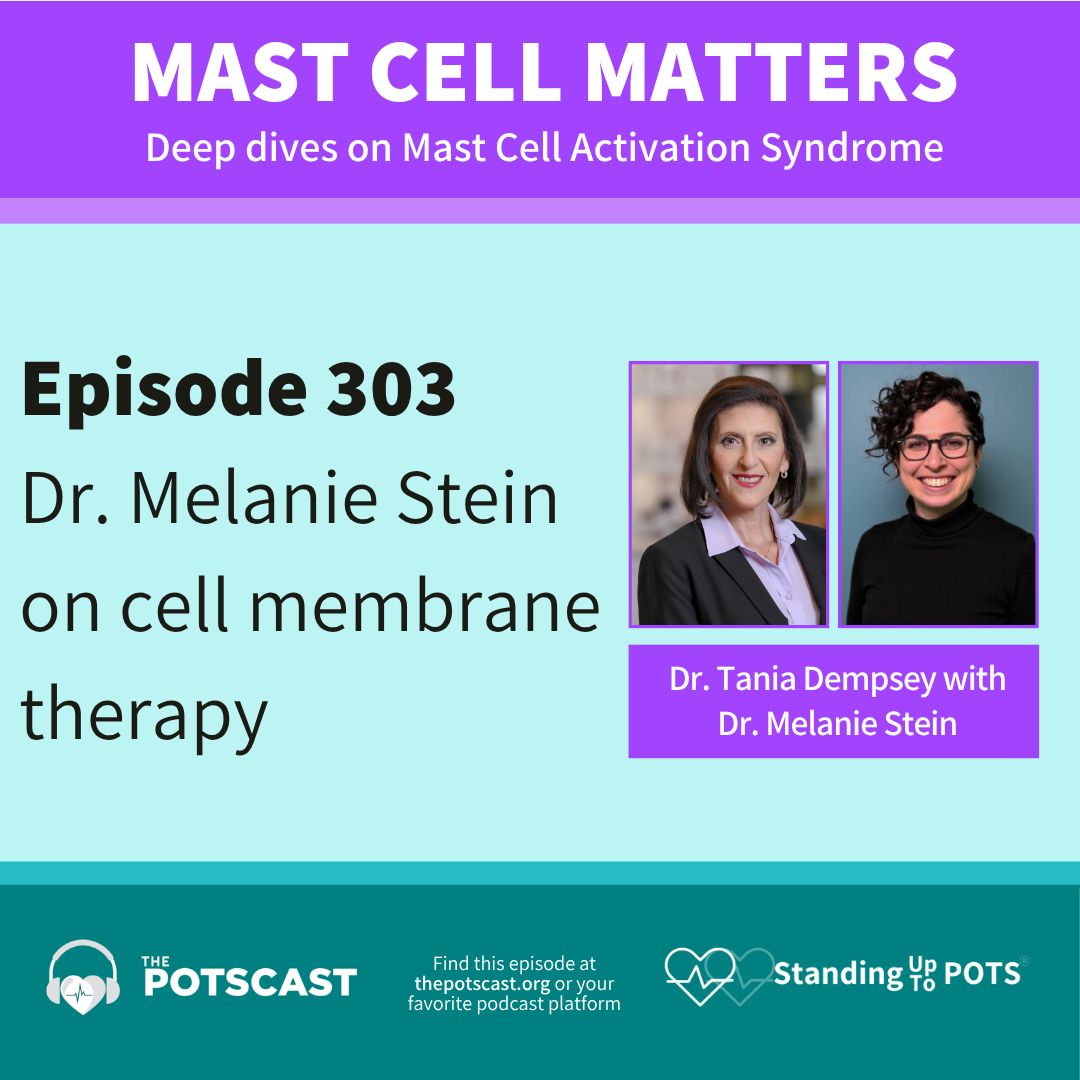
Cell membrane health with Dr. Melanie Stein on Mast Cell Matters with Dr. Tania Dempsey
April 01, 2026
Dr. Melanie Stein, ND is a licensed Naturopathic Physician in Portland, Oregon and a recognized leader in Cell Membrane Therapy for the treatment of complex and chronic illness. She specializes in restoring health at the cellular level—repairing and revitalizing cell membranes to improve energy production, enhance detoxification, and restore healthy communication between cells.
In this episode, she and Dr. Dempsey discuss why cell membrane health is relevant to MCAS and many other chronic illnesses, testing and treatment approaches, their favorite in-office treatments, diet considerations and much more.
Dr. Stein's clinic's website is here.
Dr. Stein's book, Breaking Through Chronic Illness, is here on Amazon.
Episode Transcript
[00:00:00]
Jill Brook: Hello, fellow mast cell patients and lovely people who care about mast cell patients. I'm Jill Brook, and this is Mast Cell Matters, where we go deep on all things related to Mast Cell Activation Syndrome or MCAS, with the help of our wonderful guest host, Dr. Tania Dempsey, Johns Hopkins Med School graduate, world renowned mast cell expert, physician, researcher, and more. Dr. Dempsey, thank you so much for being here today and which of your fascinating colleagues did you bring with you today?
Dr. Tania Dempsey: I'm so excited to have my friend and colleague, Dr. Melanie Stein here today. She's the medical Director of Restorative Health Clinic in Portland, Oregon where she helps patients navigate complex, often misunderstood illnesses, including tickborne disease, environmental toxicity, MCAS, and neurodegenerative conditions.
She specializes in cell membrane therapy, a cutting edge approach that repairs damaged cellular membranes to [00:01:00] support detoxification, mitochondrial health, and long-term vitality. A sought-after speaker and author of the new book Breaking Through Chronic Illness, the Science of Cellular Repair and the Path to Lasting Recovery, she is dedicated to turning medical confusion and dismissal into clarity, validation, and a clear path forward. Dr. Stein, welcome, so excited to have you today.
Dr. Melanie Stein: Thanks, Dr. Dempsey. I'm very excited to be here today.
Dr. Tania Dempsey: I'm so excited about your book and I wanna talk about you know, how you, how you got to this point, but maybe we can start maybe from the beginning and how, a little bit about your journey to where you, what got you here. Can we start with that?
Dr. Melanie Stein: Yeah, sure. You know, I think that when I think back to, you know, college, I actually was gonna be a veterinarian. And I was all set to go to Tufts Dental School. And, you know, I remember sitting in biology classes and chemistry classes and just always asking like, [00:02:00] well, why, why does that happen? You know, I, it just doesn't make sense to just be told it happens. And you know, one day I was actually the office manager of a chiropractic clinic, and one day she said to me, you know, you love herbs and you love, like, you know, getting to the bottom of things, why are you not becoming a naturopathic physician? And she was a great mentor of mine. She took me to the exploration day of the naturopathic school here in Portland.
And within a week my whole life's trajectory was changing and I was going to naturopathic medical school instead of veterinary school. And, you know, it was during medical school that my whole life shifted. I never knew I was gonna go into complex chronic illness, but I was actually on a Qigong retreat and I woke up in that, that next morning paralyzed.
So I couldn't move from the waist down. I had full body tremors. It was, it was a really terrifying situation. And I got taken to the hospital where I was extremely dismissed, you know, because they ran all of the [00:03:00] standard medical tests and they couldn't figure out anything wrong with me. So, of course, what did that mean, I had conversion disorder. So I had neuropsychologists coming in, talking to my family and I saying, you know, why is she choosing to do this? And, you know, I am a very stubborn human, if anyone knows me, I have goals and dreams and I'm gonna get there. And so, you know, I looked at her and I said, I have things to do. This is the last place I wanna be. And I feel like in many ways I was the lucky one because five days into my stay, I developed a bullseye rash. And so, you know, having been a medical school student, I was like, ah, I know what this is. But here in Portland, Oregon, you know, the, the infectious disease doctor even came to me and said, well, you know, Dr. Stein, there's two sides of Lyme disease, there's people that believe it's here and there's people that don't. And I just couldn't believe that, right. It was just baffling to me how, you know, pathognomonic sign of [00:04:00] tickborne disease, I have Lyme disease, I'm, you know, in a wheelchair and debilitated like, come on guys.
And it was through that journey that I, I had to fight to find help. And, you know, eventually, of course I did and, and I did IV antibiotics and, and many other therapies. You know, we both love IV ozone. But I was that patient that reacted to everything. Right, and, and you know, now I think you know, we've, we've learned so much more that now I know that it was mast cell activation, and I wish I knew that then, because back then we just called everything a Herx.
Dr. Tania Dempsey: Yeah. Yeah.
Dr. Melanie Stein: But eventually I got better, right, eventually, I, I got a lot better and I was doing really well, and then I got COVID. And when I got COVID, I actually started to have seizures 20 times a day. And, you know, I had to take a step out of practice and, you know, I was already treating Lyme. It became, my whole life's purpose at that point was to treat, you know, complex, chronic, undiagnosed, confused, mysterious illnesses. And I had to take a step out of practice and I was [00:05:00] trying all the best treatments. Again, I did every mast cell medication. I was doing tickborne treatment, I was doing mold treatment.
I just, nothing was making me better. Everything was making me sicker. And you know, it's, it's always funny because, you know, I kind of feel like we should never be our own doctors. Because I forgot about the very core of, of medicine that I was already practicing the, the cell membrane medicine.
And it was really, you know, I took a step back, I called my mentor, I flew out to his clinic and I, and I did the cell membrane protocol that everything shifted, the medications started working. And within just a matter of like a month, I was feeling better.
Dr. Tania Dempsey: Yeah. Wow, that's powerful.
Dr. Melanie Stein: It was, you know, it was a lot to go through, but I think it really taught me that we're missing a key piece when we're not thinking about the cell membranes and the damage that these infections do on this cellular level. I think we have so many [00:06:00] wonderful treatments, and I know you and I have, have had a lot of conversations about mast cells and you know, what do we do?
I just called you about a patient case the other day when I was like, I've tried all the best mast cell therapies on this patient. What do we do? And you know, believe it or not, it was, I went and I did a little bit of IV PC on her, and that's what stabilized the mast cells. So, you know, we just, we can't forget about the membranes.
Dr. Tania Dempsey: Yep. So that, that sounds like that led you to writing this book, which is incredible. I love the book, because it is really very accessible. You do not need to be a medical professional to understand it. I think it's just so well written and it's so simplified in the sense that I think anyone could then really understand the power of addressing that cell membrane.
I mean, I've been doing cell membrane work for a long time as well, and, and I can attest to the fact that it is a game changer. It's not, it's not the whole piece of, of the puzzle for everyone, right. You and I recognize [00:07:00] that. But sometimes you can't get anywhere unless you address it. So I love how you outline that in the book and explain all that in the book. It's really, really great. I recommend everyone read it.
Dr. Melanie Stein: Yeah. And I mean, you know, perhaps for our listeners, we should kind of break down parts of that and what we mean when we think about the cell membrane work, right. I guess we could just start as what, what is a cell membrane, right.
Dr. Tania Dempsey: Yeah. What is it?
Dr. Melanie Stein: So when we think about the cell membrane, I like to think of it as this protective layer around our cells. So our cells control every process in the body, and we need those processes tightly controlled. And so we have these cell membranes that protect what nutrients can come in, what toxins and infections might be able to come in or maybe keep out. And then how we're able to get toxins out of the cell. And within the cell membrane, we also have a membrane around our mitochondria, and those mitochondria, right, the powerhouse of the cell. All energy production or ATP, the energy currency of the body, is produced [00:08:00] in the mitochondria. But something that is very interesting is that mast cells have a mitochondrial membrane too. And one of the main processes that happen with Mast Cell Activation Syndrome is PLA2 actually activates and cleaves our phospholipids off of the mast cell membranes to release things such as leukotrienes and prostaglandins, which creates so many of our mast cell symptoms. And so we need to stabilize these membranes because it's very well researched when patients have a lot of inflammation or Lyme disease or mold, that the membranes themselves start to become oxidized, which means they start to become thick and hardened and toxic.
So now that specialized regulation of controlling what is happening in the cells and controlling the ability for infections to come in, the ability for mast cells not to degranulate uncontrollably and cause symptoms and [00:09:00] inflammation, the ability to make energy in the body, it goes fubar, and we can't do it anymore.
Dr. Tania Dempsey: So how do, how do we know if our membranes are damaged or not working well? Is there a way that, that patients can get this information?
Dr. Melanie Stein: Yeah, so there used to be a really amazing test out of Germany that I think we both used to use a lot of which is by far my test of choice, but unfortunately it is no longer. So lately I've been using a test called the ProdromeScan, which I, I do think has its limitations, but I think it can help us understand phospholipid levels in the body, mitochondrial levels, or mitochondrial fatty acid metabolism at least, and plasmalogen synthesis as well.
And so, you know, plasmalogens are just as important as phosphatidylcholine because plasmalogens, I like to think of 'em as the sprinkler for the fire alarm, right? So if, if toxins are infecting the body or inflammation's infecting the body, the sprinkler system [00:10:00] goes off to try to calm down all the inflammation, and that's the job of the plasmalogens. So the test also will tell us about plasmalogen levels to see do we have enough phospholipid levels in the body to do these cellular processes?
Dr. Tania Dempsey: The other thing that I've found, I don't know if you do this, but we, we use a a piece of equipment called a Bodystat, and it's a body impedance analysis. And so it can measure, you know, body fat, lean, lean muscle, lean body mass, fatty tissue, like you can get all those sort of percentages, intracellular water, extracellular water. So it's pretty cool. But it also measures something called a phase angle. And the phase angle actually is a very rudimentary view of cell cell membrane health. And so it's not, it's not as good as a test you're, you're, you're mentioning, right, 'cause that gives you the specifics. But I will sometimes like just screen people [00:11:00] by using this, this Bodystat where we, you know, can look at the phase angle. And typically if the phase angle is under seven, I know that there's a membrane problem. And usually what we'll also see is high extracellular water and less intracellular water because it means that the cells are leaking.
Dr. Melanie Stein: Yep, that makes sense. And, and that's a nice way, you know, and I think the reality is we need to look at this data from multiple different angles. You know, I do use the the Vibrant Wellness Oxidative Stress Panel as well because, you know, the more oxidative stress in the body, the, the higher the chances that we are oxidizing these healthy fats and causing membrane damage too.
So I think when you can put all these pieces together, because you know, the, the reality is cell membrane therapy, it is expensive and you need a lot of IVs to actually be effective too. So I think the more information we have to help determine if it's really truly necessary, 'cause it is not a one size fits all approach. Sometimes it's just [00:12:00] that key to unlock healing.
Dr. Tania Dempsey: Are there symptoms that you see that patients have, that sort of clue you in that that's the path that you need to look at?
Dr. Melanie Stein: Yeah. You know, I mean, the number one thing I think about is in my patients where, you know, I've been trying all the best treatments in our pocket and just nothing's hitting the bar. You know, I've been treating tickborne disease and either they're having a ton of reactions to the treatment and we just can't move forward through treatment, or it's just not doing anything.
Or, what I find the most is when, you know, maybe they're on treatment and they get a lot better, but the minute we stop treatment you know, they, they start to have symptoms again. And I think that kind of has more to do with the cell danger response. And, and feeling like we're stuck in a fight and flight state and we have membrane damage so we can't return back to normal cellular processes even though we've gotten rid of infections or calmed down mast cells.
Those are kind of the most common signs that I think about this, especially in patients who are mold toxic. [00:13:00] You know, mold actually burrows itself into the lipid bilayer, and so we know, and patients have been mold toxic and you know, I, I feel like if it's just mold, it's actually pretty easy to treat.
It's when you know, now we have fungal colonization or mold is set off immune system activation and caused other things to happen, then I start to think about membrane damage as well, so.
Dr. Tania Dempsey: Yeah, I think that's, I think that's that's right. And so how does that, do you think about let's say MCAS patients, do you make assumptions that MCAS patients have membrane issues, or not necessarily? I mean, how do you, how do you think about those patients?
Dr. Melanie Stein: Yeah. I mean, not necessarily because I'm hesitant to put everyone in a box. But definitely the patients that, you know, you're trying all the MCAS medications, you're compounding it with many different excipients and it's, it's still just not, you know, they're still just reacting to it. That's when I really start to think about membrane damage because there's [00:14:00] something deeper happening that's not allowing the cells to, to heal.
Dr. Tania Dempsey: Now you mentioned IVs for treatment. But are there things that you can do if, if people listening don't have access to IVs, are there things that they can at least think about doing, whether it's diet, lifestyle, supplements? Where, where can they start?
Dr. Melanie Stein: I mean, you know, definitely diet, eating a phospholipid, fatty, rich diet is very important, right? Eggs, egg yolk specifically is one of the best sources of phospholipids. Mackerel, salmon, sardines have a lot of great essential fatty acids in them. Nuts as well, and, and seeds. We can't forget about our seeds and our good olive oils to have those healthy fats in our body.
But when it really comes to membrane health, you know, I think that starting to replenish phospholipids orally is a completely reasonable place to start. You know, there's some really great products out there. I love Return Healthy Phospholipid Synergy. I [00:15:00] just find my patients tolerate it really well.
BodyBio has a great phospholipid product. I will say be careful about the phospholipid product that you're using. Not all of them are created equal. But then butyrate as well. And so we, you know, we're talking a lot about phosphatidylcholine, but butyrate is extremely important too because we're having so much oxidative stress and so much inflammation in the body that's creating oxidized fat.
And so we need to give butyrate to help calm down that oxidation and help get out the toxic fat out of the body as well. And all of your good mitochondrial support to start healing mitochondria, right? ALA, CoQ10, resveratrol. I love photobiomodulation therapy. I know that that is not fully accessible to everyone. But, you know, photobiomodulation therapy to help stimulate mitochondria to make ATP and calm inflammation down.
Dr. Tania Dempsey: So like red light?
Dr. Melanie Stein: Red light. Yes, yes. Red light therapy. And I [00:16:00] actually have, I use low level lasers, so I have violet and green as well. And so the green light stimulates all of the complexes of the mitochondria.
Dr. Tania Dempsey: That's really cool.
Dr. Melanie Stein: But yeah, red light, red light therapy.
Dr. Tania Dempsey: So we have our red, we have a red light bed here with a PEMF component to it. And yeah, I'm a big, big fan. We put people in the, in the bed before we even do the IVs for a number of reasons. But I think that that combination of the, the mitochondrial stimulation and whatever else they're gonna get from the red light, combined with, you know, if I'm gonna give them phosphatidylcholine IV, or ozone or anything like that. But also what red light does is it sort of warms everything up so the veins start to pop. So, especially if we have people who have like poor vein, you know, venous access. We stick them in that bed and boom, their veins pop.
Dr. Melanie Stein: Yep. We've done that a couple times where we took the laser, kind of just shined it on the veins to help vasodilate.
Dr. Tania Dempsey: Yeah. Yeah.
Dr. Melanie Stein: Yeah, it's great. You know, we'll, we'll do [00:17:00] that too, actually. Where we'll while they're getting the IV, we don't necessarily do it before, which is a great idea to start doing, but we'll laser the, the brain and the thymus while they're getting the IVs as well.
Dr. Tania Dempsey: Cool.
Dr. Melanie Stein: So yeah, I love it. And I know you and I were also talking about the idea of doing plasmapheresis before and then following up with some of these, these phospholipid therapies to kind of help cleanse the body of the toxins and then, you know, when you're replenishing the cells, that idea. And so that's an idea I'm thinking about trying too.
Dr. Tania Dempsey: Yeah, yeah, yeah. No, I, the, the TPE, Therapeutic Plasma Exchange, has been really incredible in, in how we're using it, not just for yeah, getting rid of the toxins and, and then of course, you know, doing other things after, but, but as far as you know, being able to clear out biofilm, clear out you know, maybe lower the load of, of an infection, lower the load [00:18:00] of mycotoxins. It's really incredible the tools that we can use now that we have, you know, accessible. So when we pull that out, and then we go in with PC after to, to help complete the, the toxin removal, but then also to repair, or if we do, let's say SOT, after we've cleaned everything out with TPE, that's actually been a really great, great protocol.
Dr. Melanie Stein: That's been my approach to the tickborne infections afterwards because I would say that, you know, at the end of the PC therapy, 80% of the time, if I just start doing immune system modulation, I don't have to treat the infections as aggressively, which I love. But in that other, you know, 20 ish percent where we do need to go after the infections, SOT is by far my favorite therapy right now.
And I feel like, you know, like you said, if we could get the infectious slow down, or in my case, if we could get the cells really working again. I just followed up with a patient, she's only three weeks post SOT and her Morgellons [00:19:00] is completely cleared up. She said that she actually engaged with family over the holidays. You know, went out and she said she has plans for dinner tonight. And you know, I just think that's incredible. You know, three weeks after administration, right. And I'm just thinking to myself, imagine what the next four months of this, this little molecule working in the body could do.
Dr. Tania Dempsey: That's what's exciting about, I think, where we are in medicine, at least this part type of medicine. We don't have all the answers yet. I'm hoping that we're gonna have more. You know, we're not suggesting we're curing everyone, right. But, but these are really powerful when, when used, you know, in the right order, in the right patient, selecting them appropriately. I think that, you know, we have so much more than we did 10 years ago. I think back in, into, you know, all we had, like you said, you were treated with IV antibiotics. I mean, that's kind of like what we had.
Dr. Melanie Stein: Yeah. And even then, right, I had to fight to get that med, you know? And I think the biggest part is, is just how far we've come with the understanding of mast cells, because I feel like that's a missing [00:20:00] piece for so many of the patients. Like, I remember when I first started treating patients, you know, people would just stop treatment because they would get so sick and they would have these reactions that I was like, I, I'm barely giving you anything.
Why are you reacting this way, you know? And it was just like, this just doesn't make sense. And now we have so many more answers and so many more tools that we can pull from even, and, and resources for compounding and what we can put in as stabilizers in, in the medications. And I feel very excited. And, you know, just the advances in the last year to see where we're gonna come this year, I, I have a good feeling about 2026. It's always even numbers. They're good years.
Dr. Tania Dempsey: Yeah, I hear you. Sure. For sure.
Jill Brook: This is so exciting what you're talking about, and I was just wondering if you could talk a little bit more about the stabilizing of the mast cells. And with some of these tools that you're talking about, do you think that if somebody in the past has failed a treatment, like maybe there was some medicine that was supposed to be so good for them, but they reacted to [00:21:00] it, once you stabilize their membranes, is there a chance that they could try it again and maybe be able to tolerate it this time?
Dr. Melanie Stein: I am finding that. You know, and, and again, I'm hesitant to say everyone, but I am finding that when patients were not tolerating treatments or you know, just reacting to things or even reacting to the mast cell medications. Once we can stabilize those membranes and, and, and I think too, not even just stabilize the membranes, but we mentioned the cell danger response, which I think is an important topic, of the body starts to not feel safe over time and it's, it's a true biological mechanism where, you know, when we have mast cell activation, inflammation, toxins, infections, the body shifts the way that it survives. And it decreases its ATP production to survive and it goes into defense mode all of the time. And so it's always reacting to everything.
So you're getting more mast cell activation, you're getting more inflammation, and then ultimately you're getting more oxidation of your lipids as well. And [00:22:00] so when we can stabilize the membranes and create less oxidative stress in the body, the body is able to shift out of that cell danger response and it's able to say, hey, I'm, I'm safe again.
I don't need to react to everything. I don't need to always be in defense mode.
Jill Brook: My other question is about something that I think we just sometimes hear out there on the internet, which is sort of this debate about cholesterol and is it essential for cell membranes or is it bad for our hearts? Do we want it high? Do we want it low? Do we just not worry about it? Is there anything to be said there?
Dr. Melanie Stein: You know, I mean, there's good fat and bad fat, right? And, and you know, I think there's a couple things about cholesterol. One is it's a marker of inflammation. So sometimes high cholesterol isn't actually the fact that our arteries are clogged and we have cardiovascular disease.
It's just, hey, our body's really inflamed. We need cholesterol, right? Sphingomyelins, they're these little cholesterol rich molecules on the cell membrane that have everything to do with immune systems signaling in the [00:23:00] body. They also help make up the myelin sheath, or, you know, the, the sheath around nerves.
Like I think about like rubber around a wire, right? And that those sphingomyelins help with nerve conduction in the body. So we need cholesterol for so many different processes in the body. Now yes, you know, too much cholesterol, can it cause plaques and can it lead to atherosclerosis? Absolutely. But there's a fine line in a healthy balance.
And, you know, when we start to put people on statins, we're depleting CoQ10, we're hurting our mitochondria. You know, we're, we're causing more problems whereas, you know, I think there's other things that we need to look at to why is the cholesterol going into the wrong places and the wrong processes.
Dr. Tania Dempsey: Yeah, I couldn't, I couldn't agree more. And you know, the first thing I think about, I have several patients with cholesterol that's at a level that's beyond, you know, anything that I've ever seen. 400, 600. And, and these are people [00:24:00] that we know that, let's say several years before they were 200. So this is not a hereditary, I'm not, I'm not talking about a hereditary problem.
I'm talking about something is causing this incredible inflammatory reaction and their liver is pumping out all that cholesterol. And so I, I check cholesterol also, you know, sure, there are definitely patients who are at risk for cardiovascular disease. I'm not gonna minimize that, and I have those patients too.
But cholesterol for me is a marker for the liver, the liver's health, the, the amount of toxicity and, and inflammation. And if we start to think of it this way, I think there's gonna be less about, oh gosh, I can't eat this because it has cholesterol. And more about like, what can I do for overall, overall health. If this is going on, what's the why behind it? Why is the cholesterol 600? And infection and, and mycotoxins are probably the leading causes [00:25:00] of like high cholesterol.
Dr. Melanie Stein: Absolutely. And, and it, and like you said, it's the number one sign that I need to give more liver support too.
Dr. Tania Dempsey: Exactly.
Dr. Melanie Stein: That's like the first marker that I look at. And I actually, you know, on the, on the lipidomic testing that I did, the ProDrome scan, the first thing I actually look at is, is their cholesterol high enough too? Because in some of my patients I'm actually seeing low cholesterol, and when they have low cholesterol now, you know, we can't make a lot of our pro-inflammatory cytokines that we need to help those inflammatory processes as well.
So it's, it's kind of one of those double-edged swords that are, that are happening. And, you know, I, I sometimes wonder too, and this is just me kind of going on a tangent at a hypothesis, but I sometimes wonder if these plaques and, and you know, clotting risks actually have nothing to do with cholesterol and if we were wrong, and if it's actually more hypercoagulability due to these infections and toxins and lack of oxygen getting to the tissue, leading to the cholesterol clumping because [00:26:00] it's not flowing where it needs to flow as well. And I don't know that, but I know hypercoagulability is just so huge and it's one of the first things that I try to treat in my patients with brain fog and pain.
Dr. Tania Dempsey: When you talk about hypercoagulability, you're talking about like micro clots. You're talking about the blood being thick, which you can see, you know, when you do ozone therapy in patients, you can, you can appreciate, some patients have this like really thick black blood and you know that there's, there's like biofilm and there's all this stuff in there.
And I think, I think you're onto something, and I think a lot of us have been talking about like, is, is plaque buildup in the arteries, in fact a type of biofilm? You know, is it not in fact just a cholesterol driven process? And, and listen, I think we have some evidence in people who have heart attacks, who have normal cholesterol, right?
It's not always, you can't say high cholesterol equals heart disease. What you can say is that it's a, it's a biomarker of some kind. It's an [00:27:00] interesting biomarker. It could be used for a variety of things, but lowering doesn't necessarily change risk factors for some people, depending on, you know, what else is going on.
So I, I agree, like sometimes you have to deal with the other things in the blood to help circulation. The other thing I think about too is that mast cells, there are tons of mast cells in the vasculature, right? They basically, well, they're in all our organs and and they're everywhere, but they're, they line our blood vessels, right?
And so if you think about, you know, if there's a reaction, if there's, if there's something that's irritating the mast cells, they'll release their, their cytokines and cause spasming of, of blood vessels. And where there's a syndrome called Kounis syndrome, K-O-U-N-I-S, which is basically a, a vasoconstriction. It's an allergic event that causes the arteries to constrict and can cause a heart attack actually, or [00:28:00] close to it, and there's no plaque involved. This is, this is a mast cell driven problem. So, so there are a lot of things to think about and that's why I think that cholesterol is given too much attention in my opinion.
Dr. Melanie Stein: Mm-hmm. I agree.
Jill Brook: Can you talk more about this blood thickening that you see?
Dr. Melanie Stein: Yeah, so, well, I think there's several different mechanisms, you know, Dr. Dempsey just mentioned, you know, mast cells, but then also biofilm. But then also, you know, long COVID too. I just, I think that what happens is, is these inflammatory components, Bartonella too, I see a ton in Bartonella where we create biofilm, we create this inflammation, and then the body tries to come up with these different protective mechanisms to try to protect itself.
And in some ways, I think too, this is kind of what happens with, like Dr. Shoemaker's work too, like VEGF and TGF-beta 1, where when we start to decrease VEGF, we're starting to decrease our vascular growth, we start to decrease [00:29:00] oxygenation to the tissues, which is TGF-beta 1 is a marker. And so now the body is, is kind of pushing harder to try to get there and it can't get there. So the body builds these biofilms and these protective mechanisms, which then makes the blood really thick and gooey. So it's just not getting to where it needs to get. And so like I, I have the same observation with, with ozone therapy.
I actually have some patients who've just, you know, they've clotted the whole line and we've heparinized them. There's really no reason they should be clotting the line. And it's not that, just to clarify, like, and I think that's a good point that you made, is it's not that they're having clotting throughout the body and they're huge risks of pulmonary embolism. It's these little tiny micro clots in the body that are further creating inflammation and fibrin nests, places for infection to hide and infect more. And then again, I think the, the end result is decreased oxygenation to areas of the tissue, which is why it's one of the first things I think about when I just wanna give my [00:30:00] patients some relief from pain and, and brain fog, because if we can start to get oxygen to these areas again, they find a lot of relief.
Dr. Tania Dempsey: I think that's, I think that's key. And, and I think that what complicates things is when we think about Bartonella and, and Babesia, Bartonella definitely is in the vasculature, along with the mast cells. They're basically, you know, they get into the same places.
They also can live in the red blood cells along with Babesia. They have a synergistic relationship with Babesia, so they invade these red blood cells. The red blood cells are what caries oxygen through the body. And so you have, especially if you have this sort, sort of perfect storm of COVID, you've had these infections before, you have biofilm buildup, now you have these infections that are contributing to the biofilm buildup, but are also contributing to decreased oxygenation of tissue because they're affecting oxygen carrying [00:31:00] capacity of the red blood cells through the body. You know, these patients really feel, they feel it. And you can't measure it with a pulse ox. Like a lot of people will say, well, my pulse ox is 99, it doesn't matter.
Dr. Melanie Stein: That's not what we're talking about.
Dr. Tania Dempsey: Yeah. That's not what we're talking about, right, so, but, but brain fog, I would say is definitely up there on types of symptoms that they, they feel. But it can be anywhere in the body. POTS is actually for some of these patients, a manifestation of this process because again, if low oxygen to the tissue is a sign that the heart has to compensate, beat more, faster. And, and so it's not the only thing that causes POTS obviously. But, but it isn't something that I think about sometimes in this patient, you know, cohort.
Dr. Melanie Stein: Especially in the long COVID patients I think. I'm seeing more and more that that's the cause that, you know, it's interesting. It's interesting that you brought that up too, 'cause I'm thinking back to like my treatments the second time around, and I was actually doing heparin [00:32:00] drips where we were dripping, you know, a mill or two of heparin into me with procaine which is one of my favorite, favorite things. And it was helping me immensely. You know, I was just mixing up all of my words and I wa I just wasn't making sense a lot of the time. Stuttering a little bit, and after the heparin drips it was like this cloud would lift. And you know, ultimately it only lasted a little bit of time because we had a bigger process to take care of. But it was incredible how I felt afterwards.
Dr. Tania Dempsey: Heparin is something that's been actually used in this sort of realm of vector-borne infections for, for some time. The problem with heparin is that it has such a short half-life that it's out of your system so quickly, and that's why, you know, lots of people are looking at these other types of drugs that have this ability to sort of thin the blood that have, you know, longer, longer, half-lifes. Unfortunately I think that, some of my patients are sensitive to some of those drugs, and so then you kind of run into this problem where heparin does [00:33:00] tend to be maybe the best for some, maybe not for others. But yeah, super interesting, right? Like all these different, again, looking at these different tools and trying to understand the patient and what is what's gonna be, what's gonna make the biggest dent in their case like it did in your case. Right? It may not be for others. Yeah.
Dr. Melanie Stein: Well, and you know, I often just start my patients on you know, nattokinase, lumbrokinase, serrapeptase, those proteolytic enzymes sometimes we'll just do the trick. Sometimes we don't need these high force interventions. Now we have to also start thinking these open biofilms too. So when we're opening biofilms, sometimes, you know, that's not the right answer for those patients. But I have quite a few patients that we start 'em on a product called Natto-Serrazime and they feel so much better.
Dr. Tania Dempsey: Yeah. Yeah. We have a similar product and we do, yeah, we do a lot of that too. But yes, you have to make sure that you're ready for whatever that's gonna potentially release.
Dr. Melanie Stein: Yeah.
Dr. Tania Dempsey: Yeah.
Jill Brook: So this is the first that I've heard that there can be biofilms [00:34:00] inside the bloodstream. That's kind of horrifying. Is that what saying?
Dr. Tania Dempsey: Yeah, and there's a test, for instance called T-Lab, which I've talked about quite a bit on this podcast. And it's a, it's a test that we use for, you know, testing for Lyme, Babesia, Bartonella. And it's a molecular test that uses technology called FISH with confocal microscopy. So it's Fluorescent In Situ Hybridization. And basically the easiest way to think about it is that they're able to localize the bugs in the bloodstream and they can see it under the microscope because it glows. So it's, you know, much better than antibody testing. And there are lots of, lots of tests out there, lots of companies trying to figure out the best way to, to figure out if patients have these infections.
This is one of my favorites because it, it allows you to understand whether the infection is there and active. But the other tests that they do is a sort of a biofilm test where they can look at the [00:35:00] blood and, and they can see whether there are clumps of platelets which make up the biofilm, 'cause the biofilm is sort of like, it's garbage, it's old cells that have died that the body hasn't cleared. It's infections that are living, that are being protected in that, in that garbage dump. I think of it like a, like a, a web that a spider you know, like a spider web where things get stuck in there and they can't get out very easily and they keep getting stuck.
But what's really cool about this test is that, you know, under the microscope they can show it and they send you the pictures of it and it's pretty incredible what you see with, with some patients. And that is helpful in understanding that that's a piece of the puzzle for them, right. So then I, we understand, okay, they have infection, they have biofilm or the infections are negative, but they have biofilm, so maybe they have infection, but it's in the biofilm.
And so we, we won't figure it out until we break some of the biofilm down. But that [00:36:00] biofilm again, is affecting the circulation of blood through the, through the body.
Dr. Melanie Stein: Yeah, and I actually use that test. I love, I love T-Labs as well, for one, SOT because it, it does help us know, like, is this infection active versus these immune system tests that, you know, we, we know at some point they had it, but is it still there? But. What I love the biofilm test for is, is so butyrate, which is part of the IV protocol as well, is, is a biofilm agent because these, these biofilms also have phospholipids in them, and so butyrate can actually break open the phospholipid component of, of the biofilm.
And so the, the T-Labs biofilm test, I'll use it to tell myself that I actually need to give them even more IV butyrate so I can actually attack the biofilms directly through the bloodstream.
Dr. Tania Dempsey: That's, that's awesome. So, so actually we, we, we got sidetracked a little bit. So tell a little bit about the actual IV. So you're doing, you mentioned PC, you mentioned butyrate IV. So yeah, [00:37:00] tell a little bit about how you do it with patients.
Dr. Melanie Stein: So, so, I like to start my patients low and slow because my patients are very sensitive. And so I usually start out with just a little bit of PC just to see how do you respond. You know, I think our limbic systems are scared of treatment too, so, hey, this is safe. You're gonna be okay. I work you up a little bit, and once I work you up and you're tolerating well and I've, I've kind of detoxed your cells a little bit because PC helps clear toxins from the membrane as well.
Then I add in butyrate. And butyrate is very important to help scrub the cells of that thick, gooey, toxic, oxidized fat. But as we just mentioned, it's also a biofilm agent. So sometimes at that point, I'm starting to treat infections too. If I think I'm breaking open a lot of biofilms, and then I'm adding all sorts of different nutrients into the IV too. It kind of just depends on the patient. You know, I I use a lot of dexpanthenol for, for mitochondrial fatty acid transport, manganese and magnesium [00:38:00] for mitochondrial health, taurine for bile support, carnitine to help fatty acid transport into the mitochondria. And then of course, lots of glutathione. Everyone gets glutathione that can tolerate it just to help with detoxification. You know, it's a three, three and a half hour IV. You wanna administer PC pretty slow so that it has time to actually coat those cell membranes. And so, you know, in my practice there's kind of two different ways you can go through the therapy.
If you're here locally in Portland, we might go a little bit slower. We might do one, two days a week and then allow some recovery time in between. But sometimes patients will fly to my clinic for two, ideally three weeks, be very aggressive, you know, with the protocol, and get the protocol three to four days a week and then go home and rest.
And I always tell everyone, you know, that month after you've finished your treatment, your cells are still healing. You know, just rest, don't do anything else. And that's when I usually see the shift happening is about a month after treatment, [00:39:00] or honestly even about halfway through treatment, people start telling me instead of feeling toxic and bad and, and detoxy after treatment, they start to feel better.
I know I'm halfway done then because I know I've gotten rid of that junk out of the cell and now I'm really starting the repair process.
Dr. Tania Dempsey: So how many infusions do you typically need?
Dr. Melanie Stein: I would say the lowest amount, 20. 60 to 80 typically is what I see in my sickest patients. You know, so we're talking about being in this for the long haul. I'd say the average 30 to 40 though, like if we're gonna kinda have a nice medium, but I have had patients need up to 80 treatments, but I will say I've never had a patient that's told me it's not worth it. There is, the one caveat I, I will say is if you are in mold, it's just not even worth it.
Dr. Tania Dempsey: Well, you've gotta get out of the mold. Yeah, I know. I know. I know. That's the hardest. That's the hardest.
Dr. Melanie Stein: But it is a commitment.
Dr. Tania Dempsey: Yeah, I mean, listen, it's a, it's an amazing I agree, amazing [00:40:00] tool. Probably underutilized, you know, I think, and, and that's, and that's why it's great that you came out with your book and you're talking about this more and more, 'cause it's a piece of the puzzle that we, you know, we have to keep remembering.
I mean, again, when you deal with complex chronic illnesses, you know, the way I explain to patients is that there, you know, there are lots of pieces of the puzzle. We're trying to put all, all of them together. And there are a lot of pieces to deal with, right? And it's not just, you know, some patients, let's say they find out they have Lyme and, you know, their knee jerk reaction is, well, we gotta treat the Lyme. Like we gotta kill, everything's like, kill, kill, kill. Right? And sometimes, as you said, it's not about the killing, it's about the restoration of the immune system and the, and the body. And then maybe you don't have to kill. Or maybe you do an SOT and that takes care of it. So, you know, I love this way of looking at it, 'cause that's how I, that's how my brain works too.
Dr. Melanie Stein: Yeah. Yeah. And I think, you know, you and I have had this conversation where there isn't a one size fits all approach. What works for one person [00:41:00] is not gonna work for someone else. And so I think the more tools that we can have in the toolbox to use to kind of fit those puzzle pieces together. You know, my biggest thing too is before I'll kill Lyme, your mast cells need to be stabilized, right? Like, we need to stabilize your mast cells, you need to get out of mold first. There's, there's just so many steps, steps to the process. And so I, you know, I just like to tell patients, it can feel defeating, it can feel overwhelming, you know, but there's so many great practitioners out there that'll hold you through the process and will walk you through the process. And the more, you know, we can have faith and we can do that work and, and go through that healing journey, there is a light at the end of the tunnel and I watch it every day. I, I don't think I could do this medicine if patients didn't get better. But, you know, to just kind of hang tight and have faith through, through that journey.
Jill Brook: So I just ordered your book and I'm excited to read it, but I'm too impatient. So I'm gonna ask now for people who are listening and maybe they can't realistically get to one of the coasts to get to one [00:42:00] of your offices for an IV, is there anything that people can do at home to start to move their cell membrane health?
Dr. Melanie Stein: Yeah, and I think we talked about that a little bit earlier, and I do outline it, you know, pretty clearly in the book of some different supplements that you could take. But, you know, starting, starting, you know, I, I would say talk to your physician locally about this to, you know, make sure you're guided through it. But starting phospholipids and starting butyrate and mitochondrial support. Eating, you know, eating a high, high fat, high healthy diet with egg yolks and salmon, sardines, mackerel, nuts and seeds. It, you know, is, is a really great, great way to start. And, you know, also, like I do offer consultation based services that, you know, we, even if you can't get to Oregon, we can have a conversation if we could see what we can accomplish, you know, without you coming here for the, for the IVs as well.
And here, pretty soon it's not up yet, but I'm hoping by the end of the month, you know, I will have an, an online medicinary where I'm hoping to have a cell detox kit [00:43:00] offered there, so that, you know, everything that kind of I use orally is, is right there available for patients.
Dr. Tania Dempsey: Yeah, and I think I, I'd like to sort of emphasize the diet piece you know, a little bit more because it's the thing that you have the most control over, theoretically. Now the challenge is that, that many of my mast cell patients have a lot of food, you know, reactions and they're limited. And so they may only have three foods that they can eat, and unfortunately the foods that they can eat are not those that are high fat or have phospholipids in them, right?
So it's like chicken, rice and, I don't know, something else, right? Something that's pretty bland and doesn't have, and, and it's chicken breasts, so it doesn't even have any, you know, fat. So you know what I, what I think is that it becomes a vicious cycle. And so the more restrictive they get, the worse their health gets and the more deficiencies they develop, which makes the [00:44:00] mast cells and the membranes worse, right? So they're, you know, this is where you really have to, you do have to work with someone. I mean, I know you have guidance in your book, but like, they need the, they need support, they need mast cell support.
They need to figure out why they can only eat three foods. If they're living in mold, they will be in a perpetual state of mast cell activation. So they will never be able to, you know, improve their diet unless they get out, right. Which is a whole, you know, obviously very stressful situation to be in. Or if they're, you know, sick with infections or they just had COVID. I mean, there are lots of reasons, right? So you have to keep working on the root cause, you've gotta stabilize the mast cells. But ultimately the more you can expand the diet and incorporate these foods, the healthier you get, the better your mast cells get, the better your immune system gets, right. So, but it's, but you have to break through that and that's often the hardest part of this is breaking through that, trying to figure out [00:45:00] how we're going to get that gut to work properly.
Dr. Melanie Stein: Well, and, and at the end of my book, I, I have a whole chapter on, on membrane medicine for life because I think, you know, once we get there, you know, once we have healed the cells, once we've calmed inflammation down, we've gotten rid of toxins, we've stabilized our mast cells, I think that's where food is medicine shines, is, you know, now we can really incorporate these healthy dietary fatty acids into our body. You know, protein rich foods, vegetable rich foods for long-term health as well.
Dr. Tania Dempsey: And I'll mention, I should mention too, as we're talking about the gut and, you know, a limited food intake, it's not uncommon to see patients with chronic yeast overgrowth in the gut, parasites, dysbiosis. It's usually a combination of all of those things. And so, again, as you peel the layers of the onion away you, you know, then you have, have [00:46:00] access to those foods that you need to actually you know, recover. But it's, it's, it's hard. Sometimes there are, you know, what I'll say is that sometimes I'll use like the carnivore diet and I know that you know a lot about the carnivore diet as well. You know, I'll use the carnivore diet.
A lot of people know I'm a carnivore as well. I'll use that because sometimes that can help move the needle and calm the, the gut down and decrease the load of yeast and then you can start to move past that. And the nice thing about carnivore diets is that they tend to be higher in, in the good fats if done right. What do you think about that, Dr. Stein?
Dr. Melanie Stein: I, I 100% agree. I think we've both talked, we love the carnivore diet. And you know, and I, I find that if, if patients can tolerate it, that's usually what they're gonna tolerate. Unless, you know, they have kind of an alpha-gal type picture that they will tolerate usually meats before they tolerate anything [00:47:00] else. So, and, and it's just so anti-inflammatory, I think. You know, that's why I think that it will calm things down is you just, you're getting all of those good anti-inflammatory fats in the body that way.
Jill Brook: So, when you say the carnivore diet done right, do you just mean like with the higher quality things, like not hot dogs, not processed meat, not factory farmed things, but like the, the higher quality, is that it?
Dr. Tania Dempsey: Ideally, right, like grass fed meats and, and you know, fish that doesn't have microplastics and and high levels of mercury. Eggs, if they can, you know, tolerate it, again with the egg yolks that are high in choline, and you know, so, and, and ideally pastured. But, you know, sometimes I have patients who can't afford the best quality, and they still sometimes can have good results just by eliminating some of the other foods that are are for them inflammatory, right? It's just trying to figure out in the moment of time [00:48:00] what their body is able to digest and, and, and, you know, be able to utilize the, the nutrients from. I'm not against vegetables, but for some people vegetables are difficult to digest. Raw vegetables tend to be very difficult to digest for most of our patients. They need to be cooked. But vegetables are really high in cellulose. And cellulose, humans don't have an enzyme, right?
So we don't have cellulase to, to break it down, but other animals do. So it just makes it a little bit harder if you're, again, if the gut is not in good shape, you know, animal proteins tend to be a little bit easier to digest, 'cause we have the digestive enzymes to digest that. So, ideally, yes, highest quality, but you know, you do the best you can.
Jill Brook: I have one more question for Dr. Stein that I know every listener is just dying to know is were you able to walk again?
Dr. Melanie Stein: Yes. It was kind of my life goal is that at my medical school graduation, I'd be able to walk across the stage and I, [00:49:00] I did. And now I walk totally unassisted. I hike, I ride bikes. I'm, I am very active. And, you know, I, I, I have some symptoms, but for the most part, I'm, I'm doing great and I'm not debilitated every day by it.
Dr. Tania Dempsey: Amazing story and an inspiration for people who you know, are listening who, who or have family members where they don't know what's going on and they're debilitated and you know, like there's hope.
Dr. Melanie Stein: Yeah. And I think, I think there's so much hope, and I just, I can't say it enough. You know, it's, it's so easy to feel hopeless and, and, you know, you might feel better and then you have a mast cell flare, you get exposed to something, to a loud, stressful place with hot heat. Or you're feeling better and then now all of a sudden you have a Herx, right?
Like, I just had a patient today who was feeling really, really good and they're four months into their SOT and now all of a sudden they're having like one of the worst Herxes I've ever seen. And I think it's, you know, it's a roller coaster and it's, it's a marathon. It's, it's not a race. And the more that, you know, we can support you [00:50:00] guys and all these patients through this, you know, there, there is a light at the end of the tunnel and I kind of say every day you wanna get a little tiny bit better and we need to celebrate that 1%. The 1% improvement adds up to a hundred over time.
Dr. Tania Dempsey: Excellent. Well said. This was amazing. I think we can talk for hours.
Dr. Melanie Stein: Oh yeah.
Dr. Tania Dempsey: But tell people where they could find you.
Dr. Melanie Stein: Yeah. So, my clinic is Restorative Health Clinic of Portland. We post a lot on Instagram and then I have my personal Instagram, Dr. Melanie Stein. But you know, like I said, I do consultation services and then also I have patients that come out to see me all the time. So, we could put a link to my, to my website and then my book is available on Amazon as well, if you guys are interested.
Dr. Tania Dempsey: Highly recommend. Thank you.
Jill Brook: Dr. Dempsey, Dr. Stein, thank you so much. This has been just some absolutely amazing and hopeful and new information today. So I am really excited. I can't wait [00:51:00] to read your book, Dr. Stein. We're just so grateful to both of you for your time and expertise and all your great work, so thank you.
Dr. Melanie Stein: Thank you.
Jill Brook: Okay, listeners, that's all for now. Thank you for listening. May your mast cells be good to you this week, and please join us again soon.