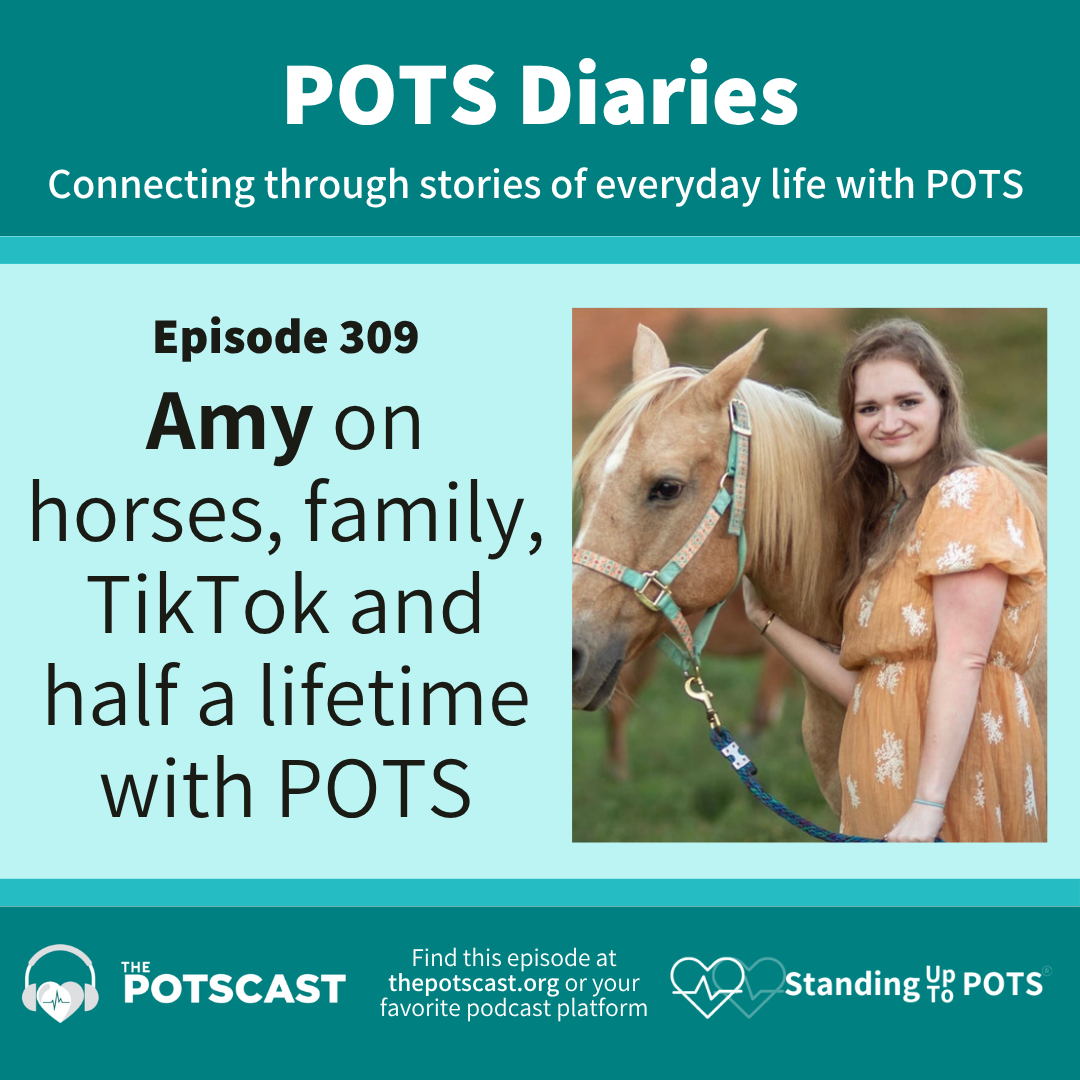
Diaries with Amy on horses, family fun, and spending over half her life with POTS
May 10, 2026
Amy is a mom and equestrian from North Carolina who has now spent over half her life with POTS. In this episode she shares how she finished high school (early), has enjoyed horses throughout periods of being able to ride or not being able to ride, her favorite POTSy activities, her TikTok videos (see them on TikTok at @amymarieeee00), her favorite quick meal, and so much more.
Episode Transcript
Jill Brook: [00:00:00] Hello, fellow POTS patients, and beautiful people who care about POTS patients. I'm Jill Brook, your horizontal host, and today we have an episode of the POTS Diaries with Amy. Amy, thank you so much for joining us today.
Amy: Thank you so much for having me. I love listening to this podcast.
Jill Brook: Oh, that's so nice. Well, we're excited to get to know you. What should we know? What are the basics about Amy?
Amy: Well, I was diagnosed when I was 15. I'm 29 now, so I've had it for pretty much half of my life. When I was diagnosed the doctors didn't really know what it was, it wasn't talked about. People didn't know what POTS was. I remember like, I got the flu shot and then immediately got the flu when I was 13.
And I went in for my 14-year-old checkup in January and they were like, something sounds off with her heart. And they sent me across the street to the cardiologist. And I went and saw him and he was like, I think you have PVCs. And then he [00:01:00] sent me to a children's hospital that was like this big hospital around here.
So we drove down there and I saw a specialist and I got diagnosed with POTS at 15.
Jill Brook: Whoa. Okay, so let's dig deeper into that. But first of all, so where's here?
Amy: North Carolina.
Jill Brook: Okay. And you're 29 now, and I know you mentioned children.
Amy: Yes. I have two kids.
Jill Brook: And what do you like to do?
Amy: I'm an equestrian, so horses are like my love language. I always loved horses and then I really just fell into it and ended up getting my own horse, and they're just very healing. So that is my kind of hobby.
Jill Brook: Wow. So when you say horses like riding horses, and if so, like what kind of riding or is that...
Amy: Well, I had like an accident when [00:02:00] I was pregnant with my son. I didn't know I was pregnant yet and I fell off, and so I took like a seven year break where I didn't even get on a horse and I was just scared. But I wanted to be around him. And then I got an instructor that was great. She got me back on and I have been riding, like I kind of have like my days where I'll just kind of do more groundwork with her, but yeah, I do ride her and it's just great how much, like horses, they don't have to speak to you, they just know how to help you without talking.
Jill Brook: Oh, that's amazing. What is your horse's name?
Amy: Blondie.
Jill Brook: Okay. So thank you for helping us set the scene. So, okay, back to this really wild experience you had when you were 14. Can I ask you to go back to when you were 13? What were you like at 13? What were you doing? What was your life like?
Amy: I would say I was pretty like, like wild and loud in my family and [00:03:00] I'm just like silly and goofy, which I still am, but I really was into soccer at the time and I remember just like wanting to go out and play soccer with my siblings. And like after POTS happened, it was just not a thing I did anymore.
So like, yeah, I remember doing stuff like that and just how drastic my life changed and, you know, like from school and stuff, but yeah.
Jill Brook: Okay, so you mentioned, so you got a flu shot and then you got a flu, and then you got POTS. Is the thinking that some of that helped trigger the POTS?
Amy: So from my cardiologist is from what he said, most POTS is triggered by like a virus or an illness. A lot of people got it from COVID. Mine was flu. So ever since then, I've never gotten another flu shot, just my own personal thing. So I had the flu and then I went back to the same hospital when I was 16 and I got diagnosed with [00:04:00] fibromyalgia and chronic fatigue.
So it was like, just like this snowball effect after I got the flu shot. So it was just one thing after another.
Jill Brook: Man. Now, how long did it take you to get diagnosed with POTS?
Amy: About a year, from me going to see my cardiologist and him sending me to my specialist.
Jill Brook: Yeah. And so what did that time look like and like what symptoms were you feeling and what did you think was going on? What did your family think was going on? How was school?
Amy: Well, school was very hard because for my freshman, my junior, and my sophomore year, I went the first semester because I would like get strong over the summer and like gain my strength back and feel like I could do it. And I would go and then I would do what they would call tire out. And so they would pull me out and they would home bound me for the remainder of the year.
And I did that three [00:05:00] times. And then my senior year, I graduated in January so I didn't have to do that. But it was just really hard. Like I was listed medically fragile. I was on a 5 0 4 plan. My teachers had to have Gatorade and pickles and stuff like that in the classroom. I was not allowed to walk, like during class time, I was not allowed to walk anywhere alone. Another student had to walk with me just in case something happened. But there was like a lot of days that I would just go in the bathroom and text my mom and just be like, please come get me. Or just like go of the counselors and just be like, I'm so tired. And I didn't really have a reason why at that point yet.
Jill Brook: Yeah. Yeah. And so like how did that go for you? I mean, a lot of people would say, oh, you're just trying to get outta school, or something like that. Were you taken seriously?
Amy: Some people did and some people didn't. There's been a lot of people, you know, that you take it as you're just [00:06:00] lazy or like, you know, and I had a lot of that, but I think a lot of that was also just like in my head and like what I thought people thought of me. But no one ever told me that.
It was more of just my inner thinking. But I did have a a lot of pushback with, you know, just some school things like getting extra time, getting extra help. My mom had to like, bring me to one of our dances in high school and like that was not the best thing. But, you know, she was there and she was there in case I needed her and it worked.
So it just, my school experience looked a little bit different and I was bullied some because I had to wear like a heart monitor and it went off in class and, you know, I was called the beep girl for a little bit, but, you know, kids just make fun of things they don't understand. So, I think it's just a mixture of not understanding and, you know, growing.
Jill Brook: Yeah. And so, I mean, so what's that like to go to a dance with [00:07:00] your mom?
Amy: Well, it was different, I'll say that. I had a boyfriend at the time and he was more like, why is your mom coming? And I'm like, I'm sorry. But everybody loved my mom and she just would come and like check on me every once in a while, but then she would kind of go and try to hide in the corner and act like she wasn't there.
And I was momma, it's okay. But it was fine. Like I wasn't embarrassed by it. But I mean, I kind of liked having her there because I knew that if something went down or if I needed her, if I passed out or something like that, she was there. So I did like that.
Jill Brook: Gosh, you know what? Somebody needs to make a documentary or some sort of tribute to the amazing mothers of POTS.
Amy: Yes.
Jill Brook: We hear a lot of stories and this is just one more. That's really nice of her to, to fade into the background between checking on you. And well, so once you had this diagnosis, were you able to find things that helped a [00:08:00] lot.
Amy: Not really. I just, I remember like the rest of my teenage years just being in my room a lot. And that's why I got like so down and so depressed. I ended up being diagnosed with depression and anxiety, because you, you know, you don't have the energy to really get up and do anything and there's not a lot of people your age that understand. And so I would just be stuck in my room and that just made it worse.
So. Yeah, I mean I ended up getting like a part-time job when I turned 17, and so that kind of helped me a little bit. But I didn't have a lot of friends or anything like that. I had a few like core friends and then we ended up moving when I was 18. So, yeah, I had to kind of like start all over in a new place and like re-explain everything, which is kind of like the hardest part for me, is just like going through and like re-explaining everything.
Jill Brook: Yeah. So you said you had POTS and then [00:09:00] fibromyalgia and chronic fatigue syndrome. Can you explain what fibromyalgia is like?
Amy: Yeah. So the way I got diagnosed was because I kept complaining of pain in like my elbows, my knuckles, even what I call my toe knuckles, my ankles like just in the weirdest places. And it would hurt and to a point where I couldn't do things. So we ended up going there and he like did a, a test on me and like, I remember him like pressing on different parts of my body and having me lay down and stand up and do all these different things. And then I was diagnosed. So for me, fibromyalgia is just like this annoying pain that comes and goes in your joints.
Jill Brook: So you still have it today?
Amy: Mm-hmm.
Jill Brook: Yeah. Yeah. So how do you feel like your functionality [00:10:00] has changed, if at all, in the last 14 years?
Amy: I feel like I got kind of stable in my early twenties. I reached a stable point, I guess you would say. I got to where I could work a part-time job. Every time I would start a full-time job, I would end up quitting like about two weeks in 'cause I just couldn't do it. And I got to where I could live like an, almost like a normal life, I guess you could say, 'cause I had my son, I was married and I was working a part-time job and I was going to school online. So I still had like some sort of, you know, a social life. And recently I lost some weight and when I lost weight it almost made my POTS like 10 times worse.
Jill Brook: Really.
Amy: So I went to like a bunch of doctors and stuff and they said that losing weight kind of can make your body feel like it's dehydrated or going into dehydration.
And all that I've been told so far [00:11:00] is that like my body has to catch up. So I'm going to go see a specialist. But yeah, it's been like a rollercoaster. I've been in places in my life where it's been kind of stable and almost where I know what to do and to keep myself maintained and without having like so many episodes, I guess you would say.
But recently I just, I'm back in that divot of being down and having a lot of symptoms and trying to find things that help.
Jill Brook: Yeah. So what are your worst symptoms?
Amy: Probably just being tired. Super dizzy. Like it used to be like every once in a while I would get dizzy. Now I'm regularly getting dizzy. Brain fog, really bad brain fog. Yeah, just being extremely tired. I feel like I can never get enough sleep, but then also sometimes I can't even sleep. So it's like this, you try to find this balance. [00:12:00] But yeah, those are the symptoms that I'm dealing with the most right now.
Jill Brook: Yeah. So how do you cope? I mean, so you've, you've been dealing with this for a really long time now. Do you have like any strategies for when you're feeling stressed or mad or sad about it or anything that helps keep you going?
Amy: Yeah, for me, I mean, again, it's the horses. They're very healing and just being around them can change your day. And I know that every time I have a bad day, I have my husband drive me over there and see my horse, and it just makes my day better. And then also Christian, so praying helps me and just talking to my family and my friends.
Jill Brook: So a lot of people will talk about how their dogs can sense if they're sad or need a little love and even even people whose dogs are not trained to be service dogs, they say can like sense when they need something or even, even sense when they're like [00:13:00] about to pass out. Do you think horses have any of those abilities?
Amy: I do think that they definitely know what's going on with you, like they're gonna know what's going on with you before you know what's going on with you, I think. I think so, yeah. I think horses are very, like, they pay attention. I think so for sure. Like Blondie, when I come up and see her and I'm having a bad day, even though she is like very stubborn, she will love on me. Or like the other day I went over there and even just this random horse that is with her in the field came over to me and just put his head in my lap and I was like, just like he knew. And so yeah, I do think so.
Jill Brook: Oh, that sounds amazing. Wow. And so what do you do with like your family or your husband nowadays when you wanna just relax and have a good time? Like what are some activities that work for you within your [00:14:00] limitations?
Amy: We recently had a hurricane here in Western North Carolina, so we do a lot of, like, I have TikTok and so I do a lot of driving around and showing people what it still looks like and what it did look like. And so just a lot of that and like my kids getting to see places like that and stuff too.
And then we do a lot of me going outside and my kids riding their bikes and me reading while they're doing that or parks, stuff like that. Yeah, and then I love to make like, TikToks with my kids, and just like silly goofy TikToks. And I also make TikToks about my POTS and like showing people like what it's like to live with POTS, because I think that's important.
But yeah, just stuff like that, just little family things like that is what, that's what makes me happy and that's what we usually do.
Jill Brook: Oh, that's so nice. If you want to, we could share your TikTok handle in the show notes in case. Do you want people to [00:15:00] be able to see 'em?
Amy: Yeah. It's @AmyMarieeee00. It's four E's at the end, and then two zeros, and that's my handle. Amy Marie with a sunflower. And that's me.
Jill Brook: Okay, perfect. We'll put it in the show notes so people can find it. So do you think this whole experience has changed you as a person at all? I mean, I know that everybody changes from age 13 to age 29, but do you think like your personality or anything is different for having gone through this?
Amy: I think so. I think someone that goes through something like this can never judge another person or just never not be sympathetic, if that makes sense. Because I could never, like just knowing what I've gone through, look at someone and judge them for what they're going through or how they're handling a situation, because, you know, roles could be reversed and they could look at me that way.
So for me it's just, I've never judged anyone for what they're going through [00:16:00] medically or anything like that. So, yeah, for me it's opened my eyes to look at people differently.
Jill Brook: Oh, that's nice. What is the hardest thing about living with POTS?
Amy: Just the lack of knowledge that's out there and the lack of like understanding, I guess, because I feel like there is such a stigma around like people with POTS are lazy or, you know, they just don't want to do something and that's not the truth.
Jill Brook: Yeah. Have you found anything that really made a big difference to your symptoms?
Amy: I love Liquid IV. I drink it daily. So I think Liquid IV helps. Portable fans. You can get portable stools, that like collapse you can carry in your bag. Also like towels you can put around your neck that'll keep you cool. Stuff like that. And then also, even though I'm 29, I have a shower chair because that is like when I have the most symptoms when I'm taking a shower [00:17:00] and I feel like I'm about to drop. So a shower chair has changed my life for real.
Jill Brook: Great. So what is the best way that family or friends or people can support you right now.
Amy: Just listen and be there and you know, learn about POTS and the symptoms of POTS and, you know, what people go through with POTS and the new studies that come out. I also was listening to the podcast about RTHM and I, I'm so excited about that. And so like, stuff like that, like listening to that and listening to podcasts like these, just learning more.
Jill Brook: So has anything positive at all come from having chronic illness? Are there any silver linings?
Amy: Yeah, I think it's made me a better person and I've got to meet some really amazing people too. I just, I wouldn't change my story. I, I mean, it's just who I am. I mean, I've had it since I was [00:18:00] 15. So yeah, I think it just made me a better person for sure.
Jill Brook: So you mentioned that you graduated from high school early. So how'd you do that?
Amy: I went to, I was being bullied really bad in my junior year and I went to my counselor and she mentioned that there was a high school program at the local community college and it required less credits. So that's what I did. And I graduated early. So yeah, it worked out. You got to go in at 12:00 PM and you got to leave at 4:30 PM so with POTS, you know, getting to come in late, that's amazing.
Jill Brook: Oh, that's the first time I've heard of a program like that, but that's fantastic.
Amy: It was, it really was.
Jill Brook: Wow. Okay. So if you imagine your past self. Whenever you were at rock bottom at your worst [00:19:00] in terms of POTS what would your current self say to that down and out version of yourself?
Amy: You got this. You know, it might, it's gonna be hard and there's gonna be some hard moments, but you got this.
Jill Brook: Yeah. Okay. So can you tell us, so like from day to day, what, what in your life counts as a victory? Like, you know, oh, today I did this.
Amy: Mm-hmm. Just being productive. Because I struggle with that just with my depression, and because I've been inside so much and just isolated myself, I have now gotten to where I have social anxiety. So just like getting out without another adult with my kids is a success for me. So taking them to the park, just me and them, or taking them to the store, just me and them is a success.
So just small things like that or just being able to take a shower and cook dinner and get normal things [00:20:00] done is a success for me.
Jill Brook: Do you have any favorite dinners to cook? Purely on like how fast and easy they are, or like, I once wanted to start a cookbook called Fast Enough for Fainters, and I wanted to get like famous chefs to give their absolute, absolute fastest recipes. And nobody responded. I reached out to all these people and nobody responded.
But you know, I don't know, like, we don't care how it tastes, we don't care how healthy it is. What do you do that's nice and fast?
Amy: Okay. You take some chicken and you fry it up or however you want to cook it, and then you can shred it or make it whatever consistency you want. Put it with some rice, put it with some cheese, mix it all together, put it in a casserole dish and bake it a little bit. And there you go.
Jill Brook: Nice. And and how long does that usually take you?
Amy: I mean, well usually my, I make my husband cook, so, it don't take that long, but you can get pre-made [00:21:00] chicken, you can get like rotisserie chicken or something like that and just get some shredded cheese. And you can also get like rice that you put in the microwave, takes like five minutes, and then put it in a casserole dish and put it in the oven for like 10 minutes until the cheese gets a little bit crispy.
Jill Brook: Right on. Yeah. So do you ever think that in some ways having POTS, when you have little kids, it like gets you down on the floor with them more often or anything? Like I find that with dogs, I find that like my dogs probably think that I am like the least dominant one in the family because I am laying down with my belly up and my feet up even more often than they are. It probably confuses them. But I've always thought like my having POTS is actually good for the puppies because, you know, makes me play with them more. I don't know. Do you find yourself on the floor a lot with your kids and thinking, [00:22:00] oh, maybe it's actually kind of nice for a kid to have a mom who's...
Amy: Actually, now that you mention that, I was just on the floor the other day and letting my daughter do my hair, and she was in the couch and I was in the floor. So yes, I do do that. Yeah.
Jill Brook: Yeah. Are you up for doing a speed round where we ask you to just say the fastest thing that comes to your head?
Amy: Yeah.
Jill Brook: Okay. What's your favorite way to get salt?
Amy: Liquid IV.
Jill Brook: What's the drink you find the most hydrating?
Amy: Liquid IV cotton candy.
Jill Brook: Cotton candy.
Amy: Specifically cotton candy.
Jill Brook: Okay. What is your favorite time of the day and why?
Amy: Probably in the morning, like right before my son goes to school, 'cause it's just like my son and my daughter and me and it's just like everybody's chill and we're all calm and we're all like just riding to school, having a good time.
Jill Brook: [00:23:00] Where is your favorite place to spend time?
Amy: With my horse.
Jill Brook: How many doctors have you ever seen for POTS and related things?
Amy: At least five.
Jill Brook: How many other POTS patients have you ever met face-to-face in person?
Amy: One.
Jill Brook: What is one word that describes what it's like living with a chronic illness?
Amy: Difficult.
Jill Brook: Describe your favorite TikTok video you've ever made and put out there.
Amy: Goofy.
Jill Brook: What's some good advice you try to live by?
Amy: If you can dream it, you can do it.
Jill Brook: What is something small or inexpensive that brings you comfort or joy?
Amy: Chapstick.
Jill Brook: Who is somebody you admire?
Amy: Annie Oakley.
Jill Brook: Oh, do you wanna say why?
Amy: She was the person I picked for career day in like third grade, and I had like read a whole description of her and I dressed up as her and I had like a little pony and everything.
Jill Brook: What is [00:24:00] something you're proud of?
Amy: My children.
Jill Brook: What is an activity you can enjoy even when you're feeling really POTSie?
Amy: Reading.
Jill Brook: What's your favorite thing to read?
Amy: Romance novels and like fantasy novels.
Jill Brook: So I have not interviewed her yet, but I have been contacted by a POTS patient who writes romance novels and she has POTS included in a character at least. So we'll hear more about that soon. What is your pet peeve?
Amy: Yelling.
Jill Brook: You have any tricks that help you fall asleep?
Amy: Sometimes if you count like the tiles in the ceiling or if you count backwards, it helps.
Jill Brook: Do you have any tricks to get energy when you need it?
Amy: Go on TikTok and find some funny videos or some dancing videos and it'll make you feel better or make you want to dance.
Jill Brook: Oh, nice. What is something you are grateful for?
Amy: My family.
Jill Brook: [00:25:00] Finish this sentence please. I love it when...
Amy: I love it when I have a productive day.
Jill Brook: People might suspect I'm a POTSie when...
Amy: When I stand up and almost hit the ground.
Jill Brook: I hate it when...
Amy: I hate it when I get tired like as soon as we go somewhere.
Jill Brook: And have you ever had to sit down or lie down in a weird or funny place because of POTS? And if so, where?
Amy: Yes. I laid down in the middle of the road once.
Jill Brook: Not a busy road, I hope.
Amy: No, it wasn't.
Jill Brook: Okay. I just have a few more questions. What do you wish more people understood about POTS?
Amy: Just all the symptoms that come with it.
Jill Brook: Is there anything that you wish you had known sooner about living with POTS?
Amy: I wish I would've had more resources like when I first got diagnosed [00:26:00] to be able to like continue my journey with POTS, if that makes sense.
Jill Brook: Mm-hmm. Why did you agree to let us share your story today?
Amy: I think people need to know about POTS, so it's not something that is so secretive. More people can share their stories. More eyes can be seen on POTS.
Jill Brook: Yeah. So thank you for sharing your story. And last question, we hear from a lot of patients that they listen to this when they're not feeling very well, and so is there anything you would say to your fellow POTS patients out there, especially the ones who are maybe having a bad day today?
Amy: Just take it step by step, thing by thing, day by day. You got this and you're stronger than you think you are.
Jill Brook: And, sorry, one more question. After having this for half your life, and I think you said 14.
Amy: Mm-hmm.
Jill Brook: 14 or so years. 15 [00:27:00] years. Does it get easier?
Amy: No.
Jill Brook: Do you feel like you get better at managing it?
Amy: Yeah, I feel like I get better at just learning my body too. I feel like now I know my body inside and out and like if I take a new medication or if I do something, I know immediately if something is going on with it or something's off. POTS has definitely taught me, myself, and my body, and I know it.
Jill Brook: Yeah. Yeah. Well, Amy, thank you so much for sharing your story and all your insights with us, and we, we just so appreciate it and I know that everybody is wishing you and your family and your horse all the best.
Amy: Thank you so much.
Jill Brook: Hey, listeners, that's all for today, but we'll be back again next week. Until then, thank you for listening. Remember, you're not alone and please join us again soon.