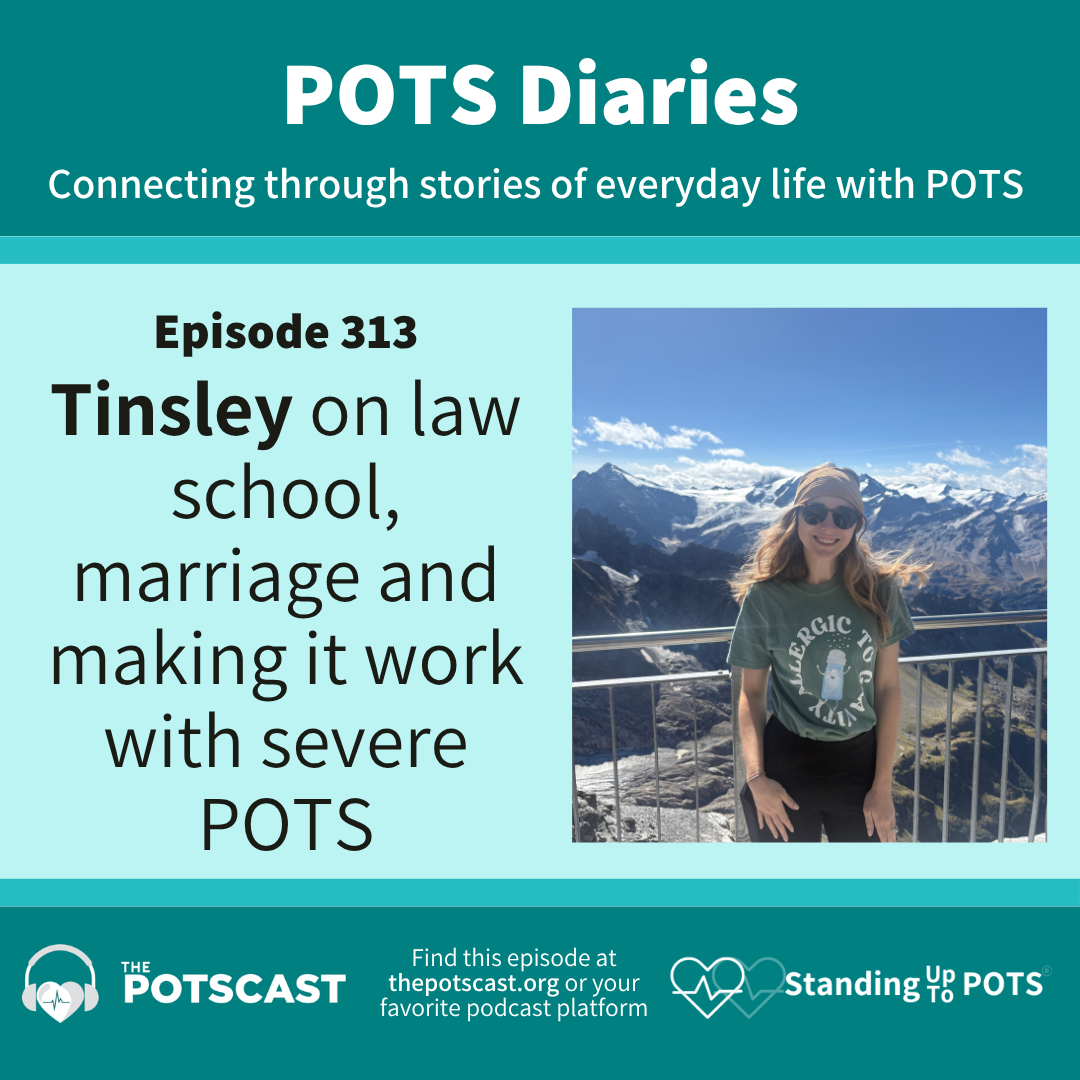
Tinsley on law school, a dream job, marriage, and making it work with severe POTS
June 07, 2026
Tinsley has had POTS symptoms during two different stages of her life. First at 16, in response to a severe allergic reaction to her braces, which went into remission when she had them removed; and second, during college, when she suddenly began having 15+ convulsive episodes per day with other debilitating symptoms. And yet, she graduated college and law school, worked her dream job, got married and has a very full life. In this episode she discusses her journey and how she's managed her POTS enough to have a full life again.
Episode Transcript
Jill Brook: [00:00:00] Hello, fellow POTS patients, and magnificent people who care about POTS patients. I'm Jill Brook, your horizontal host, and today we have an episode of the POTS Diaries with Tinsley. Tinsley, thank you so much for joining us today.
Tinsley: Thank you for having me.
Jill Brook: So I actually have to ask first, 'cause you have such a beautiful and unique name. Is there like a backstory or anything?
Tinsley: There is, it's a little weird. It was my brother's best friend's name in high school. He's a half brother that's pretty decently older than me. He was already out of college when I was born, and my whole family got together and were brainstorming names and he just threw out Tinsley and my mom fell in love with it. She had forgotten all about it.
Jill Brook: Well, it's beautiful. I love it. And so, okay, so before we get into the rest of your story, can you give us like a little bit of a introduction, like who's Tinsley?
Tinsley: So I am an attorney in Atlanta, Georgia, where I was born and raised, and now I [00:01:00] live with my husband and my dog, Molly.
Jill Brook: Very nice. And so how come you don't have an Atlanta, Georgia accent?
Tinsley: You know, it's funny. Both my parents, if I listened to recordings when they were younger, they had these really thick southern accents. But my dad worked in New York for a while, so he purposely got rid of it, and Atlantans really don't have accents, weirdly enough.
Jill Brook: Good to know.
Tinsley: Although if I get tired, it does come out a little bit more.
Jill Brook: Oh funny. Okay, so what are some things that you enjoy or are passionate about?
Tinsley: So the main thing is that I really love talking to people. So I love doing activities where I get to spend time with my husband or my friends, my family, even strangers. So I love doing things where I'm chatting. I love trying new restaurants. I like going to sports games, really anything where I'm spending time with people and a lot of activities that allow you to get to know each other and enjoy something [00:02:00] together.
Jill Brook: Very nice. Okay. And if we were to make you brag about yourself, what are you good at?
Tinsley: So when I was younger, I was really good at playing the harp. I actually went to college for that originally. So I started violin and harp as a very young kid. I started violin actually at 18 months old, and then harp at six. And I did the competition scene. I did orchestras, all of that. Now I would say most of my life is still work-wise, but it's more the legal side of it, more so than the music side.
Jill Brook: Did you say that you started playing violin at 18 months old?
Tinsley: Yeah.
Jill Brook: Okay. Talk about that.
Tinsley: You can only play E string. It's really just rhythms. But my mom was a violin teacher and it was easier for her to have us on stage with her than to have to deal with a nanny. So she just taught us how to play E string. Essentially we would just play along the twinkle, just doing the rhythms on the E string, and she would just plop us up there with her.
Jill Brook: [00:03:00] Wow, that's pretty cool. Alright, so when in your life did POTS enter? And if we can back up a year, can you tell us what you were doing in the year leading up to that? Like what did your life look like in the year before POTS entered?
Tinsley: So I kind of had two big phases of POTS or chunks of it, batches, I guess. I first got it when I was 16. Before then, I was a pretty normal high schooler. I always was a little bit weaker than other kids, so it's possible that I had something going on. My whole family has low blood pressure, so that's not really shocking that I was a little bit dizzier than others. But I was pretty normal.
I did a lot of music stuff. So I was already in a lot of youth orchestras. I actually traveled for competitions. I did a lot of that kind of stuff, and then also school and just spending time with friends, having fun. And then around [00:04:00] 16, I randomly started passing out like one to five times a day.
I lost like 20 pounds. I was really tired. I just was weak all around and really unnecessarily, and it took about a year to figure out what was going on. And I got diagnosed with POTS not that long, like about a year in, we got me into a cardiologist and they figured out that it was POTS. They kind of didn't give a lot of a treatment plan.
They mostly just told me you'll grow out of it. Like I don't even remember being told to have a lot of salt in my diet. It was very straightforward. But actually what ended up happening, a dermatologist figured out that I had an insane nickel allergy because I also had really bad eczema. And she looked at me and she said, I've never heard of somebody having as bad of a reaction as you did. You need to get your braces out.
Jill Brook: Wow.
Tinsley: Within [00:05:00] two weeks of taking my braces out, I was back to my normal pretty much.
Jill Brook: Wow. And so was that the extent of your 16-year-old POTS?
Tinsley: Yeah, pretty much. I mean, again, I was always a little bit weaker than other kids as far as like cardio goes or, and I would get dizzy and I, I had double vision, I had little things, but they were incredibly manageable before and after that one year of having braces. But I essentially went into what I thought was I got over it. But I now realize was more of a remission, because it came back with a vengeance when I was 20.
Jill Brook: You know, it's so funny because as you're talking about music and early signs of POTS, I just had a flashback and I'm wondering if this has ever happened to you. Probably not 'cause you were probably a better musician than I. But I played cello as a teenager and I was not great, so I'd get like the easy parts. And I remember that the song Pachelbel [00:06:00] Canon has 64, I believe it's 64 measures of the exact same four notes for the cello part that I was playing.
And I would repeatedly like sort of pass out while playing that. And I always thought it was 'cause I was bored. And it was only many years later when I would've passed out many other times, like during graduate school also thinking I was bored and later would find out, no, that was POTS. Did you ever have trouble like playing music, 'cause that's a lot of like standing still and...
Tinsley: I did during that year. I don't remember having a ton of trouble otherwise, other than I also played through a lot of, like, I got strep throat a lot and so I remember playing through some pretty high fevers. I remember doing a concert where I think I had, I think I was at 102 degree fever and I still played the concert.
Jill Brook: Wow.
Tinsley: We, we ended up going to the hospital in the morning 'cause it had gotten up to 1 0 4.
Jill Brook: My goodness. Okay, so then [00:07:00] you were kind of back to normal, you got rid of the braces, and so then how long did you have before POTS came back? So what happened next?
Tinsley: About three years. So it was in the middle of my junior year in high school where I got better, and then I made it all the way through my sophomore year in college, being very normal. I got to enjoy the rest of my high school years. I enjoyed college and I was pretty normal. I mean, I was busy and I, I, I did a lot of activities and school and everything and worked and, but I, I was pretty normal.
And then all of a sudden, I remember it was October of my junior year everything changed and it kind of came out of nowhere. I still to this day, don't really know why it happened, but I remember thinking there was an earthquake. Everything was shaking. My eyesight was, everything was was going crazy in front of me, and I felt [00:08:00] so wonky or dizzy or off kilter.
And then I woke up. And it turns out there wasn't an earthquake. It was that my eyes would flutter, or I'm not sure the perfect word for it, but they would flutter when I would have a really bad symptom and then I passed out. And then after that, I was never the same. For the next six months I was passing out with convulsions each time, 10 to 15 times a day.
Jill Brook: Oh my goodness.
Tinsley: Oh yeah, it was really bad. My like eyesight would go in and out. My mind was essentially drunk, is the best way to describe it. I felt like I was super drunk. I couldn't form memories very well, like I was working on like the lowest autopilot that you could trying to function and having no idea what was wrong with me. And I'm still in the middle of the school year.
So I'm going to class, I'm trying, I'm taking exams where I can barely function during [00:09:00] it. But I didn't wanna stop. I wanted to keep going, but I start going to all these doctors and unfortunately, like a lot of other people, I was met with the, oh, you must have some kind of personality disorder or some kind of anxiety, and they didn't even, it took two years before I even got an MRI, or a heart monitor or a EEG, like anything. It was a really long journey because I would wait for six months for a doctor, I'd finally get into the doctor, they'd spend about five minutes, and then they'd send me on my way and say, you need to talk to the psychiatrist.
And I tried that route too. I went to three different ones and they all said, no, I, I really think you need to go back to the doctor. You don't have anything like that. So it took a really long time to get better and I, I had ups and downs. Like I was always bad, but I was not always 15 times a day, sometimes it was five times a day.
[00:10:00] And also, this whole time had horrible chronic migraines. For the first year and a half, I had one that did not stop. All day, every day, the whole year and a half. And just every symptom you could come up with. I had horrible nausea and things that I'm not even thinking of, like I, 'cause it's, so much of it has just disappeared from my brain. I don't know if this is normal, but I straight up couldn't form full long-term memories when I was really bad. So I just lost chunks of my time.
Jill Brook: But did you stay enrolled in college? I mean, what was that like?
Tinsley: I did. I actually graduated. So I, it was pretty tough and my grades certainly dropped during this time. But I made it work. I actually worked, while doing it, I worked at a bubble tea shop. 'Cause I had to make rent and I had to make all these things happen. So I essentially took every inch of energy I had left, got poured [00:11:00] into either working or studying.
I pretty much had to drop any fun part of my life and just focus in. But I was able to make it happen, and I did have plenty of times where I was able to have fun. Like I, I even tried studying abroad and then quickly had to take medical leave and come back. But there was a lot of, a lot of sacrifices, a lot of focusing but I'm glad I did it.
A lot of people told me to take medical leave, but my response to them was, if I take medical leave, will we actually figure out what's going on? Or will I just end up in a situation where I have to go back to school? I was already there and I had a support system. I had friends. And I was able to make it happen. But it was, it was not an easy process. I'm glad I did it, but I don't envy myself.
Jill Brook: Now, before we started recording, you had mentioned kind of a mindset that had helped you. Was that at this time or did that come in later?
Tinsley: [00:12:00] That actually came in really early on. I was obviously very overwhelmed, very upset from the beginning. And I realized that if I was going to pull all of this off, I had to save where my energy went. And how I did that was by saying, I can't be upset about yesterday, but I can be upset about now. So what I promised myself was I refused to be upset about the fact that I was sick and the things that I've missed out on.
And all of these like missed opportunities or how sick I've been and how painful it was. But I can be upset that I'm still sick. I can be upset about tomorrow, that I'll still be sick. And it was tough to get used to, but after a while, getting used to that level of acceptance and saving myself from having to spend that energy being upset about the past, but still carve out a section of myself to allow myself to feel the [00:13:00] emotions that I needed to let out, it really, it really helps and to this day I still stand by that. I am not upset that I was sick in the past. I am annoyed that I am not perfectly healthy now and that I probably never will be, but that has always been a really good way for me to get through it.
Jill Brook: So, we could talk about this later or now, whatever you prefer, but do you have any other tips for people who are trying to get through college while feeling terrible? I mean, do you have any, like, I don't know, little, little personal policies you followed about when you're allowed to just nap and when you push through or, I don't know, anything like that?
Tinsley: Yeah, I think the best tip I have is take advantage of your good times. And this kind of requires you to decide what is your priority, because you have such little good times where you can focus in and you can get things done. And what your priority is is completely fine. But for me, my priority was [00:14:00] graduating on time and, and getting my schoolwork done and trying to preserve whatever of my grades that I could.
And so when I had good days, instead of going out and like seeing my friends and having fun, I studied. I also got really good at not procrastinating. I started as early as I possibly could on everything. I was never working on something the day before it was due because I couldn't trust that I could finish it.
And even now that I'm so much better, I still keep that mindset of I don't procrastinate. If something needs to be done, I'm gonna do it at the earliest moment that it makes sense to do it, because I don't wanna wait until the last minute. That was kind of how I was able to get everything done.
Jill Brook: Yeah. You know, it's funny, I've heard a theory that one reason some people procrastinate is because they need the adrenaline of a last minute deadline to get going. And so I almost wonder if hyper adrenergic POTSies have less of a procrastination issue than other people because they always have enough [00:15:00] adrenaline to go do it.
Tinsley: That's fair. I always have anxiety, so maybe that's part of it too.
Jill Brook: Okay, so what happened next? Like, did you get a diagnosis? Did you find a good doctor? What happened?
Tinsley: Yes, so I tried a million things and went through a lot of processes, and what's so weird is that I did know that I had POTS when I was 16, so you'd think I would've gotten diagnosed really quickly. But it took three years to get a diagnosis and I went to four cardiologists during this time and at each one of them I said, do you think it could be POTS, 'cause I had that when I was 16. And the first three all told me, nope, absolutely not, that's a teenage problem. You're too old. And I was like 20 years old. I was 20 to 23. I wasn't that old, but they all told me doesn't make sense for you. Your symptoms are way too extreme for POTS. POTS is really just, you stand up too quickly and you pass out.
But I kept asking, and I went to [00:16:00] several neurologists and I mean, I probably went to every doctor you can think of in the meantime, but I kept trying and finally I go to the fourth cardiologist, I ask about POTS and they go, yeah, let's get you a tilt table test. And that was, that was it. That was all I really needed was for one doctor to, to try that out.
And then they did have me wear a heart monitor for a couple days too, to confirm. But, it was really pretty straightforward after that. We figured out what was wrong, and in the meantime I had other things, like I do have the chronic migraines. I've been working with a neurologist for, for years on that. But I got diagnosed and in the meantime, I actually started law school three weeks after I got diagnosed.
Jill Brook: Awesome. Okay. How did that go?
Tinsley: So it actually went really well. Getting into law school was kind of tricky for me because I had to take the LSAT as a college kid with extreme POTS like [00:17:00] untreated, pretty severe symptoms. I remember I passed out three times during the LSAT and by the last page my vision just went out. I could not read anymore, it wouldn't work.
So I just put B for the last seven questions 'cause I couldn't read it. It ended up going fine. I got into a good law school and it worked out. But the only reason that that worked out was because I did a hundred practice tests because I knew I was gonna pass out in the middle of the exam. So I had to be as prepared as possible.
But I got in and then I still wasn't diagnosed when I graduated undergrad, so I took a year and I deferred for a year, and I worked at this wonderful criminal defense firm that gave me so much great experience and they were so kind to me when I had to leave earlier, if I had to lay down, they knew what was happening the entire time. I didn't realize how rare of a gem a place like that is, that [00:18:00] is supporting you.
Like the partner drove me home a couple times 'cause I couldn't drive myself and she didn't want me to wait for my parents to come pick me up, because she wanted me to get home earlier 'cause I was feeling so sick. Like they're wonderful people. But I really enjoyed working there for a year. And then that's when I got diagnosed and I, I was, I thought I was gonna have to defer again. But I got diagnosed, got on a beta blocker immediately, and I just responded really well to it.
Weirdly enough, I actually think being diagnosed so close to starting law school was kind of a superpower for me. And it's because I had been so used to being at 30 to 40% capacity of a healthy person, and I'd been so weak and I'd been pushing through when I was so weak, and then all of a sudden I get on this beta blocker.
i'm still disadvantaged compared to my peers, but compared to how I felt, it felt like I could run for miles. I couldn't. I [00:19:00] could barely run down the street. But I had so much energy because I hadn't had energy for so long. And so when I studied, it was easier for me than it had been for years.
So I could study for longer, and I cared so much more because I knew what I had done to get there.
Jill Brook: Wow. That's fantastic. Okay, so what next happened? How did the POTS go? How did the job go? Or how did law school go?
Tinsley: Law school went great. It depends on the person, but I actually loved it. I mean, it was incredibly hard and you're unbelievably busy and I, I was still sick the whole time. But I kept getting better. I kept getting stronger. Now that I knew what was wrong with me, we could try different meds and I could try lifestyle changes, 'cause I remember before I was diagnosed, every time I exercised and pushed myself, I felt worse. I didn't know if it was actually a bad idea for me to try and exercise, or if it was a good idea. Like I [00:20:00] actually had some direction on how to make lifestyle changes now. And so it took some time, but I kept getting steadily a little bit better and I started making more and more friends.
And I met my husband actually my first year of law school. We were just friends the first year, but the summer after our first year we started dating and he's been incredible. And so I had this beautiful time where I got to pursue my, my career and my passion, and I got to meet all these wonderful people.
And I've steadily gotten better. I certainly am still chronically ill. Like, I still have POTS. I'm not a hundred percent, and I have it at least to some extent every single day, but I am very high functioning.
I can stand right up next to a healthy person, and I can meet them where they're at. I just have to then maybe take it a little easy on the weekend or help [00:21:00] myself out in other ways and be conscious of all of my decisions. But I've come so far from barely being able to walk down the stairs to get water, to now I'm traveling. And at some point I got up to doing five Ks. I also realized I hated it and I stopped doing it. But I, I'd gotten there. I hiked a mountain the other day in Switzerland. Like, I've gotten this life that I didn't think I was gonna be able to do.
Jill Brook: Oh, that's fantastic. That's so wonderful to hear. So throughout all of it, what do you wish you had known sooner? What do you think other people might want to hear as far as advice or tips?
Tinsley: There's a lot of things I wish I knew sooner. Mainly what was wrong with me, but I would say that one of the things that I wish I knew sooner was how to deal with doctors, and to advocate for yourself and keep trying and do the research. 'Cause it can be really disheartening when a doctor's saying [00:22:00] there's nothing left for us to try, or they're not trying at all. And it takes so long to get an answer sometimes that I, I wish that I could have sped up the process a little bit more and pushed, and that first cardiologist said, just order the tilt table test. Let's just see. And had that backbone that took a few years for me to really build up.
Jill Brook: Yeah. Yeah. And so what do you have to do now if anything that is special? Like do you have special snacks or drinks hidden throughout your, you know, office and car and home? Or like, do you have any routines you have to follow? Is there anything that you kind of rely on to keep performing at this high level?
Tinsley: I mean, honestly, it's mostly just learning what works for my body. Like I, I know that I can only do one cup of coffee in the morning. I have to drink water throughout. I know how much food I need to have. I know what exercises are better for [00:23:00] me. It is actually my husband's idea, but I figured out that mat Pilates is the best thing for me to do. And I can't do it every single day, sometimes that's too much for me, and I can only push myself so hard, but kind of just learning the things that work for me and the level that I can push myself and how much to relax over the weekend, and when to say this is too much, I need to take a break, and have boundaries. It just kind of helps.
Unfortunately, I don't have like a perfect hack for how I get through my days. It's just been a lot of trial and error 'cause I've been sick for almost 10 years now.
Jill Brook: Yeah. Have there been any silver linings to being sick?
Tinsley: Yeah, actually. I would not change my past at all. The life I have today, I wouldn't have. Initially, I don't know who I would be because it's not that I was that different of a person, but your experiences shape you. [00:24:00] And I don't wanna be a different person. I am much more thoughtful and considerate of not just other people, but myself in a way that I wasn't at 20 years old before I got sick.
Part of that is that I was 20 years old, so I probably would've gotten better no matter what, but I like who I am, but also the life I have, I probably wouldn't be in. I would've not taken a year and then gone to law school.
I would've gone straight. I probably would've gone to a different law school. I might not have met my husband. I probably wouldn't have the same jobs I have. I certainly wouldn't have all of the friends I have today. I wouldn't risk losing the life that I have. So I would say almost my entire life is a silver lining of having POTS.
Jill Brook: Oh, that's so wonderful. So are you up for doing a speed round? So we're gonna ask you to just say the first word that comes to your mind. What is your favorite way to get salt?
Tinsley: Probably [00:25:00] Parmesan.
Jill Brook: What is the drink you find the most hydrating?
Tinsley: I'm so lame. I really just like straight up ice cold water. I'd rather just take a salt pill and have a water so cold it hurts.
Jill Brook: What is your favorite time of day and why?
Tinsley: Probably afternoon, or quick enough after eating lunch where I get the strength from it, but long enough afterwards where my body has stopped being dramatic about the fact that it ate.
Jill Brook: Where is your favorite place to spend time and why?
Tinsley: Probably on my couch at home. I live in this really cute neighborhood and there's a lot of light that comes in, but I'm comfy and I can either watch TV or read or talk to somebody. There's just a lot of options, but I'm still comfortable in my own home.
Jill Brook: Awesome. Who is somebody that you admire?
Tinsley: My sister.
Jill Brook: Do you wanna say why?
Tinsley: Yeah, I will. So she is probably the most generous person. I don't [00:26:00] think I would have the same memories of when I was so sick if it wasn't for her. She made sure that I had something to look forward to. She would find these activities that I could actually go and do without overwhelming myself. And she did all of these things, but never let me feel guilty. I honestly, she never made it seem like it wasn't what she would prefer to do in the first place. I never felt like a burden to her.
Jill Brook: Aw, and I see you're getting teared up 'cause it means so much to you. How wonderful that you had somebody like that in your life.
Tinsley: Yeah, like if you want like a really cute example, I love fireworks and I always have. But I was a light trigger. So if you had lights in front of me, it would trigger me to pass out and have the convulsions and the flicker, like to the point where Christmas lights on a Christmas tree sometimes would trigger me.
It was insane. [00:27:00] So going and seeing fireworks was not gonna happen. But she found a hill that overlooked the city skyline. And for 4th of July, she took me there and we sat out and we could see the fireworks really far in the distance, so far that it didn't cause any problems for me. And we were just hanging out on a hill.
So if I passed out, it wasn't a big deal. We weren't in a huge crowd of people. And so she just would do those kinds of things and if we were somewhere with really bright light, she figured she would have me close my eyes and she would just walk me through it. And she got really good at just being my guide dog.
Jill Brook: Aw, well shout out to all the beautiful people like that out there.
Tinsley: For real.
Jill Brook: Do you have any hacks for falling asleep?
Tinsley: I wish I did. I am terrible at falling asleep. I've always been bad about that. The only thing that works for me is falling asleep like on my husband's chest, and that has really [00:28:00] worked for me. But I can't necessarily say just go out and get a husband. So that's all I got for you.
Jill Brook: Do you have any hacks for getting energy when you need it?
Tinsley: So I have a way that works for me now, but it wouldn't have worked for me at my worst. Weirdly enough now, if I go on a walk, it actually really helps me. I have coworkers actually where we'll message each other and just say, hey, I'm a little bit slumped, do you wanna just go around the block? And so that really works for me. But when I was at my worst, I don't think that would've worked. Like I very often couldn't even make it down the street without essentially feeling like I was gonna collapse. I don't know how helpful that is for other people, but now that I'm feeling a little better, that tends to work for me.
Jill Brook: Well, it's a good reminder that things change and so strategies that you tested a decade ago might need new testing.
What is a gift that you would have sent to every POTS patient if you had infinite funds?
Tinsley: Honestly, it's not even one [00:29:00] that I think would require infinite funds, but I kind of wish there was a buddy system where you had like somebody like almost like a mentor, pen pal, somebody that you could commiserate with and get to know that is going through the same thing that you are.
Ever since I got POTS, I have not had somebody that I got to like bond with that has gone through it. I've luckily met a few people with chronic illness, like different illnesses that I can kind of commiserate with, but I think it would be really nice to have somebody that you could go to for advice that was always there.
Jill Brook: What is something you're grateful for?
Tinsley: All of it. Everything. As I said earlier, like I am grateful for all the people in my life. I'm grateful for the life that I've been able to build. I am so grateful that I am feeling so much better than I was. I have to remind myself that, when I'm feeling really bad, 'cause I still [00:30:00] get flares and I still am sometimes weaker than I should be. But when I think about how bad I was, I am so much luckier now.
Jill Brook: Wonderful. Okay. I just have a couple more questions. Have you ever had to sit
or lie down in a funny or a weird place because of POTS? And if so, where was the funniest or the weirdest?
Tinsley: Yes, the answer is definitely yes. Probably the weirdest would be on top of an industrial freezer.
Jill Brook: I see the appeal of that.
Tinsley: I said I worked at a bubble tea shop earlier, and I would very frequently pass out at work and that was the place that was the easiest to lay down on 'cause all the tables we needed to use to make the bubble tea, but the freezer in the back was rarely opened, so I was able to go and just lay down and feel better and then get back up.
Jill Brook: Well, yeah, I guess I had never thought about places with giant freezers that don't get used very [00:31:00] much as being good places for a POTSie job.
Tinsley: I mean, it was a lot of on my feet. Part of the reason why it was such a good job for me was 'cause I'd already been there and they already liked me, so I didn't have to start working there at a disadvantage. I had a little bit more leeway to be passing out at work because they, they already liked me.
Jill Brook: Okay, and one last question. What do you wish more people understood about POTS?
Tinsley: That it's all the time, that if you have somebody in your life that has it and has particularly has it pretty severely, it is constantly a consideration for them. If you ask them to go do something, they're having to think about, okay, will there be water.
Will I be able to drive home afterwards? How taxing is this gonna be? Am I gonna be able to sit down? You might get breaks from it, but they never do.
Jill Brook: Yeah, that's a really good answer. Well, Tinsley, we're so happy that things worked out so well for you and that you had the grit to [00:32:00] make it through. And so it has been lovely to speak with you. I know that everybody listening is just wishing you all the best going forward.
Tinsley: Thank you.
Jill Brook: Okay, listeners, that's all for today. We'll be back again next week, but until then, thank you for listening. Remember, you're not alone, and please join us again soon.