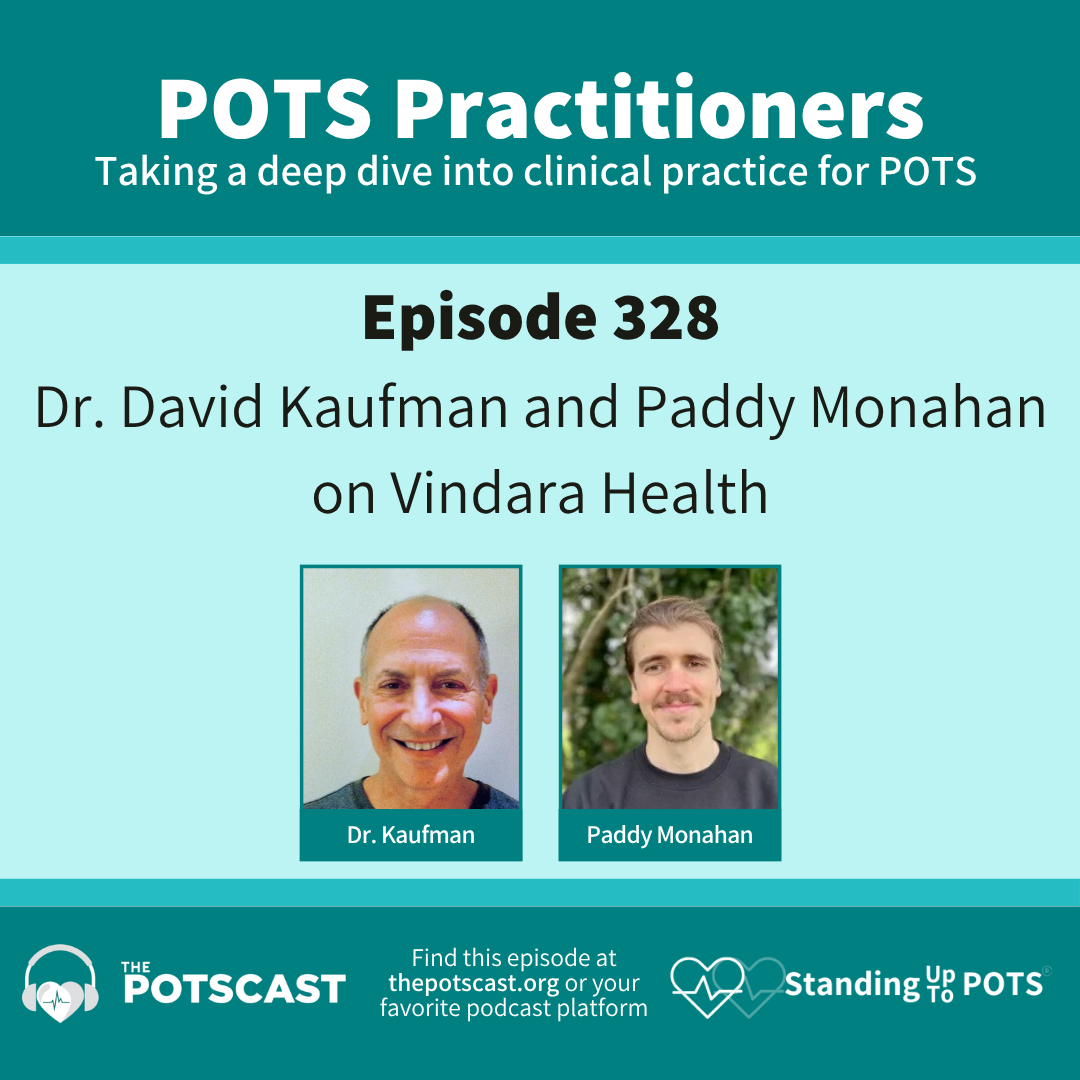
Dr. David Kaufman & Paddy Monahan on Vindara Health for Complex Patients
September 20, 2026
Vindara Health is the new telehealth specialty clinic created by Dr. David Kaufman and Paddy Monahan, to improve access to expert care for patients with the most complex conditions, including POTS, long COVID, ME/CFS, MCAS, autoimmunity, Lyme, fibromyalgia and more. In this episode they discuss how it works, why they were inspired to create a new model, why they think there is increasing complex chronic illness, why working within the standard medical system is so limiting when treating complex chronic illness, and what research and treatments they are most excited about currently. They also mention they are hiring providers.
Links to mentioned resources
- Dr. Kaufman's article on the use of low-dose rapamycin for fatigue and post-exertional malaise in ME/CFS
- Dr. Kaufman's presentation at Stanford University's Community Symposium on the Molecular Basis of ME/CFS on 9/11/26: Rebooting the System: mTOR, Autophagy, and Low Dose Rapamycin (link to video will be added when it gets released).
- Case report on amlexanox helping a few patients with MCAS.
Episode Transcript
[00:00:00]
Jill Brook: Hello, fellow POTS patients and beautiful people who care about POTS patients. I'm Jill Brook, your horizontal host, and today we are speaking with the co-founders of Vindara Health, a new virtual specialty clinic designed from the ground up for people with complex chronic illnesses like POTS, MCAS, ME/CFS, long COVID, Lyme, fibromyalgia, and related conditions.
Our guests today are the co-founders, Dr. David Kaufman and Paddy Monahan. Dr. David Kaufman probably needs no introduction with many of our listeners. He's a longtime dedicated physician to some of the most complex patients. He was once on the front lines of treating AIDS when that was the biggest problem of the day.
He's been a longtime leading expert in ME/CFS, POTS, MCAS, autoimmunity, and now he's at the leading edge of treating long COVID. He's an absolute wealth of knowledge, experience, and compassion, and [00:01:00] now he is the medical director of Vindara Health. Paddy Monahan also joins us. He is co-founder and CEO of Vindara Health.
Paddy has lived with long COVID since 2020, so he knows the lack of access to informed care, the isolation, and the burden of coordinating complex illness largely on your own. He leads Vindara Health's vision and strategy, building the clinic that he wishes he had had when he was sick. So today we're gonna discuss why and how they built a new clinic for complex patients, how Vindara Health is different, the team that they have assembled, how technology fits in, what it means that Vindara Health is patient-led, and what brings them optimism for the most complex patients.
Dr. Kaufman and Paddy, thank you so much for being here today.
Paddy Monahan: Thank you so much for having us.
Dr. David Kaufman: Yeah, Jill, thanks for inviting us. It's really great to have this opportunity to talk about what we've been working on so hard.
Jill Brook: Yeah. [00:02:00] Well, maybe before we get into Vindara itself, maybe you can talk about what problem you were trying to solve. Like, what were you seeing in the way that people with complex chronic illness were being cared for that made you think, "We need to build something new from the ground up"?
Dr. David Kaufman: So I think many of your listeners have probably heard me rant about this, write about it, complain about it. You know, over the last twelve, thirteen years that I've been doing this I, I would say the biggest, single biggest problem I've had is finding physicians willing to collaborate in the care of the patients, both while taking care of them, like PCPs willing to work with me or us, and also physicians who are ready to take over the care because I can only see so many patients.
I mean, I tried so many ways to fix the problem. You know, offered my phone number, never planning to charge for my time. Just call me anytime. And I [00:03:00] just mostly hit a, hit a, a brick wall. And I don't blame the physicians. I, I think that they're in a very difficult position in terms of the, you know, the fifteen-minute visits, and they don't know this material, and they're a little scared of it.
Plus, as we may talk about later, most of the treatments, if not all the treatments, are off-label, kinda out-of-the-box stuff and you know, if you're not comfortable with that, it's very difficult. So, for me, the, the Vinara idea was kinda like a dream come true.
Jill Brook: So, so Paddy, what is your backstory with Vindara?
Paddy Monahan: Yeah. So, you know, my background you know, I've spent years working in startups as an engineer, you know, designer, like different, different roles, but in like healthcare and data privacy. And I was just at that point where I was really comfortable in what I was doing in life. I was really active. I used to kitesurf a lot.
I was in the gym three, four days a week. I was training for a marathon actually at the time. And then I caught COVID. And I mean, this story [00:04:00] is, it's just classic. I think everybody, you know, the amount of people, everyone listening here will really understand. You know, it's-- they're so familiar. My health just fell apart.
You know, it just deteriorated over the course of a year. I went from being that active to being, you know, completely housebound. You know, a shower would be my big activity for the day. You know, overexerting in any way could put me back in bed. And, you know, because of the lack of knowledge and understanding of these conditions, you spend probably a year or two, you bounce around the kind of conventional medical system.
You might run out of road there, and then you realize, "Okay, I've actually got to do this myself." You become your own researcher, your own case manager. For me, I traveled all around, and it cost a fortune to try to find anyone who knew what they were doing to kind of help me out and try out different treatments.
And it was so difficult and so much work on me and on any other patients I met that I was like, "There has to be something we can do here," and how can I take kind of that experience from before and try to apply it in a, in a positive way to, to change something? And I just started speaking to patients and advocates [00:05:00] and, you know, finding the top specialists I could speak to if they would.
I was sending out kind of cold emails and reaching out to people, and one of those people was David, so Dr. Kaufman. And it was amazing. I think from our very first call, we were both like, "Something has to be done here." And you know, David, you were so, obviously, you're so incredibly knowledgeable, but you were so forward-thinking.
You were just like, "Absolutely, we can take technology, find a way to do this in a better way." And Vindara Health wasn't our first, you know, launching the, the clinic and the AI-enabled clinic as we've, you know, as it is today, wasn't actually our first idea. We actually started out saying, could we build tools to help patients to manage their own care?
Could we help them with that research part? Could we help them build their own care plans? Could we help connect them to clinicians that are out there? The problem was, even if you give people the right information, you know, they can't get access to the treatments they need. They can't get access to the tests they need.
They can't get anybody to just take them on, to just take that work off their hands, and we decided we had to do it ourselves. And that led to Vindara Health.
Dr. David Kaufman: So when, so when [00:06:00] Paddy first contacted me, like I said, it was a dream come true. I didn't actually, you know, I sort of wondered was this a some sort of scam or phishing exercise, right? And plus he had this wonderful Irish accent, so it just took off. And I think it's interesting, Paddy, when you talk about our first iteration, that really drove home for me why we had to do what we've ended up doing.
Because basically, initially, we said, "Well, we'll put all the data together so patients can have it and bring it to their doctor." But I already had that problem, and I knew it wasn't gonna work. That's kind of what it came down to. And so we really pivoted and said, "All right, we're just gonna build it."
And that's what we've done for the last two years, basically.
Jill Brook: Wow, two years. Okay. So I know your website describes Vindara as a virtual specialist clinic for complex illness. So if I am a new patient, what is different about walking through your virtual front door versus, like, booking an appointment with a conventional [00:07:00] specialist?
Paddy Monahan: I can give kind of the, the higher level view, and maybe you can give kind of the more clinical depth as we often do. You know, when you join Vindara Health, you know, we sort of say we're an AI-enabled clinic. It's basically just our way of saying we are building tools specifically for this type of care to try to make it better and more efficient and, and more affordable to patients.
So when you sign up with us, you know, patients kind of onboard at their own pace. You can sign up on our platform. You know, you'll be guided through an onboarding. You can upload all the files and everything you've had before. You can get us to request your records from any clinics you've been to before.
There's quite a big data-gathering exercise to make sure we know everything about you. And then, you know, but you're meeting a real person. So that's the big difference. And, and even along the way, like we're a real team that's behind that. Like, we'll, we'll give you our email at the end of this, but if people reach out, you're gonna get a response from me.
You know, you're gonna meet like Victoria or, you know, any of the clinical team when you actually jump into visits. It's a monthly care model, completely telehealth, so people, you know, for people who are bed-bound, home-bound, you know, people with accessibility issues, really allowing them to [00:08:00] still access the care they need.
They don't have to travel. And then we work with a lot of third-party providers in terms of labs, specialty labs. You know, we can send them off to LabCorp and Quest to, you know, get in-depth testing, but we can also send a phlebotomist to your home. So we really try to cater for all scenarios and contexts of patients as well.
And then you'll be working with our team monthly. So there's monthly visits, but there's-- it's, it's quite a high-touch model of care. So there's a lot of interactions between our support team, between our clinical team. And then David, maybe you could kind of give more of the, the clinical context.
Dr. David Kaufman: In answer directly to your question, which is what's different from just calling up your doctor for an appointment, the difference is we, we want patients with complex illness. That's what we live for. That's what we built here. There's no gaslight here at all. We have no gas, okay?
And, you know, we, we welcome these patients. That's what we're about. And, you know, we're open to all kind of versions of complex illness. [00:09:00] And by that I mean, you know, ME/CFS for thirty-five years versus long COVID for six months. You know, whichever it is, whether you have POTS and MCAS and, and all the other stuff that we can talk about, the septad and all that. We can get into that. But the point is, the patients don't have to teach us about their illness. And the only patients that get to do that is, is if they're lucky to find a doctor willing to listen to them. We're basically here to hit the ground running is probably the best way to put it.
And we're just, that's how we're designed. And we have a lot of support system for ourselves built in in order to deliver that care effectively, both with respect to the clinicians that a patient might see with me kind of in the background making rounds and having cases presented and discussed and, you know, weekly conversations, clinical meetings, an educational curriculum that we've built that can be available to the clinician and to other people when needed, and even to the patients.
So it's a pretty comprehensive thing we're trying to [00:10:00] present.
Jill Brook: And, and you said monthly, so they have monthly meetings with their specialist? Because that's a big difference, right? With my specialist, I would wait six months to get in, and then I would wait another year and a half to get in again.
Dr. David Kaufman: Jill, for me, for me, as chief medical officer, co-founder, that was a non-negotiable criteria. All right? I was only willing to do this if we set up a monthly visit plan. And, and it's been an interesting issue because some patients think they don't need monthly, they just want maintenance. And there may be a few people like that, okay?
There may be. But my experience over the last ten years, ten-plus years, the difference between monthly visits and the previous every two to four months is it's more than night and day. It's like the dark side of the moon and the light side of the moon. It, it's so different in terms of the continuity of care, what the clinician remembers and learns and, and evolves over and iterates on, and for the patient as well.
And, and I would add in between those monthly [00:11:00] visits is messaging back and forth through the portal. So if I say or the clinician says, "Try a beta blocker and then do another lean test and let me know," that's like three days from now, and that's not four weeks from now, you know? So it's a huge difference.
Jill Brook: Wow. Yeah. And you also mentioned some AI in there. So, so you have some help from AI. How does that work into it?
Paddy Monahan: Yeah, I, I mean, I suppose, you know, there's actually three parts to Vidara Health. So we have a whole educational curriculum that we're putting together. You know, our plan is to not only be able to educate our workforce to do this internally in Vidara, but also to actually externalize that. You know, can we work with medical schools?
Can we kind of open source that and, and just educate more clinicians to do this work? Then we have a technology piece. So we've built from the ground up a platform and a set of tools specifically to do this type of care. And then the last is we're actually building the clinical network to deliver that care.
And it's those three kind of work in symbiosis. And what we're really [00:12:00] excited about is we have instrumented this so that it's kind of a learning machine, so that over time we have the training, you know, you train up the workforce, you deploy them on, you know, our platform, and we're always learning. So every decision that's made, every outcome that's improved, we can feed that back in and, you know, continually improve our ability to improve outcomes for patients, but also eventually do research.
So although we're not doing it now, our goal is that, you know, by 18, 24 months we're, we're moving into research. And in terms of the actual tools, you know, that's everything from, like, there's such an incredible amount of data. I think one of our patients uploaded 160 pages there two weeks ago. And like, how long is it gonna take, can one clinician go through that? Probably not. Can we take that, break it apart, and analyze it? You know, we have tools where the clinicians can literally try to pull together and connect dots across years' worth of records and look, you know, at a different depth of, of pattern recognition. But also, you know, that's more amplifying their abilities.
Like, it doesn't replace anything. It's, it's all the clinician's [00:13:00] judgment, but it's just giving them the tools that kind of supercharges their ability to, to work with these patients.
Jill Brook: So instead of having to like flip through 160 pages worth of files trying to see what has the history of this blood test said, you can just type in, "What has the history of this blood test been?"
And get an instant answer. Is that, is that the type of thing we're talking about?
Dr. David Kaufman: You know, Jill, I, I think, I think some of the feedback we've gotten off and on is some anxiety or angst or concern about using AI, from patients, which I understand. But what I would say is any patient who's taken their own records and put them into Claude or Gemini or ChatGPT has been astounded by what you get back.
And, and that just says it all, you know? I understand the anxiety about AI, but we're not using it that way. And what we're using it for is as a tool to make pre and post visits more effective and efficient and, and comprehensive. And, [00:14:00] and even during a visit, making available at the kind of the press of a button for the clinician, " you know, let me check the dosing on this drug if you have a kidney problem first."
You know what I mean? So it just changes the whole ballgame in a, in a very effective way.
Paddy Monahan: And, and probably a good point to note is that, you know, there's a lot of work that goes into the compliance of our system. So everything we're building is HIPAA compliant. You know, we, we put a lot of thought into protecting the privacy of our patients and into ensuring that they have full control over their data.
So, you know, everything is protected in terms of any of the technology and tools that we use.
Dr. David Kaufman: And patients can use the AI as well. I mean, they will have, you know, the ability to query it with you know, specific questions or checking things. So it works both ways. It's not just on our side, on the clinician side.
Jill Brook: And I also imagine that it's a huge help to the clinicians to keep these very complex patients in mind because I'm hoping next you'll tell us [00:15:00] about your network of, of providers. But I could see where if you are going to embrace all complex patients all the time, that could just make your brain explode if you didn't have some help keeping track of people and what their deal was and what their records were saying.
Dr. David Kaufman: I mean, Jill, that's, that is absolutely correct. I mean, I'll, I'll just speak personally. You know, I see average about five patients a day, which sounds like nothing to any primary care doctor who's probably seeing twenty to thirty patients a day. And, and honestly, I'm pretty exhausted at the end of the day.
It's cognitive work, and I've actually—patients with long COVID and ME/CFS who talk about brain fog when they try to think or do things, I, you know, I get that. I don't get brain fog, but cognitive effort is hugely metabolically demanding. And so there's always the concern about the fatigue. The burnout is a huge concern, and we'll come back to that in a second.
And then the third is [00:16:00] it's hard to remember everything, you know? I mean, even though I get to know the patients very well, I, I always am going back to notes, like from the very first visit to go over the chronology and stuff like that. Having the AI will make that so much faster and easier instead of me clicking around in the middle of an appointment.
So it, it has multiple benefits like that. In terms of the burnout, that's something Paddy and I and and the, and the team talk about a lot. I'm sort of acutely aware of and very concerned that we protect our clinicians and don't burn them out, don't over calendar them. Don't overschedule them either daily, weekly, or, or in general in terms of panel size.
And that will be a work in progress. It may, as we learn more and as the AI helps us learn more and as everybody gets more skilled, we may be able to increase panel size to some degree. But I, I think there's a very fixed limit ultimately, and that's just solved by getting more clinicians.
Jill Brook: Okay, so tell us more about your other clinicians and providers, 'cause you had some big names on your [00:17:00] list.
Dr. David Kaufman: Well, we're, we're basically in the, in the process of recruiting to get more people, okay? We have an NP who has been an extraordinary discovery as far as I'm concerned. She's, she has experience in in the allergy/ immunology world, so she's very, very knowledgeable in MCAS.
And she and I have been working over the last many months in terms of some of the other aspects of complex illness. What we didn't expect is that she's also incredibly tech-savvy and has become a major, a major team member in building the platform, and Paddy can probably speak to that better.
So it's kind of a unique thing. She's bringing the clinical skills that Paddy and Barry, our chief technology officer, don't necessarily have, and she's has that and bringing them to platform development. So that's been a huge asset. But we need more people. We're actively recruiting for more nurse practitioners.
Paddy Monahan: So we're at, we're at a [00:18:00] pretty early stage. You know, we've, we've only been live for a couple of weeks, so about two months actually. And, you know, so far the feedback from the patients is phenomenal. You know, a couple of people, as you imagine, having that realization or, or giving us that feedback where I think they've just tried everything else, and then they've come to us and been like, "Wow, this is incredible."
You know, somebody's actually sitting down, they understand my condition. They've actually put in the work ahead of time. They're actually taking the time to dig into it with me. And, you know, we're getting some really positive feedback there. And what we're doing now is kind of in that recruiting and training.
So we'll start to grow out that network. So now we're, we're quite small, but over the next couple of months, we'll continually add more clinicians, you know, bring them through our training, through that mentorship and start to grow out that network.
Jill Brook: And did you mention something about, like, rounds or case reviews? So you actually kind of like, the, the tough cases where you get stuck, like everybody puts their heads together for that patient?
Dr. David Kaufman: Right. So, like today after this call, I have a appointment with [00:19:00] Victoria to go over two new patients to, you know, discuss them, kinda present them. I don't know that that will always go on that way in the sense that as she gets more and more experienced. But, you know, I'm always available, and it's been a very, very fulfilling kind of experience for me.
It's not just me answering questions or teaching. I find it very interesting. It brings to mind, to my mind, oh, maybe we should try this. Haven't done this. Let's, let's see how this goes for this problem, or maybe we should do this test. So yes, that's, that's an ongoing process. I think as we get busier with more patients and more clinicians, we will definitely have, you know, weekly or every other day rounds where we take a, a difficult, in quotes, "difficult case," difficult patient, and discuss it.
You know, it's complex illness, but some of the patients with complex illness are relatively straightforward, and others are, "Oh my gosh, what is going on here? We need help." And so that-that's kinda what we're set up [00:20:00] to do.
Paddy Monahan: And David, I think as well there, there's like that access to a broader network as well, you know, to, to other clinicians that we know, to specialists that you know, that we can bring in outside expertise also if, if needed.
Dr. David Kaufman: That's an important point. I'm glad you brought it up, Paddy. So, another goal, and it's, it's not yet set up, will be to bring on or create access to other complex illness physicians, clinicians who may not work for Vindara. They're not employed by Vindara, but who are available to consult on a case or just kind of what we say in, back in hospital days, curbside.
Get an opinion kind of off the record, "What do you think about this drug versus that drug?" And we're looking to do that in psychiatry and neurology and physiatry and all those kinds of specialties
Jill Brook: Very exciting. So Paddy, I wanted to ask you, one thing that your website mentions is that you are patient led, and you [00:21:00] even have some patients on your website that had kind of inspired Vindara. And I, I'm like, what, what does that mean? 'Cause you never see that on anybody else's website.
Paddy Monahan: Well, I suppose patient-led being that I myself am a patient for one. But all of this has been built from the patient perspective. I mean, obviously we have the clinical, we have the technology side, but, but the way that we set up everything, the way that we think about how we build everything, the way that we think about the structure of how care works at Vindara is all based around patients.
And that even goes back, if you look at kind of the genesis and how things started, it started just with conversations. Conversations with, like hundreds of conversations with patients, just really understanding, like, what are people's lives like? What are the commonalities? What are people really struggling with?
What is it gonna be like when they have to sit down and do an appointment? Like, what's their energy like when, you know, it, it's difficult, you might be going through a dip, and then you have an hour-long call. Like, that's incredibly difficult. And how do you account for these things? How do you account for having to do, like, admin is terrible.
Nobody [00:22:00] likes it. Nobody likes having to sign up and fill out medical forms. We do try to reduce the, the pain of doing that. Some of it, though, is, is about how can we help people break that up? How can we help them do it at their own pace? And, you know, we have a patient advisory board, so they were brilliant.
Just some of the patients who were so involved, like everyone has been so generous. That's what I've really found. You know, we've been so fortunate and, and owe the community so much. People have been so generous with their time, sharing their stories, willing to tell us, like, incredible in-depth detail of, of what's happened with their health.
And a couple of those people are now our patient advisory board. So the people who really came back and just put in so much, you know, Mateo and, and Joanne, and a couple of these, like, amazing people who have been instrumental and just you know, phenomenal for, we might send them, say, a new version of the onboarding, and they'll send us back, like, detailed, you know, notes of things that work, things they're confused about.
We'll jump on calls. We'll talk about these things. We'll get everybody on as a group. We'll discuss, you know, different initiatives or different things we're thinking [00:23:00] about. And even language. Like, things like language have been really important. That's been big learnings that we've gotten from the community, how you communicate things, how somebody should feel, and the safety of a visit.
So I think putting the patient front and center is so important, and I think it's something that just doesn't happen enough in healthcare because things are built from the perspective of, of the clinical side only. So I think that's what we mean by patient-led.
Dr. David Kaufman: Yeah, I, I would just add and you said it a little bit, I wanna amplify it in, in terms of patient led. Paddy is speaking to the patients after, after they are seen by the clinician, right?
I mean, that, that's a huge thing. And granted, he may not be able to do that if we expand and we end up having 1,000 patients.
Not gonna get to speak to every patient. But the, the point of that is not to sell the product, you know, make Vindara, uh, more marketable, to use all that language. It's to see how the experience was for that patient with the platform and the clinician, and what changes might be made [00:24:00] based on what that person says.
And I'm not just saying that. We've actually-- that's what's happened. We have made many, many changes even in this short-- I think we've only been seeing patients six weeks.
Even in that short time, we've made tweaks and changes to the platform and to the way things are done based on that feedback, and I think that's a big difference.
There aren't a lot of other practices where you get that opportunity to get feedback and, and use it, so it's been really important.
Jill Brook: So, so obviously one huge perk of working with Vindara is getting to be exposed to to your work, Dr. Kaufman. I mean, you are, are very well recognized as being a leading edge clinician for the most complex cases, some that some people would say felt hopeless. They had already tried all kinds of things, and you are kind of known for not giving up on those people, that you still have ideas.
And, and I guess my question is, like, so you're not [00:25:00] following any protocols because everybody who comes to you has already tried all the protocols. And so you are sort of on the leading edge having to find what to try next. So this isn't for the, the person with mild POTS who hasn't yet tried just salt and compression, right?
For somebody who just has something pretty straightforward to try, they might really not need you yet. But I guess how is it, how, how do you not get burnt out? How do you find the next thing for people to try? How do you, how do you do your thing?
Dr. David Kaufman: Well, first of all, thanks for saying those nice things about me. It's a good question. You know, I'll, I'll, I'll start by saying something a little bit maybe funny. I sometimes think I'm gonna run out of ideas, okay? Like, I'll have a patient and I've tried XYZ and ABC, all of them off-label, all of them kind of out there on the edge.
I say, "Oh my gosh, what am I gonna do now?" And then inevitably new things come up, and it's [00:26:00] not that I make them up. I think it's more that, you know, I, as you know, I'm on Masterminds all the time reading everything. I mean, I, I find that the most phenomenal educational source in my life. And there's so many things that come up, like, Jeff Boris, one of the docs on the, on the site will say, "Well, you can go on a higher dose with, with ivabradine." Well, you know, for me, that's like, "Oh, I didn't know it. That's a new idea. I'm gonna try that now."
And, and granted, many other physicians won't be comfortable doing that. They wanna wait because it's not FDA approved to go above fifteen milligrams, or it's not FDA approved to use drug X for disease Y. I honestly, I'm sort of past that, okay? And, and that's how, that's how, you know, new ideas and new interventions come up.
And that will continue to happen. Every time I think I'm running out of ideas is what I'm trying to say, new ones come up. And in terms of protocols, you're right, there are no set protocols overall. I mean, you know, there's some POTS [00:27:00] exercise protocols like CHOP and, and those things. But everything else is off-label, and it's, it's kind of a constant work in progress.
One of the things we literally just have had back and forth conversation with on the team is building some protocols to, to start with, which would then be constantly adjusted and iterated on because I don't expect there to be one way to fix POTS or one way to fix MCAS, especially since POTS and MCAS work together all the time.
So, you know, it's a constant work in progress. I think, not to pat myself on the back, I think what you said about not giving up is the first step in the game. All right? If, if that's how you start out, you have a very sick, difficult medically patient, you start out by saying, "I'm not gonna give up. I'm gonna try to figure this out". And I may not figure it out in the first month or even in the first year, but we'll figure it out. We're just gonna keep trying. And, and then you just dive [00:28:00] into all the resources. And, and the last thing I'll say is AI has transformed that. The only thing that's transformed it more than Masterminds, the listserv that we're on together, is AI.
I, I just can't tell you what AI has done in terms of plugging in ideas, developing new, new treatment thoughts, testing out something that's not FDA approved, testing it in terms of language and AI. So you know, I don't see any end coming up with new ideas.
Jill Brook: Yeah, and I think maybe one thing that is probably super obvious to you, but maybe it bears mentioning to, to the audience is that at least in my opinion there's a huge body of unofficial sort of information about what is helping clients that swims around among, among clinicians for years before anybody does a clinical trial on it. And then we even know that after that happens, it takes years for that to get published.
And so I think, you know, there's that famous publication about the [00:29:00] 17-year lag between the time that something gets published in the research and then gets adopted in clinical practice. And I would say there's, so there's even a few years leading up to that before it is published. And so there's always a lot more that is promising and at least helping a lot of people that is just years ahead of ever getting put in a journal in a way that maybe the average clinician would be comfortable in order to then give it to a patient if they're in sort of the normal system. Is that right?
Dr. David Kaufman: Yes. Actually, let me say two things about that 'cause it's really important. The first, the first is a, a big difference both in my practice and in Vindara's practice. We, we, we don't have any rules about going off-label, about using something that has not got the, the right FDA indication, in using an intervention that doesn't have a nice [00:30:00] randomized clinically placebo-controlled trial to, to validate it. We're not gonna wait.
We can't wait. Patients can't wait. You know, it's ridiculous. I mean, you know, if we had waited for that back in the HIV days, we would have made no progress. It's the same problem, okay? And unfortunately, employed physicians, most of the PCPs who are employed in corporate medicine, meaning hospital-run clinics, they're literally not allowed to do these things.
And that's one of the problems that patients run into and the physicians run into. So, you know, I'm just basically saying that's not how we look at it. We will always consider safety and risk, but it's always a risk-benefit decision. It's not based only on FDA or RCT or reference articles.
Jill Brook: Yeah. You know, I'm just thinking of myself and the, the last couple of treatments that have helped me immensely. One was Amlexanox that I got to try because...
Dr. David Kaufman: Perfect example.
Jill Brook: Yeah, and a great example. I think there was [00:31:00] one case report published about how it had helped, like, maybe, like, four MCAS patients, and based on that, I was able to get access.
And wow, lo and behold, it helped me hugely. And another one was Sulodexide, a drug that's not even, like, available in America, and it was life-changing. And again, off-label. And so I, I completely respect that there's some patients who may not feel comfortable with that. And for the patients who are desperate and do, you know, I, I think it's kind of a, not a bad system. I, I am also very sensitive to the fact that there's lots of patients who can't afford to go out of the insurance model, and that is, is very sad that there's, there's gonna be a lot of people who don't have that option. But at, at least I'm so grateful that people like you are so open with your information and what you learn, and you are always telling everybody what helped so that that information gets out as fast as possible.
And it does eventually trickle to [00:32:00] the people in insurance, like low dose naltrexone. I think that's an example of something that happened that way.
Dr. David Kaufman: Right. Right. Yeah, I mean, I mean, you're absolutely correct. The insurance issue and the, and the economics are, are very upsetting, okay? I mean, my fees are very high, and that's a huge problem. Vindara fees are much lower, but they're still a problem, you know? And right now it is what it is. We hope we can change that.
But I think a key piece of what you were just saying, which is this is gonna be open data, you know? I mean, if we, if we use drug X in Vindara and we're starting to see great stuff, you can be sure I'm gonna be writing about it on Masterminds, and I'm gonna be talking about it at the MCAS meeting, and I'm gonna be talking about it whenever I can because I want everyone else to try it.
And, and your examples are good. Other examples for me or in my mind are rapamycin. You know me and low-dose rapamycin. Tirzepatide, the GLP-1s, right? [00:33:00] And those actually have gained traction in the non-complex illness doctor world. So it does work, you know? We just have to, we have to do the work, always be aware of risk-benefit, and then try to disseminate that information.
The goal here is to, is to not keep it to ourselves. It's to spread it.
Paddy Monahan: I think that's actually a, a, a big point and something we talk about a lot, which is we think about ourselves as just incredibly collaborative, and whether that's with research, advocacy orgs, with other clinics. At Vidara Health, we're not looking at people thinking, "Oh, wow, these people are in competition with us."
We're thinking, "This is another person on that kind of shared mission," because there's so many patients who need this type of care. And even just to, to kind of touch on the insurance point for a second, it's incredibly difficult to make this style of care work in the insurance model at the minute. But certainly you know, a medium-term goal of ours is to build the data and build a case where we can approach insurers to build those relationships with the aim of getting this covered.
But [00:34:00] unfortunately, the data isn't out there. So the outcomes data isn't out there. The real world data isn't out there. You know, even the, the, the real world data on, say, the, the economic cost of patients when they're in the wild. So there's simple things that don't exist that insurers and you know, large organizations need to even understand what the problem is and to understand that a solution like ours could, could help them solve it.
Jill Brook: Yeah. Yeah. So okay, so you mentioned that you are still looking to attract more providers, and so I would say what would you say to providers that are currently in the normal model who are curious about being outside, you know, and having no you know, for example, no, no rules about what they can or can't prescribe? Like, what, what are the advantages of having left the system? Like, how, how long ago did you leave the system, and what, why, why do you like working outside the system rather than inside the system better?
Dr. David Kaufman: Well, I can give a pretty big sales pitch for [00:35:00] this. First of all, I mean, and not necessarily in any order of priority. First of all, you get to spend a lot of time with your patient, unlike current PCP or specialist situations. I, I mean, I would compare it to any employed physician situation. You know, there used to be a whole world of independent private medical practices.
That's nearly dead, okay? The, the only piece of it that's kind of surviving is the concierge model. But even there, the economics of that don't necessarily foster lengthy visits. So to me, the big first difference is you get a lot of time with the patient, and you get it every month, right?
Second difference is you, you get to think for yourself. If you, if you read an article about using low-dose Abilify, and you say, "Hmm, that's pretty interesting. I read this report out of Stanford, and I've spoken to three doctors who use it. I'm gonna give it a try." Go ahead. Go [00:36:00] for it, okay? It can be done.
Same with rapamycin, same with tirzepatide, same with the more conventional drugs like propranolol, et cetera, or going a little higher on the doses. I was giving an example before. Another difference which may be, which may be a little bit less of a difference, but I think it probably is still significant, is the team, team function, the team nature of Vindara.
You know, right now we're very small, but we will be getting bigger, and that will create even more kind of exciting dialogue both clinically and, and even technically, technologically, educationally. I mean, there's just so many different ways that we can go versus, you know, so many clinicians who kinda go in at nine o'clock and go home at five and pretty much feel very frustrated.
So I think there's a huge difference. And you know, we are looking, we are looking for people.
Paddy Monahan: Yeah. And, and as well as the training, you know, this is like we really look at helping people [00:37:00] develop as well, so there's a lot of training. And apart from as David mentioned, you know, we all love working together, so we have a great working environment. But on top of that, something that was flagged before is the ability that if you're working on our clinical team, you're working within a system, whether that's the way that we operate as a company, whether that's how our technology works, where you can turn around and, you know, essentially instigate change.
You know, you can give feedback, and we take that feedback on board, and then things change. So whether that's about how workflows work when you're in a visit, whether that's how, you know, some of the support you're getting from the team in different functions, you know, there's, there's a lot of say to be had when you're on that clinical team.
And we take it very seriously, and, and we think that's kind of a unique part of the job as well.
Jill Brook: Yeah. Okay, great. Well, yeah, I hope lots of people decide to to focus on complex patients. I mean, does it seem like there's a lot more complex young patients than there used to be? I mean, I, I mean, like, not just since COVID. Like, does it seem, does it seem like we're going [00:38:00] in the wrong direction here since you started your career, Dr. Kaufman?
Dr. David Kaufman: Yeah. So I think if we leave long COVID out of it, which is hard to do 'cause that's like twenty million people in this, in this country, right? Twenty million people. Yes, I agree. I think that there has been a, a clear rise in, in what we're calling complex illness. And, you know, we can reframe that word and say infection-associated fatiguing illnesses.
We can say autoimmune disease. We can say you know, POTS and MCAS. I think there has been an increase. An easy answer is based on increased recognition, so better diagnosis. I think that's part of it. But I think it's also because of the the nature, unfortunately, of our environment. There are just more and more exposure to contaminants and toxins.
Our food is contaminated. We have all these chemicals and I do absolutely believe that the environment has contributed to a rise in illness. There's just sort of no question in that. And I think that has [00:39:00] been amplified by climate change, and therefore, you know, the ticks are moving north.
So now you have ticks, you know, the tick that caused alpha-gal disease, you know, the, the meat allergy disease which was restricted to Southeast United States, they now have it in Maine, okay? That's climate change. That's not somebody picking the tick up and bringing it there. All right, so that's another reason that we're seeing these changes.
And I, and I think therefore, another dream of mine is that Vindara will help in convincing and educating more and more physicians because we desperately need that. There's no way we can meet this need. We meaning Vindara. I mean, it, it's just enormous, and it will continue to grow.
Jill Brook: Okay, so let's flip it and look on the bright side now. I know we, you had teased with a bit about rapamycin and tirzepatide, and maybe you could just say, now, now people are saying, "What? What's that? What, what does that help with?" Maybe you could say a few words about what you've learned about those [00:40:00] or any other treatments that you're excited about these days.
Dr. David Kaufman: Sure. So I gave a talk on Friday. Did you see the Stanford Community Day talk? Okay. So I don't know how well this came across in my talk, but one of the things I was trying to say was or is, you know, there's the septad where we know about POTS and MCAS and EDS and leaky gut and reactivated infections, and that's a huge deal, okay?
And we don't need to spend time on the septad, but those are key, key things. At, at this point for me, while I'm not in any way ignoring those, obviously, I, I am diving deeper, and I think we need to dive deeper. Either we can say dive deeper or look at the bigger picture. Those are my two ways of talking about it.
And by that I mean what's happening at the molecular level, the mitochondrial level, the metabolic level that is ultimately driving the persistent [00:41:00] fatigue and post-exertional malaise. And so that brings up, well, what do we do about that? And that brings up, you know, interventions like rapamycin, tirzepatide, you know, multiple other things.
I can, I can name other stuff. I don't know how much medicine you wanna get into. But the, the point is that there's, there's dealing with what's obvious, at least obvious to us, which is POTS and MCAS, and then dealing with what's under the water, the bottom of the iceberg, which is what is driving that illness.
And that's where I think a lot of work is happening now. And I actually am very optimistic about that. Sometimes I sound pessimistic, but I think the research has been incredible. The basic science research coming out of labs all over the world, including NIH even, has been huge. And I think one of the things that we need to do is speed up the movement, the translational science here, moving from bench to clinic.
And, and that comes back to being willing to do things before you have a perfect [00:42:00] RCT or a perfect FDA approval, which I'm doing, and we're doing, and others are doing.
Jill Brook: Mm-hmm. And we'll put a link to that Stanford talk assuming that it's out, so that people can...
Dr. David Kaufman: I don't know how good it was. I'm just telling you how I was thinking about it.
So in that talk, I started with the septad, and then I dove into our work with rapamycin. That was, that was what it was focused on. But the whole day was great. There were some great talks there.
Jill Brook: Yeah. And that, that is hugely hopeful for this patient community. So what do you wish more physicians understood about the complex chronic illness community after, after all this thought that you've put into it? Is there, is there anything that, that you would hope if there was just one nugget that the physicians that are still in the normal system would understand?
Dr. David Kaufman: You know, this brings us back to the very beginning, okay? My frustration with the inability to collaborate with physicians, that we talked [00:43:00] about. Part of the reason I would get so upset, ranging from frustrated to angry, is I don't see this work as that difficult, okay? I, I mean, I understand it's difficult in the sense that you have to have a somewhat different mindset and there's stuff to learn.
But I'll say this to you. You have POTS. I'll say this to you as a, as a POTS patient. The truth is managing POTS is not that difficult as long as you say, "Well, okay, this person has a problem. Every time they stand up, gravity takes over, their blood pressure falls or their perfusion falls or their heart rate spikes. What do you do about that?" Well, you know, in medical school I learned about beta blockers. They slow the heart rate down. And there's this new drug which I learned about in the journals, and it's not that hard to learn that. So, you know, one of the things I'd love to convey is this is not rocket science, right? This can be learned. But the first step is having an open mind and a willingness to say, "Wait a [00:44:00] minute. Jill has POTS, but I don't really think anything's wrong 'cause she looks great." You look great, right? You talk to me like a normal person. Nothing's wrong with you. It's all in your head. They gotta get past that and realize patients aren't lying. Something is wrong. And if they're still not sure, all they need to do is take your blood pressure standing up, you know? I, I, I hope I'm making my point clear. It's not that difficult and, and I'm ready to help change that perception of complex illness patients.
We just have to get in the door, and I do think Vindara is one way to do that. I hope, you know.
Jill Brook: Awesome. Paddy, do you have any final words for our audience? Your long COVID must be a bit better if you've been able to build a new startup.
Paddy Monahan: I, do you know what, I feel very fortunate. I'm kind of functionally recovered. I go up and down. So at the minute I'm having a little blip, so my, my physical capacity isn't amazing right now, but I can I can work well, and, you know, I feel very lucky. And, and to be where I am now compared to a [00:45:00] couple of years ago is, is night and day.
So, maybe it's a message of hope. You know, there is help out there, and for a lot of people it can take many interventions that don't work as you speak to anybody who's made progress. But I, I think definitely a message of hope. You know, it's something we see internally. It's, it's the reason why we're doing what we're doing.
If we thought there was no hope, we wouldn't be doing it. And then a thank you. You know, we've been very fortunate that the community have been very supportive to us. We've got a lot of help from patients in terms of being very generous with their time. And then also, if you wanna come join Vindara Health, we're people.
We're not some big faceless corporation. When you drop us a message, I'll get back to you. You know, when you come and meet our clinical team, like, I think that's a good thing to remember, and it's something that we wanna maintain in what we're doing, is that I think there's a kind of personal touch to medicine that can be lost as, you know, things grow, and it's something we wanna hold onto so that we can stay connected with where we came from and, and with the patient community.
So [00:46:00] I don't know if that's a coherent message, but yeah, those are my closing thoughts, I think.
Dr. David Kaufman: Let me just, just add one thing. We talked earlier about not giving up. I don't give up on a patient. It's just as important to emphasize patients shouldn't give up. All right? I understand why they do or how hard it is, especially if they keep getting gaslit when they go to a doctor or ignored or, or, or just, I mean, I mean, it's infuriating, and I'm very aware of it.
Every new patient I see, it's usually starts out with how many doctors they've seen that didn't believe them or anything, okay? So patients shouldn't give up. In terms of some just practical logistics, we're, we're a brand-new healthcare delivery company or clinic or platform. We're building.
We, we are looking for more clinicians. Therefore, if you go to the website and you, you say, "Oh, I wanna join," please understand that we can't take everybody all at once because we're not gonna take people unless we can deliver the care. So there, there is a wait [00:47:00] list. That wait list is purely a function of, of clinician capacity and then licensing and regulatory stuff, and we have no control over that other than to filling out all the forms.
So please don't give up. Don't give up trying to get to Vindara, and don't give up on yourself.
Paddy Monahan: And Jill, if I can add one thing, this is actually for you. I just want to say thanks for everything you do because, you know, it's your work and people like you that gives people that hope. It helps bring them that education. And then even personally, you're fantastic at this, by the way. So I was actually quite nervous coming in.
You're such a warm personality, and, and you've really made us feel comfortable, and you've given us a space to talk about this, and I just want to say thank you very much.
Dr. David Kaufman: Yeah, I echo that
Jill Brook: Oh, gosh. Well, it is such a pleasure to get to, to get to connect with people like you, and I'm so grateful for the work that you're doing. And I can't imagine how much work it is to build something from the ground up, especially when you're dealing with long COVID. And Dr. Kaufman, I know that you probably just, [00:48:00] like, could be out golfing every day if you wanted to be, and you choose to keep fighting for the most complex patients.
And the fact that you guys have created a clinic that is actually for the most complex of the complex, it just brings tears to my eyes. So thank you for what you're doing. I just hope it is a huge success, and thank you for sharing your information so freely, what you learn, with everybody.
Paddy Monahan: Thank you so much. Appreciate it.
Dr. David Kaufman: Thank you very much, Jill.
Jill Brook: We'll put your link in the show notes, vindarahealth.com. I know we've been calling it Vindara, sometimes Vindara, V-I-N-D-A-R-A.
Dr. David Kaufman: Whatever works.
Jill Brook: We'll put it in the show notes so that people can click there to learn more. And thanks a million, and hopefully maybe we'll connect in another year and see what you've learned.
Dr. David Kaufman: Great. Great. Thank you so much, Jill.
Paddy Monahan: Thank you so much.
Jill Brook: Okay, listeners, that's all for today, but we'll be back again soon. Until then, thank you for listening. [00:49:00] Remember you're not alone, and please join us again soon.