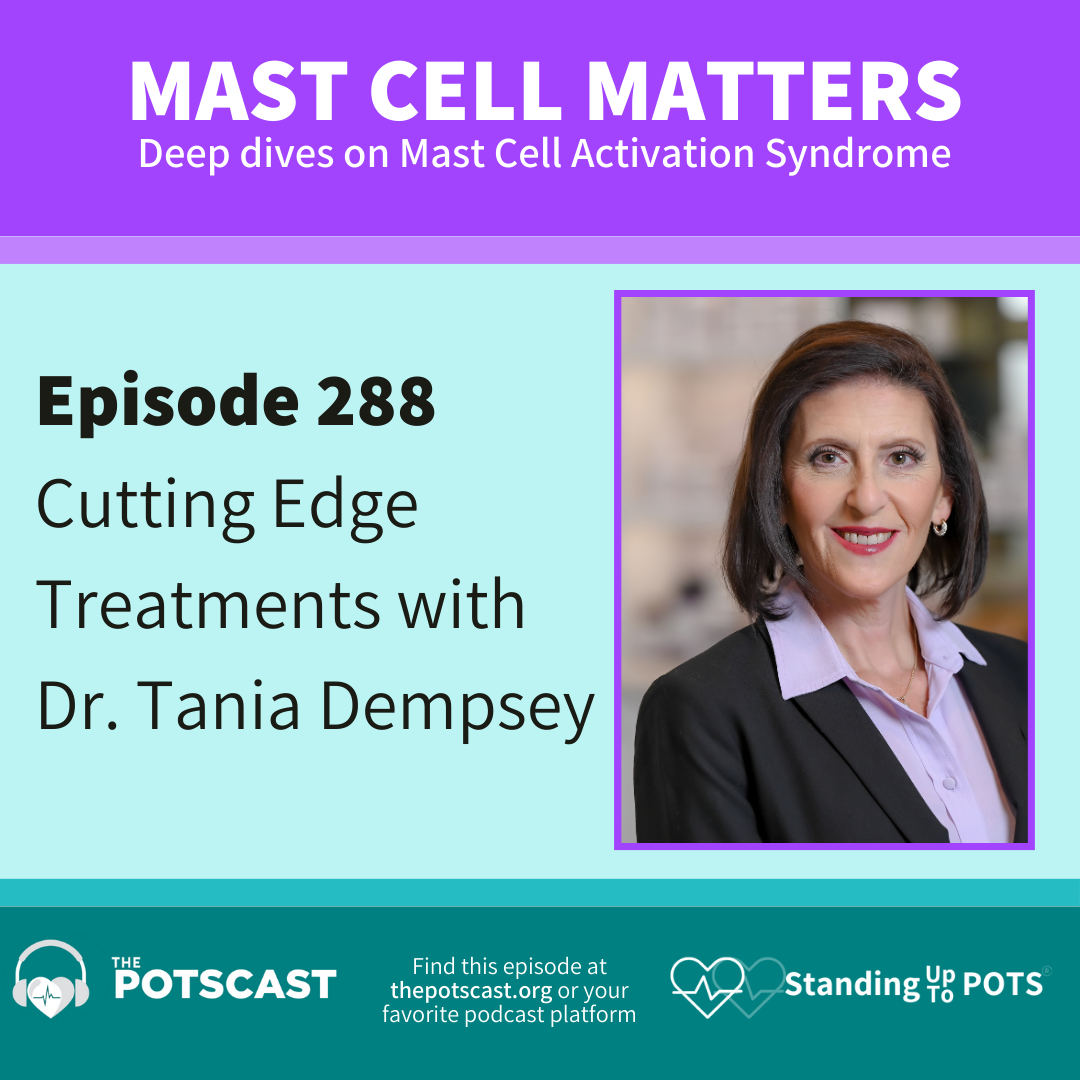
Dr. Dempsey on leading edge treatments she is finding helpful
December 15, 2025
One of the most common questions we get from listeners is about the novel treatments that Dr. Dempsey mentions, such as therapeutic plasmapheresis exchange (or apheresis), SOT, ozone therapy, UV light blood irradiation and more. In this episode she discusses each treatment: What it is, how it works, the risks and benefits, who is a good candidate, and more.
More information about Dr. Tania Dempsey and her clinic can be found at https://drtaniadempsey.com/.
Episode Transcript
[00:00:00]
Jill Brook: Hello, fellow mast cell patients and beautiful people who care about mast cell patients. I'm Jill Brook, and today the amazing Dr. Tania Dempsey is going to answer the most common listener question we've been getting lately, which is, what the heck are those advanced therapies you are talking about with many of your guests?
Can you explain those better because I have not heard them elsewhere? So we've gotten this question about treatments such as therapeutic plasma exchange, SOT, ozone therapy, UV blood irradiation, and others. We'll get to as many as we can today. And Dr. Dempsey is going to educate us on what they are, how and why she uses them, their risks and benefits and things like that.
So you may recall that Dr. Dempsey is a world renowned expert in complex multi-system diseases. She's the founder of the AIM Center for Personalized Medicine in Purchase, New York. She's board certified in internal medicine and in integrative and holistic medicine, trained at the Johns [00:01:00] Hopkins University School of Medicine with residency at NYU.
And her clinic attracts patients from all over the world with Mast Cell Activation Syndrome, Lyme and other vector-borne infections, mold and environmental toxicity, dysautonomia, hormone, and metabolic disorders. And I think she also gets a lot of mystery patients who wish they knew what they were dealing with.
She serves on the board of ILADS, she's part of the US ME/CFS Clinician Coalition, and she is a founding executive board member of the International Society for Mast Cell Activation Syndrome. Dr. Dempsey has authored and co-authored numerous peer-reviewed publications on MCAS and related topics, and we're so grateful to have her here today.
Dr. Dempsey, thank you for coming.
Dr. Tania Dempsey: Oh, thanks for having me again. You know, thanks for that wonderful bio. I appreciate it.
Jill Brook: Well, I didn't want people like we, since you are so kind to to be our guest host, I didn't want people to take for granted all of your qualifications. And then there was one other thing I thought people should probably know. If they've [00:02:00] been listening, they will know this from previous episodes, but these advanced treatments you're doing today, this isn't like all you do, you also do all of the basic stuff.
You address lifestyle, diet, stress, sleep, triggers, all that stuff. But today we're kind of talking about some of the more novel treatments that you are very much a leader in. And so I thought maybe we should just start by what makes you choose to kind of look beyond the basic stuff?
Dr. Tania Dempsey: Yeah. Thank you for saying that. You know, I think it is important to emphasize the fact that, you know, there's foundational work always that we do with patients, right? And we need to make sure that, that everything is dialed in the best that it can be. We're, we're looking at triggers. You know, if it's a mast cell patient, of course we're looking at the triggers.
We're trialing, you know, various interventions to calm down the immune system, calm the mast cells down. You know, if there's an underlying infection, if there's an underlying environmental toxin, mold, et cetera, right, we're trying to [00:03:00] eliminate that or deal with that, right? So, so it's a very it's a very involved process, you know, and patients know that, right?
It can take time to work through a lot of things. But one of the things that I, that I noticed, you know, pretty early on in my journey into this space of complex chronic multisystem disorders is really that we don't have all the tools that we need. And I just feel so compelled to, to continue to look for better ways to treat patients, certainly since once you get to the point where they have exhausted a lot of options. Initially, that was sort of my thought process.
You know, you do, you do everything and then you get to a point where the patient maybe isn't getting better. Or maybe the patient reaches a point where they're 75% better, but you need to get them to a hundred percent. And so I'm always looking for that, that next best thing. Okay, what, what can we use?
But you know, my thinking has shifted a [00:04:00] little bit since I started bringing on these other tools. And what I'm starting to understand is that these are not necessarily tools that have to wait until you've exhausted all other options. These are tools actually that can come earlier in the process of working with the patient and the patient going through the process of getting better.
And it might actually move the needle a little bit more for many patients so that they can work through the other things that they need to work through. So my thinking has definitely changed. And, and some of the tools and what's really, really actually fascinating to me is, is that the tools that I've brought in are really the, the basis of them actually came, many of them came from what I'll call the longevity put in quotation or anti-aging space. And although there's definitely a lot of overlap and there definitely were people using some of these technologies for chronic illnesses, [00:05:00] but what I find really interesting is that the anti-aging community has adapted a lot of these into their, into their protocols.
And what I see is really that patients with complex chronic multisystem disorders, including MCAS, including all these other things that I treat, really have inflammation as the basis of their, their condition. Inflammation is the hallmark feature. And guess what the hallmark feature is of aging. Inflammation. And we call it inflammaging. And so once I started to really like, think about it in that context, then it made sense to start exploring things that are being used for inflammaging, or inflammation, in the aging population. And, and think about how those technologies can be applied to our patients who are chronically ill and inflamed and, and [00:06:00] aging probably faster than they should because of this, you know, low level inflammation that is constantly there. So, so that's sort of the basis of, of, of like my thinking and why I started to bring in these various technologies. I started, you know, I started one thing at a time. Ozone was probably the first thing that I brought into the, into the practice.
And some of that was actually based on my own, my own experience using ozone. And I'm happy to share some of that. And then, and then I saw what ozone can do in the forms that I, that I got it, you know, that I was able to receive it in and then I wanted to, anything that I try that I like and I can see and understand the mechanism of action, I can understand, you know, the safety profile and all that. Once I understand that, then it just, for me, I can't keep it from my patients. Like I feel compelled to share it because, you know, why, why wouldn't they, you know, have the access to the things that, that I've tried that [00:07:00] have helped me in you know, various ways.
So, so that's sort of, you know, the journey. And then the therapeutic plasma exchange is, is really kind of like the last, probably one of the last things that I, that I brought in. And it's not gonna be the last thing. I know it won't, because there'll be, I'm always looking for other tools. Because every, everything we're gonna talk about today is exciting and I can definitely tell you a lot of the, you know, the good stuff. It is not right for everyone. Everything that's great for some people, right, also has the other side where it may not be right for, for others. And so, and that's why I need all these different options because ozone may be great for one person, may not be for another. Therapeutic plasma exchange,
great for one person. Maybe, maybe it's great for a lot of people, but you need good IV access. You actually need two veins. You know, some people don't have that, right? There are limitations to some of these technologies. And so, I'm, I'm always gonna be looking for what else can I use for [00:08:00] patients then who cannot do some of these things we're talking about today?
Jill Brook: Well that's great. And you know, it's funny 'cause I've heard you speak before about how some of this is inspired by the anti-aging stuff and what goes through my head is, well that makes me happy as a patient because it A) suggests it's safe enough for people who don't have a chronic illness and that B) even if it doesn't help my chronic illness, at least I'm getting some anti-aging. By far we get the most questions about the therapeutic plasma exchange. So what is that and when do you use it?
Dr. Tania Dempsey: Okay, so, it's called, it's, it's known by a few different names. So I think it may be worth kind of talking about, 'cause I know I get a lot of questions on Instagram too, about, you know, is this the same as this? Is that the same as, and, and a lot of the things are similar. So sometimes people know this as apheresis.
This is a form of apheresis. It can be called plasmapheresis. It could be called TPE, which is, which stands for Therapeutic Plasma Exchange. And, and I've [00:09:00] also heard it called PLEX, PLEX. And so, they're pretty much the same. There may be some, some differences like apheresis in Europe is a little bit different than the way we do it here in the, in the US.
But generally speaking, the concept is the same. It is a process of cleaning the blood. Now, if we think about where, where this really started, this actually started mostly in the realm of autoimmune diseases. That's where there is some FDA clearance for, for this stuff. So we think about the diseases at least, like when I was working in a hospital, these were the things that we could use plasmapheresis for, were things like Guillain-Barre Syndrome, myasthenia gravis. And the, the reasoning behind this was if you could pull out these bad antibodies that were attacking these various parts of the body causing that disease, and that's what, that's [00:10:00] what this thing is doing, and we'll, we'll talk about the mechanism, if you could pull out these bad antibodies then it gives the body a break and allows it to heal and recover and sort of resets the immune system.
That's, that's sort of the thinking behind, behind it. When it sort of started to go into the anti-aging realm, it really was about cleaning the blood out of all the garbage, all the cells that are not, you know, have died or are not being cleared properly. You know, I really think about it as it is garbage that that needs to be removed.
And, and by doing that, that allows the body to remove all this inflammatory cytokines and mediators from mast cells and mediators from other cells. And so now again, the body has less inflammation and that can lead to, to better health. Now obviously we're looking at this technology in other conditions, right, including vector-borne infections, mold, toxin [00:11:00] exposure, microplastics and, and potentially MCAS. So the way technology works, at least the, the, what we're doing in, in my office is really that it's set up as a, as a special machine. We have amazing nurses who are, are well trained on this type of technology.
Most of them have done work in the hospitals using this or some of them are dialysis nurses 'cause it's a similar technique. And you do ideally need two veins. One vein is where the blood is taken out of the body and one vein is where the blood is put back into the body. That allows the process to happen a little bit faster.
You can do it with one IV in one vein where the blood is taken out and put back in the same vein. That is possible. You know, there are ways around this and there are other types of lines that can be put into people who don't have IV access. If you really need it, when there's a will, there's a way, right?
[00:12:00] So there's, there are other options. But most of the patients get one IV in one arm, one IV in another arm. The machine and the, and the nurses through calculations, we calculate the blood volume. We need lab work to determine the person's hematocrit and the red blood cells. Like we need to know what's actually in the blood and we need to know how much they weigh and their height and all those things because there is a very specific calculation that is, that is done by the machine to figure out how much blood is gonna be pulled out, how much plasma is gonna be pulled out, and what needs to be returned. So out of one vein all the blood comes out and it's spun through a special centrifuge in the machine. And plasma goes into a bag, and the red cells, white cells go back into, into the body along with albumin, which [00:13:00] is sort of filling the space of what, where the plasma was, basically. The plasma is kind of a yellowish color. It is where all your antibodies are. It's, it's where, again, the, the garbage is. Maybe, maybe these systemic, chronic infections, potentially plastics, mycotoxins. You imagine there's lots of stuff in, in the blood living in the plasma.
And so when you pull, pull all these things out you, you know, the hope is that you're gonna minimize inflammation and again, help the body to heal. So, the other thing that I think is important to, to understand, people sometimes worry because you do need antibodies, you do need immunoglobulins for your immune system. When you remove this through this TPE process, you're not removing all your antibodies. You're removing a portion of them. Because there are lots of antibodies that live in other [00:14:00] organs and tissue and cells. So one treatment of this takes out a portion of things. Once that the plasma is out, and again, it's been replaced with this clean albumin and, and we give a tiny amount of immunoglobulins or, or IVIG at the end to just to sort of replace a little bit.
Over time, over several days, the garbage, the other stuff that's still in the body, hiding in various organs, kind of comes back out into the blood, right? There's like a, there's like a gradient, right, knows that, oh, it looks too clean. So, so more stuff comes into the plasma and then you need to do it again to, to make sure you continue to this cleaning process.
So a lot of people will say, can you just do one? Can you do one treatment? And, and what are the benefits? So you might see some initial benefit. You might, you might not see anything. And you could do one just as a way [00:15:00] of just understanding how your body does with it, see what side effects you have.
But generally speaking, for the chronic complex patients with MCAS, with these other conditions that I've mentioned, you know, typically four to six sessions spread out over a certain amount of time, and everyone's different. Sometimes it's once a week, sometimes it's twice a week. We generally don't do more than twice a week because it is good to let the body sort of recover in between.
And also, you know, let the rest of the stuff to come back into the, into the blood. But, you know, four to six, six seems to be the sweet spot for a lot of people. And then we, you know, sometimes if we're trying to pull out, let's say plastics. This is a study that's, that, that is ongoing right now with a couple of different sites around the country.
We're looking at, and I don't think we have the data yet, but we're looking to see, you know, after a certain number of sessions, you know, does [00:16:00] the microplastic levels in the body decrease? And there are tests that we, that we do to, to check that. You know, there are other markers that we're looking at also, just to see what the, you know, what the shift is.
And and then we decide, you know, at some later point in time, is there a need for another round? You know, is it a few months later? Is it six months later? Is it a year later? You know, everyone is different. I've certainly seen really miraculous results in certain people. But then after several months, a return of some symptoms, not quite where they were before, but over several months, there's like a slight, you know, uptick again.
And so then we say, well, maybe, maybe we need another few to finish the job. Maybe now is the time to do that. So everyone is different. There are different protocols. I really wanna emphasize that, that this needs to be personalized. We're working on creating protocols, but right now this is sort of, you know, what we're, what we're doing.
So, so what, so let me [00:17:00] kind of talk a little bit about what I've used it for. You know, I mentioned on another podcast and a lot of people are, are contacting me because I said something about I wanna do a study on MCAS specifically and, and TPE. I just wanna clarify, we're not doing a study right now.
My hope is that I will acquire enough data to publish on it. I would need significant funding to run a study on, on, on MCAS. So it's not there yet, but that is my goal. But I would publish a retrospective analysis of patients with MCAS who are using this treatment for MCAS along with these other, other conditions and comorbidities that many of them have.
But what we see, what we've seen so far, anecdotally, is that, that some of the MCAS patients are noticing a dramatic decrease in MCAS symptoms. Now the question is, can it be maintained? Right? We don't know yet because we haven't, we don't have enough data going out several [00:18:00] years. So we, we, we see the decrease in, in MCAS symptoms and some of that we believe is the removal of the cytokines and the mediators that may be floating in the bloodstream. Maybe it's histamine, maybe it's heparin, maybe it's you know, various other, I mean, there's right, interleukins and various other inflammatory mediators. And, and so I think that patients can feel a, almost like a relief, like the body is just, you know, it, it doesn't necessarily stop the mast cells from reacting. You still have to do all the work, work on the triggers, et cetera, but you're removing a big part of like what is continuing to cause inflammation. So that's interesting. You know, we've definitely seen that. We've had patients with various neurologic conditions. They have MCAS too. I mean, I think there are very few patients in my practice who don't have MCAS. So I just make an assumption, right? Just if I'm talking about these patients, they also have MCAS. But, [00:19:00] you know, Parkinson's-like, conditions, things like that. You know, we had a patient who was using a walker when she came to the office, was getting more and more disabled.
This condition came on very quickly. She had other things that we had been managing from, related to her MCAS, but the neurologic condition came on quick. You know, difficult to walk. A lot of fatigue. And so she comes in with a walker. Very, very difficult walking. We actually videotaped her on the, before the first session.
She completed six sessions. Stayed for a few weeks with her husband, and she basically walked out after the last session without a walker.
Jill Brook: Wow.
Dr. Tania Dempsey: Then told me that she was able to a month later go to Italy and walk all over Italy with a cane just because she wanted, like to make sure that she was safe, but probably didn't really need it very much.
And she was at the point where she didn't know if she was ever gonna travel again. This was a month after the [00:20:00] TPE in six sessions, okay. That was pretty remarkable, right. So now not every case is like that, but when you do enough of these, we, we are seeing that there, there is a lot of utility to this. But again, I think the patients have to be selected properly.
I think that there are, there's a discussion that needs to be had about what we're trying to achieve with this. And there's certainly people who do it, who don't really notice much. And, and it may not be noticeable. And that's what I think is really interesting. I think there's some people who don't feel anything, any difference.
However, when we start to treat, continue to treat them, they just seem maybe less reactive or they seem a little bit able to tolerate things, but they're not noticing a specific change in a particular symptom. And, and I'm sure there are also gonna be people who don't, you know, don't have any benefit and we, we haven't seen that yet, but I, I'm sure like any treatment that's, that's always a possibility.
But [00:21:00] I'm, I'm really, really excited about this because I think that it, out of all the therapies that we can do, it just is so much more profound for the, for the amount of sessions that you need and the amount that you need to do. You know, so I, I, you know, was really excited to be able to start really treating patients with this.
And, and again, as I get more data, I will share. And as I have more understanding about the effects on MCAS, I will share and I will publish. And then eventually, yes, we'll get some funding and we'll do, and we'll do the study. And I, I have already a lot of volunteers reaching out to me, telling me they wanna be in the study, and we'll do it.
But in the meantime, I think it's just important that we report whatever we're, you know, we're seeing. So that's why I was really excited to talk today about this, because I just, you know, I think, I think people need to know
Jill Brook: So I have a few questions. So I assume this is not for just like the run of the mill MCAS patient, it's is this for people with fairly [00:22:00] severe symptoms that haven't responded well to other things? Or how do you kind of decide if somebody's ready for this step?
Dr. Tania Dempsey: So, you know, no. So I don't think it has to be the most severe. I think it just has to be someone who is looking for improving their quality of life. And again, because this is also used in the longevity space where they've published research on extending life by a couple of years after plasmapheresis.
I mean, there's pretty, pretty interesting data that's coming out in that space. So I kind of look at it like, well, it's probably theoretically good for a lot of people. But let's say you have someone with mild MCAS who is generally controlled, you know, we'll, we'll do a scenario of like generally controlled with some H1, H2, maybe a few things.
They have little flares. Maybe they're not debilitated to the extent that some people are. But maybe they have, they know they have underlying [00:23:00] Lyme, Bartonella, Babesia. That they're always, you know, kind, kind of comes out and then they have to deal with, maybe they had a mold exposure. So they're highly functioning, but they're not optimized.
And, and, and I think for a lot of patients, and I see this in men and women. I used to think it was mostly just women. I think it's just both, both sexes. Where, where especially people who are in that mild category, they push through and they just think that that's how their life should be, not realizing that they're actually not as mild as they think they are.
That's kind of my impression of, of a lot of people. Because again, I think, I think maybe it's because of gaslighting. Maybe it's just because of their, their personality. Maybe it's there are lots of reasons, right? Or their family doesn't believe them, and so they just push through, you know, whatever they're doing.
They go to work or they take care of kids or whatever. And, and, you know, they're maybe functioning at 70% and they've tried [00:24:00] some things, but nothing has really moved the needle enough where they really feel optimal on a daily basis, right? So I think that that could be someone who tries plasmapheresis. Can we move the needle really significantly, get them from 70 to 90% or more potentially. You know, maybe combining it with, with other, other treatments. You know, I think the more severe cases are a little more challenging, actually. It's not that I wouldn't do it in more severe cases, but there's always the patients who are really, really sensitive to so many things, right?
I may be a little bit more cautious about putting them through this before I do other things first to get them a little more stable, right? So the, so the milder patient may actually be, you know, maybe a little easier, let's say, to get them, you know, through the, through the treatments.
Jill Brook: And how long is the treatment?[00:25:00]
Dr. Tania Dempsey: So about two and a half hours. We have a really comfy chair that reclines. And and you sit there, it's quite comfortable. I mean, I've done the videos. People may have seen me, you know, doing it myself. And I actually was really kind of surprised because I was thinking, wow, to sit there with an IV in each arm for two and a half hours, right? Like that seems a lot. It can go a little faster depending on the person, depending how much volume we need to take out. And I would say like two hours to two and a half, and then at the end a little bit longer, maybe just to give back some IVIG. We usually give like two grams of IVIG at the end.
Because there are some studies that show that that little bit, it's a tiny bit of IVIG. I've not seen any reaction even in people who have had reactions to IVIG in, in, in the larger forms when they were getting therapeutic IVIG. This is so small, I've actually never seen anyone react to it. But [00:26:00] there are some studies that show that there's like a synergism between that, that little dosage at the end and the the treatment. So about, you know, two, two and a half hours. And then, and then you're done. And I would say that the most common side effect after is fatigue. You know, I can, I can attest to that. I remember, I, I usually, if I'm gonna do it, I'm doing it at the end of the day, so I don't have more patients.
I once scheduled a podcast after TPE. That was rough, I'll, I'll admit. I was like, probably not on my game then, but it was just like, I was like, oh gosh, I just wanna go home and sleep. But other than that, you know, again, I, I am really, really pleased with the, the, the way patients are tolerating it, you know, 'cause it's my always my concern with any kind of treatment.
And again, even people who are fairly sensitive actually do do quite well during the treatment and after the [00:27:00] treatment. And, you know, the next day some people also feel a little bit tired. You know, again, there's a shift in the blood, there's a shift in things. So, so that doesn't surprise me. And and usually by the next day things are kind of back, back to normal.
Either you notice something positive. I did. I did it, first off, from a more like, anti-aging perspective. And also because every new tool that I bring into the office, I have to try first before the patients, 'cause I, I just wanna make sure this is gonna be the right thing.
And so I've done, I think I just did two so far. But, you know, I noticed some interesting things, like I was a little stronger in the gym, you know, a couple days later. More stamina. Like, I, I, I work out a lot, so it's all relative. But I was like, this is kind of, this is kind of cool. But I, you know, everyone is different and everyone's gonna have a different response.
Jill Brook: Wow. We had on one of our POTS Matters episode, an [00:28:00] ME/CFS patient and expert who had done this to get rid of I guess some of his long COVID issues. And he said that what came out was black and they said it was micro clots. Have you seen any weird things come out of people's blood?
Dr. Tania Dempsey: Yeah, so what we're looking at is the color and the the color and the, and the clearness of the, of the plasma. So when we see, so like, let's say my plasma was the first one was yellow, which is what you want. It had nice color with, with a slight cloudiness. That cloudiness is probably, maybe it's plastics, maybe it's other, you know, again, cytokines or other, other maybe it's cells that, it's senescent cells. It's probably a combination of things. The second one I did actually was clearer. And, and it had a, like, it was a, like a nicer, lighter yellow. So the nurses got, they get all excited.
They're like, wow, that looks so good. You know? I'm like, wow. It's like a competition for the, who has the [00:29:00] plasma. But we've seen patients, yes, we've, we have treated long COVID patients and many of them, and even not just long COVID, but again, people who are more seriously ill. The plasma can be dark brown.
It could be almost black. It could, it can have like pieces in it, like, which may be the micro clots. It can have like a real cloudiness and you're thinking to yourself, wow, this is what's going through their body. No wonder they don't feel well. And we had one patient who had really dark plasma on his first treatment.
And then after six, the plasma, you know, wasn't perfect after the six, but it was significantly, it was yellow at least. And it improved dramatically. Every session we saw the change in the color of the plasma. So that, so yes, I do think we are removing micro clots.
Jill Brook: Interesting. Okay. And then are there just any other risks that people should know about?
Dr. Tania Dempsey: You know, if people are on [00:30:00] blood thinners, you know, we, we do have some protocols about what to do with blood thinners. These are really big IVs that go into the, to the veins. And so the process itself is not a problem. But afterwards, we had a patient who was taking Eliquis and she just, you know, she had a hard time it took hours and hours for the veins to stop bleeding after the procedure.
So we've started to try to, you know, hold the dosage and try to figure it out. You do get some blood thinners during the process to help the blood, you know, keep flowing. So, you know, again, there's certain patients that we have them stop for a day because we're gonna give them something anyway, and then they restart it.
Other risks, I mean, like any IV, right, there's, there's a risk anytime you put an IV into somebody. Of course we've never seen this, but we have you know, you can get infection, right? You can get blood clots in the veins themselves and people who are really hypercoagulable. We call it like, superficial thrombophlebitis where there's [00:31:00] inflammation in the vein after an IV, and the vein kind of gets hard and there's like a little blood clot in there. Again, I've not seen that with TPE, but these are all theoretical risks of any time you're putting any type of IV in. And I mean, those are, those are the, the main things I, I haven't seen anything else that is significant in this regard.
But I think, I think for MCAS patients, which I think is different from a general population, is just, you know, whether they're gonna tolerate the shifts in, and I would say maybe POTS patients too, the shifts in volume.
Okay. We don't know. I've not seen any problems yet. But, you know, you are, again, you're taking blood out, you're putting back in. It's a pretty quick process. You're not like without blood, you know, it's, it's only taking a little bit out of the time. But you know, I think there are probably gonna be patients where that shift maybe, you know, is uncomfortable or maybe doesn't make them feel good, right?
So for some patients, what we've [00:32:00] done preventatively, you know, if we know they already have some, let's say, dysautonomia, we'll give them some fluid before we even start just to make sure they have enough volume in their body. That has helped as a preventative. Sometimes you can see hypoglycemia, so their blood sugar can fall during, during the procedure. So we always recommend that people have some sort of meal at least a light meal beforehand to minimize that hypoglycemic effect.
Jill Brook: Okay. Amazing. So the next one that came up is SOT. And what does that even stand for and what is it and when do you use it?
Dr. Tania Dempsey: So SOT stands for Supportive Oligonucleotide Technique. Actually, the name has changed recently and it's called now, it's called Q-RESTRAIN. I don't know why that's changed, but just so people know, I, [00:33:00] I've seen that now people using the different terms interchangeably. This technology is based on cancer research, which I think is really, really fascinating.
And the doctor who started this SOT technology, he's really a cancer researcher. And so that makes sense. He started, you know, doing this technology for cancer and then realized that it had its utility in treating infections and things like that. So, so basically the concept is this, that if you take a cancer cell that has abnormal DNA, that is allowing the cancer to multiply without any breaks, right?
So what happens with cells is cells can only multiply, regular cells can only multiply a certain number of times, and then, and then they're supposed to die and the body's supposed to clear it. Cancer cells just keep multiplying and multiplying, right? That's why cancers spread and can [00:34:00] metastasize. So there's a mutation you know, in, in the, in the cancer DNA that's allowing this to happen.
So the technology in the cancer world is called antisense therapy. So a molecule, a protein, very short protein, called an oligonucleotide, essentially like an RNA molecule, is created to match that faulty DNA of the cancer cell. And that oligonucleotide, that little short RNA, binds the DNA and sends a signal. And the signal is stop multiplying, right? So they, I mean, it's incredible technology where they really can isolate that specific part of the DNA that's making the cancer replicate like this. And it goes in and it, and it binds to that specific region, sends that signal, and then the cancer can die, right?
So it's incredible research and there are a number of universities around the country here in the States doing [00:35:00] this, this research. I don't know why it hasn't actually made it to primetime yet, to be honest, 'cause it's so incredible. But I know that it's in, you know, I know there are different researchers looking at it.
So, so in the infectious disease world it's sort of doing the same thing. So, let's say you have, it could be Lyme disease. Lyme disease is caused by a bacteria called Borrelia burgdorferi. If you have a test that proves that you have a Borrelia burgdorferi infection, this lab that we work with, you send the blood to them, they create, they, they find the Borrelia burgdorferi. They identify the DNA of that, of that organism, and they create an RNA, very short oligonucleotide, that's why it's called supportive oligonucleotide technique. They create this short protein that matches the DNA of that Borrelia burgdorferi. [00:36:00] That treatment is, is basically sent to us. We infuse it. It's an IV. And over the course of four to six months, little RNA molecules, and there are really millions of them actually, that, that you get in a small little sample, are working to bind to these various Borrelia organisms and sending that message to stop multiplying and to die, basically.
Because the, the whole thing about, the whole thing about working with, trying to, trying to kill Lyme or these other infections is really that even with antibiotics, very hard to kill these, these things for a lot of reasons. But if you can reduce the load, you can get them to stop multiplying as much, then the immune system can then kick in and take over.
That's really our goal because it's very unclear whether every single Lyme organism or any organism can be killed completely. [00:37:00] And I'll go into that a little bit 'cause I think that is a really important point, but it's about really trying to find that balance between knocking down the load and that's where SOT I think comes in. You know, it works really well.
And then allowing the immune system to then see that all is well, and now, now it's gonna work better and keep whatever's left suppressed. That's, that's the goal. And that's really the goal of any treatment with with vector-borne infections, with other chronic infections. Because, and this is, this is like my little pet peeve. In the infectious disease world, there's this understanding or lack of understanding of what organisms do, microbes that in infect ourselves. Like we are exposed to lots of infections over the course of our lifetime, okay. As a kid, you're exposed to like Coxsackie and you're exposed to strep, and you're exposed to Epstein-Barr and you're exposed [00:38:00] to herpesvirus 6, herpesvirus 1.
I mean, there's a like a thousand, you know, viruses, bacterias, things that, that your body can be exposed to. But you know, the, the understanding from a, from the ID people is really that you have an infection and your body clears it, or you take antibiotics and it clears it, and then you're, you know, you, you just, you move on.
But, but that's not actually the case for most of the things you've been exposed to. They go into the cell and they hide for your lifetime until they can reactivate. And the same is true with a lot of these other infections I'm talking about. So I, I love to use the example of strep. Because this, this really drives me crazy because it is really kind of stupid how doctors approach strep.
So kid comes home, strep throat, they say, oh, it's going around school. So they put the kid, you know, they do the strep test, they put the kid on amoxicillin or whatever antibiotic for [00:39:00] 10 days. And the kid gets better. Sometimes within 24, 48 hours they're feeling better. Great. They go back to school and like a month later, maybe a few weeks later, right, the kid comes home again sick.
And, and again, they, they're like, oh yeah, you know, strep's still going around. They probably got it again. No, he didn't get it again. Most likely that strep was still living in his body, in his tonsils, in his gut, wherever it was hiding. And the immune system did not kick in to take over and it started multiplying.
So you take antibiotics. Let's say they're a million strep during a strep infection. You take antibiotics, maybe you drop it down to a hundred, you reduce the load from a million to a hundred. I mean, this is not exact. I'm just giving you an example, right? So let's say at a hundred you don't feel anything, you feel fine.
And you know, maybe your body can just keep it there and then you don't, you know, you don't get strep again. But if your body can't handle it, and that a hundred, [00:40:00] those a hundred strep organisms all of a sudden start to multiply. You know, maybe the kid didn't get enough sleep. Maybe, maybe they ate too much sugar.
Maybe there's something that altered the immune system and all of a sudden the hundred is a thousand, is a million, and, and now they have strep again. And you know, the same thing can be said about, let's say Epstein-Barr and lots of other things that people are exposed to, including Lyme. So we live with all these things.
Lots of people have lots of infections in them. For some people, their immune system can keep it at bay and they'll never really get sick fully. You know, they'll, they're just, they're just able to, to go on with their life. And there are others where there are gonna be triggers that are going to bring it out. COVID, for instance, is absolutely a trigger for bringing out Epstein-Barr. We have research to support that. So the Epstein-Barr is like hiding in a cell. And then they had, you know, the patient had mono at some point, and then they get COVID, and then now [00:41:00] the Epstein-Barr virus is reactivated and now causing and wreaking havoc or reactivation of Lyme or Babesia or Bartonella. We've seen reactivation of all these infections following COVID. The immune system got dysregulated, had to fight off one, you know, one virus, and now can't hold the other things at bay. Boop, things are out.
And, and so for a lot of these patients, again, I can use all the antibiotics in the world. I could do all these different protocols. I, I may be able to reduce the load and that's where SOT comes in too. I'm gonna reduce the load, and work on the immune system to take over to be able to keep it, keep it suppressed. And that's where I think plasmapheresis comes in also. That's where I think ozone comes in.
Like I think, I think it's about trying to continue to work on the body, get it into the best state possible so that it can handle that stuff that there may be remnants of that are not, you know, fully fully [00:42:00] killed.
Jill Brook: So can you talk a little bit more about what it is that you send off to the laboratory so that they can customize it?
Dr. Tania Dempsey: Yeah. So the process is, I'll go through the process a little bit. First you, you do need a test that, that proves that you have the infection. Ideally in, in my opinion, using molecular tests or tests that prove that there's actually active infection is the best. Some people, you know, have antibody tests that, that suggest that they have infection or were exposed.
Those are a little trickier, but, but, but sometimes they work. So, you know, you screen people, right. I check viruses. Sometimes it seems like the Epstein-Barr is activated. Sometimes it's Lyme or Bartonella or Babesia. Maybe all of them, very often.
Maybe there are other strains that I've identified through other testing. So I, I need to have a test positive and I need a test within six months. The lab will only accept a positive [00:43:00] result within six months. We then draw blood. We send the lab the results and a new, you know, sample of blood and we say, okay, we found, you know, we found Bartonella on, on this test. We want an SOT for Bartonella, or we wanna SOT for Bartonella and Lyme, or we want, you know, we can, we can order usually up to, up to like two or three at a time, depending. So the lab then processes that sample and they look for what we are saying is there, okay. And I think the molecular tests are best because it's already been identified by another lab that it's there for sure.
They found it usually through a FISH test or a PCR test. So then the lab has an easier time. So they they look for the bug, they use their own technology to find that particular infection, and then they create that small [00:44:00] little molecule to match the DNA of again, whatever organism we're ordering.
So if it's Lyme, Bartonella, maybe multiple ones, they can create multiple SOTS. These little proteins are essentially freeze dried and they are sent back to us where we then can hold it up to six months. And within that timeframe, we will want to infuse it. And a lot of it is really trying to figure out the right timing for the patient, make sure that they're, they're in good shape and figure out which one we do first if we have multiple ones.
And then the IV, usually what we recommend is that the patients take an antihistamine orally. Occasionally I'll give IV Benadryl. It depends on the patient. Some patients want some IV Benadryl. We always give IV famotidine. So you want an H1 blocker, you want an H2 blocker.
Steroids often are [00:45:00] recommended. We don't do that as often because a lot of our patients are very steroid sensitive. So it is based on the case, but the lab does recommend steroids. We are a little hesitant with our population. And then we give those premeds and then we reconstitute the freeze dried particles and, and or their, you know, the, the proteins and and then we infuse it. And then it's in the body working somewhere between four to six months.
You know, again, localizing to the, the infection and then binding to it, to the DNA and and inactivating it. Side effect wise, fatigue is the most common side effect following an SOT. I would say like 90% of people just feel tired. I've actually never seen a severe reaction immediately.
We've never seen anything during the infusion. And we haven't seen anything severe after the infusion. What we do see is [00:46:00] that there's a subset of people who get some sort of Herxheimer or die off reaction as the SOT is actually working. Often it sets in after a few days. Like it could be like day three to five or three to seven, when, when things are starting to die. The organisms are dying, they're releasing sort of inflammatory chemicals. It may be setting off the mast cells a little bit. And so we always have protocols for patients on how to deal with that if that if that happens. It's always stabilize mast cells more, increase your H1, H2, do whatever you can, right. And then, and we have some detox stuff that we do. Doesn't happen to everybody. And it actually is interesting. I have people who have gotten multiple rounds and they only react to like one strain. You know, they were okay with Lyme, but they reacted to Babesia, but they didn't react to Bartonella or, or whatever. So it does seem just like the body just deals depends on, on the organism.
[00:47:00] But it's really been really an incredible technology. We, we brought it in around 2018, I wanna say 2018 ish. Then of course, you know, by 2020 with COVID, we kind of had to to stop and then of course we, we started back up in, in 2021. So, so we've been doing it for a long time. We have hundreds of cases, if not more at this point.
And and for so many patients, it has allowed them to stay off of antibiotics. Some of them are chronically on antibiotics because they're constantly relapsing. Some of them cannot tolerate antibiotics, right? There are lots of MCAS patients who are just unable to, to tolerate anything. So interestingly, they do quite well with SOT therapy which is really incredible.
So we can address their infections without having to put them on things that they are potentially going to have a major [00:48:00] MCAS flare from. So I think it's been it's been really exciting. Like every therapy, it sometimes doesn't work or it sometimes really requires multiple treatments. I think that's actually more common than it not working.
The reality is if a patient has, I'll give you an example. If they have Lyme, Bartonella, Babesia, they have relapsing fever, Borrelia, they have oh gosh, what else, Epstein-Barrr, you know, they have all these different infections. And you decide you're gonna do Bartonella, but you don't do anything else.
Generally, you know, the response rate is low because you're really only targeting one infection. It's so specific to that infection, it's not going to bind anything else. And a lot of people ask like, this is like an RNA thing. Is this gonna be like COVID, the COVID vaccine? It's nothing like the COVID vaccine.
It can only bind to the, to the organism that it's designed to bind to. It can't bind to your DNA, it's not gonna alter your [00:49:00] DNA, it's not gonna do anything else. It's not gonna bind to another organism. It's so specific, so that, you know, if you're only addressing one thing and there's lots of other things happening, lots of other infections and lots of other processes in the body yeah, that probably won't work well.
And, and I've learned over the years, I used to, you know, say, let's just do one especially if, you know, finances were a concern. I'd rather just do something. But, you know, I, I now would discourage people from doing one because what I find is that they need to do whatever infections they have present. And often they need to do another round or two or three. Over time, it may be yearly, it may be in one year they need to do Bartonella twice or Lyme twice. You know, it's about rechecking, seeing how they respond, seeing what their symptoms are like. The patients who have done the best are the ones that we've been really [00:50:00] persistent over a number of years just making sure we're continuing to lower the load and lower the load and lower the load.
And those are the people that, that really, it's been a slam dunk. So, again, you know, again, exciting. Very little downside other than cost. But does need some persistence and multiple treatments. And often we're also working on other things, right? Every treatment that I talk about, it's just important to know like we said earlier, earlier on, we're always addressing other things too. Sometimes patients still need some herbs. Sometimes patients still need more mast cell support. Sometimes they need vitamin support, nutritional support, maybe they need limbic retraining and, and vagal nerve stimulation.
Like there are all these other things that affect the immune system and the body. So I think it's always important to like always have like a wide view lens on, on on what's going on with the patient.
Jill Brook: Yeah, [00:51:00] for sure. And my guess is that none of these things are covered by insurance. Insurance is gonna be a long time coming to thinking these things.
Dr. Tania Dempsey: Yeah, for like plasmapheresis, I guess, you know, if you're in the hospital and you have Guillain-Barré or myasthenia gravis, I think, I think that that is probably, you know, covered by insurance. But other than that, yeah, I mean, unfortunately the way insurance is set up and the way the, you know, current medical model is, is just not allowing for these newer treatments for other conditions.
You know, the hope is really that we're gonna, we're gonna hopefully move the needle and maybe we have the ear of the government, and hopefully over time we'll be able to, to, to work on getting some of these things covered. I mean, that would be, that would be amazing.
Jill Brook: People are dying to know about ozone therapy and I know that you had mentioned that sometimes that goes along with UV blood irradiation, so I don't know how you wanna tackle that whole thing.[00:52:00]
Dr. Tania Dempsey: Yeah. So, we have two different systems of doing ozone in our, in our office. There are others. I have colleagues that are doing ozone slightly differently, but I'll just talk about the way we've been doing it. We have, we have a system where it's, it's called major auto hemotherapy.
And it's basically, it's a more manual way of doing things. So ozone is, I call it super oxygen. Oxygen is O2, has two oxygen, two oxygen molecules. O three is ozone. So, so I call it super oxygen. Ozone goes back to oxygen very, very quickly in the body. So, but ozone can, can be picked up by the tissue and, and oxygenate our tissues.
So what we do is we draw blood. We take, we take blood out. We put it into a bag with some saline, and we have an ozone [00:53:00] generator. It looks like air. We pull it outta this machine and we put it into the blood in the bag. And the red cells, because your red cells are what picks up oxygen and oxygenates all your tissue, those red cells pick up the ozone. And what's really incredible is my favorite thing, is sometimes the blood is really dark. Patients who are, you know, sick and maybe they have mi a lot of micro clots, maybe they're really toxic. The blood sometimes is like black. And then when, when the red cells pick up the ozone, it becomes this beautiful, like red color. Like, it's just like, you could just see, it's like life coming back into the blood. And then that blood gets basically goes back into that, into the IV. And we have a machine that's basically a UV light. It's a number of UV lights that, that, that the tubing passes through. So as that ozonated blood is going back [00:54:00] into the body, the blood is also getting irradiated with UV light. And UV light, right, kills things. Like if you go for a manicure and they put, they put the, the instruments into this machine, that's like a blue light, right? I don't think it works that well, but anyway, for them, but it it's supposed to kill things, right? So UV has this killing property, but it also probably has some other, other anti-inflammatory sort of mechanisms. And ozone also, not only just oxygenates the body, ozonate the body, but it also is anti-microbial and it also kills, right?
So, you know, there are people that talked about using like ozone generators and ozone purifiers during COVID to kill the COVID virus. So ozone, you just really don't wanna breathe it in. But this goes into the body, it's just irritating to the, to the lungs if you breathe in the gas. But it goes into the, into the bloodstream through this UV light, [00:55:00] and, and, you know, and then it's, it's a pretty simple, simple IV. You know, what I would say is most people need multiple sessions. And we're using it for long COVID, we're using it for infections, we're using it for fatigue. I mean, there's a lot of different things that, that I think ozone can be really, really helpful with.
And we start at a lower dosage. We can really manipulate the ozone on this, on this treatment. Usually start a little lower and we, you know, work our way up and and people do quite well. The other way that we do ozone is with what's called a 10-pass machine or Zotzmann machine, which comes from Germany.
And this machine sort of automates things a little bit. You still have someone there. You know, the nurse is still there doing it, but what happens is the blood is, is drawn out, but it goes through a tubing into a glass bottle. And what I love about this is 'cause it's a glass bottle, not a [00:56:00] plastic bag. But so it goes into the glass bottle, the machine generates the ozone and then, and then the ozone is pumped into that glass bottle. So the same concept. The, the red cells pick up the ozone and then the blood is passed back into the body. That process can be done 10 times, which is why it's called 10-pass. We often start a little less, you know, we might give two passes, three passes, get people used to it. So the blood comes out, ozonated, put back, blood comes out, ozonated, put back, you know, put it back and you can do it 10 times. You could do it more than 10 times, but generally it's called 10-pass.
That tubing can also be run through the UV light. So we sometimes will combine that as well so that people get the maximum effect. That 10-pass Zotzmann machine is more powerful. We can give a lot more ozone than we can with the other, other, piece of equipment. But it's not always about how much [00:57:00] ozone people are getting.
So sometimes people actually find that they actually like one way versus another way. Less ozone maybe for some people better, more ozone, you know, better for, for others. And in my experience with that was, so I had already been training. This was back in 2020, already bringing in ozone into the practice.
Then, then COVID hit. I actually was in Las Vegas at this, at this ozone conference, the weekend that everything shut down pretty much. And and I had already bought equipment and I was all ready to go, but I wanted to do this course which was turned out to be amazing. And I met a, I met a colleague there who was telling me about this Zotzmann 10-pass ozone, you know, and, and I said, well, I'm just gonna start with like this stuff and take it slow and then well, you know, I'll call you if I'm interested in doing that.
He said, no, no, I'm telling you you need, you're gonna need both. And I'm like, okay, we'll see. So then obviously COVID hit [00:58:00] and you know, we were shut down. We were doing telemedicine and we weren't doing a lot of stuff in the office. And then I got COVID in January of 2021 and I don't know who knows, but I was pretty sick and I actually was hospitalized. And I got, you know, the Remdesivir treatment.
It was pretty bad. And and then I, you know, I recover. I mean actually that, that stuff actually really worked for me. I came home, I was there for five days. I came home and and coincidentally that that colleague called me out of the blue, literally the day I got home from the hospital.
And he was just like, just checking like, hey, how you doing? And I'm like, oh my God, I just got home from the hospital, I had COVID, blah, blah, blah. And he's like, you need 10-pass ozone like now. And I'm, and I, I'm like, okay, yeah, hook me up. So I I went to his office and I went twice a week for four weeks and it was miraculous.
It was for me like [00:59:00] incredible. I was like, I came home from the hospital, I was fatigued. I was really trying to like, get back into it, and every treatment I got, I just felt better and better and better and better and better. And then I was like, back to working and I was like, oh my gosh, I need this for my, like, you know, the same thing I talked about with all the treatments, right?
I try first and then I have to be convinced that this is really good for patients. So I thought, well, for people who have long COVID, I, I thankfully didn't have long COVID. I just had COVID and I was just recovering. So during the recovery period, certainly for long COVID, for people with Lyme disease, we, we actually see some really great results that allows us to, again, reduce the load, 'cause I do think it's killing some of the stuff in there. And so it's reducing the load on the body. It's, again, oxygenating tissues so that the, the body can heal better. And so that's kind of the story. And so, we are you know, loving these modalities and, and patients are, are really, really doing well.
So that's, you know, that's the, that's the ozone story.
Jill Brook: Wow, that's quite a [01:00:00] story and we're glad you're okay.
Dr. Tania Dempsey: Oh, it was a long time ago. And yes, thankfully. But I share it because I, I think, you know, I think it's important for people to understand that, right, I'm not just promoting treatments, right, just because, oh, you know, I heard somebody else was doing it. Or, you know, I, I really believe in every single thing that I, that I do because either my own experience or, or just again, seeing how the patients are responding.
And, you know, if there's a therapy that I'm not convinced is working, then I don't continue it. And I have had other things that I've done or that we've used that we don't do anymore because it's not worth it. It's not gonna work. So, so that's, you know, so that's why I think it's important, you know, to, to talk about that.
And I think that what I, what I like about talking about these things is really giving people hope. Because so many people who are kind of stuck, they don't [01:01:00] really know what else is available to them. They've tried a lot of things already. I just, you know, always wanna just, you know, show people that yes, it does take a little bit, you know, more to get some of these treatments and there it may not be available in your area.
But, you know, hopefully we're just gonna continue to find things that are more accessible for more people, right. That's really my hope. But, you know, for now, this is what, what we have and, and I think we can help a lot of people this way.
Jill Brook: Yeah. Well this has been some incredible information. And speaking of hope we didn't even get through a third of the treatments that are on the list of things that people are excited to hear about and that you are offering. So we'll have a part two and maybe a part three. But yeah, there's hope. And that's really exciting and I know that at least what I've been thinking as I listen to this is at first, some of this stuff sounds so, so scary.
Like, you're gonna take my blood outta my body and like do stuff [01:02:00] to it and put it back in. But the more you talk about it, the more you know, and it feels like, okay, okay, I, I see what's happening. And it sounds like, especially for people who have some of these infections that are just so hard to get rid of...
Dr. Tania Dempsey: Correct, and persistent. The body is just beaten down. And ozone can, can, like, whether it's ozone or whatever else we're doing, like really can allow the body to start to heal and come back to, you know, come back to life. I've done videos on 10-pass ozone, like I got 10-pass ozone, I don't know, a few weeks ago and I posted it.
And so, you know, people can watch that and I've done the videos on, on the TPE. And I guess, I guess I need a video on SOT. So I'll, I'll see if a patient will be willing to talk about SOT therapy while they're, while they're getting, while they're getting it. Because I think it's good for people to to hear the experiences of, of others, you know?
Jill Brook: Right, right. Well, this has been [01:03:00] incredible. Dr. Dempsey, thank you so much for doing the work to find these things and then to try them on yourself and to pay attention to how your MCAS patients are doing and to publish on it, 'cause gosh, if it weren't for you, I mean, I, I don't know where we would learn any of this stuff.
So, huge, huge gratitude to you and we can't wait for part two and three to hear more.
Dr. Tania Dempsey: Thank you.
Jill Brook: Okay listeners, that's all for now. So thank you for listening. May your mast cells be good to you this week, and please join us again soon.