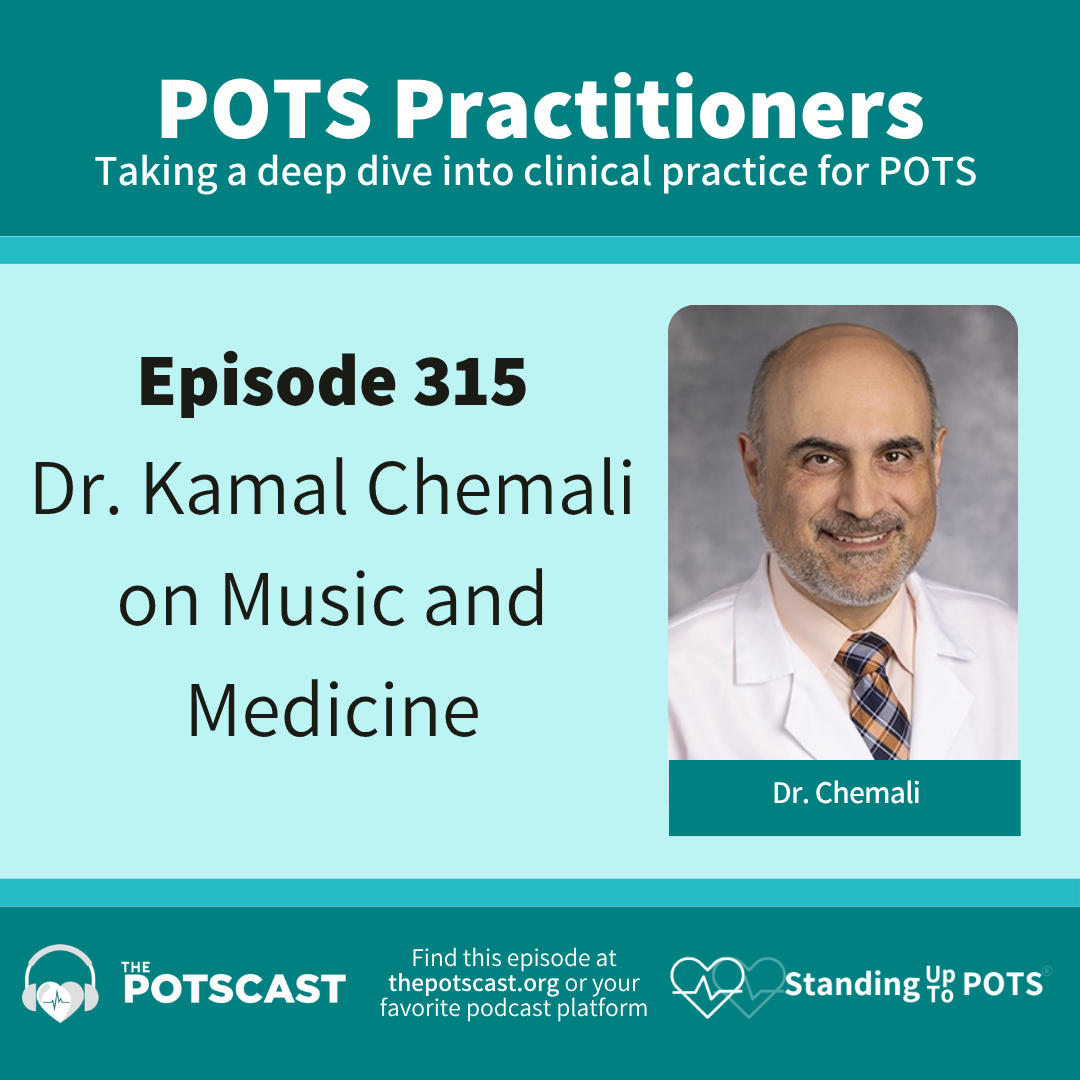
Dr. Kamal Chemali on Music and Medicine
June 21, 2026
Dr. Kamal Chemali is an autonomic neurologist, Professor of Medicine and Director of the Autonomic Nervous system Program at Case Western Reserve University. He started studying the piano at age seven and today is a conservatory-trained pianist who still performs. Dr. Chémali’s firm belief in the power of music in connecting people and in healing disease led him to start the Doctor-Patient Music Connection Program, where physicians and musicians perform for patients in the hospital, and also the award-winning Music and the Brain™ Concert-Lectures. He was the co-founder of the Cleveland Clinic Arts and Medicine Institute and the Founding Director of the Sentara Music and Medicine Center. Today he is the Medical Director of the Music and Medicine Program in the Neurological Institute at Case Western Reserve University.
In this episode he discusses what is known about the power of music to affect mood, heart rate, pain, energy, and his research into how aspects of music, such as tempo or harmony, may affect the body. He discusses music therapy and shares his personal favorite pieces of music with us.
Episode Transcript
[00:00:00]
Jill Brook: Hello, fellow POTS patients, and beautiful people who care about POTS patients. I'm Jill Brook, your horizontal host, and today we are speaking with the one and only Dr. Kamal Chemali about music and medicine and how and why he's incorporating music into medicine. You may know Dr. Chemali for being a highly sought after autonomic neurologist, professor of medicine, and director of the Autonomic Nervous System Program at Case Western Reserve University. He has published widely on autonomic disorders and helped establish some major autonomic programs and laboratories. But did you know that he is also a serious musician and champion of using music to help people heal and recover from neurological conditions?
Dr. Chemali started studying piano at the age of seven, and today is an accomplished conservatory trained pianist who still performs. Dr. Chemali's firm [00:01:00] belief in the power of music in connecting people and in healing disease led him to start the Doctor-Patient Music Connection Program where physicians and musicians perform for patients in the hospital.
And also the award-winning Music and the Brain Concert-Lectures, combining education on the effect of music on the nervous system with live performances. He was the co-founder of the Cleveland Clinic Arts and Medicine Institute and the founding director of the Sentara Music and Medicine Center, and today he is the medical director of the Music and Medicine Program in the Neurological Institute at Case Western Reserve University.
And I could go on. And on top of all this, he also speaks four languages. So Dr. Chemali, thank you so much for being here.
Dr. Kamal Chemali: Thank you for inviting me Jill. Happy to be here.
Jill Brook: So your work suggests that music is apparently more than just pleasant sounds. What can [00:02:00] music do that makes you incorporate it into your neurology program?
Dr. Kamal Chemali: Yeah. You know, pleasant sounds are not to be minimized. It's very important to, to acknowledge that the primary goal of music is to be pleasant, and to inspire us, right, to inspire the soul. As Monteverdi said in his first opera, the L'Orfeo, I believe 1690 or something there, the opening of this opera really sings the virtues of music and, and music says, I'm here to inspire the soul, but I'm not just that, I also can move people from being sad to being happy, to feeling energized or feeling calmed down, et cetera. So, so [00:03:00] there are medical implications through music and physiological changes that music produces that are tightly related to the neurological system. And because of that, music has taken such an importance in the neurosciences and it's taking more and more importance actually. So just to summarize, you know, I don't like people who say, oh, it's not important to talk about music in a very effective, emotional way, but we have to analyze everything that music does physiologically so that music has, you know, a value. That's not true. The principle value of music is that it's auto sufficient by itself.
It doesn't need science. You know, we are the comers to music and [00:04:00] we are the ones who are trying to apply music to our science, really. Music doesn't need us to exist. Fully valuable, alright. So that's, that's an important point that I wanna make. But I hope I answered your question about why neurology is interested in music.
Jill Brook: Yeah, absolutely. And since our audience largely has POTS or loves people who has POTS, I guess, so what are some examples? If you have a, a POTS patient who has, oh, you know, pain and they're stuck in sympathetic overdrive and they have brain fog and fatigue and, well, all the things that you know better than I do.
What are some things that you think are practical ways that, that music could affect that person?
Dr. Kamal Chemali: That's a very important question to which unfortunately there is [00:05:00] no answer. POTS has not been the subject of music research yet. But, but it, it should be, alright. So this is on the agenda. And we have started actually. But you know, POTS as a syndrome, right, as you said, which has multiple symptoms to it, has not been studied with music therapy.
But if you look at the individual components that we can see in POTS, for example, you mentioned pain. There's tons of studies on music therapy and pain.
And almost all of 'em, you know, surprisingly are positive studies, meaning that music helps paint, right. Now, I have a lot of reservations about, about that and we could, if you're interested, we can talk more about my reservations, but maybe [00:06:00] the, the main point here is that some of the symptoms of POTS have been subject of studies with music. You know, now like for example so we talked about pain, but maybe energy, chronic fatigue, you know, those were also studied. But brain fog in particular, I don't think has been studied. Heart rate in particular has been studied in the lab, but not in real life, okay. We have studies that show that music slows heart rate when we slow the tempo of the music. We call this entrainment, okay, and we can speed heart rate if we speed the tempo of the music. So in other words, we can stimulate the vagus nerve or the parasympathetic system, or stimulate the [00:07:00] sympathetic system. So that's something that, there are some studies that showed that. Could it be applied to POTS? We're not there yet. But that's the next step is the translation to POTS.
Jill Brook: Another one that I think you've mentioned in the past is anxiety. Is that something that music can maybe affect sometimes?
Dr. Kamal Chemali: Oh yes. So, you know, I think music therapy, you know, if you go back to the history of music therapy, and I'm talking about music therapy really as a discipline. So not music listening and enjoying and feeling better. That's not what I'm talking about. Talking about music therapy as intervention, a discipline that has been well studied, structured, taught in universities and in conservatories, with diplomas and board [00:08:00] certification and licensure, et cetera. So music therapy boomed after World War II in this country, and this is because people needed it, because people were coming back from the war, they were having psychological syndromes and so music therapy addressed those very early on, such as anxiety, for example.
Depression also. So this is where it started. But then the neurological part came later. Okay, and there even was a field, a subfield of music therapy called neurologic music therapy, which now exists, right? Music was applied to improve gait in Parkinson's disease, in stroke, improve language in stroke.
Even pain, we can [00:09:00] put it there because, you know, pain could be neurologically mediated, so can put it there. Now there is a big focus on dementia and music therapy. So those came later. But initially, yes, music therapy was to address anxiety and depression, and we have a lot of studies for these applications.
Jill Brook: Wow. Can you talk a little bit more about what is music therapy versus just listening to music and maybe what you think is the most useful way to use music to improve health or happiness or wellness.
Dr. Kamal Chemali: So, music therapy, we have to be very careful with that, because music therapists don't like people who call them themselves music therapists, even if they're doctors, you know, just because they made their patients listen to music and then they say, okay, we treated [00:10:00] you with music, right?
So, so this is not music therapy. Music therapy, really has a specific definition where you are using a musical based intervention to achieve a non-musical goal. And for this, the persons who really administer that intervention, the music therapists have to be trained in this, specifically trained. So not everybody can improvise themselves as music therapists.
But if I am a pianist and I'm playing a concert for my patients, you know, I'm not doing music therapy, but I am treating them through music. So because of that, people came up with that name called music medicine. So I'm doing music medicine. I'm not doing music therapy, right.
Jill Brook: Okay.
Dr. Kamal Chemali: [00:11:00] Okay. So music medicine could be live concerts or could be passive listening to music, which also is a word that I don't like very much because you know, passive listening, meaning that you have your headphones there or you're listening to music, but you're not producing it, you're not performing it, right. But listening is never passive. If you're really listening, you're not in a passive state. You are following that music and you're moving to that music, and you are living the music. So it's not passive. But this is the word that we use. Unfortunately.
Jill Brook: Yeah, so I can imagine that doing research is difficult because there's no real big music that wants to fund millions of dollars worth of music research on health. But you know, we see, for example, in the Olympics, you see the athletes listening to their special songs [00:12:00] before they compete. And I've heard of, for example, coaches to CEOs or high performing people that sometimes they'll make a playlist that they listen to before they have to do something where they wanna be at their best. And so I understand there might not be research behind some of these things, but it does seem like people have figured out that they can use music in some interesting ways to be at their best.
So I guess, even if there's no research behind it, like do you personally or do you have patients who use music? Do they have ways that they do it to, to feel better or to improve their health? Do you have stories of how people have done it, and, and seen nice results?
Dr. Kamal Chemali: Well, you're absolutely right, Jill. First of all here, here again, I mean, music does not need us to prove that it is beneficial. It's [00:13:00] been something known since the dawn of humanity, right? So today we're more sophisticated, we have a little bit more, you know, we have tools because we wanna demonstrate that fact.
Everything is researched today so that you know, if we wanna get third parties to pay for the procedures, we have to prove that the procedure is useful and that we have to follow a certain protocol of research. All that. But yeah, I mean, music has been, you know, known forever to be beneficial. And so the story I can tell is how I got into the field.
You know, that's one, one good story because, you know, I, I grew up as a musician and as a pianist, and I followed a conservatory curriculum. But I was focused on myself and my fellow musicians when I was playing chamber music. Never really thought that this could be applied to, to [00:14:00] medicine.
But when I started playing for my patients as a medical student first and then as a physician, there was no research behind that. There was just sessions of mini concerts, sometimes not very long, you know, 15 minutes to 30 minutes in an informal way and place. But I would start to get those feedbacks from these patients, like letters at the time or emails saying, you know, we, we felt the impact of this concert on our pain, on our energy level, on our stress level, and this lasted beyond the time of the concert.
So now we're writing a week later and we are still feeling this positive effect that this concert brought us. So I got several letters like that, and this is [00:15:00] what, you know, at the time, I, I took to the CEO of the hospital where I was and I said, maybe there's something to explore here. You know, why don't we formalize this activity called Music and Medicine and start doing research. So same thing, I mean, people don't really wait for us to tell them when to use music. Whenever they feel they, they need music, they would listen to music and you know, most of them are gonna say, we feel better.
But obviously we need to run research and to quantify what better means and in what conditions, et cetera.
Jill Brook: Yeah. So does it make sense that somebody with POTS, for example, could use music, you know, does it make sense that that a harmless thing to try would be to make several [00:16:00] playlists, a playlist for when you want more energy, a playlist for when you wanna calm down, a playlist for when you wanna reduce anxiety.
And I mean, would, would that make sense?
Dr. Kamal Chemali: Yes, they can do that. However, I would not be very hopeful that these playlists would achieve what we wanna achieve in the treatment of POTS, because this has not been studied, you know. So if they feel better, great. And people know their bodies, they know what they like, what they dislike, what makes them feel better, what makes them feel worse, and that's perfectly fine.
But if we really want to study the effect of music on POTS, we have to subdivide POTS into its different components. So as of today, parts is still defined based on a heart rate [00:17:00] increase when people stand up. So we need to address that. How can we prevent this heart rate from increasing when people stand up?
So now we have medications to do this. We give a beta blocker and we prevent heart rate from increasing. Can we achieve the same results but without a medication? With a tempo. Okay, so that's what we need to study in the first place. Then we have to look at, okay, we slowed the heart. Let's say we did. Does this improve POTS?
So we know that giving a beta blocker does not necessarily improve POTS as a syndrome. It may improve the heart rate component. It may not improve your fatigue, it does not improve your constipation, your diarrhea, your pain, your et cetera, et cetera. So, so we have to really go and dissect POTS into its different [00:18:00] components.
Also, in real life, we also will have to adapt to every patient because every patient is different, you know, but, but in order to know what I'm going to prescribe to Jill and what I'm gonna prescribe to Kamal, it depends really on bases that should have been studied first, okay? What kind of music should I use to improve fatigue? Should I use high tempo, fast tempo, slow tempo? Should I use preferred music? Like I would leave it up to the patient to tell me what they like and use that music. Or should I come up with the music for them, which I would have studied in the lab before, which could be more universal, maybe. Should I use consonant harmonies?
Should I use dissonant harmonies? Should I use a very, very salient [00:19:00] melody? Or if the melody is not very clear, can I use just a very rhythmic beat? Should I use a simple beat? Should I use a complex beat, a quaternary beat, a binary beat, a ternary beat, what kind of beat I'm gonna be using? And then what kind of timbre I'm gonna use?
Is it gonna be piano music, or clarinet, or trombone or percussion? Just imagine how many things have to be studied separately, okay, so that we can come up with meaningful conclusions that are generalizable.
Jill Brook: So this sounds to me a little bit like nutrition in the world of POTS because I believe that Dr. Jeffrey Boris has a survey from parents showing a fairly high percentage of families were able to find a dietary [00:20:00] approach that helped their POTS patient, but it was very different as to what it was for different people.
And, you know, there were some commonalities, but there wasn't like one thing that was good for everybody. And so it strikes me a little bit the same, where you could either spend a lot of money on research or you could encourage patients to just go explore and experiment and and it seems like it's pretty promising that patients, if they played around, might find things. And it sure seems harmless. I mean, has anything bad ever been shown to happen from music?
Dr. Kamal Chemali: Well, here's another story of how I got into it too. Okay, so, when I was 18 years old, I was in college. I was a member of a rock band, even though I'm classical pianist, but I played also in a rock band. And we used to give concerts and you know, it was the eighties. [00:21:00] And you know how it was there, there, during the concerts, not only the decibels were very high, but also there were things going on during concerts, like fumigants and there were some, you know, stimulants that they would put there. It wasn't us, the group, the players, but the organizers of those events. And the, the purpose is to stimulate people, right? To make them, as, you know, hyped up by the music as as much as possible. And so the combination of these stimulants and of the fast beats obviously made their, their hearts go up in in heart rates.
And in one of the concerts, somebody collapsed, okay, and actually died, unfortunately. And the patient was in his forties. We were 18. So to us, I mean, when I [00:22:00] looked at that, I said, why do old people come to those concerts? It's not made for old people. So this is what I attributed it to, you know, that this is an old man who came to a concert where he shouldn't have come to and he died. So, but it happened a second time. The second time, the, the, the person was a little bit older, in their fifties, and they didn't die, but they collapsed. You know, they had a syncopal episode. And I was telling the story to my dad and I told him, you know, it happened twice. You know, why do these people come to young people's concerts, and I don't understand. But then he told me, are you sure it has nothing to do with it, with your music? That was an eye opener, that question. I never thought about it. But then I started researching. This was before the internet. [00:23:00] It was very hard to To get any literature. But you know, once in 1995 we had access to the internet and to PubMed and to all this, I felt that, oh my gosh, I thought I was the only person in the world interested in this topic, but I found that there's were tons of literature obviously, that looked at this entrainment effect of music and tempo on the heart. So yes, it could be in certain cases where the heart is weak using a fast tempo music could be detrimental. It's not always a good thing to listen to any type of music for any person. And all these things need really researched in order to be able to tell exactly what is good for a POTS patient, what, what is bad for a POTS patient? Now, this being said, you know, if the patient feels good with their playlist, we cannot tell [00:24:00] them not to listen to that playlist.
Jill Brook: Yeah. Wow. That is, that is fascinating. And I, I guess, I guess you don't know what sorts of, it sounds like you were alluding to the fact that maybe some people in the audience were using drugs, so there's no way to know what they were using or how much, and how much that contributed. But the music, the, the music is powerful. So this episode I have to give a shout out to friend of the podcast, Nellie Clay, who is a professional singer songwriter, and she's a POTS advocate. She was performing an opening for many Grammy award-winning artists, and she got POTS herself and is no longer able to perform. But she has really encouraged us to think about how music can be healing and she has said that she really feels like when she plays her guitar, that feeling the vibration of the guitar is, is very healing to her. And thanks to her, I have started trying to learn guitar and I'm not very good yet, but I have also [00:25:00] noticed that there's something about when, when you hear a few notes together in a beautiful chord and you feel the sound that there, there is some kind of a calming. And even, even more importantly, so I, I struggle with some mast cell activation issues, and so when I'm reintroducing foods that have previously done me wrong, I have some anxiety and I have found that playing the ukulele or playing the guitar while I wait for that half hour to see if it's gonna turn into something scary is the most magical thing ever because it's a good distraction and it's calming and it's fun. And at least with ukulele, it always feels a little silly. And so I have found that to be better than I, you know, I've done the, the neural retraining things. I've done all of the things to try to teach myself to calm down and those work, and they're wonderful, but nothing works for me as well as playing a ukulele to, to pass that time.
And so, and so anyway, so what, [00:26:00] what Nellie had said about actually playing an instrument as opposed to just hearing it did kind of resonate with me. Do you have any ideas about that? Do you, do you think playing is different than just hearing it?
Dr. Kamal Chemali: I think it's different. It has to be. However, we don't have studies, you know, to, to compare what's happening when you play an instrument versus when you listen to the music. Not enough. It's starting. Some people are doing that. But it's really very recent. But that's a good way forward, you know, to start, you know, measuring from the brainwaves of the performers and compare them to the listeners.
Yeah. But we're not in the translational stage yet where we can, you know, take this information and say, this is what it means. When we come to, you know, to, to recommend music or to recommend to [00:27:00] somebody to play an instrument to improve their POTS or their disease, whatever it is. So we're not at this stage yet, but we have to go there, yeah.
Jill Brook: And then we hear about humming or singing sometimes being a way to stimulate the vagus nerve. Do you think that is a significant enough effect that it's worth people trying that.
Dr. Kamal Chemali: Physiologically it makes sense, because this is what, you know, almost similar to a Valsalva maneuver, you know. And you could stimulate those structures, you know, that mediate vagal activity. So, it makes sense, but I'm not aware of how much this has been studied either.
Jill Brook: Do you have any just experience with either different songs or different types of music where you think you've seen people respond better or worse?
Dr. Kamal Chemali: Yes, but in the laboratory. It, it's all, you know, now to, [00:28:00] to the lab. It's a clinical lab. You know, it's not, we're not talking about mice or rats. Talking about humans, you know, in whom we have applied certain musical elements, I'll call it. So it's not like I played Billy Joel to them. No. That's not how I approach it. But I dissect music into, in, into its different elements, which include melody, harmony, tempo, rhythm, timbre, et cetera. And I study every single one of them. Why do I do this? Because this is generalizable. You know, this is not genre dependent. Whether you like country, whether you like rock or classical, you know, the elements are the same in all types of music, as long as it is western music, of course.
And, and, and this way we could, you know, all what we learned from this approach [00:29:00] can be applied to different genres of music, and to preferred music down the road. So, so what I've noticed in the lab and is that, you know, tempo obviously drives the heart down or up. Harmony is very important. Okay, so there are two broad categories of harmony. You have the consonant harmony and you have the dissonant harmony. I would say grosso modo, consonant harmonies go all the way to the end of the 19th century. By the end of the 19th century, dissonance started to make its place in classical music.
And today, any modern composer, nobody composes the consonants, unfortunately. But what I notice is that consonants [00:30:00] stimulates parasympathetic activity, so the relaxation system if you want, and maybe the anti-inflammatory system as well. We're gonna be looking into this soon. And dissonance does the opposite.
So it's, it irritates you, 'cause generally it's not beautiful. Okay, it's not consonant, it's dissonant. And it stimulates the sympathetic nervous system. It may increase your pain level, it may increase your inflammation. So, so it depends. Doesn't mean that we should never use dissonant music, but in certain clinical situations, for example, if somebody is lethargic and you wanna stimulate them, you don't wanna make them listen to an adagio piece that's beating 40 beats per minute. You wanna make them listen to a Presto piece at a hundred seventy, a hundred sixty, a hundred seventy beats per [00:31:00] minute to wake them up. Or maybe a hard rock song, you know, not a, a slow song, something like that. So all that can be, we, we can learn more and we're learning more by doing this kind of work on the musical element separately.
Jill Brook: That's very exciting. Is that the kind of thing that you do at your Music and Medicine department?
Dr. Kamal Chemali: Yes, I do that, but also I work with music therapists. Okay, so these are the real music therapist. Okay, and we do a lot of you know, interventions. We call those music-based interventions to ease pain in certain diseases. We have a, a, a research going on now on with POTS to start to see if we can slow down the heart in POTS.
We're just at the beginnings. And when it is music therapy, then we [00:32:00] go beyond elements, not necessarily elements, but we look at protocols, you know. Now the protocols are based also on physiological basis, you know, like for example, the tempo. So there are music therapy protocols that aim at slowing the tempo of the music progressively, which leads to slowing the heart rate or the breathing rate.
And we see if this improves pain, for example. And then we go and we look at inflammatory markers to see if this improves inflammation and this explains why pain goes down. So there is this kind of approach, you know, which is not purely based on dissecting music elements, but focusing on music therapy protocols themselves.
Jill Brook: Wow. That sounds amazing. Is music therapy something that is widely available? Like can patients find that generally, or can you, can you ask your doctor if they would give [00:33:00] you a referral for that? Is, is that a thing?
Dr. Kamal Chemali: Yeah, I wouldn't say it's widely available unfortunately. However, there are certain hospitals that employ music therapists. In my hospital, for example, we have 12 full-time music therapists, which is maybe one of the highest numbers in the country. You know, there are certain places also that have a high concentration of music therapists. But I would say, if I remember, my last statistics that I read is about maybe 10% of US hospitals employ one part-time music therapist, and everybody else doesn't have any music therapist. So we cannot talk about widespread availability. And you have music therapists that are in private, like in their own practices also, where people, of course, they can go see them. The problem [00:34:00] is that it is not reimbursed. It's not like physical therapy, occupational therapy, speech therapy. Those services are reimbursed by Medicare. Music therapy up until now is not. And in certain indications, it's far more effective and far more economic than any of physical therapy, speech therapy, or occupational therapy. So really, really there, there is a need there for, for that reimbursement to happen, to make it more accessible to people.
Jill Brook: Yeah. I mean, I think that patients would, would love this. Is there anything that patients or families or other practitioners out there can do to show their support for this or to show, you know, to help, to help make this get better funding or happen more.
Dr. Kamal Chemali: You can always talk to your representatives. You know, and urge them to, to approve reimbursement of [00:35:00] music therapy. That's, that could be very helpful.
Jill Brook: Well, this is very exciting and we're so grateful for you sharing your knowledge with us today, and I know that you need to get running, but I hope to ask you one last question just for you personally as as just a longtime musician who has presumably listens to a lot of music. What is your favorite piece of music ever?
If you were gonna go to a desert island and you could only bring one piece of music with you, what would it be?
Dr. Kamal Chemali: Can I say three? Not one. I would take with me. Mozart Symphony number 38, number 40, and number 41. And I think that with these I can be very happy and I could maybe say I don't need anything else.
Jill Brook: Wow. Strong endorsements. Okay, well I think there's a few thousand people rushing to go find out what [00:36:00] those are right now.
Dr. Kamal Chemali: Great. Great.
Jill Brook: Dr. Chemali thank you so much for all of your work and everything you do in every area of autonomic neurology and we're just so grateful to get your time today. Thanks a million.
Dr. Kamal Chemali: I enjoyed talking to you. Thank you very much.
Jill Brook: Okay, listeners, that's all for today, but we'll be back again next week. Until then, thank you for listening. Remember, you're not alone, and please join us again soon.