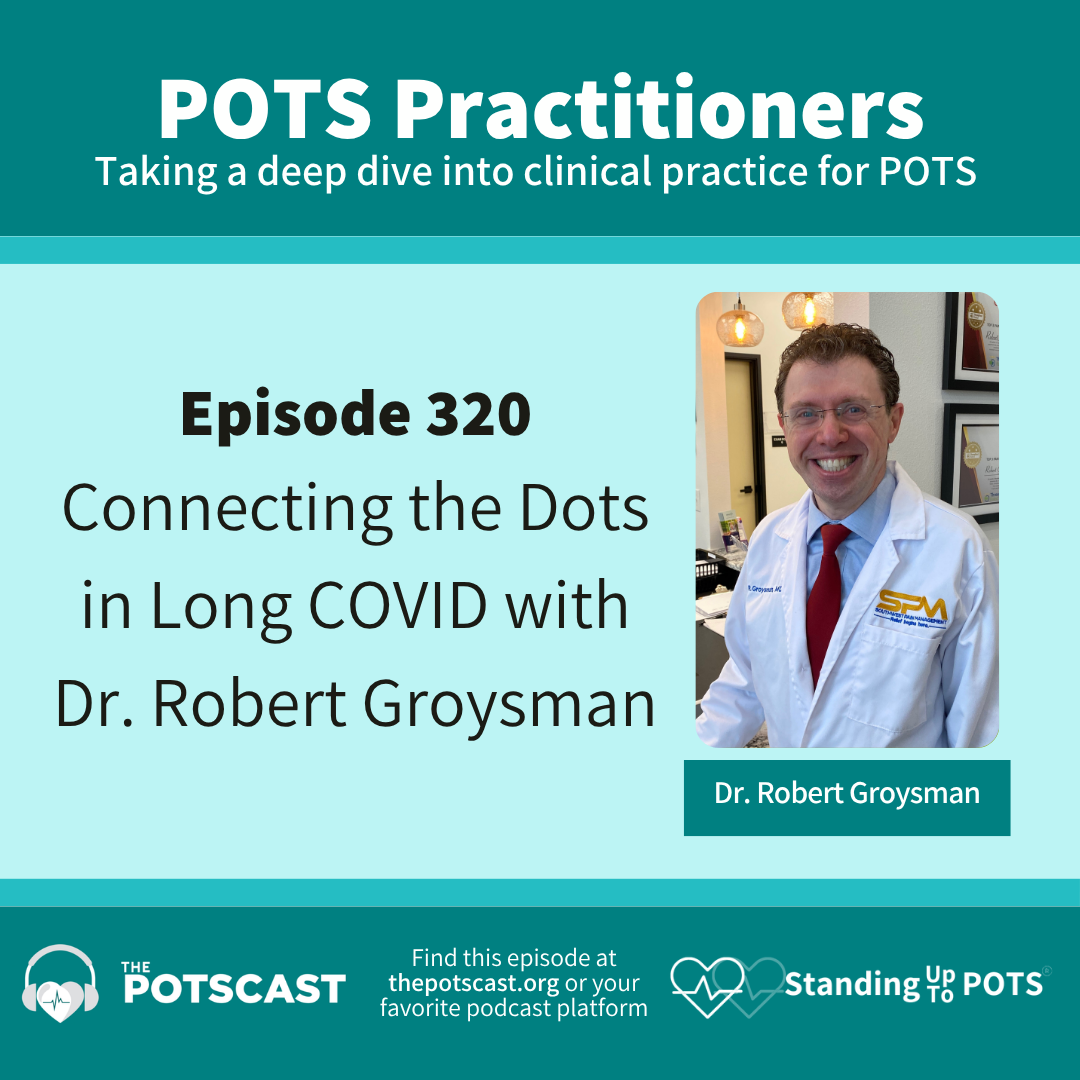
Connecting the Dots in Long COVID with Dr. Robert Groysman
July 28, 2026
After successfully treating his own Long COVID, founding the COVID Institute, treating hundreds of patients, and publishing the seven-volume Complete Long COVID Handbook series, Dr. Robert Groysman has published a peer-reviewed article in Frontiers in Medicine proposing a new way to understand Long COVID as a “network disorder.” In this episode, Dr. Groysman explains his mechanism-anchored model, in which six primary biological domains can interact with one another, amplify symptoms, and produce very different clinical presentations from patient to patient.
The six primary domains include dysautonomia/POTS, mitochondrial and bioenergetic dysfunction, endothelial and microvascular dysfunction, gut dysbiosis and barrier disruption, mast cell activation/histamine-mediated signaling, and neuroendocrine/hormonal dysregulation. Secondary amplifiers may include persistent immune activation, viral antigen persistence, autoantibody formation, neuroinflammation, sleep-related destabilization, and small fiber neuropathy.
Dr. Groysman discusses how this network model may help patients and clinicians move beyond symptom labels and toward more individualized, mechanism-informed evaluation and treatment strategies for Long COVID and related complex chronic presentations.
Dr. Groysman also offers an online community for patients to ask questions and have discussions with him (and other members) at Long COVID Family.
Episode Transcript
[00:00:00]
Jill Brook: Hello, fellow POTS patients, and beautiful people who care about POTS patients. I'm Jill Brook, your horizontal host, and today we are speaking with Dr. Robert Groysman about his new publication describing his proposed model of long COVID as a network disorder. Dr. Groysman's article was recently published in the journal Frontiers of Medicine, and there's a link in the show notes if you wanna check it out right now. And to give some background on Dr. Groysman and his paper, here is an excerpt from his website. Dr. Groysman didn't plan to specialize in long COVID . He was treating chronic pain and PTSD with interventional procedures when he contracted long COVID himself. His symptoms persisted. Traditional medicine had no answers, and he could have cycled through specialists, but instead he did something different. He researched the mechanisms himself. What he discovered changed everything. Long COVID [00:01:00] wasn't one problem. And that's where his paper today picks up. He has come up with a new framework that he has applied to long COVID. It also appears in his seven book series, the Complete Long COVID Handbook, published in 2024 to 2025. And now at his clinic in Plano, Texas, he offers what he needed when he was sick, which was answers. So Dr. Groysman is a diplomat of the American Board of Anesthesiology, diplomat of the American Board of Pain Medicine, member of React 19, member of the Long COVID Alliance. And he is the first doctor I have ever seen with a perfect five star Google Review score from 63 patients, as in not a single patient rated him less than five stars. So that's pretty amazing, Dr. Groysman. Thank you so much for being here today.
Dr. Robert Groysman: Thank you so much. I thank you for having me on. [00:02:00] So, start wherever you like and I'll I'll do my best to answer.
Jill Brook: Okay. Well, so I think a lot of people think of long COVID as like such a messy, complex disorder where a lot of patients don't look the same. They don't respond to treatments the same. The tests don't really show anything. And so I know that I've heard a number of doctors say that this is why they don't even believe that long COVID is a real thing, that they think it's just anxiety.
And so what intrigued me about your model is that it seems like it can really account, it can explain all that. And so I guess, I guess my first question is, is like, was that what you were up against when you were thinking about this model? Or what problem were you trying to solve when you decided that COVID needed a new, different model?
Dr. Robert Groysman: Well, well, at first all I was trying to do was find something that would help me and the patients that I was [00:03:00] seeing in my own practice and clinic. And what I realized fairly quickly is that what was currently out there was insufficient. It, it was missing too many details to be able to actually act on. So, where a lot of doctors, I guess, and patients fall through, and, and this goes to Occam's Razor, right, simplest solution is always, is always the right one. The problem is, is that long COVID is not a single entity, not a single illness. It is a syndrome. And this is why there's so many different presentations.
Each person is going to have different damage caused by COVID to different mechanisms, and therefore they're gonna present completely differently than from somebody sitting next to you. I mean, I can have 10 people in my waiting room, and all 10 of them have different strengths from each mechanism, different mechanisms and so forth.
So, when I was looking [00:04:00] at long COVID now, I realized that it wasn't gonna be a single upstream solution. That is one magic pill, one, one treatment, one supplement or, or set of supplements that is going to cure or, or treat long COVID. So, that's the very first thing you need to realize before you are able to actually get into long COVID or, or be able to treat long COVID, is that it is not a single solution syndrome.
Jill Brook: Yeah. And actually before we start explaining that, just so that everybody listening knows how much this might apply to things outside of long COVID, I know that for me, I have most of the mechanisms in your model, but I had them all 20, 30 years before long COVID came along. So do you think that your model applies to a lot of us who got basically this same cluster [00:05:00] of, you know, dysautonomia, POTS plus, you know, MCAS and various other things. Do you think that it, it applies to, to some of us who didn't get it from COVID?
Dr. Robert Groysman: Yes, I absolutely do think it applies to many other chronic conditions, including postviral syndromes. My next step will be to apply this to ME/CFS as well. But first, you know, when publishing studies, you have to be very specific in what you're talking about and can't be too broad.
So, so you mentioned POTS. So POTS in itself is a syndrome or, or an umbrella in itself. So, that's not, not a single cause for that either. So there's kind of umbrellas within umbrellas. Some, sometimes there's three sets of umbrellas before we, we actually get to the root of the issue.
Jill Brook: So let's kind of maybe help people understand more specifics of your model. [00:06:00] I know that you propose that long COVID is a network disorder sustained by interacting physiological systems. Can you maybe explain what that means?
Dr. Robert Groysman: Sure. So, when we think of network disorders, this comes from computers. So a node is an area that can interact with another node next to it, or even a node that's further away from it. There's communication both ways between each node. So, one node affects the other and, and vice versa. So that's, that's first.
Then there's modifiers and amplifiers that come in into the nodes to modify the response. So what's important to know about COVID or long COVID is number one, there's no single cause. So there's no point in looking for an upstream cause since there's [00:07:00] multiple mechanisms happening at the same time.
Number two, what you have to understand is no mechanism is superior to another. In one person, a mitochondrial dysfunction may be more of an issue. And it's affected by dysautonomia and it's affected by gut and it's affected by hormone imbalance as an example. In another person, they're more presenting like dysautonomia.
And like I said, with dysautonomia being an umbrella on top of POTS being an umbrella, you have the fight or flight, which is going to be more with anxiety, sleep problems, and easily startled, and hypervigilant kind of stuff, versus POTS, which is more gonna be orthostatic. Now, in, in practice, none of these dysautonomia conditions are going to be pure.
It's a hundred percent POTS, it's a hundred percent fight or flight. There's gonna be some combination of, of [00:08:00] multiple, multiple conditions in one. There may be one predominant one that's visible, but it's, it's rarely, if ever, a hundred percent pure into one category. So between, between the six main ones, which are dysautonomia, mitochondrial dysfunction, right, the, the gut, dysbiosis and sibo, and the hormonal imbalance and problems and endothelial dysfunction where there's either clots or poor flow, poor, poor oxygen delivery. So all of these are nodes in themselves. They, they do influence the other nodes around them, and they're influenced themselves by amplifiers and by by secondary mechanisms, not in importance, but the, they essentially magnify what, what's happening.
Jill Brook: So before we get into the amplifiers, one thing I loved about your paper was how it, [00:09:00] it gave some specific examples of how the different nodes can interact with one another and kind of almost, it seemed like turn into vicious cycles sometimes, or make each other worse.
Dr. Robert Groysman: That's, that's my third paper.
Jill Brook: Okay. And I know that like we've touched on some examples of that here on the POTScast. So we do a lot of talking about how MCAS can make POTS worse and how POTS can make MCAS worse. And your paper had all kinds of great examples. And so I know I don't wanna give away any fun stuff about your upcoming paper, but maybe could you give a couple more examples about how some of the different nodes can interact with one another?
Dr. Robert Groysman: I'm gonna be giving a presentation on this in Delaware next month. So, specifically relating to neuroinflammation, and that's what my third paper is about. But the way, the way this works is if there's a problem in your gut, whether it's in the colon or the small intestine, [00:10:00] your gut flora is actually communicating with other areas of your body. There's, there's what's called gut axes. So the gut communicates with the liver. The gut communicates with your lungs, with your heart. It's, it's something surprising, but one of the big ones that we worry about is brain. So it communicates with the brain multiple ways.
Number one, it communicates through the vagus nerve. So if there's a problem in the gut, it sends signals up to the brainstem to tell your brain that something's up, check it out. Number two is neurotransmitters. These these flora not only make vitamins that we use, but they also make neurotransmitters. They process neurotransmitters. So when that entire colony or environment changes, it also changes what the brain is receiving. Now, [00:11:00] the brain doesn't know what the alarm is necessarily, but it knows something is, is saying something is wrong. And the third, the third way that the gut can communicate with, with the brain is through blood.
So in, in this case, if you have leaky gut or, or substances that are debris from bacteria or, or viral debris can make its way into the bloodstream, especially during meals, since that's when your gut gets the most blood flow. And so if that gets to the brain now, it doesn't actually have to get through the blood brain barrier.
People make this mistake all the time. Now the blood brain barrier isn't like the, the wall of China, the Great Wall of China, okay? It's actually a living organ, believe it or not. It has immune cells inside it, and it has blood vessels, and they change and [00:12:00] alter even without something penetrating the blood brain barrier. So you don't actually have to get inside the brain to affect the brain.
Jill Brook: Okay. Okay.
Dr. Robert Groysman: So, so these toxins, for instance, can change the blood flow in the area. Okay, and they can cause localized inflammation because even though the microglia on the other side of the, on the other side of the blood brain barrier are not technically in contact with the problem.
Because of the proximity and because it gets the blood brain barrier excited, it will also activate the microglia. So in essence, you can cause inflammation in the brain without actually getting into the brain.
Jill Brook: Okay. Okay. That's so interesting. And this kind of speaks to just how deep and complex some of these interactions are between the systems. And, and I thought of a couple more examples. I know that, for example, Standing Up to POTS [00:13:00] is funding research right now looking into how micro clotting in pre COVID POTS patients' blood might be present and affecting their POTS.
And so, you know, it makes sense, at least theoretically that if somebody has overly clotty blood, that that would make their circulation worse and it could exacerbate POTS. And I know that there's some mast cell experts who also have theorized that having extra clotty blood could make your circulation worse and that could contribute to mast cells being less happy.
Dr. Robert Groysman: Well, yes. They're all interlinked. They're all interlinked. So I mean, when, when you think gut, you, you, you probably automatically think digestion and vitamins and nutrition. We don't typically think about brain and immune system, but your gut is probably one of the largest organs in your body for the immune system.
Mast cells congregate in the, in the gut. [00:14:00] They, they respond to what's being presented to them and that's why usually mast cell activation happens post-meal, from that trigger.
Jill Brook: Okay.
Dr. Robert Groysman: So yeah, I mean, mast cell is affected by mitochondria in order to keep the mast cell nice and happy and stable it needs energy. And if it doesn't have sufficient energy, can degranulate because of that.
So, with mast cells in general, it's not about the number of mast cells. We still have the same number of mast cells. The issue is, is that they have a hair trigger. They're, they're just like ready, they're itching to go. They're, they're just waiting for that opportunity to degranulate. If a lot of them degranulate at the same time, you get anaphylaxis and you end up in the ER. If only a few degranulate, then you'll have some symptoms, but not the full anaphylactic episode, which, thank God we don't see that that often in long COVID.
Jill Brook: [00:15:00] Okay. Yeah, so, so every node can affect every other node, but but that doesn't completely account for the model. Now you also bring in, I think, what you call amplifiers. Can, can you talk about the other pieces?
Dr. Robert Groysman: Yes. So amplifiers can be, for instance, things like connective tissue disease as an example. And neuroinflammation can, can also be an amplifier, even though it could be caused and then amplify the original problem, even if you remove the original signal.
Jill Brook: And that sounds like a bummer because I think what you're saying is that once the COVID is long gone, you can still have all these problems.
Dr. Robert Groysman: But that's the essence of long COVID. It's these persistent loops that continue despite the original triggers gone, which is COVID. But the loops continue. So I explained that in the next two papers that [00:16:00] are hopefully gonna be published soon. So viral antigens, okay, so if there's any debris that connect as an amplifier, right?
Jill Brook: Mm-hmm.
Dr. Robert Groysman: Any, any antibodies or auto antibodies, that can act as an amplifier. And the big one is small fiber neuropathy because that links with dysautonomia and mast cells and connective tissue disease.
Jill Brook: Okay. Can you explain that more?
Dr. Robert Groysman: Well, small fiber neuropathy in long COVID a lot of the time is going to be functional. So even if you do a, a biopsy of the ankle and the thigh and maybe the back of the neck you won't find actual decrease in number of nerve endings, okay. You can. You still can, and you can still have small fiber neuropathy, the real kind, the classic kind. But more often than not, what I'm seeing is the functional kind. So what causes functional problems [00:17:00] with nerve endings? Well, one is deficiency in, in vitamins. During COVID or during long COVID, you can have trouble absorbing and processing certain vitamins and that can cause a problem.
Dysautonomia is, is obviously linked to small fiber neuropathy because that's, that's part of the autonomic nervous system. You mentioned clots. So if you don't get proper nutrition support to the nerves, they're also going to misfire and misbehave. And what the nerves do when they misbehave, they either go numb, they cause pain, or they cause pins and needles.
Those are, those are three, but in any combination of those. Pretty unusual to see true weakness, but it does happen. But there's a, there's a layer on top of each nerve called the vaso vasorum, and it kind of looks like like a netting that surrounds the nerve from all sides [00:18:00] and kind of looks like yeah, like netting.
And those are all blood vessels. And even if the nerve is perfectly fine, even if there's nothing wrong with the nerve, if you're not getting enough oxygen and nutrition, it's still not gonna work right. So it creates this kind of dichotomy when you do EMGs and nerve conduction and looks normal, especially in small cover neuropathy.
And you may do some other testing or imaging, and the nerve does not appear abnormal, but yet the patient still has these symptoms. Well, that in those cases it could be functional.
Jill Brook: That makes so much sense and I've never heard anybody talk about that before.
Dr. Robert Groysman: You know what histamine does to nerves?
Jill Brook: What.
Dr. Robert Groysman: Nerves don't like histamine. Most people associate histamine with with itching, but it actually cause pain. So remember, mast cells live in connective tissue. They, they, [00:19:00] they typically don't float around in the, in the bloodstream. They mostly move around in connective tissue from one area to another. And if the, the area is rich in mast cells plus nerves, that's a bad combination, when you have the mast cells basically spitting up every, every few minutes or every couple hours. Your nerves are not going to be very pleased. And they're gonna tell you about it by hurting or feeling pins and needles or, or more.
Jill Brook: Mm-hmm. Wow. So the nerves really get hit from a lot of different sides.
Dr. Robert Groysman: That's the problem. So you can have the same, the same issue, small fiber neuropathy, but it could be caused by multiple different mechanisms.
Jill Brook: So once you have this model in mind or other clinicians do, how do you use it when you see a new long COVID patient in front of you?
Dr. Robert Groysman: So that's, that's paper number two is how to apply it clinically, [00:20:00] okay. And, like I said, it's already, it's already at the, at the journal. They're still doing their editorial review. But essentially what I'm doing is I'm not looking at a symptom in isolation or, or groups or clusters of symptoms. As, as you, as you've read in the paper, that may be fine for phenotypes.
Jill Brook: Mm-hmm.
Dr. Robert Groysman: But it's not, it's not, it doesn't exactly reflect the biological causes, and that's what I'm after. I'm after treating everyone who falls into this biological bucket.
Jill Brook: Yeah.
Dr. Robert Groysman: And the way to determine that is to look at triggers, is to look at timing, and to look at position.
Okay? So, these, these three things, triggers more so than than timing, but they help you localize which mechanisms are most likely involved. Once you know that you can test the mechanism or mechanisms to see [00:21:00] if you are right, and that's the correct approach, the person gets better or you start treatment and nothing changes.
And then you have to revise your hypothesis. But yeah, so it's not, it's not a perfect system, but it's hell of a lot better than just relying on symptom clusters.
Jill Brook: Yeah.
Dr. Robert Groysman: That combines a bunch of different biologically. I, I just showed you a small fiber neuropathy. So if you took, if you took let's say a hundred patients with small fiber neuropathy, well you don't know if some of them are caused by diabetes preexisting, if some of them have micro clots or, or blood delivery problem.
Some of them have mast cell issues. If some of them have dysautonomia on top of the small fiber neuropathy and all of those are lumped together into one phenotypic group, small fiber neuropathy. They have pins and needles and pain in their extremities. But the treatment is gonna be very different for each one [00:22:00] of them.
And that's my whole point. And the whole point of this paper is to show that if you just rely on phenotypes the way things look, you're going to combine biological groups that are very distinct and, and dissimilar, which means even if you are successful at treatment, it's gonna get diluted if you combine it into the full phenotype.
So you may help, let's say the micro clot group, but there's only 10 people who are micro clot. But you have 90 others who are not gonna see any benefit whatsoever. So the study looks like it failed.
Jill Brook: Right, right.
Dr. Robert Groysman: Because you combine biologic groups, biological buckets, instead of isolating by mechanism. That's the point of this model is to, to be able to separate through the mechanisms and then to do the study on that enriched group.
So now that you know that everyone in this group has the same [00:23:00] biological problem, that's what you're going to trial your, your medication or your treatment or whatever it is. And then you'll know if it's actually helping or not.
Jill Brook: And that's so huge. One thing that we've had brought up on this podcast a number of times before, which is not even specific to long COVID, but just in the, the trifecta space, that oftentimes you will test a new treatment, and on average it'll look like it totally failed, but it might've really, really helped 10% of the patients.
And, you know, in a, in a controlled trial, that still looks like a failure on average, but you're saying if you group people more carefully and you get the mechanism right now you can start to, to test a treatment against the relevant mechanism and you won't have the same problem in your treatment trials.
Dr. Robert Groysman: That's exactly right.
Jill Brook: Yeah. So our audience is gonna be very familiar with the [00:24:00] testing for dysautonomia and the testing for Mast Cell Activation Syndrome, but your paper talks about some testing that I think is foreign to most of us in some of the other areas, for example, the endothelial damage and the micro clotting.
How do you try to figure out if that's somebody's issue?
Dr. Robert Groysman: So there's, at least in my practice, I use four core markers. Now, they're not biomarkers or anything, but if, if more than one is elevated or abnormal or if at least one core plus several ancillary abnormal, then I, I, I look at endothelial more seriously. Now, me personally, I, I stratify patients into four tiers.
So first off, you know who, who, who would be considered to have an endothelial problem? Well, the problem is it's not always obvious. [00:25:00] Yes, the classic symptoms are gonna be shortness of breath, on exertion especially, or chest discomfort, chest tightness. Those are common. Also, livedo reticularis rash. That kind of looks like a mottled appearance. And some people will have either Raynaud’s, their fingers turn white, red, blue, purple, or the toes. That's the most common area we see. Changes in temperature will cause a, a change in color. Now, all these are clues. They're not definitive diagnostics, okay?
So you still can't say, yeah, this person has endothelial dysfunction. But that's why my stratification system works, is what I'm looking for is these four core values, number one. Plus I combine it with the nailfold capillaroscopy test that I do in my clinic, in my office. And we actually don't charge for that. I do that on every, every patient.
Jill Brook: And what is that? Just like a little gadget you have.
Dr. Robert Groysman: No, no. So what this [00:26:00] is, is this is a tool that's been used by rheumatologist for diagnosing scleroderma. Okay. However, I I repurposed it for endothelial dysfunction. And here's how I did this. I'm looking at the nail fold, okay? And this is the area just before the cuticle.
So you have little capillaries there, and they're very, very thin, and they go towards the cuticle and there's no place else to go because the cuticle is technically dead. So it has to make a u-turn. So it makes a loop and comes right back to the, to the rest of the finger. Now you can't see them with the naked eye.
You have to have significant magnification, at least about 200 times. Okay? So that's what I'm doing. I'm using a digital microscope to examine this nail fold area. So what what this tells me is, is if there's damage to the loops in a specific pattern, then there's a good [00:27:00] chance that this is happening elsewhere, in your brain, in your heart, in your liver. But you can't exactly take a biopsy of those areas safely and not invasively.
So the only time this is I guess, thwarted, and not as accurate as if you are really traumatic with your nails. I mean, you're, you're working, you're working a lot with your hands and that area is beat up, or you're pushing back the cuticle super aggressively. So that can cause damage without meaning anything else.
It's just damaged for, for damage sake. So what I'm looking for is sluggish flow. Okay? So you can actually see red cells moving with each beat of the heart in a line. There'll be areas with no blood flow at all. Okay? And those, that's called ghosting.
Jill Brook: Okay.
Dr. Robert Groysman: You'll see dilated loops. So the loops normally are nice and thin and straight, and in, in damaged cases you'll see them dilated.
You'll [00:28:00] also see spiraling of these, of these loops. Like I said, it really should look like a forest. You walk up to it and all the trees are straight and straight up. But some people you, you walk up to the forest and there's only bushes there. So these loops are cut short. It's like they've been damaged repeatedly over and over again, and they break down.
The worst case scenario is there's nothing there. You look and it's barren. So no, no trees, no bushes, no nothing. Okay. That's kind of the worst. Well, that means that you've had so much damage, so much scarring that like I said, unless you're really beating up your, your nails or the, the cuticle area.
It, it would, it would somewhat reflect what's going on in the rest of your body. So we look for new blood vessel generation. It's called angiogenesis. And that happens where instead of just being straight up and down, you start getting little branches [00:29:00] forming like branch loops forming off the main loop.
So that tells me that there was damage chronically, I mean it is damage, repair, damage, repair. It's trying to reestablish the blood flow.
Jill Brook: Kind of like the collaterals that they talk about in people who have the venous outflow disorders.
Dr. Robert Groysman: Okay. Yes. I thought you were going with the coronaries because if people form, form collaterals, it doesn't really matter if the main one gets blocked off since you still could feed the heart. But yes, it's blood vessel growth someplace where it doesn't belong or it's not normal to see.
So one of the, one of the ancillary markers that I look for is VEGF that is released by endothelial cells.
Jill Brook: Ah.
Dr. Robert Groysman: Okay? So if there's damage there, you're going to have spillage and you're gonna have elevated VEGF levels. I also look at D-dimer, look at fibrinogen, and several [00:30:00] others. But the point is, it's a gestalt of several different things, not just one thing, not just labs, not just nail fold, not just symptoms.
It's all combined. And all combined, I have a system where I assign them to one of four tiers. The, the more advanced the tier, the more aggressive treatment is. So I, I know some people are treating it like, you know. Basically one treatment no matter what it is. You have microclots, you have endothelial, and you only get one treatment. It's universal. But for me, I prefer to treat it more conservatively if it's not as severe. So you don't need as much. And treatments for endothelial dysfunction of micro clots are not benign. Okay? Being on an anticoagulant, being on a fibrinolytic, being on an antiplatelet greatly increases your risk for bleeding.
And I'm not just talking about like nose bleeds [00:31:00] and bleeding outta your ears or eyes, or when you brush your teeth, I'm talking about if you bump something or do some minor trauma and the bleeding does not stop.
Jill Brook: Yeah.
Dr. Robert Groysman: That you know, that's not, that's a real risk. That's a real risk. And God forbid you're in a car accident, the chances of you surviving that, even if it's minor, it's gonna be significantly reduced. So because of that, I, I think long and hard and really want to qualify people into the higher tiers before actually going out and putting them on anticoagulants, antiplatelet agents, and fibrinolytics, right. So that, that's, that's kind of how my, my setup works. And it's, it's objective.
Okay. So it's not like how I feel about it. You have to, once you meet the criteria, you go into this tier and that's it. It's you know, I don't think, like, you know what Mr. Smith, I think, you know, I think I'm gonna put 'em in tier two. No, it doesn't [00:32:00] work. It's, it's, it's independent of me. It's, it's just on the data. Okay, so the data controls the, the tier level.
Jill Brook: Yeah, no, this, this sounds huge. You know, as I mentioned Standing Up to POTS has funded some research to look at micro clotting in patients with POTS before COVID and I think this might turn out to be a big thing. And so will you, will you be including this in any of your papers so that other practitioners can learn how you do this?
Dr. Robert Groysman: I haven't gotten to write the, the endothelial part yet.
Jill Brook: Okay. It sounds, it sounds so important, and it sounds like you've really taken a look at it. Is anybody else looking at the nail fold capillaries like you are, or did you learn to do this?
Dr. Robert Groysman: I learned to do this from, I guess, you know, rheumatologists, like I said, they use it for, for scleroderma. It's a connective [00:33:00] tissue disorder and it damages those blood vessels. But I, I thought about it and I found that you could repurpose it for looking at endothelial dysfunction, especially microcirculation like capillaries.
So it's not validated yet. But the, the point is, is that I am seeing some changes and typically if I don't see any problems there, the person is not gonna have any vascular issues.
Jill Brook: Okay. Are you using any other tests that you think are really helpful that maybe other people are not using enough?
Dr. Robert Groysman: So if I think about all the mechanisms that that I process and, you know, in my, in my, in my clinic, in my practice, I do look at every single one. Not just the core six, but also the amplifiers and everything else as well. But for dysautonomia, [00:34:00] yes, there's the tilt table test. I prefer, I prefer the lean test, NASA Lean test over it because it's more real world conditions.
Jill Brook: Mm-hmm.
Dr. Robert Groysman: Since you're actually standing not being strapped to a table.
There is pseudo-motor testing for that as well if you want to look at sweat production to a stimulus, for instance. So sweat glands are part of the autonomic nervous system. Usually if you have small fiber neuropathies affecting your sweat glands too, so you can have abnormal sweat responses.
Jill Brook: Mm-hmm. I was gonna ask about any of the auto antibodies that you look at as amplifiers. Is, is it specific ones or is it not even available yet because they would be COVID specific and too new to have any testing, or is there any testing available for that?
Dr. Robert Groysman: So auto antibodies generally fall into the [00:35:00] rheumatology category or allergy/immunology. And people don't realize, but we have tons and tons of antibodies floating around the system. Some of them are autoantibodies against self, but most of the time they don't do anything. They don't activate a receptor, they don't bind to anything and they're there, but it is more of like an onlooker thing. So far there's been no association or correlation of any specific antibody with long COVID or any of the specific, I guess, phenotypes. I use endotypes, though. Endotypes work on biology. Phenotype works on what you observe. So nobody's really, I think nobody's really looked at endotypes in terms of, is there a particular one that causes an issue? Yes, there's antimuscarinic and anti adrenergic antibodies found. But are [00:36:00] they significant or do they cause a problem? We don't know yet. Nothing I've read so far shows if that's, if just because their presence is there doesn't mean they're actually causing a problem, and that's the rub.
Just because you see something wrong doesn't mean it's actually a problem. So when you, you know, I tell patients all the time when you order, you know, a thousand labs, even, even if nothing is wrong, I promise you 10% will come back abnormal. Some of them are gonna be false positives, okay. And what do you do about it?
You know, what do you do with these abnormal values? You know, a lot of doctors will say, I don't know.
Jill Brook: Yeah. Yeah. You have so few tests and imperfect ones.
Dr. Robert Groysman: But here's the thing. Now that you got 10% that's positive, now you're gonna go down that rabbit hole. You're gonna, you're gonna do more tests, you're gonna do more imaging, you're gonna do [00:37:00] biopsies or whatever else the test requires. And most of the time you're gonna end up at the bottom of an empty well, and you spent a ton of money and a ton of time and probably significant discomfort, and you really didn't have anything to show for it.
But that's why I try to really, you know, a lot of patients, they, they equate the number of tests ordered to how smart a doctor is, how good a doctor is. The more tests they ordered, the better the doctor is. They must really care. You know, they, they ordered, they ordered 20,000 blood work tests.
I mean, I have, I have like half a pint of blood left, but I'm gonna definitely know the answer. But it doesn't take a genius to order labs, okay? You, you can even, you, you know, you can even put it up on the board and throw darts. Wherever it lands, that's what you order. There's no, there's no thought process behind there. The thought process is deciding which labs you need.
Jill Brook: Yeah.
Dr. Robert Groysman: That's, that's the hard part [00:38:00] is figuring out which labs you need and only order the ones you need. And you should, you should have an internal question in your, in your mind. If this test come back this, I'm gonna do this. And if this test come back that I'm gonna do that.
If the answer is, if this test comes back A, I'm gonna do A, and if this test comes back B, I'm gonna do A, then why are you ordering the test? Okay. So it has to change what you're going to do. It has to change the treatment, it has to change the imaging. Has to alter you the doctor's behavior in some way, otherwise there's no point in ordering. I don't like these fishing expeditions. You know, some patients send me a stack of more than a thousand pages of labs. What do you do with those? Okay, some of them are gonna be abnormal. Okay, but what do you do with them? Why were they ordered? What question was asked before you ordered them?
Or did you just pick labs and order them for the sake of ordering them? [00:39:00] See what I mean? That's, that's sort of the, the big conundrum with diagnostics.
Jill Brook: Especially 'cause I think anybody who remembers their statistics 1 0 1 will know that most of these tests are calibrated so that 5% of the time a result is basically considered abnormal, just by chance. And so if you have a hundred tests done, then on average five of those, you know, will, will not really be accurate, but you won't know which ones.
Dr. Robert Groysman: People don't realize that none of the tests, no matter whether it's a blood test or an imaging, none of them are a hundred percent sensitivity and a hundred percent specificity, okay? So there is an error built in, not because it was purposely put there, but because no test is perfect. No lab is perfect, no test is perfect. And therefore a certain percentage, like you said, just due to [00:40:00] statistics alone, is gonna be a false positive or a false negative.
And the problem is, is the more you order, the more that's gonna happen. And again, you, you end up chasing ghosts or these red herrings and the majority of the time you, you, you spend a lot more money, a lot more discomfort, a lot more time chasing something that really isn't there. It's an echo.
Jill Brook: So can I ask you if you have a patient come in who's really complex, really severe, and maybe has most of the nodes and amplifiers present, do you have some favorite places to start where you're like, okay, I think I can have some easy wins here or there, and start kind of undoing this mess.
Dr. Robert Groysman: So the reason I chose these six nodes is because they're all actionable. So if I diagnose you with something, but I can't do anything about it, what's the point? Okay, great, you can jot down on your notebook, I have this mechanism. Wonderful. [00:41:00] But if you can't do anything about it, then what's the point?
So all of these are actionable and depending on what the pattern shows, and it's all about patterns, I will target the most problematic one first, and then I will start peeling back the layers. It's like peeling an onion, okay? So we take off the, the first cover, and then we see something else underneath, and then we start working on that.
So each person is gonna have a different strength or different intensity for each of these nodes, okay? That doesn't mean that each person is gonna have all six, okay? Some people have two, some people have all six, some people have four. In very minority you'll have somebody who has only one, but it does happen.
And then I also look at the secondaries, the amplifiers. The amplifiers I don't treat until we've done with the nodes first. So I want to [00:42:00] stop the loop first before moving on to the thing that's kind of making it angry as a secondary mechanism. So, just, just a reminder that they're all equally important.
Okay, the amplifiers, the, the primary nodes. There's no difference in importance here. Okay, but the order matters. What you're treating first matters. What you're treating multiple of matters. And to decide what to tackle first, I, I look at the pattern for the patient. What their symptom pattern is, what the trigger pattern is, what the timing is, what the positional issues is.
Is it better standing up or laying down? These symptoms start to get worse when you're laying down. So there's a lot of, a lot of things that go into I guess my machinations when I, when I come up with the solutions, but I consider all this stuff. For every single patient, I consider all this stuff. And of course, the toughest [00:43:00] question is, is, you know, do I have long COVID?
Well, you may have had some preexisting problems, like you said. You can have mast cell problems, mast cell activation. You can have EDS or HEDS or other connective tissue problems. You can have POTS or dysautonomia preexisting. So then you have to decide what is actually actionable. So if you had something that's structurally damaged, is that something you're gonna be able to repair, you know, 30 years after, kind of thing?
Or is this a functional problem that's gonna reverse relatively quickly if you correct the, the problem? That decision makes a huge difference because if you're chasing something that's structurally damaged and can't necessarily be fully repaired, you're not gonna see a huge improvement in symptoms.
But if you target something that's functional or recently damaged, newly damaged, those you can, you can [00:44:00] reverse or, or treat relatively quickly. I'm, I'm of the mindset that I think we can, we can technically stop ME/CFS early, early, and potentially even reverse it from setting up shop.
The, the reason I say that is because, this is, this is my third paper. But I don't mention ME/CFS specifically, like I said, because I don't want to you know, pollute the, the hypothesis. But my, my, my hypothesis here is, is that the ME/CFS is very similar to how long COVID sets up. And the problem is it's not always a ongoing trigger.
Yes, Epstein-Barr absolutely can, can, can reactivate and remain activated and can cause problems and can drive ME/CFS, but not every case of ME/CFS is caused by Epstein-Barr, right? There's also cases caused by enterovirus. There's [00:45:00] cases that are caused by, who knows? There's no, there's no viral identified component, and yet the person still makes the diagnosis ME/CFS. My point is, is that these same mechanisms are involved, okay. Maybe slightly in a different order. Maybe we change which ones the nodes, which ones are the amplifiers, but they're, they're all there. And once these loops set up and become more resistant, it's much more difficult to break those loops.
Okay. And I'm talking about years, not a couple of months or, or even, you know, three or four years. I'm talking about 20, 30, 40 years. You know, if you had ME/CFS for 40 years, it's much more difficult to be able to get you out of it.
Jill Brook: Mm-hmm.
Dr. Robert Groysman: Not because you are sicker, it's just because your body's gotten used to these loops being there for a very long time.
And even if you break the loops, they just reform because it's [00:46:00] memory. The initial trigger is no longer there. It's long gone. But yet your body remembers it. Your brain remembers it, and in susceptible patients, they have this repeated loop that, that occurs, or loops, I should say. It's not a single loop.
It really is multiple loops that's driving this. And early treatment, early intervention, I believe, can stop that from happening. Now, the problem is, is we mainly treat ME/CFS symptomatically, right. If you're tired, fatigued, what do you get? You get Adderall, you get some other stimulant, right? If you have POTS, it's treated like, like, like normally we treat POTS, right?
Then we have a couple of the low dose stuff like low, low dose naltrexone, low dose Abilify, a few others similar to that. So it, it's very [00:47:00] symptomatic. It's not driven by, by mechanisms like the treatment. And yes, I think now people realize that pacing is very, very important and that is a protective mechanism, okay?
It is not a treatment. It is a protective mechanism for causing additional damage, that's all. So, you can prevent from your baseline, from declining any further or declining at all, if you do it early enough. Can you prevent every single PEM episode? Of course not. That's impossible. But you can come pretty close.
You can come pretty close. That's part of it, okay, pacing should be, should be the first thing on every mitochondrial dysfunction plus ME/CFS patients should should know pacing inside and out. You can use spoons. You, I mean, there's a lot of different, different ways to do it, but the point is, is not to hit that wall. Because once you hit that wall there's no going back, you're gonna crash. [00:48:00] You can't undo that. The only thing you could do is prevent yourself from hitting that wall potentially. And that's also getting to know your body really, really well.
Jill Brook: Mm-hmm.
Dr. Robert Groysman: And understanding your body signals and when you're getting close when that wall is, you know, visible now.
And we don't wanna smack our, our skull into it.
Jill Brook: Yeah.
Dr. Robert Groysman: I do think, I do think I'll be able to make some, some, some stuff happen for ME/CFS as well. But I really think if we, if we engage early, early, like within the first few years, I think there's a possibility of reversal there.
Jill Brook: Wow, that's so hopeful. So what I'm hearing is early and think about the mechanisms, not just the symptom clusters.
Dr. Robert Groysman: Yes, yes, if you stop the mechanisms, if you stop the loops early on, those loops never cement themselves in and therefore the condition kind of resolves. Now, I'm not gonna say cured, okay. [00:49:00] What I'm saying is, is remission, okay? Because I have no idea what the future holds, if you can completely, fully repair everything.
I mean, in a susceptible individual, whether it's ME/CFS or long COVID, there's something about them that makes them more likely to develop these conditions because other people get COVID, other people get Epstein-Barr and, and enterovirus, and they don't develop these conditions. We haven't identified what this is.
It's probably not gonna be one single thing. Just like, just like the, the other stuff I was telling you. It's not gonna be a, a single problem. But there, there likely is a set of rules that if you have this, this, and this, your risk increases. So you can't do anything about that part, okay?
That's the hand you're dealt, whether it's genetics or whatever. But the point is, is you can't necessarily undo that part. But what you could do is you could stop these loops from cementing themselves early on. [00:50:00] And they, they take a long time to start setting up shop, okay. Even if they develop, I, I still think that a considerable amount of time has to pass of doing absolutely nothing about the loops before they're much more resistant.
Jill Brook: Mm-hmm.
Dr. Robert Groysman: So I do think if we act early, if we diagnose better. I mean, a lot of patients, they, they, they hop from doctor to doctor. They have ME/CFS, but nobody actually gives 'em the diagnosis. And, and lo and behold, they, you know, they bounced around for the last 10 years. Nobody told them about any, any of this stuff. And the damage is done.
Jill Brook: Mm-hmm.
Dr. Robert Groysman: So my goal is to intercept it as early as possible, work on those mechanisms early as possible. Break those loops and keep them broken, okay. Keep them broken. That's the most important thing. That's why I call remission, okay? That's what I'm gonna call remission from this condition.[00:51:00]
And if it flares up, we treat, we, we keep breaking those loops. We don't let it, we don't give 'em an opportunity to set up. That's all. And, and it's, it's a different way to manage it. I'm not managing the brain fog with stimulants. I'm not managing the fatigue with stimulants. And I'm not managing sleep with medications. I am breaking the reason for those things.
Jill Brook: Because you're thinking about the mechanism, not just stopping the symptom.
Dr. Robert Groysman: Yes, i'm actually figuring out what's causing it and then breaking the issue or fixing the issue, I should say that's causing it.
Jill Brook: Yeah.
Dr. Robert Groysman: Look, like I said, if you have a structural damage, a significant structural damage, I mean, you're not gonna repair that, okay? If you have your arm lopped off, you're not gonna grow a new one, right? So, I mean, the same thing happens on a cellular level as well. So [00:52:00] if there's significant damage, you can't always completely repair. But if you had a stroke and you go through physical therapy and you go through rehab, you can regain function of your arm, you can regain function of your legs and so forth.
So that's what we're doing. We're, we're using kind of alternate ways to work around the damage that we can't fix. Sometimes we can't. Some damage we can, like mitochondria. If you're born with damaged mitochondria, okay, so you know that all your mitochondria, every single one in your body comes from your mom, from the egg.
The sperm doesn't provide any, any organelles. All it does is provide the DNA, that's it. The 23 pairs of chromosomes. That's it. The mom's egg or the female egg, right, is what provides all the organelles. So you need, you need a template to build from. You can't make mitochondria from scratch, partly because it has its own double strand of DNA inside the mitochondria.
Now, [00:53:00] most of the genes for the mitochondria have been moved to our genome, but there's still that double strand of DNA, that if you don't have it, you can't make a mitochondria, okay? So this is the only organelle in our body that has DNA.
Jill Brook: Okay.
Dr. Robert Groysman: So you weren't born with damaged mitochondria. If you were, there's not a whole lot you can do about it, because every single copy is gonna be bad, okay, or, or relatively, I mean, sometimes there's chimeras where you have like some, some are good, some are bad. But my point is, is they're, they're inherently damaged.
Jill Brook: Okay.
Dr. Robert Groysman: People with long COVID, people with ME/CFS, they don't have, they're not born with damaged mitochondria. They're damaged after the fact. So as long as we have a working copy, a clean copy, you can rebuild the mitochondrial workforce from those.[00:54:00]
Jill Brook: Oh, that's very hopeful.
Dr. Robert Groysman: So that's why I said early onset is better because guess what happens of 10 years of destroying your mitochondria or 20 years of destroying your mitochondria. You may not have anything left to use.
So another possible treatment may be to introduce an external mitochondrial system that will replicate. There's no reason we couldn't.
Jill Brook: Oh, that's intriguing.
Dr. Robert Groysman: There's no reason that we couldn't. But my point is, is something like that can even probably help those, those kids that are born with damaged mitochondria. So all mitochondria are relatively the same. Of course, there's, there's, there's, there's differences in lineage just like there is in, in our DNA.
But I don't know, for instance if if there's any chance for your body to reject a mitochondrion since it lives inside the cell. it's not really exposed to your immune system per se. But I'm just thinking, kind [00:55:00] of thinking out loud that, that, that could be a possibility.
But for, for most people who haven't damaged every single one yet, there's definite, definite hope, because even if you have one or two that are still healthy and working, you can rebuild your workforce. They're all clones. They're all clones of each other. So your, your, your ovum the egg provides the initial seed, right?
You know, several thousand mitochondria. And from that, you, you, you create all the other ones in the rest of your body. So they're all clones of each other, which is kind of neat. But as long as you have a functional working healthy mitochondria, it can, it can make more of itself. It can split. It can actually bud and divide into into multiple copies of itself.
Jill Brook: Wow. Well, this sounds amazing. And I mean, I, I love how much fresh and independent thinking you're doing on all of these parts that are involved with long COVID [00:56:00] and just for a lot of us, you know, you can call it the trifecta plus, or, or whatever, you know, whatever you wanna call the, the cluster of things that we have.
But I, I know that I need to let you go soon, but can you just tell people about your long COVID handbooks? Because I think you have a seven book series that goes deep on all your thinking, right? So people who are listening saying, wow, I wanna, I wanna hear more.
Dr. Robert Groysman: Sure. So when I first started, everything looked like it was gonna be dysautonomia. The one, the one master mechanism that was responsible for all long COVID. But as time went on and I was reading and researching more, I realized, you know what, that can't be all it, all it is. And then I found mitochondrial dysfunction because COVID damages mitochondria.
And again, I thought, okay, it's these two mechanisms. Definitely these two mechanisms. And then gut came in. So if you notice the order, that was the order of [00:57:00] discovery, okay. So, so it is funny, these seven books kind of followed the order of me discovering these mechanisms over time. So it started with dysautonomia, it went to mitochondrial dysfunction, then gut, then then it was mast cell. It's very much associated with gut too. And then we had the endothelial dysfunction, micro clots, and then the hormonal. So that was the order, and that's why I brought 'em in that order. So the purpose of these books is the, the first volume is all around. So it, it talks about all the mechanisms, but just not in detail.
So if somebody is more interested in one particular mechanism, that's what each of the books does, is it goes down the rabbit hole for each one to explain what exactly COVID does, what happens in long COVID. Why does this mechanism cause long COVID? So in essence, long COVID is a collection of these mechanisms gone wrong.
And the result of [00:58:00] that is long COVID. I'm working on a two volume series that's gonna be a little bit more in depth. So these are gonna be large books, okay. I'm warning people now. It's gonna be over 800 pages. These are eight and a half by 11, okay? These are these are gonna be textbook size, but it's gonna be fully cited and referenced, so you can see where I'm getting this information from. But the, the only, the only difference is, is you're gonna be seeing my, my kind of unique ideas in how I apply it. So, volume one is gonna be talking about the mechanism, the triggers, the timing, all that stuff. And volume two is gonna be talking about all of the treatments and, and how that works.
I had to split them because it would be way too big, otherwise. It's already way too big. But I don't know what else to eliminate. I, I also map every single symptom, even though I, I don't encourage this, patients like this. Every single [00:59:00] symptom and how each mechanism causes it. So you can look up any symptom, all 234 of them.
I, I, I know they only logged 203, but I've, I've logged 234 and each one is explaining how it maps to each mechanism. So if you're curious, like, I have this, what could cause it, there's a whole section in volume one. It's part three. It's a long section. It it actually takes 600 pages just for that alone.
It's more of a reference though. So it's not meant to be read from, you know, from if when you read part three, you shouldn't be reading page one to the end. The point is it's a reference. You can index it or look in the index or the table of contents, find your symptom or symptoms, and then look up what mechanisms can cause it and how. The other thing I'm, I'm, I'm writing is a mitophagy specific book for chronic illness. So I really go [01:00:00] into a lot of depth in how this mechanism works, why it works, why it gets broken in these conditions. Not just long COVID, I'm talking about ME/CFS and many other postviral syndromes and what happens, why this stuff happens? How do you fix it? How do you treat it? So, a lot of, a lot of the stuff is more so than the volume two with the mitochondrial dysfunction. I go into more detail in how your body repairs in general. This is not an anti-aging book. This is not a wellness book. This is about what happens to your body when you have a chronic illness.
It doesn't have to be long COVID or, or ME/CFS, but really any, any chronic illness. Your body goes through this. And when I was thinking about this while I was working on this book, it's not finished yet, but my, my mindset was like, I don't wanna, I don't wanna deal with anti-aging, okay? I am not interested in talking about, you know, [01:01:00] getting younger or anything here.
And I'm not interested in wellness applications. I'm interested in showing people what happens to their bodies during chronic illness and what to do about it. So that's, that's kind of a different take on all of this. It's gonna have different information and a different way to look at it.
I don't think they're gonna come out before 2027? Okay. I'm still nowhere near happy with with where they are. So I have a lot of work still to do, and so yeah, that's hopefully gonna be out in 2027, if things go right. So my brain, like, I wake up in the middle of the night and I have this idea, like it comes outta nowhere. I have to sit down and write it down or dictate it, or else I'm gonna forget it, you know, I'll go back to sleep and I'm like, what was that idea that I thought of last night?
So, so, yeah, so these are like little epiphanies that I have because I, I have all this information floating [01:02:00] around and it clicks at some point and it makes sense all of a sudden.
Jill Brook: Yeah. Well, we'll put a link for people so that they can find your handbooks, that they can find your article that has been published. As soon as your other articles get published, we'll add those links.
Dr. Robert Groysman: I hope so. I'm, I'm crossing my fingers here since you guys can't see, but like I said, I have, I have four more articles sitting out there hoping they're gonna pass editorial review, gonna pass peer review, and, and then hopefully get published. But it's not an easy process. It takes several months and usually the reviewers aren't happy about something or have a critique that you have to address or explain.
It's really very similar to defending a PhD thesis where you're in front of somebody and you have to either defend it or agree with them and make the changes. So, those are, those are [01:03:00] some of the, some, those are the two options you have. But they have to be happy with the paper so that then it goes to the, to the final editor to decide whether they wanna publish it or not and so forth.
So even after all that, they could say no thank you.
Jill Brook: Right.
Dr. Robert Groysman: You could spend several months on, on all the, all the work and still not get published.
Jill Brook: Wow. Well I can't thank you enough for how ambitious you are in trying to tackle this, and I'm so sorry that you got long COVID, but I mean, how lucky for the communities that are benefiting. You know, long COVID messed with the wrong person.
Dr. Robert Groysman: I didn't set out to tackle this problem. I never envisioned that I was gonna be, I mean, look, I'm a pain doctor and I'm an anesthesiologist. Never in my wildest dreams have I ever thought that I would be personally tackling long COVID or any of these chronic illnesses. But, the circumstances worked out. The pandemic happened when it did, and [01:04:00] I had a lot of downtime because we weren't allowed to work. And I put it to good use. And again, it kind of came out organically and naturally. It wasn't like something I, I sat down and said, you know what? I'm gonna, I'm gonna learn more about long COVID and how to treat it.
So it, it evolved and still evolving, for the last six years. I mean, it's, it's been a work in progress and as I'm learning more things and as getting feedback, I'm also able to improve as I go along.
Jill Brook: Well, I just can't thank you enough for, for, for working this hard and, and it seems like you just bring such independent, fresh thinking to it and I can't help but think that people are gonna look at your model and say, oh, now it makes sense.
Dr. Robert Groysman: I was always the weirdo, okay. I never followed the crowd. I had people scratching their head like, what is this guy thinking? So, [01:05:00] you know, kind of, kind of like the movie Divergent where everybody solves the problem one way, but you have a completely different way of solving the problem.
That's me pretty much my entire life. Doesn't make for making friends or getting along with people because you're different. And when you're different, you know, you stand out.
Jill Brook: Well, we sure appreciate you and this is just amazing work. So again, everybody, we'll put, we'll put the links in the show notes to everything, dr. Groysman's website, his article, and his handbooks. And Dr. Groysman, thank you so much for your time today and for all you do, and we can't wait to hear what you come up with next.
Dr. Robert Groysman: Hmm, thanks.
Jill Brook: Okay, listeners, that's all for today. We'll be back again next week, but until then, thank you for listening. Remember, you're not alone, and please join us again soon.