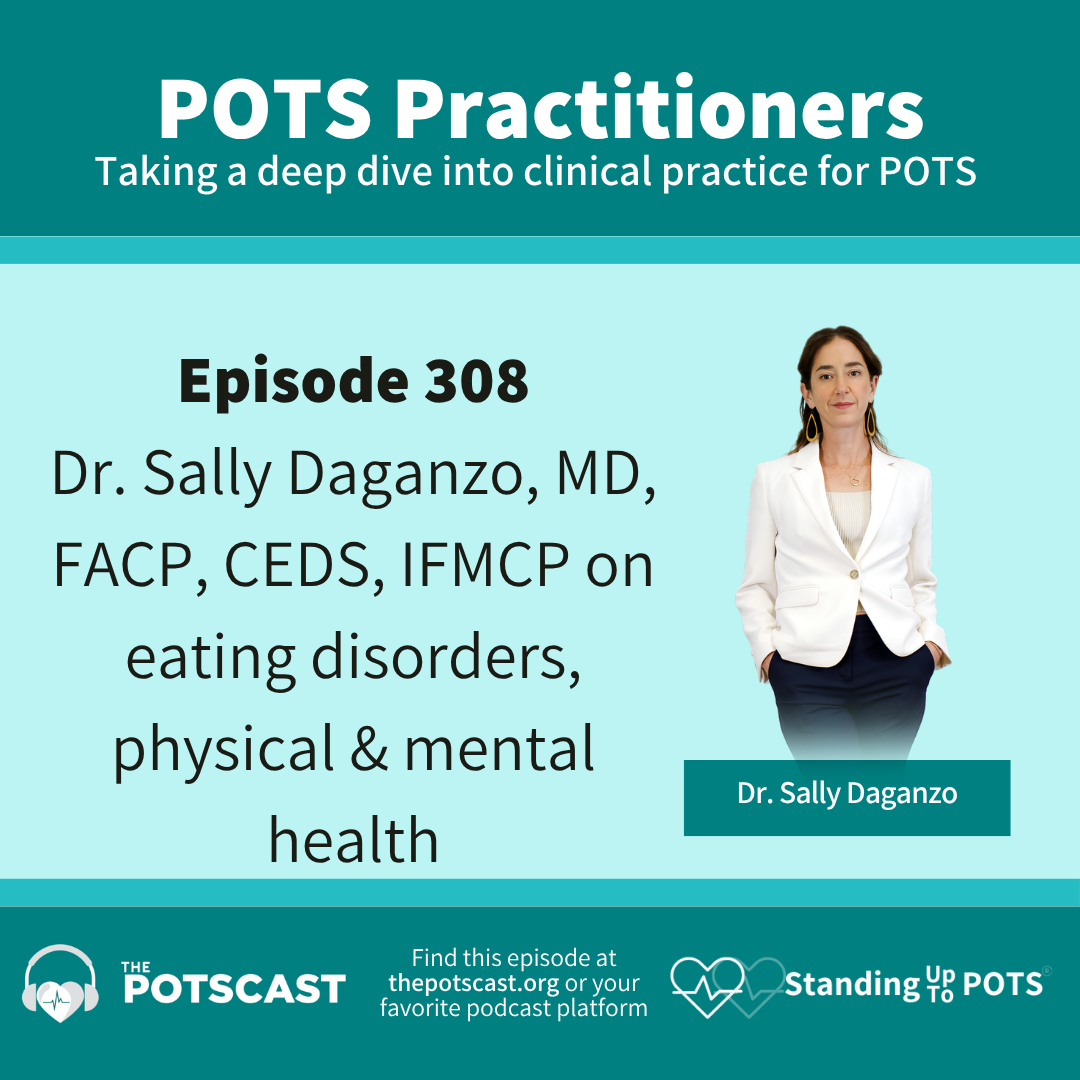
Dr. Sally Daganzo on eating disorders, physical drivers of mental health and more
May 02, 2026
Dr. Sally Daganzo is a board-certified internal medicine physician with advanced training in psychiatry, eating disorders and functional medicine. She has a private practice in San Rafael California and also offers telemedicine in several states. In this episode she discusses her approach to treating complex patients, the mental-physical health intersection, eating disorders and what made her decide to start her own clinic, whose website is https://www.sallydaganzomd.com/
Episode Transcript
[00:00:00]
Jill Brook: Hello, fellow POTS patients, and marvelous people who care about POTS patients. I'm Jill Brook, your horizontal host, and today we are interviewing Dr. Sally Daganzo, a board certified internal medicine physician with advanced training in psychiatry, eating disorders and functional medicine.
She has a private practice in San Rafael, California and also offers telemedicine in some states. Dr. Daganzo earned a bachelor's degree in chemistry and a master's degree in physics from UC Berkeley, then earned her medical degree at UC San Francisco, did residency in internal medicine at California Pacific Medical Center, plus a psychiatry fellowship at UC Irvine.
Dr. Daganzo specializes in eating disorders, complex chronic illness, integrated mental and physical healthcare, and unexplained symptoms. Also, from her website, I learned that she has played flute in a choir, runs a 2.5 hour marathon, and trains her [00:01:00] dog in agility and nose work. So Dr. Daganzo, you sound so multi-talented and interesting.
I'm really excited to talk with you. Thank you for being here today.
Dr. Sally Daganzo: Thank you for having me. I'm excited to be here.
Jill Brook: So can you tell us a little bit more about your background and how you came to specialize in the more complex patients?
Dr. Sally Daganzo: Yeah. Absolutely. So, I mean, first I took a bit of a winding path to medicine, as you mentioned in the intro. I started in physics and chemistry at Berkeley. Went on to graduate school in physics, just full on nerd just getting to the why of the world. And then I, I had always thought about medicine but it turned out everybody at Berkeley, you know, going in was also pre-med, and so I kind of decided to do something different. But it was always in the back of my mind, and so during grad school I kind of realized that I actually wanted to solve different problems and really work with people. And so I went back into medicine and as a [00:02:00] physician I was really drawn to patients.
I mean, really, I was drawn to everything, I was fascinated by the human body and the way it works, in the same way with physics, trying to learn how like the world works and the universe works. But I, I liked the patients that maybe other doctors I wouldn't say like struggled with, but maybe avoided or didn't wanna see, like, because they, because doctors like to be right or they like to know what they're doing.
And so when you're presented with a person where you don't have like, oh, it's a UTI, I need to give them this antibiotic, for example, or something really straightforward, it gets a little bit uncomfortable to say, I don't know, for a lot of, I think for a lot of people in general, but especially a lot of physicians who are used to just getting everything right, getting good grades and getting good scores, and that's kind of how they got to medical school.
But those people really interested me and that was you know, it could be a mystery symptom, but then I, I found my way into eating disorders when I started working here in San Rafael [00:03:00] at a big HMO. And the thing with eating disorders, and that could be anorexia, it could be avoidant restrictive food intake disorder, it could be bulimia, it could be binge eating, it could be you know, a multitude of other things, night eating syndrome, anything really related to food and eating, and you know, even body image. The thing with eating disorders is they're really full body conditions and so, you know, they affect the brain, they affect the heart, they affect hormones, they affect the bones.
They just affect everything. Yet they are kind of put into this mental health area because, you know, it is the brain. I guess that's how it manifests, like refusing to eat. It looks like the brain. But it affects every part of the body and primarily it's therapists or dieticians , and sometimes psychiatrists that may be treating it, but they may often dismiss or, or maybe not always dismiss, but not, not know what to do with the physical ramifications, which could be like a dysautonomia type picture or, you know, [00:04:00] gastroparesis comes up often, but a psychiatrist or a therapist isn't really gonna be equipped to treat those things.
So I, I liked that sort of as an internist, an internal medicine physician, that eating disorders drew me in as like a, you know, everything kind of diagnosis or kind of patient. But they can be very difficult because sometimes they don't want to get better. That's part of the illness or it can be part of the illness.
And then from there, there were these underlying people with eating disorders would also have maybe, I mean, POTS often, often they have dysautonomia, orthostatic intolerance. And so, then you start looking at what's, what's the anorexia, what's the dysautonomia? And actually which one came first? And as you, as you get to know some of these patients and talk to them, it, you, you start to just, it kind of turns into this it's hard to know what came first. Often it is like maybe was gastroparesis as like a little, you know, a young kid and nobody knew.
It was [00:05:00] like, oh, they were just like a picky eater. But actually it didn't feel good when they ate 10 things, or maybe it was mast cell activation. I mean, it's possible we'll never know what it is for a particular person. Or Ehlers-Danlos or another connective tissue problem. And I think that's where, you know, suddenly they get labeled, oh, it's anorexia, you just have to eat. Or you know, something like that. And actually there's often more to it. I mean, for a lot of people there's not. The people I see, there are. You know, not everybody's coming to me when it's like really straightforward. But that's kind of the path that I got towards this complex illness, because sort of, there were some people, like I take care of lots of people who don't have eating disorders, but they may still have like food preferences. I mean, we all do, but there are still maybe like intolerances and that's more like the mast cell population. And they may be more frustrated that they can't eat certain things and they're, you know, maybe losing weight.
And then sometimes if they're predisposed, they can get an eating disorder because that can be [00:06:00] how they work. So I think it's really important for anybody working in that, in that space, actually in the complex illness space, to be really aware of monitoring for that, because somebody who doesn't have a history, you can precipitate one, for example, if you start giving them an elimination diet.
Jill Brook: Yeah, so that's interesting and so I'm just kind of curious because on your website for example, it mentions that you like working, I think at the intersection of physical and mental health. And are there a lot of places where you find that intersection or does our little world of POTS, dysautonomia, MCAS, hypermobility, and its whole growing cluster of things tends to be one of the biggest areas that does encompass. I guess how rare is it to have those things intersect?
Dr. Sally Daganzo: I mean, actually I was thinking about this the last couple of weeks. I just went to an integrative mental health conference and I mean, none of the talks were really about [00:07:00] psychiatry or mental health necessarily specifically. They all were really focused on body inflammation and sort of environmental toxins, a lot more I would consider like internal medicine topics. And so like we know that people who've had a, I think it's people who've had a heart attack, have a much higher risk of depression. I don't, I don't know the numbers, I'd have to double check, but there is a link, and I believe diabetes as well. There's these links to depression with heart disease and with diabetes, and a lot of people are like, oh, well of course you had a heart attack, you're depressed.
That makes sense. But actually that's not exactly the link. There is something about more like either it could be low cholesterol, we give people statins and there's some data, I'm not an expert on this data either, but I'm very interested in it. There's some data that people with really low cholesterol have a higher risk of suicide.
Like I just learned that in the last year and like [00:08:00] I should know that, like as a person who treats people with heart attacks and diabetes who might be prescribing a statin, I should know that, I mean, I should at least clarify that data and that's something that I just, I simply never learned. That was never presented to me.
And I think, you know, whether that's a hundred percent true or not, it should be something that if there's data out there that is suggesting that we should certainly be aware in counseling our patients or, or show me the data that it's not true. You know, we, we should sort that out given these are are prescribed so widely.
And so, no, I think the intersection of mental health, I mean we, when psychiatry sort of splintered off, I don't know exactly the history, but psychiatry and neurology kind of like splintered off in the, maybe in the fifties, I don't know exactly. Definitely before I was born. When you do internal medicine training or other like family medicine training, cardiology, sort of all of these specialties, you [00:09:00] do some neurology generally, but we don't really rotate through psychiatry, which is crazy.
Like we all have a brain, like it's a pretty vital organ. And I, this is what I was thinking about the last couple weeks, like, how is that like not one of the critical rotations. We do it in medical school, or at least I did, you do a couple months in medical school, but as a resident, pretty much in any specialty seems pretty critical to be able to, you know, diagnose illness in the brain, whether it's inflammation, which is kind of what I was getting at with a heart attack or, or we know, when somebody gets the, like the flu or a cold, those people they also have a low mood and there's, there's actually data to support that feeling, depressed can be, can come before the onset of symptoms of a cold, of certain colds. And risk of I think heart attack or COVID, I forget, it goes up with influenza. So if you have influenza, you're like [00:10:00] higher risk of getting like a heart attack. That's why we try to push those people to get vaccinated.
But those links between our brain, our mental health, I think if there's biological links, genetics, biochemistry, environmental factors that just get overlooked because we want it to be that we can talk our way out of, you know, OCD or something. But you know, if your brain is inflamed, you can't talk yourself out of it.
I don't think, I haven't seen that happen yet. You know, you could do therapy, it helps, right? It might help get through the world, but if there's like, you know, something going on in your brain like Alzheimer's disease or toxins or whatever, you know, seems like we should be taking a, a closer look at that.
And that's sort of how I see most of psychiatry is like, we just haven't figured it out yet. Like, there's something there and like neurology is the stuff we kind of [00:11:00] like, we sort of figured out the pathophysiology of it. And then psychiatry is sort of this other stuff that like we just, we haven't figured out yet. And so we just kind of throw things at it, like medications, which are important and can help a lot, but it doesn't mean we understand what we're doing. And I think we're on sort of the precipice of a lot of that changing.
And people with complex illness like, like dysautonomia or, I mean, we'll say POTS specifically or orthostatic intolerance, you know, if you're not getting blood flow to your brain, like it's not gonna work properly. We all know that. And so you might not be able to think clearly, like it's sort of obvious. And so why would I treat somebody with blood flow maybe not going to their brain properly, why would I give them an antidepressant?
Like, it doesn't even make sense. They might, they might feel better with it, but it's not gonna help the blood flow to their brain if that's the problem. So that's when we'll wait, maybe we try compression stockings, like, you know, [00:12:00] or whatever. I think psychiatry and sort of the rest of medicine needs to kind of have like a reconciliation of ideas.
Jill Brook: Yeah, I noticed that on your website it said after years of seeing patients stuck in a cycle of misdiagnosis and fragmented care, I built my practice to do medicine differently. And it sounds like maybe that's sort of what you're talking about, like can you talk about your approach at your clinic?
Dr. Sally Daganzo: Yeah, and I mean, I'm not, I don't know that it's perfect or the right way. It works for me. I'm not, I'm not for everybody certainly. But I have a patient, often they do have an eating disorder or a mental health diagnoses that they may wonder about or have or they're struggling with, something like that. But but not always. And we do a thorough intake on basically like from when they were born, or preconception to now, including like family history, all these things. What are they most concerned about? What are their goals in like working [00:13:00] together, 'Cause that's really important, 'cause I could think like, oh, you must want to, you know, be able to do X, Y, Z, but actually they just want a better sex life. Or they just want like to be able to go to work. So I think one thing is like getting a really thorough history and I try to get as much of it upfront, but there's always more pieces. And then also really feeling like, you know, trying to figure out, for me, with a lot of it being eating disorders, I, I take a a pretty close look at like a nutritional physical exam, like looking at sort of hair and skin and nails and other things around that. Sometimes testing but also sort of partnering with them and kind of seeing them regularly and setting goals together in terms of what will progress look like, what are we gonna do? And you know, and I learned from my patients too, like it's not, if it's not working, I, I have to check in and say, is this working? They may bring to me something that they read on Reddit or wherever and I have to look [00:14:00] it up and find out. I love that. I love when people look something up because if, if they don't tell me about it, I may not find out about it, 'cause I'm not on Reddit.
Jill Brook: Oh goodness. I just see everybody now taking notes. Here's, okay, here's the doctor who, like when you do that.
Dr. Sally Daganzo: But it's true. I mean, that is a place, I have a couple of patients where they get a lot of information there and then it actually tells me what they're worried about. You know, had somebody come to me and asking about creatine and POTS and I was like, I don't know. And I was like, that's not, we haven't tried like the 10 other things I would use for POTS, but like, they had read it on Reddit that it had helped some people. So I'm, you know, then it goes onto my list of like, I need to do like a Pub Med, you know, I need to start looking. And that also tells me like, you know, I, it gives me the opportunity to say, what is it that you're hoping it will help for it, 'cause if, if they just say it'll help for my POTS, that's different for every patient, you know? So like, really trying to say like, is it, I've been trying to do this with different people now, trying to for myself and for my patients, 'cause progress can feel very slow sometimes, not always, [00:15:00] but figuring out like, okay, like how much time am I spending upright? Like, is that a metric we wanna look at? Or, you know, what are the things that are important to you? Like I use I don't know if you're familiar with, there's a questionnaire, actually one of my chronic fatigue patient, she brought it to me a couple years ago called the FUNCAP 55. I had of it.
You probably know about it. I don't know. I'd never heard of it, but I use it all the time. For me it's nice to see, okay, let's fill this one out again, you know, every three to six months we do it. And actually you can, you can see, so even though you feel like, well, I'm still not where I was three years ago, you know, I'm still not normal, it's like, wow, in these areas, I can take a shower without sitting down, or I can go to the grocery store, I can cook for myself, I can socialize, you know, whatever, whatever it is that they might wanna do.
And so I think it both shows me where they're struggling the most, but then it can also show us progress and even, even get you down to like, what therapeutics we might wanna try, depending on which things are more [00:16:00] difficult, you know, is it something positional or is it, you know, sleep, something else.
So I've, you know, I learned those things, that came from a patient. I'd never, hadn't come across it yet. I'd come across other surveys, but I hadn't seen it. She, she got it from a friend and she gave it to me.
Jill Brook: But what I, what I like about your idea is that each patient has different things that matter to them, and there's different surveys that address those different things. So maybe it's not a bad idea for patients to come up with their own survey to do periodically to measure their success. Because I have to laugh because one, one survey that I see come up pretty often in the POTS research is the Compass 31, and I always have to laugh because I don't know anybody who cares about their pupil dilation, for example.
Dr. Sally Daganzo: A good metric for autonomic function maybe, right? But it's not like, it's not relatable.
Jill Brook: Right.
Dr. Sally Daganzo: But I have tried to get people to, and this is, I haven't figured it out yet but I have tried to get a few of my patients, I mean, because sometimes they're really tired.
So it's hard also to like know how much to push somebody [00:17:00] to come up with their own metrics versus how much, you know, that's, and that's me just being cognizant of like, I don't wanna pressure them, 'cause I have, I have a lot of energy, and my patients don't always have it.
And so that's I think a lot of people, if you haven't experienced that, just don't even understand that like they just for whatever reason, cannot do that. And so for her and for, for a few other people, I'm trying to come up with like a Google doc that we can share or a Google spreadsheet which might have meaningful metrics that we could measure.
And so when we're putting an intervention, like how could we measure things? So not just like a FUNCAP 55, but actually like, what, you know, what are the things that you want, you know, in the next couple months, what would be like a meaningful shift? Like if you sit up for 30 minutes versus 45 minutes versus like be able to go here or do that.
So I don't have it all worked out, but that's something I'm trying to partner with my patients to, you know, to work on and, and having it personalized makes sense. [00:18:00] Like we have these ones for depression and anxiety, and I use those in my practice too. And for eating disorders too, we have different, you know, questionnaires, but having patients develop what's meaningful to them helps a doctor or whoever you're seeing provide the care that you want. You know, it's a, it's a two-way street. Like I'm here, I have a lot of knowledge, I have a lot of experience, but I'm not in your body and I also don't know what you want. Like, I may want something different when I'm suffering.
Jill Brook: Right. But it is interesting to think that somebody could just come up with a list of questions of things that they care about and use that as their own little personal measure of success.
Dr. Sally Daganzo: We should propose that on the website. I don't know, like pick and choose the questions. I mean, it, it makes sense 'cause then people, it's not just your heart rate lowers, like that's what I see a lot of times. Like, take the propanol, take the ivabradine.
I have this girl, they just keep wanting her to stay on ivabradine, but she's like, noticed no difference. It's, it's lowered her heart rate, but like, nothing at all. And like she's [00:19:00] like, this isn't helping. Like, I need something else. And, you know, that's not, maybe she still needs it to slow her heart rate a bit, but like she doesn't feel any better.
And so that's what we're missing as doctors sometimes, you know. And I do too, I'm sure I've missed a lot of things. But it has to be this, this collaboration and this partnership between you and your patients, 'cause that's ultimately the goal is to get people feeling as good as possible in, in, in their life.
Jill Brook: So I know that there's patients and practitioners listening who are gonna want me to ask you a little bit more about eating disorders, because there's some questions that come up pretty often in this space, and I think that there's some concern that there's a higher rate than the background of eating disorders in the world of POTS and related comorbid conditions.
And then there's sort of this debate as to how much or whether to suggest elimination diets to patients and when and which patients or do you ever do it at [00:20:00] all? And what are the considerations? And so can I just ask you to maybe just kind of free associate about that? And especially like who are the patients where you would maybe suggest trying elimination diet, and then who are the patients where you would not recommend that?
Dr. Sally Daganzo: I mean, I rarely, rarely do it because, I've seen it go bad. But there are people that I'm willing to do it with, so I'll get to that. But there's the eating disorder piece, but there's actually the allergy piece as well. Like if you eliminate, if you do an elimination diet, like a, a pretty strict one, you can get somebody feeling pretty amazing. Like, it, it can, it really can work. But then, you know, the idea is you try to like, bring things back to see what they might react to, people can have pretty, like if they do have significant anaphylactic type reactions, they can have a, a pretty severe. So I get nervous to, I wouldn't do that myself without sort of collaborating with, you know, an allergist [00:21:00] or somebody like that, 'cause I'm cautious like that. Or unless, yeah, some other good reason. But then separately, the eating disorder issue, you can really trigger, I mean, we see eating disorders start after, I've had a patient who had started after fasting during Ramadan. You know, she was just fasting as part of her family's religion and then suddenly she's anorexic. It just sort of, you know, the brain, it's something switches in the brain I guess, and then just, it kind of takes off. I've seen it after a GI illness where people have like a gastrointestinal illness and then lose some weight and then suddenly it's like, you know, they are terrified of eating, not just 'cause they're gonna have a GI illness again, although that can happen too, but also it just starts to have. If it's anorexia, that kind of, that can like take hold. Because with anorexia in particular, the, the more weight people lose or the more, I don't know, it's not, maybe not always weight, but the more restrictive they are, the [00:22:00] worse the brain perceives things to be.
So it's almost like the worse it gets, the worse it gets, which is what makes it so hard to treat. So the more weight people lose, the harder it is to get them out of that. So I think of it as like when they lose this weight from either, you know, say they tried an elimination diet, they may lose some weight 'cause it's really hard to prepare all that food.
Or they're with a GI illness, then suddenly it's like, it's like the brain likes that starvation feel and then they can't get out of it. And so the times that I would do it, I wouldn't do it without a dietician on board. And so I'm pretty like insistent. I've had patients ask about doing different types of elimination and I'm pretty insistent that if we're gonna do it, we're gonna make sure your weight is stable, we're gonna make sure, you know, we got the dietician, so I'm open to it, but it's gotta be like, I think, I think it gets prescribed a bit willy-nilly. And maybe I'm wrong, but I have the perception that people would just like use it, 'cause you could feel better if you eliminate a [00:23:00] lot of things, but they're not thinking sort of down the road of the implications of what could happen. And it's pretty common. I mean, eating disorders are common and they're, and they're awful. So I don't know if that answered your question.
Jill Brook: Yeah, no, I think there's just a lot of people who kind of see it both ways and you know, there's, I think, large communities out there of patients who are following certain diets and they love it and they feel good and they feel empowered and they enjoy finding the recipes that go with it, and they maybe even sometimes come to embrace nutrition more because now they're seeing how when they eat what feels good to their body, it makes 'em feel better and it's a source of joy and it feels good to be able to have something you can control. And I also get that patients want, you know, patients are, are oftentimes impatient. They don't wanna have to wait six months to see the, you know, specialist again and get the next chance to try something new. They want something they can do on their [00:24:00] own. But I also absolutely hear the stories coming from physicians and dieticians saying that this population from what they're seeing may be at a higher risk than normal. I've heard it described as maybe sometimes this population has reasons why eating can be more uncomfortable or more scary, or things like that. And so once they start restricting a little, not only do they feel better physically, but then you have all of the messed up patriarchy that you know, especially is gonna tell young women, oh, now you're super skinny...
Dr. Sally Daganzo: Now you look so much better, and now this, and...
Jill Brook: Bam. That's a really bad combination.
Dr. Sally Daganzo: Autonomy is important. If somebody feels better, I'm not gonna, I mean, I'm not gonna tell somebody to eat like junk food all day, every day. I mean, I'm still a doctor and most people don't feel good on garbage. There's this idea of like all foods fit. And I don't think that all foods fit for every single person. Like I have a patient with celiac disease and like all [00:25:00] foods certainly don't fit for her. And if she has celiac disease, she probably has a leaky gut and she probably has other intolerances, but she also has a history of an eating disorder.
So like, you know, we have to be very mindful about how we go about that. And that's where having a dietician on board, I think is, you know, am I still gonna see her and support her if she just does it on her own, of course. Like she has autonomy and if I can help her do it safely, that's fine too.
But it's not something that I go to initially. But I do think that like, you know, anti-inflammatory diets or a lot of these whole food plant-based or, you know, like, I mean, mostly whole food, but I kind of think that's logical. Like if you don't know what went into whatever you're eating, like your body might be confused also. But I think it's logical. I don't know if everybody agrees with me and so I'm not gonna like, push people to eat, you know, stuff that they're not going to eat. And certainly I believe in autonomy, but it's just not a, a first [00:26:00] intervention generally.
Jill Brook: Is there a way for people, especially like parents or practitioners, to get a feel for who is more vulnerable to an eating disorder. Are there any like telltale signs?
Dr. Sally Daganzo: I mean, that's interesting. I mean, there's certainly screening tools. They run in families for sure. Sometimes OCD also, obsessive compulsive disorder. I think there's a lot of overlap. There's some people that think, you know, certain eating disorders are just like OCD, but around food. I'm not an expert in the genetics and nuances about why that may or may not be true, but they definitely co-occur a lot. And so if you have a kid or somebody with OCD, I would imagine they may be more at risk. I don't, I don't see it as like a, like social media and things like that, I don't see that as like a primary driver.
I do think that there's something more like biologic. You know, we all see social media and we don't all end up, [00:27:00] you know, with bulimia or anorexia. Like there are, there's something else to it. I don't think it helps, but, but yeah, I think it runs in families. People can be mindful about, you know, for, for parents and you know, how they talk about food and weight actually. I mostly see adults, I see some teens, but patients who were told by their pediatrician or, or the pediatrician told their parents that they needed to like lose weight, 'cause we're looking at BMIs in children and our bodies grow at different rates, and we all have different bodies.
And for a kid to hear something like that and be told they need to lose weight when they're 11 or something is just so, horrific. And I've, I've seen that lots of times. So, you know, they hear everything we say. Just being careful, I think, and mindful about how we talk to each other. But also, you know, just 'cause you're not addressing a a child doesn't mean they're not hearing it. And you know, for BMI in particular. 'Cause that is something that, [00:28:00] that happens frequently. And it's not, I don't think there's an intention, there's no pediatrician that is like saying that so that the kid gets an eating disorder. Right. Nobody wants that. And everybody, I think we're all on the same team of, of health for, for what that means to each individual person.
Jill Brook: And speaking of change, I was wondering if there's anything out there that you see that gives you optimism for this population? Whether it's, I don't know, treatments or awareness or initiatives or...
Dr. Sally Daganzo: Yeah. I mean, an optimist. I can hold the optimism because there's so many there's so many things, like for POTS in particular, there's, there's so many treatments and avenues and things to try. I mean, some of it is really uncomfortable.
Like, you know, compression. It, it works pretty well for people, but like, I don't wanna wear it. Why would my patient wanna wear it? Right? So like there are there are so many things out there to try and I think, I refer to that an article that Dr. Cutchins wrote, I don't know if it was like last year, I don't remember when it [00:29:00] came out, but I often like, refer patients to, and I say, look at this table of all these different things we can try and, you know, like I know about them.
They're, they're on, you know, the Standing Up to POTS website, but like a lot of people don't even know that there's so many options out there. It's so nice to have that in one place. And so I use that as like a source of optimism and, and then the more people see these things, the more primary care physicians like myself or like clinicians that are not a neurologist, not necessarily a cardiologist. It should be able to be taken care of in any clinic. It's hard, but it's not that hard to try a lot of these things. They're meds that we all are familiar with, know how to use. Doing a NASA Lean test or some of these other things, it's like, it's just not that hard.
So, I think I have optimism with like COVID that that maybe shed a bit of light because COVID created a lot of dysautonomia and a lot of people, I mean, I think you probably know that and we all know that. And in some people it, it goes away and in some people it didn't.
But I think the, the benefit is it [00:30:00] really shed light on like, you know, 'cause we've all had whether it's a patient or you know, a family member, we, I think everybody's really knows somebody suffering like that or has known somebody. So that gives me optimism that finally, like, it's taken seriously. It's not just some made up stuff. This is like, it's real. It's not people just like being sick 'cause they wanna be sick. Like that doesn't even make sense.
Jill Brook: Yeah, and I mean, I'm, I'm grateful that people like you are deciding to maybe kind of open your own clinics and work with the more challenging patients. And I'm wondering if you can just say a word about that to other clinicians out there who are maybe listening. And I love it that you just said that POTS patients are not that hard to treat.
Like what would you say to another physician who's maybe like in a big system who's only getting 10 minutes per patient right now, what would be the trade-offs? You know, what led you to do what you did and would you recommend it to [00:31:00] others?
Dr. Sally Daganzo: Yes and no. I mean, for me, my personality, I think I actually, I miss my last job. I'm probably like the only person to say that. Like I miss, I, I, I actually really loved my colleagues, I loved my system. But I do really value like thinking and researching and looking things up, and I just, I just couldn't do that seeing 20 people a day and answering 50 emails. I couldn't. I have three kids. I got a dog. And also I just need to sleep and eat and like do other things. And so that was hard because of my personality. Like I can't really turn off my brain and not think and look stuff up.
I really value like creativity and autonomy and connection. Those are some of my core values. And so I think for, for some people, if you're in a system where you are seeing 20 people a day, there's definitely ways to treat people with POTS.
I mean, do a NASA Lean test. Like somebody's coming in with like brain fog, do orthostatic vitals. That's standard of care for so many things where we do orthostatics. Like [00:32:00] brain fog, we could be doing it too.
And it takes five minutes, it takes time to do, or maybe 10 minutes depending on what, what test you're doing, but it takes time. But also you don't have to do it every single time you see them. And that's something that's well within the scope of a medical assistant or, you know, nurse, whatever. And so I do think it's, you know, implementable into a practice like that. It comes down to, like, for me, I like being my own boss. I like doing what I want. I value that autonomy and sort of ability to go to conferences when I want. So that's more like personal preference and sort of the treating the mental health part as well because I do sort of focus on that too, which is harder to do in, that's a little bit harder to do in 10 minutes, I think. You need a relationship over time to kind of get that trust. But I do think that, you know, it's not something you just need to punt to the specialist. I think that it's, you can consult, but I think in a, in a busy practice, it's entirely doable.
But I [00:33:00] do think it's changing because I think there's just too many people suffering and like, it's just we can't turn away from it now. Like we can't ignore it. And and we shouldn't because this is our, this is our community. This is our, our country, this is our, our world. We should take care of each other.
Jill Brook: Well, that's so nice and, and your empathy comes through so much that it's just been so nice to hear from you. Where can people find you online?
Dr. Sally Daganzo: I am not too active. I have like a LinkedIn page and Instagram and a Facebook which are all public and maybe Twitter or whatever it's called, anyway. You can find me there, but I'm not super active 'cause I'm, I just am not I'm more, yeah, you can contact me through my website basically.
Because I'm usually just being a nerd and, and reading things and learning things and I'm not, I'm trying to keep up on, on yeah. Facebook to see like the goings on of like what other people are doing and, and keep up. But yeah, I'm not, I'm not [00:34:00] too vocal. Mostly just my website.
Jill Brook: We'll put all that in the show notes so people can find it, and it has been so nice to meet you. And do you have any final words for people or any last message you wanna leave people with?
Dr. Sally Daganzo: I think if you're, if you're a patient that not being afraid to like, make a list and bring those concerns to your doctor. And being your own advocate. I think a lot of people are, but some people kind of freeze up when they go. I've learned that they like forget to ask what they were gonna ask when they go, and then they freeze.
So writing that list and actually letting the doctor see it. And it's not that they can answer everything in that one time, but sometimes you, like I used to negotiate, you get one thing and I get one thing, 'cause I might think your chest pain's really important and you might think something else is important. So we can kinda like come together.
But you have to be your own advocate and it doesn't mean it's adversarial. It's just like you're the only one that knows what you need, but these healthcare providers are there [00:35:00] to, to serve you. And like, we really do want what's best, but we, we don't, we can't read your mind always. And so we do need to work together.
And so just kind of encouraging people to not be discouraged. And you know, to look for the right person, 'cause they're out there and they're everywhere. They're in the, they're in the big systems, they're in the little practices. I think there's, there's great people everywhere and, and, and most doctors are those people. I still am an optimist that way. I think that they all want to do the best for their patients, but they don't know if you don't tell them.
Jill Brook: Awesome. Well, Dr. Daganzo, we are so happy that the medical world got you instead of physics. So, thanks for choosing medicine.
Dr. Sally Daganzo: Physics might be happy to.
Jill Brook: It is been so lovely speaking to you. Thanks a million.
Dr. Sally Daganzo: Thank you.
Jill Brook: We hope you'll come back again and speak to us whenever you have more messages to share with the POTS world. Okay, listeners. That's all for today, but we'll be back again next week. Until then, thank you [00:36:00] for listening. Remember, you're not alone, and please join us again soon.