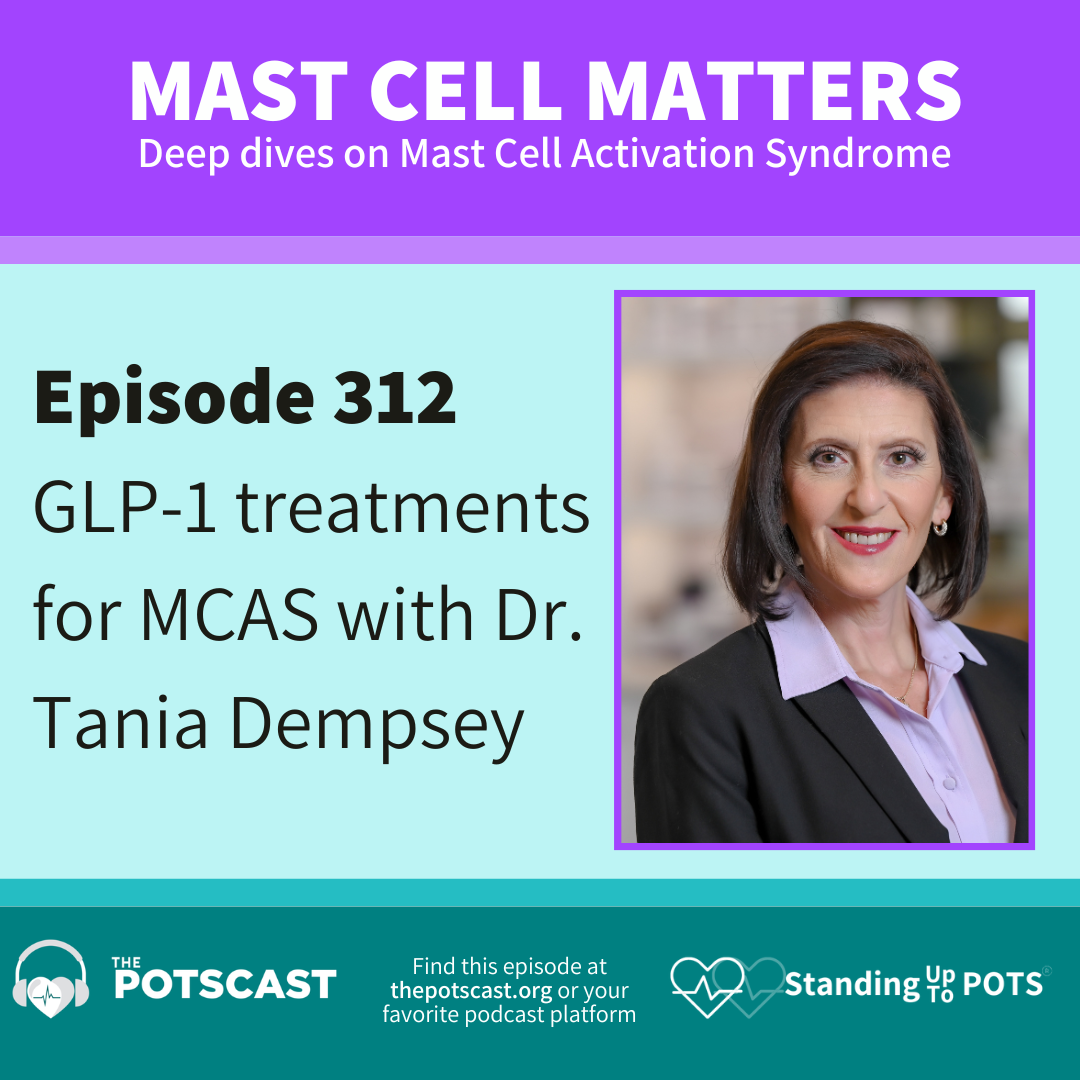
Dr. Tania Dempsey on GLP-1s for MCAS, POTS and related conditions
May 30, 2026
This is a not-to-be-missed episode! Dr. Dempsey discusses the use of GLP-1 medications for MCAS, including her most recent observations and recommendations. This is a follow-up to Dr. Dempsey's free online GLP-1 Masterclass, which covers all the basics. If you have questions for Dr. Dempsey about mast cells and related topics, you can send them to research@standinguptopots.org.
Dr. Dempsey's published article about GLP-1 treatments in MCAS is here.
Dr. Dempsey's website is https://drtaniadempsey.com/
Episode Transcript
[00:00:00]
Jill Brook: Hello, fellow mast cell patients and beautiful people who care about mast cell patients. I'm Jill Brook, and today we have a much anticipated episode with Dr. Tania Dempsey answering questions about the use of GLP-1 and GIP targeting treatments like Ozempic and Mounjaro and such, in MCAS patients. Dr. Dempsey's website has a free, wonderful masterclass on this created last year, and it covered all the basics about what are the GLP-1 and GIP receptors, why are they important, how do the medications that target these receptors work, what Dr. Dempsey was observing at the time and how she was prescribing these medications often in tiny doses.
And she shared some ways to even take advantage of these receptors without needing medication. It's a fabulous, fabulous masterclass. We'll put the link to that video in the show notes. So today is for follow up questions, since some time has [00:01:00] passed, more information has come out, more research has been published, and Dr. Dempsey just keeps gaining experience. So that will be our topic today. You may recall that Dr. Dempsey is a world renowned expert in complex multi-system diseases and the founder of the AIM Center for Personalized Medicine in Purchase, New York. She's board certified in internal medicine and in integrative and holistic medicine, trained at the Johns Hopkins University School of Medicine with residency at NYU, and her clinic attracts patients from all over the world with Mast Cell Activation Syndrome, Lyme and other vector-borne infections, mold and environmental toxicities, dysautonomia, hormone and metabolic disorders, and more.
She has experience with the most complex patients and we're so grateful to have her here today. Dr. Dempsey, thank you for coming.
Dr. Tania Dempsey: Oh, it's always my pleasure. Can't wait to dive in.
Jill Brook: Well, I know that you've been just [00:02:00] going all day and you don't even know what topic or questions are coming, so you're amazing. But we've been getting questions piling in from people who watched your, your masterclass on GLP-1s and GIP treatments. And so the most common question we got from both patients and practitioners was actually with the passage of more time and your gaining experience with GLP-1s and GIP treatments, what are your latest thoughts about their usefulness in MCAS and related conditions? And basically, are you still using them and are you still seeing good things?
Dr. Tania Dempsey: Yeah. Yeah. More than ever. It's the one drug, you know, we always have to be careful as doctors you know, to put too much, too many eggs in one basket, I guess, you know, I, I just throughout my career and especially my career treating MCAS patients and complex [00:03:00] chronic disease patients, right, I try to find as many tools as possible. So typically, I have a lot of tools. I have a lot of drugs, supplements, treatments, and you know, what I have always found is that, you know, I'll try, you know, one thing in one person, it might work in one person. It may not work in another person.
So you try something else. I've really struggled because there's no algorithm really. You can't say, well, if this doesn't work, then try this, because it's not always predictable in the patient, right? So you're, you're definitely doing, I always do this personalized medicine approach and we try to find the right thing, but most drugs, I would say are, are maybe in the 60% effectiveness category.
Okay. Meaning that, you know, there's a group of people, it's more than 50%, but that are gonna have, you know, a good response and that's gonna be their drug, that's gonna be the key to their mast cell or the key to their condition. Or maybe multiple drugs that work together to be the key. But the GLP-1s are, are far exceeding [00:04:00] anything I've ever used in my practice.
And it's just mind blowing. And you know, in our, in our paper that we published The Utility of GLP-1s and Receptor Agonists in Mast Cell Activation Syndrome, we found with the 47 patients we published, it was like an 86% success rate with, with that drug, right? Which is super high for a drug.
I mean, most drugs when you study them, they don't have those types of numbers in terms of effectiveness, right? 86% got, you know, significantly better. And I would say that that number may be a little bit higher now in my practice, now that I've learned more about the dosing, identifying the patients who, who would benefit most, maybe starting sooner than I used to start.
I used to put it further down the list. You know, we should, we should try X, Y, Z, do those first, rule those out and then do GLP-1. Now I'm bringing it in sooner [00:05:00] into their regimen, and so I, I just, I am just like blown away. No, I, I wanna clarify, there are gonna definitely be people who don't respond, right?
So we can have non-responders. Which is, you know, a bummer, but we'll find something else. We have patients who do have on occasion side effects. It's fairly rare in patients because we're microdosing. I think it's more common in patients who are starting with the traditional, commercially available dosing.
You know, we're using a 10th of the commercial available dose, sometimes lower. So I'm not seeing the same side effects that other people are talking about, which is really, really incredible. So, like, I can probably count on one hand, I've, I've now used this drug in hundreds of patients. So we're not, so we published on 47, but I need a follow up with, with hun, I mean, hundreds of patients using it now.
And I can count on one hand the patients who [00:06:00] we had to discontinue or you know, it just wasn't right for them or they were having some side effects. That's pretty incredible 'cause, 'cause I can take a drug like Ketotifen, and I can tell you that drug is almost like 50 50. 50% of people will be, you know, will be great and 50% will like be, have so much fatigue or weight gain or whatever, you know, and but that's not what we're seeing with GLP-1.
So that's why I'm so excited about it, because it's just like incredible. All I can say.
Jill Brook: Wow, that is such good news. And I almost wanna just say, please just keep talking, 'cause you actually already mentioned the things that people are asking about. Like, have you decided who you like to use them on, or who you don't like to use them on?
Dr. Tania Dempsey: Yeah. Well, so I used to be really cautious in patients with motility issues because, because they can slow down the gut, right? And they can [00:07:00] cause or worsen gastroparesis and colonic dysmotility and, and that, that's been in the literature on the commercially available dosages, right? So I recently had this patient who has pretty severe gastroparesis and a colonic inertia on multiple drugs to just move her bowels. You know, all those, like Linzess and whatever, there's like a bunch of drugs. And really, really struggling. Of course, severe MCAS and all this other stuff. So she's also, she's tried a lot of MCAS targeted therapies. She actually sees Dr. Afrin, and she sees me, both of us, and, and we tried like so many things and, and again, like just the needle is not, not moving.
So I put her on GLP-1 and within two hours a lot of her symptoms went away. So like pain, she had some, some like classic MCAS symptoms that went away pretty quickly. And then [00:08:00] in 24 hours her bowels started working normally. So she had the opposite, right? So everyone was like, terrified. I'm terrified.
I'm like, oh my God. I was so worried to give it to her. I was like, if you take it and this happens, and you know, whatever. And I started her so, so low and she's like, no, no, no. It just like, literally like my bowels are just normal now. I've never, I haven't been normal in so long. And so my theory on that is that her motility issues are rooted in Mast Cell Activation Syndrome, right?
So her mast cells are impacting the nerves that are feeding the GI tract. And now that we've calmed down her mast cells, the nerves are like, oh, okay, I get it now, I know what I need to do. And all of a sudden, her motility came back. So that's my way of saying that. I used to think, right, there was maybe a subset of patients that I would maybe avoid.
Maybe I would try other things first, and I'm, I'm less worried about the [00:09:00] motility patients if I, if, based on this, this one case, but now I've seen this in numerous cases, believe it or not. That, that it's not, again, we're microdosing, so it doesn't seem to have that same profound motility issue that we're concerned about.
Now, I have had patients, and this is one of the few patients on one hand that I can count, who did have a reaction that was sort of like almost an immediate, she felt it almost as an immediate, within a couple hours, she just felt like her gut just shut down. It wasn't horrible, it just was like she just could feel the motility shut down.
And so we, we really struggled with trying to find the right dosage. And it, it wasn't constipation and she was still able to eat. It wasn't horrible, but it was definitely a little different than what I see with other patients. So, like I said, it, it's variable, you know, we're gonna have people who are not gonna do well on it.
That's why I wanna, you know, set the stage for the audience [00:10:00] that it's, it's promising. I'm really excited about it. I don't think it's gonna be right for every single person, but I am definitely using it earlier and I'm less concerned about people with the motility stuff.
Jill Brook: That's great news. So of course we had lots of questions, of course, like, so the POTS patients wanna know, is it okay in people with POTS and the EDS patients and the ME/CFS patients, everybody wants to know like, is it okay to, with their comorbid conditions?
Dr. Tania Dempsey: Yeah, so, great questions. I had a POTS patient who also has MCAS though, but the POTS was the, one of the predominant symptoms. And starting the GLP-1 almost immediately resolved her POTS, I mean, within hours. This was another one within hours. And within 24 hours she was running, she went out for like a three mile run and then started running every day.
Like she could barely get outta bed 'cause of the POTS. Like her mother's like, I don't understand, like she just like gets up and like runs now. Like, what is that? You know? [00:11:00] So, so, it, it does seem to, to help POTS, you know, some patients are getting help with it. Now, early on when I started using it, but at higher dosages, okay, before we knew that we could microdose it and we can go this low, I had a couple of patients who noticed that their heart rate did increase a little bit. And there's literature on this, that GLP-1s can cause an elevated heart rate. So I thought that what I was worried about initially with POS patients is that I was somehow gonna exacerbate the POTS, but that's not turned out to be true at microdosing levels.
I've actually not seen it except for one patient who had a, had a few, it just was a slight increase in heart rate from the drug. Not, not an exacerbation of POTS, just that, you know, let's say her baseline, her rate is 60 and maybe it was 65. But I think that over time that does seem to improve. So the point is, so POTS seems very promising.
[00:12:00] I mean, I don't wanna, I don't wanna promise that everyone with POTS is gonna have this remarkable improvement, like this one patient. But that was, that blew my mind. But that's the thing about this drug. I've almost never seen responses like this to anything that I've given. You know, like I, oh, you have ketotifen, you titrate, you give LDN, you titrate and you maybe see some improvement. But like, some of these improvements are literally within hours or even like within 24 hours. So it's, that's what's like, mind blowing to me. ME/CFS I've, I've used it in a number of patients with ME/CFS. What I would say is that I don't know yet if the fatigue, the chronic fatigue part or the PEM, the post exertional malaise part is responding yet completely.
I think it's still too early for me to, to judge that. But, but their food intolerances, their, like other symptoms that are often, that often go along with ME/CFS does [00:13:00] seem to be improving for some people. I had a patient recently who had a limited number of foods, I don't know, five foods maybe that, that he could tolerate.
And after six months on a GLP-1, he tolerates everything, everything, everything. Has no intolerance. Isn't that incredible? Six months on a GLP-1, so it took some time. It's not overnight. But now he can eat everything.
But we still have stuff we're working on, okay. Still has some of that other, those other symptoms, but for him he is like, this is like life changing, right. And then we'll work on the other things. So I don't know if the GLP-1 is gonna take away all the symptoms, but it does seem to hit some big ones in in a lot of people. So you mentioned POTS, ME/CFS, what's the other one that you mentioned?
Jill Brook: We had a question about fibromyalgia and then the other one was just in people who are already [00:14:00] struggling to keep their weight up.
Dr. Tania Dempsey: Okay. That's a good question. So fibromyalgia is Mast Cell Activation Syndrome, and it's, it is something that, is a, it's a loaded diagnosis. I know, 'cause because people have been given this diagnosis for a long time. You know, they had this pain syndrome and they were often given antidepressants and, you know, a lot of it was made to, to made, they were made to feel it was in their head. But there's some research to suggest and support the, the mast cells as the root of fibromyalgia.
At least in my patient population, fibromyalgia does respond to a lot of things that I do, including GLP-1. So we do, I do have patients who find that their pain tolerance goes up, like they feel better. They, they do have less of those symptoms. It may not, again, may not fix everything.
This is why I always cast like a wide net in terms of what I'm looking for. What, [00:15:00] what are the underlying root causes? What are the triggers? But yeah, I've used it in all that. Now, in people who are, I certainly use it a lot in patients who are either underweight or normal weight, because that's a lot of the MCAS population because they have food intolerances, they can't eat, they have gastroparesis.
There are a lot of reasons why they can't keep their weight up. I wouldn't use it in somebody who's dangerously low weight but in people who, are a little bit on the lower end of the spectrum, a microdose, so we just watch it, we watch their weight carefully, I've not had a problem. In fact, I had one patient who gained a little weight on it. Not fat, but like, literally muscle because she was able to start exercising and she was able to eat more. So then actually her weight went up a little bit which was a really, actually nice response. So, I mean, I think in now those cases we have to select carefully, right?
And I would be really cautious for people who are [00:16:00] significantly below their body weight just, just for like, you know, for a lot of reasons, because it can suppress appetite, and if you're not eating enough, we have to be careful. But again, at the microdosing level, it doesn't suppress as much as people think. It's really, really minimal.
Jill Brook: Great. So do you wanna talk more about the dosing that you tend to use and how you start and...
Dr. Tania Dempsey: Yeah, I'd rather not do that because first off, I'm just worried, I don't want people to dose on their own without, right. There's a lot of thought process with how I do it. And I'm creating a practitioner training program that I'm launching in a couple months, and I'm going to really dig deep on that in that program. So I just, I feel like maybe, you know, we should avoid that.
Jill Brook: Sure, sure. Okay. And another question that you had sort of already alluded to is where in your progression of treatments you tend to use [00:17:00] GLP-1s, like we got a lot of questions that were basically, what would you try first? GLP-1s or montelukast? GLP-1, or Xolair? GLP-1s whatever?
Dr. Tania Dempsey: Yeah. So it really, really depends. So, oh gosh, as I said earlier, I'm starting to use it earlier, earlier in the treatment protocol. But I think it really depends, right? So I'm looking at the patient's symptoms and I'm trying to figure out what I'm targeting. So like I have a patient who is on a GLP-1, I put her on it in the last few months, let's say. She's on a lot of other mast cell stabilizing things. The GLP-1, no question has helped a lot of things, but what it hasn't helped for her is like the severe allergic type symptoms that she has. She has eosinophilic esophagitis and she has a lot of seasonal allergies, but, but also just year-round dust, whatever, dust, mice, everything.
So [00:18:00] she has, she's really plagued with like a lot of chronic allergic type symptoms. But again, the GLP-1 helped some of the other symptoms she was having and it does seem to have helped her fatigue. It does seem to have helped some other things. So, you know, in those cases, like I've done, she's on H1 blockers, H2, you know, GLP-1.
But then then we needed to start Xolair. You know, like Xolair was a, was a natural progression given her her symptoms, right? So the point being is that people may still need other things while they're on GLP-1, so there's no right order. You know, I've certainly done it the opposite. I've had patients, I needed to do Xolair first, and I see what Xolair does.
And I have to add the GLP-1, montelukast again, really depends on what I'm going after. Like, if I have an elevated leukotriene E4 in the, in the urine, I might try the montelukast or the, the zafirlukast, the cousin to it, which are both leukotriene inhibitors. I might try them sooner just 'cause I'm thinking like, I know [00:19:00] there's a mediator for them, so those drugs block that, may be, you know, worth trying pretty quickly.
It's a little . You just swallow it and, you know, and you monitor. So again, I don't think there's a, there's a right answer. I think this is where personalized medicine, individualized medicine comes in. And I think what's frustrating for patients and for me is that I, I just think there are not enough doctors and practitioners who are willing to go through that process with patients to really try to figure out what's right for them, as opposed to, oh, you're a mast cell patient, so this is the order. I saw this in a paper and this is the order that I, that I do things, you know? And that, that does a disservice to patients. That that's sort of, is like a bit of a pet peeve of mine, right? I just think that every patient that I see is gonna be different. So some patients, maybe I do antihistamines and then I go right to GLP.
[00:20:00] Maybe some patients, you know, I wanna try other things for other reasons, other symptoms. And then I try the GLP. Sometimes, you know, maybe I wanna be a little cautious. Maybe there are some, some things that I'm a little worried about adding that GLP-1 right away. So I wanna, you know, repeat some labs and I wanna understand that if, if there's a very clear hypoglycemia, hyperglycemia, insulin resistance, certainly with a complaint of difficulty losing weight, even if they're not overweight, but they feel like they they are, or they're puffy or they feel like there's some, there's some quite classic things that I see that are really metabolic and, and rooted in Mast Cell Activation Syndrome.
I, you know, may start that GLP much faster because I know I need to control. I also wanna be clear that I do still use metformin, which is another, you know, drug that's used for diabetes as GLP-1 is approved for diabetes and obesity. And metformin [00:21:00] has been a drug I've used for many years. It's been on the market for 60, 70 years now, maybe a little longer.
And it does, it is a mast cell stabilizer. It does reduce some inflammation. It does help with insulin resistance. It is an oral pill, right, so some people want that versus injections. But it does cause some GI symptoms too, and some people don't tolerate it, you know, so, but the point is that I have to look at the patient and really think about what I'm trying to, to target. I do wanna bring up, I don't know if it's been asked here, but I, but I've been getting a lot of questions from my patients about oral GLP-1s, 'cause I mentioned injections, so I just wanna clarify, 'cause there are now a number of approved oral formulations.
And and we can compound some of the oral formulations as well. So the question is really you know, should we try it? You know, is it better for some [00:22:00] people? Is it not? So my hesitancy with it, I have had a few patients who've tried oral formulations, but for, for particular indication, like for diabetes or for obesity, right?
So we're not microdosing. These are people who are taking the full drug. And I would say that they definitely have a little bit more GI side effects from the oral formulation, not across the board, but that's my main concern with patients especially these, these patients who are often have gut problems and absorption problems.
I don't know, I, I think I would like to avoid the, the, the GI tract at all costs. But the other issue is that the two formulas that are available orally are GLP-1 only. And they don't have the GIP part of it. And I would say that the vast majority of my [00:23:00] patients do better on the combo, the dual incretin tirzepatide, which has the GLP and the GIP.
And I think the GIP part of it reduces some of the nausea and some of the side effects, and the oral formulations don't have that. And so that may be the difference. Now, that's not to say, I definitely have patients who have found that semaglutide, which is the Ozempic, Wegovy equivalent, I do have patients who found that, found that better, interestingly. You know, maybe their mast cell receptors, you know, really just want that. But most patients do better on the dual one. And so that's why I still choose to do the injectable one until I can get more information and more experience, I just would avoid the orals. They do compound the troche. The pharmacy I use can do that and the troche can dissolve.
So I think it bypasses the gut a little bit and gets absorbed better. So that may be something that we try. I have a [00:24:00] patient who's interested in trying that. So again, as I get more experience, I'll, I'll, I'll understand it better. But but the other exciting thing is that we have this new drug that's about to be approved hopefully soon, which is a triple incretin called retatrutide, or reta as a lot of people on social media like to call it. So retatrutide has three components. It has the GLP-1 receptor agonist, the GIP receptor agonist, and the glucagon receptor agonist. And in the, the research that's been published from a weight loss perspective only, it far surpasses the other two.
It's like crazy how much weight these people lose with that drug. So it seems to increase that glucagon receptor agonist seems to increase the metabolic rate. So it's sort of like they burn calories better, maybe it preserves muscle more. [00:25:00] There's some interesting things about it. We, we can get it compounded.
There are, I do have some patients who tried it. I'm excited about it 'cause I think it may turn out to be better for mast cell too, but I think it's too soon to to know. So, I think, and then there're gonna be there few others that are coming down the pike as well. So I think it's just gonna keep, keep getting better and better.
And these are all, you know, drugs that are binding to receptors on the mast cell. So not just in the GLP-1 run, but I will tell you there are other biologics or other monoclonals or other drugs in other areas that are also targeting certain receptors. And I think we're getting closer and closer to that key, right?
We, we bind the mast cell at that receptor and we shut it down. That's, you know, that's incredible.
Jill Brook: That is incredible. So does that imply that someone does need to keep taking it to, to continue seeing results?
Dr. Tania Dempsey: Yeah. [00:26:00] Yeah. So what I say to people is this, I think the research is a little inconsistent when we think about obesity, right? So people wanna know if they've lost weight, do they have to stay on these forever, right? And so the teaching in the conventional medical world is no, they can come off it, they've learned their habits and they're just gonna be better.
And most people gain weight back. And that's because it's not about habits, it's about the, the biology. It's about what their body is missing. Their body's missing GLP-1. So you give it back and, and they get better. So I think that most patients who do well with these probably need to stay on it at least at some dosage.
Maybe it's less often. Maybe it's spaced out. Maybe you go from a regular dose to microdosing. But I, I'm still one of those people that believes that, that if you stop it, you're gonna have rebound of symptoms. So the same is true with Mast Cell Activation Syndrome, but [00:27:00] what I'll say about Mast Cell Activation Syndrome is that theoretically, if you fix what's triggering the mast cell, let's say it's a situation where it's not just Mast Cell Activation Syndrome, but let's say there's chronic infections, or you're living in mold, or variety of different things, right, that can keep the mast cells in that state of activation. Theoretically, right, maybe you need it now. Your mast cells are just, they, they just are completely outta whack. But as you start to pull away the layers, you start to treat the underlying problems and the mast cells feel like they don't have to react as much then theoretically, right, they may be able to come off it because maybe their mast cells are not being triggered as much, right? So my hope for all mast cell patients really is that they are able to get to a point where they're not reliant on as much mast cell stabilization because [00:28:00] whatever was making them overreact has been dealt with.
But there's definitely a good portion of people who those muscles will just, you know, they continue to react despite, you know, your best efforts. And so if this helps and improves quality of life and improves a lot of other things, why not? Because it reduces inflammation and now it's being looked at for neuroinflammation, Parkinson's, Alzheimer's, probably cancer.
It's reducing risk of so many things. So I'm thinking, well, if you're doing well on it, you don't have side effects, it's improving all the metabolic markers, you've reversed all this other stuff. You've, you've fixed your immune system. Well, maybe staying on a little bit just to keep everything good, you know, is not a bad thing.
Jill Brook: Wow, that is amazing. And so one question has come up. Some, some patients they, because of the [00:29:00] diagnoses they have, they have insurance coverage if they get the whole full dose, but they don't have insurance coverage if they get a tiny dose. And so they're obviously frustrated by that, but they're wondering is it better to take a full dose than to take nothing?
Or what do you see when people just have to just do the normal, regular, full dose?
Dr. Tania Dempsey: Yeah, a lot of patients have problems full dosage, less so with tirzepatide. So like tirzepatide is Mounjaro and Zepbound. And a little bit more problems with Ozempic and Wegovy. But, but I believe that Ozempic and Wegovy have a dial that you can actually microdose it even though it's commercially available.
So, in other words, there are all these charts online for how to calculate your dosage. So that drug actually is much easier to microdose, get it through insurance [00:30:00] and microdose it. The tirzepatide or Mounjaro and Zepbound comes in two formulations now. One is a pen, but the pen is a fixed dosage. 2.5 is the lowest, then it's 5, 7.5, et cetera goes up. The pen cannot be adjusted like the Ozempic can. But now Eli Lilly has vials of the med. So the vial is 2.5. You could theoretically microdose out of that vial, right? Because you don't have to pull up the whole thing. So I think there are tricks now that, that people are figuring out so that they can, you know, afford to get the drug.
I will tell you that you could pay, I think, out of pocket for Eli Lilly, it's like $350 for a month supply, even if you, your insurance doesn't cover it. I think there's like a self-pay program that they have. But sometimes compounding it is actually cheaper than that. So, you [00:31:00] know, I think getting it through insurance is more difficult for patients who are not obese or have diabetes.
It's not, it's not approved for any other condition. So what I have found is that it's really hard to get it commercially available through insurance unless they meet the criteria. They need a BMI over 28 or 29, if they have other comorbidities and there's like a bunch of, like, they have to have heart issues, specific heart issues, some other things.
I think it needs to be over 30 if they don't have those comorbidities, that's for the obesity. And they need to have diabetes proven by, you know, lab work that you have to send to the insurance company. So I think it's just, it's just in general hard to get through insurance.
Jill Brook: Okay. That's great to know. We also had a question about how some people are hearing about different formulations offered by compounding pharmacies, like combined with a B [00:32:00] vitamin or combined with other things. And do you have any favorite formulation?
Dr. Tania Dempsey: Yeah, I'm actually not a fan of the ones that are combined with B vitamins. It depends. Let's just say it depends. There are pharmacies I've used that put a little bit of B6. And I've had a lot of patients do well, but it's so little. But I know that there's some pharmacies that are using like cyanocobalamin, which is a type of B12.
It's not well absorbed. I think patients don't do super well with that formula. So we have one, we have a pharmacy that puts carnitine in it. People do really well with that. Carnitine's a great supplement. It's a great amino acid that, that is needed for the mitochondria. So it's actually a mitochondrial support.
And people do remarkably well with that because I think it just helps, seems to help synergistically. But yeah, so our compounding [00:33:00] pharmacies that are doing that, because they, that's the only way they could produce it. They have to, they have to be different than what's available commercially, so they can't make a pure product, because the FDA will shut them down. So there has to be another ingredient. But again, there are a lot of different ways to do it. And some pharmacies are willing to work with us and do different. We can't dictate what they do, but they have other options for what their manufacturing, 'cause they've done the studies, they have to determine that that interaction between B6 or carnitine or B12 doesn't interfere with the the GLP-1 drug. And that's why they're combined, because they know that one pharmacies combining BPC157, which is a peptide, with their GLP-1. Also, patients can do really well with that. So I think there are a lot of options now that people can figure out, you know, what works best for them.
Jill Brook: [00:34:00] Wow. Okay. It's such a world onto itself now, so we're so grateful for your experience and knowledge. We're down to the last question which is basically somebody's just wanting to have their expectations managed. I know you've said some people see results as quickly as two hours, but how long should a person try it before they give up? Or does it get worse before it gets better? The, the question was just largely about like, what, what should somebody expect if they try it?
Dr. Tania Dempsey: You know, again, it depends. So let's just say, we'll, we'll use the scenario, you try it, you don't have one of those profound improvements, right? But let's say you're tolerating it, but you just don't see anything, right? Well, you might need to escalate the dosage. It may be too lower a dosage, right?
So you have to work with your provider to figure out at what point, you know, do you need to go, right, minimizing side effects and maximizing [00:35:00] effect of the, of the drug. So I have seen that where people don't seem to get much out of it, but as we increase, increase, increase, all of a sudden now we're seeing results.
I do have a handful of patients who are on a higher dosage than microdosing because they actually needed that. Like whatever reason, their mast cells were pretty resistant, and we got them higher and higher and higher. I was like, oh my gosh, we're almost like, we're at 2.5. That's, that's the, that's a full dosage.
And in some, even a little higher than that. And that's what they needed, right, to, to achieve that. So again, you need to work with somebody who's willing to, to, to figure that out. But let's say you keep going up and you're not seeing anything, right? So it might not be the right drug. Maybe, maybe one of the newer ones will come out.
You'll try a different one, right? We will have so many options in the GLP-1 realm that I think that you'll, you know, you'll try one and maybe it won't work. You'll try a different one. Or let's say you try tirzepatide, but you don't see an effect, maybe you try the semaglutide [00:36:00] and then when retatrutide comes out, you try the retatrutide.
But, but if you start it and you are having side effects, I think it really depends on the side effect, right? If it's a side effect that's really disruptive, really uncomfortable, really scary, I wouldn't push through that, right? This is not one of those drugs that I would like do that for. If it's a mild side effect, you know, like you have a little bit of reflux, you have a little, it's not major, but you can, you feel like a little off, then it is worth pushing because a lot of people find after four to six weeks that it starts to shift, that those side effects tend to dissipate.
But any severe symptom, you just say, okay, it didn't work, and you, you know, you move on to a, to another, to another drug, either in the GLP-1 route or some to something else. And I also think I wanna emphasize this because we talk a lot about just managing the mast cell part, right, [00:37:00] or that's what we're talking about today.
But, but I have to say that there are patients who are not responding to GLP-1s the way I wanted them to. And that's an indication, not just that it may not be the right drug, but also that there's something else. There's a trigger that we haven't identified. And in many of those patients, they have underlying infection, vector borne infection, Bartonella, Babesia, Lyme, or they have, or they're living in mold, or they lived in mold and they, they haven't completely detoxed or they have a chronic fungal overgrowth or candida, or they have parasites, you know, whatever. I mean, the list is really long, but it always makes me go back and say, okay, what are, what are we missing, right, let's not just keep going on the mast cell stabilization, which you should do. I mean, I think you still should try to find something that gives you relief, but it often tells me that there's, [00:38:00] there's more to the story and you have to keep hunting.
Jill Brook: Oh, that's such great, great advice. So we will put a link to the publication that you and Dr. Afrin put out and was it with Leonard Weinstock, and you published the paper on GLP-1 use in mast cell patients. And I guess just to finalize, you, you mentioned that you're starting something for, for practitioners, 'cause I, I know there's a lot of people who wanna learn from you what you know.
Dr. Tania Dempsey: Sure. I've been working on this practitioner training program. I'm hoping it's gonna be able to launch in the next couple of months. It's gonna be a very comprehensive, you know, it's basically a brain dump. It's like everything I know, and here it is. You know, going over the infections, going over hormonal stuff.
I mean, it's gonna cover all the things that I talk about all the time and the, the approach to Mast Cell Activation Syndrome and the basics all the way up to, [00:39:00] you know, sort of advanced level. So I'm excited about that. That will be coming soon. And as we get closer, I'll definitely, you know, tell you more.
So the hope is that by August hopefully we'll be able to, to, to launch, maybe, maybe sooner. We'll see. I still have a lot of work to do but I'm trying to get that done because for me, like I wanna help everybody. I wanna be able to, you know, we get calls all day long from patients that I can't take on right now, new patients, and it just breaks my heart.
And so I feel that if I can train more practitioners to do this work, then then it's, it's a win-win for everyone, right, because then the patients have more options for, for treatment. Even though I'd love to treat everybody,
And I do have my book coming out next year too, which I'll talk more about as we, as we go, but yeah, it'll be, it'll be out next year.
Jill Brook: Excellent. Okay. And for anybody listening to this episode in the future, right now, [00:40:00] it is May of 2026. As soon as any of this stuff comes out, we'll put the links in the show notes that if somebody's listening to this a year from now, they can have everything at their fingertips. But Dr. Dempsey, thank you so much. I know you've had another marathon day and you just go, go, go, and you just freely give your knowledge and your information, and it means so much to us and we just cannot thank you enough.
Dr. Tania Dempsey: Thank you. Thank you. Just wanna help. I just wanna get the information out there, so thank you.
Jill Brook: Oh my gosh. We're so lucky to have you. Okay, listeners, that's all for now. We'll be back again soon, but until then, thank you for listening. Remember, you're not alone, and please join us again soon.