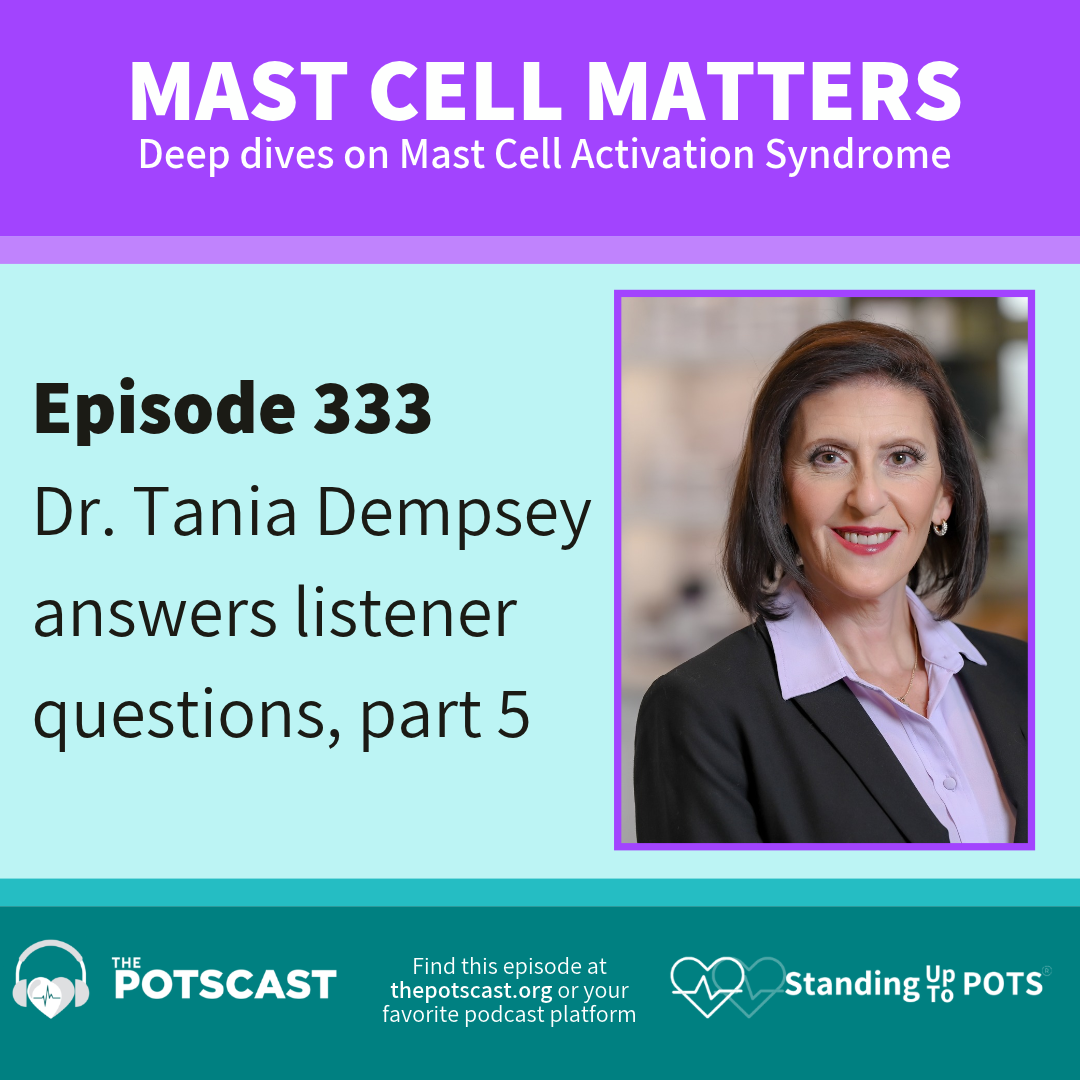
Dr. Tania Dempsey answers more listener questions in Mast Cell Matters
October 28, 2026
Dr. Dempsey, one of the world's leading experts on MCAS and associated conditions, answers listener questions about exercise as a mast cell trigger, the underlying causes of MCAS, treatments like Xolair, Amlexanox, Ketamine and antihistamines, estrogen replacement, her favorite novel therapies and much more.
If you have questions for Dr. Dempsey about mast cells and related topics, you can send them to research@standinguptopots.org.
Dr. Dempsey's website is https://drtaniadempsey.com/.
Episode Transcript
[00:00:00]
Jill Brook: Hello, fellow mast cell patients and beautiful people who care about mast cell patients. I'm Jill Brook, and today, the amazing Dr. Tania Dempsey is going to answer more listener questions, 'cause they're always rolling in. You may recall that Dr. Dempsey is a world-renowned expert in complex multi-system diseases, and the founder of the AIM Center for Personalized Medicine in Purchase, New York.
She's board certified in internal medicine and in integrative and holistic medicine, trained at the Johns Hopkins University School of Medicine with residency at NYU, and her clinic attracts patients from all over the world with mast cell activation syndrome, Lyme and other vector-borne infections, mold and environmental toxicity, dysautonomia, hormone and metabolic disorders, and more.
She serves on the board of ILADS, is part of the US ME/CFS Clinician Coalition. She's a founding executive board member of the International Society [00:01:00] for Mast Cell Activation Syndrome, and I could go on all day. Dr. Dempsey has authored numerous peer-reviewed publications on MCAS and related topics, and we're so grateful to have her here today.
Dr. Dempsey, I know it's been a long week for you, and you've stayed late for us. Thank you, thank you for being here.
Dr. Tania Dempsey: Oh, no, I love doing this. Glad to be here.
Jill Brook: So we get so many questions, and I've shortened some of them for clarity and brevity and taken out any personally identifying information. And some listeners have waited a really long time to get their questions answered, so I thought I'd start with them. Especially, I'm sorry to the person who has waited a long time for, for this question to come up.
Can you please talk about exercise as a trigger of MCAS? Like, what exactly is going on there? What can people do about it?
Dr. Tania Dempsey: Yeah. No, this is, this is, yeah, big, this can be a big issue. We'll go over the mechanism a little bit, but I will say this, that [00:02:00] once you can get things under control, often exercise turns into something that actually helps MCAS in the long term, right? So that's, that's what we're working towards because I have lots of patients who tell me that movement in general actually supports their nervous system and actually will decrease their MCAS and, and dysautonomia and some other things.
But you have to, you have to get there. And so what happens with exercise is that it's a, it's a, it's a change. You know, mast cells look at, at things in, in terms of changes, right? So like they, they react to changes in barometric pressure, they react to changes in temperature, they react to changes in, in, in blood flow, in other things, right?
So I think about exercise as a lot of those things. There's, there's you know, your body temperature starts to come up as you exercise. There's more movement. There's, there's more blood flow necessary. So I think that that for some people becomes a trigger, and [00:03:00] sometimes it's in the skin. I definitely have patients who have that sort of exercise-induced urticaria, so hives in the skin from exercise.
I've seen it manifest as POTS for some patients, so the more they exercise actually the worse their POTS is. So it can manifest in, in again, like lots of different ways. Some people get headaches with exercise. Some people get GI issues with exercise. So the mast cells are basically reacting wherever, you know, wherever is where I think the patient's weakness is, you know, wherever their mast cells are a little bit more activated.
So it is, it is really, really frustrating. And so the way I approach it is, number one is to first also look at other triggers. So exercise may be acting as a trigger, but often there are other triggers present that is making that trigger maybe a little more prominent. So we always look at to see if there are other things going on, exposures, [00:04:00] infections, other things that need to be addressed, right?
So, so step one of treating MCAS is always identify triggers. Then we're also trying to find mast cell stabilizers, mast cell-targeted therapies that are going to help prevent that from happening. And you know, very often through trial and error, we will find the key to the mast cell that literally shuts them off so that during exercise they understand that it's not dangerous and the patient can then, you know, proceed and, and, and, and feel, feel fine and be able to exercise.
And then often with time and building up stamina, there is this improvement in like, or, or actually that exercise then that actually causes less MCAS, actually controls it even more, right? So it becomes a treatment option, but to get there you have to go through these other, other steps.
I'll, I'll throw this out there only 'cause [00:05:00] it's really kind of interesting to me. I've seen now a few patients with exercise induced mast activation syndrome where their, their primary symptom was itching. And sometimes it would be during, while they're exercising, and sometimes it, it would happen after they exercise. So I have had patients where they're literally in the middle of warming up, and then all of a sudden during the warm up, right, their whole body is going crazy.
Sometimes for some patients it's after they're finished with their, their exercise. But I've had a few patients recently who have that symptom. We tried a number of mast cell targeted therapies, which really was a little bit hit or miss, meaning that maybe it helped, maybe it didn't, it wasn't consistent enough.
And what we wound up doing was actually in one patient she had babesia as a, as a bloodborne infection. So it's a, a protozoa, a parasite that lives in the blood, in the red blood [00:06:00] cells. And and parasites in general seem to induce mast cells very, very quickly. So do other infections and organisms, but parasites in general seem to have a greater impact very quickly on mast cells.
And because when you're, when you're exercising, you're pumping more blood, and the babesia is in the blood, in the bloodstream affecting oxygen, I think that there is some connection between how the babesia is inducing mast cell degranulation. And again, these, these are just anecdotal, right?
But I like to put these out there because I think sometimes if listeners hear it and it resonates with them, it just helps them maybe pursue a direction. It doesn't mean they have this, right? But but in one case it was babesia, the other case it was intestinal parasites, which I thought was interesting because they're both parasites, right?
And when we treated the underlying infection, the the [00:07:00] exercise induced MCAS actually disappeared, and it just went away. And, and this is like after so many attempts at just trying to find the mast cell stabilizer. Now, having said that, it's a couple cases, but sometimes it is purely mast cell.
It really is. There is no other trigger. It's exercise is the trigger. And, and we, you know, we work towards that. But I just thought it was interesting 'cause it was recent that this came up, these two patients, and just wanted to throw it out there that I think that, you know, something to, to think about depending on what the symptoms are.
Jill Brook: Yeah. This same listener had asked, she thought that sometimes she was seeing flares delayed a few hours after exercise. Do you see that? Is that possible? Or should she be looking at something else? Or like how delayed can a trigger be to the reaction, do you think?
Dr. Tania Dempsey: No, actually, that's a really great point, 'cause I implied that it, it could be like during, it could be right after. No, it can be hours later. And we see that with [00:08:00] any trigger with MCAS. I have patients who have such a delayed response that it could be 24 to 48 hours after the trigger, whether it's exercise, whether it's eating a food or exposure to a food or, or whatever.
So that's the problem, is that sometimes it's hard to correlate because it's so far removed. But several hours later is definitely in the realm of, of kind of common, yeah.
Jill Brook: Okay. Okay. That's, that's great to know. Next listener asks, what causes MCAS in the first place, and why does it seem to get worse over time? I, I don't know if this has an answer. Do we know?
Dr. Tania Dempsey: We don't know. We have some hypotheses, you know, some theories. If we look at the TILT research, the Toxicant Induced Loss of Tolerance research from Dr. Claudia Miller, who's at UT San Antonio, her research, if you look at that, what you would surmise is that [00:09:00] the mast cells are being initiated maybe epigenetically.
So there's some early in life, maybe in utero, maybe being passed down from a previous generation, but it's often exposures to environmental chemicals. That's what we really, really think, that the majority of people now, at least, who have Mast Cell Activation Syndrome, it's triggered by some kind of environmental exposure, either in this generation or, or a past generation, that then is passed down epigenetically, meaning that there's no gene for it, but there may be an alteration to a gene like an a, like a, like a marker on a gene that then causes an expression and, and may, you know, maybe Mast Cell Activation Syndrome is one of those, those things.
So I think there's a priming that happens early in life or in utero or in a prior, you know, prior generation that then, then someone is born with mast cells that way [00:10:00] or again, or develop early in life. And then there are events over the course of a lifetime where those mast cells that are primed become truly activated.
So there's like this initiating mechanism, but then there's like the true straw that breaks the camel's back, so to speak, right? So then there's like an event. Often it is an infection, a major stressor, a trauma a, oh my gosh, I mean, the list is very long, but there's something that then takes it from kind of quiescent, it's sort of like they're there, they're, they're leaking a little bit, but maybe they're not fully activating the way they, they would in a full-blown MCAS flare, but then there is a major event, and then there's a flare, and then it sort of keeps perpetuating. I think it's important to make this note that a lot of people think that let's say Lyme disease, mold, a lot of these triggers are the cause of Mast Cell Activation Syndrome.
They certainly can be the [00:11:00] initiating event. They can. I'm not saying they're not. But I think that they're, they're more likely to be a trigger to mast cells that were already primed in a certain way to become overactive. So what that implies then is that it's not as simple as, oh, you take away the Lyme and now, now you have no mast cell activation syndrome.
You can, you can get out of the mold, you could treat the infections, you can calm the mast cells down, you can push them into a quiet state where they're stabilized for long periods of time, but they still have a potential because they probably have had that potential throughout the, the patient's life.
That's how I look at it. I can't prove it fully, right? I think we have some research to support this theory, but we're not there yet. And, and it's certainly possible that I'll be disproven, you know, in the future.
Jill Brook: Is there anything you [00:12:00] think can be done to keep people from having their mast cell activation syndrome get more unstable or severe over time?
Dr. Tania Dempsey: You know, I think there are just some things that are out of our control. I, I always like to think that we do have control over a lot of things, but our environment is, is unfortunately not in as much control as we'd like. I would say that, you know, minimizing stress, learning to heal from stressors and traumas and things like that, I think help.
Like, all these things, whatever you can do to protect yourself and protect your body is ultimately going to help prevent escalation. But sometimes these triggers come, and there's nothing you can do. I'll, I'll give you an example. I had a patient who was really well controlled, and she had a house in upstate New York that was bordering Canada.
I think this was last year or the year before. There was major wildfires [00:13:00] happening in Canada. And so she's, she's in this house, and she's, you know, feeling fine, great, you know, whatever, and all of a sudden, the smoke started coming down. She started getting exposed to the wildfire smokes, right? That's out of her control.
I mean, she's done everything. She's on her mast cell stabilizer. She's doing really well, highly functioning. She's, you know, the best she's ever been, and then all of a sudden she gets exposed to wildfires, and then her mast cells get, you know, kind of, activated again. And then, you know, then it took some time, right, to get her out of the wildfires, get her body to settle down.
We had to try some new things. So, you know, I don't wanna sound pessimistic, 'cause you know I'm a really the ultimate optimist, but I think that I think sometimes it's good to, to know that it's not your fault, and that it's not, you know, it's nothing that you can do always to prevent it.
But, you know, whatever you could do to take care of yourself, to get the right nutrition in, to manage your stress, to sleep, those are all things that are [00:14:00] gonna be good in the long term for overall health.
Jill Brook: And we had a related question. So avoiding triggers is part of that, right? So, so it, it, to the extent that you can identify some things that you can avoid, does avoiding a trigger just help you that day, or does it also maybe help you in the future not get worse?
Dr. Tania Dempsey: Right. That's, I mean, that's the hope. And it, but it depends on the trigger and the extent of the trigger, right? So let's just say you go to a restaurant and you're exposed to a food that you know that you're sensitive to, right? But, but you didn't realize it was in the food, it was cooked in the food. I have this, you know, with patients all the time, that they tell the waiter, you know, "I can't have this and that," whatever, and all of a sudden it's in the food.
You don't realize it, and you get triggered. For, for some patients, that may be a trigger, a mild trigger that really just affects them that night. They have a pretty bad night, maybe the next day, and then they recover. In other patients, yeah, that, that turns into a major [00:15:00] trigger, and that may take a longer time.
So it really depends not just on the extent of the trigger, but also the mast cells in the person also and how they react to those triggers. And so in general, sure, we want to avoid things, but we can't always, and that's why really hunting down the best mast cell stabilization, right, the best things for you, that finding things that take you out of a flare, right, that's critical.
That's often very difficult. But, those are the things that hopefully will allow that trigger and the response to the trigger not linger.
Jill Brook: Mm-hmm. Okay, great. So this is sort of related. This listener asks "My daughter already takes four times the normal doses of over-the-counter H1 and H2 antihistamines to manage her MCAS," which they're told is the maximum she should do, and she's wondering if it's a bad idea to always be on the maximum dose all the [00:16:00] time, because then if she does, like, get stung by a bee or have some sort of a reaction, she doesn't, like, have anything extra she can take.
So she's wondering, should she keep something in reserve for bad reactions and try not to be on the maximum dose of antihistamines all the time?
Dr. Tania Dempsey: Yeah, that's a great question, and I think that it depends, right? So if you need the maximum dose to be well for quality of life, to not constantly be in a flare, then you need the maximum dosage. You know, I would argue, and I, I can't give medical advice, but, you know, the question is, is that really the maximum dosage?
Right? Because actually you'd be surprised that some of these antihistamines can go actually higher under medical supervision, right? So this may be a question that they ask their practitioner you know, "Is there room in an in the event of a, an emergency, can she take [00:17:00] more during those times?"
Right? And that's what I do with my patients, right? So let's just say, you know, they're on a certain number of, of Claritin, and but they know that in a flare they can take one or two more, you know. I'm not, I'm not telling them how many to take, I'm just saying that often there is more wiggle room than you think.
Jill Brook: Mm-hmm.
Dr. Tania Dempsey: There may be other H1 blockers that you can add on during an emergency, right? So maybe you're on a, a second-generation, Zyrtec, Xyzal, Allegra, Claritin, or something like that, and, but maybe during the emergency you take Benadryl or hydroxyzine, which is the first generation, which does make people more tired, but, and they're shorter, shorter acting, but you can mix antihistamines in the case of emergency.
So I really believe that you should be on the dosage that you need to function. If you don't know if that's the dosage you need, in other words, you've been on the dosage for a long time or, or her daughter's been on the [00:18:00] dosage for a long time, and you don't know if she still needs that dosage, you know, sure, there may be opportunity to play around with the dosage under medical supervision to see what the, the lowest possible dosage, you know, that, that that she needs.
But I guess I would say that I think there's a lot of fear and fear-mongering on social media about antihistamines in general, and there's this constant, like, feeling that we have to get people off it. And, you know, yes, from an, in an optimal, like, world, no one would take anything, right? We wouldn't take any medications.
We wouldn't do, right? I don't know if that's optimal. But in any case you know, I look at it as I still think they're very safe drugs. I think that it's safer to be on these drugs and function and, and have good quality of life and feel better than to suffer in [00:19:00] flares that can then just escalate, escalate, and be dangerous, right?
That's dangerous. That's more dangerous than being on a long-term antihistamine. So I'm not sure if that's what she's asking, but, but I just want to kind of clarify that. I just, I, I've done a bunch of reels recently on Instagram about this. I just, there's just so much fear, and the patients are so confused about what patients and, and family members are confused about what, you know, what they really should be on.
You should be on what helps you the most, whatever that takes.
Jill Brook: Okay, that's great. That's so great. We like, we like getting rid of fear. Okay, so that brings me to a few questions about different drugs, and the first one is Xolair. They're just wondering, what do you think of it? When do you consider using it, if ever?
Dr. Tania Dempsey: Yeah. Yeah, I have a few patients on Xolair and have, you know, used it over the years. I would say that you know, Xolair is an, a really interesting drug. It's a monoclonal antibody for IgE, so it binds to [00:20:00] the mast cell through the IgE receptor, and and it can stabilize the mast cell.
It's approved, FDA approved for things like asthma that isn't controlled by, by the, you know, regular drugs that are used for asthma. It's, it's approved for urticaria or hives. There may be a few other indications that they're looking at, but those are sort of the general ones. And but from, from a mast cell perspective, it has been helpful for a, for a variety of patients.
The challenge really is figuring out who the patient is. So I typically avoid it in patients who are, tend towards anaphylactic-type reactions because Xolair is a very long-acting drug with a very long half-life. The body doesn't get rid of it that quickly, so if you are gonna react to it and it's in your body for a long time, that's a little scary, right?
So I, I tend to, you know, kind of avoid it in the very reactive patients in that, in the [00:21:00] anaphylactoid group or anaphylactic group. I tend to think that it works well in patients who have more, I'll call it allergic manifestations of, of mast cell activation syndrome. Not always, but many of them who have, they're congested, they're they have hives, they you know, some of those, we'll call them allergic-type symptoms tend to respond well to it.
But I have used Xolair in patients who don't have any allergic-type symptoms. I had a patient, we used it mostly for her fatigue, which was super interesting. She has a lot of other mast cell symptoms, but fatigue is the predominant symptom, and Xolair has been helpful for a number of years for her.
It's not perfect, but it does seem to help fatigue. So point is that I keep learning about patients who could benefit from it but it is one that I use very cautiously, only because I do worry [00:22:00] about the patient where they react and then, and then the reaction is prolonged because the drug is still in the system for a long period of time. So I think there has to be a real, real good selection process.
Jill Brook: Okay so moving on to the next drug, it was amlexanox. Do you have any experience with that drug? And this person is saying they haven't really responded well to a bunch of other MCAS treatments, so they're thinking of trying amlexanox
Dr. Tania Dempsey: Yeah, so I've been using amlexanox for a number of years, and, and what I would say is this. And, and this has been actually, actually corroborated with, with other doctors. Sometimes when it works, it's, it's a pretty great drug. But it doesn't happen that often. That's what I'll say. So it's definitely on my list of things to try for some patients.
You know, like I have a little protocol that I think of and, and every patient's a little different, and in some patients I want to start one thing before another [00:23:00] thing. But amlexanox is often on the list somewhere, and sometimes we get to it, and sometimes we don't. But, you know, I, I have a patient who recently who responded really well to amlexanox.
What's interesting about amlexanox is that it is a mast cell stabilizer, and it has to be compounded, and it's a drug that was only approved in Japan, actually, initially. So I believe it comes out of Japan as a drug.
And is known as a mast cell stabilizer, but it has a very interesting mechanism of action, and it also has some effect on the metabolism and, and can help with weight loss and obesity. So that's where some of the research was going. So at one point, the more like functional medicine/obesity community was sort of looking at it for weight loss a little bit before like the GLPs became more popular.
And and so I would say like, yeah, sometimes it was a little [00:24:00] helpful. I never saw it, like people didn't lose tremendous amount of weight on it. But I think it was anti-inflammatory, and so that's why some people maybe lost a little, a little bit of weight and they felt less inflamed. So again, I think it can be helpful.
I think that I have one patient right now who finds that her seasonal allergies, right now in New York, the pollen is, is horrible, and she feels that it's not perfect, she still has to take some H1 and H2 blockers and some other things, but, but on the amlexanox, this is the first spring that she isn't like really having as hard a time.
Usually she couldn't even go outside or whatever. So that's promising to me, and I think great. I mean, I love when it does seem to help support things. But it's not one of those drugs where I can feel like, wow, I've had just, you know, hundreds of amazing cases. There are other drugs that I've had more success with, but it is nice.
It has less side effects, but I have had a few patients who couldn't [00:25:00] tolerate it, so nothing is perfect.
Jill Brook: Okay, great. Have you had any MCAS patients who did low dose ketamine therapy using lozenges for their sleep and their pain? And if so, did they tolerate it okay or do you have any thoughts on it?
Dr. Tania Dempsey: Some patients do that. Yeah, you know, I, I'm always surprised at actually how well ketamine is, is tolerated, and ketamine does have some mast cell stabilizing properties. I think the mode of delivery does seem to matter depending on some patients. Sometimes the IV is better, sometimes the lozenge is better, sometimes the nasal spray is better.
I think it's very individual. I've not seen it cause major flares in that, in that formulation, like in a lozenge formulation, I've not seen it. I have seen occasionally flares from IV therapy, but I think it's, it's not just like clear to me that it's just the ketamine. Maybe there are other things that are being administered along with the ketamine IV, so that may be [00:26:00] compounding the problem.
But yeah, I mean, it's, it, it's a reasonable thing as long as it's, you know, really supervised well and monitored.
Jill Brook: Okay, great. And you had mentioned mode of delivery. So the next question is about whether you've seen those ads for the Neffy nasal spray epinephrine and if you think that's an okay way to do it.
Dr. Tania Dempsey: So I think it sounds promising. I've not had any patients try it yet, mostly because there is like a hesitancy for a few reasons. Some of my patients have a lot of nasal issues. Especially like with connective tissue, I've had patients who don't have a septum. I have like really like destruction of their nasal cavity for a variety of reasons and so, like why would you put something in your nose like that?
You don't want to damage it more. So I think I definitely have some patients who are just leery of it. Again, the, the literature looks good, that it has a [00:27:00] very quick onset of action, but I think that we're so used to that, you know, the thought of the injection and getting it in right away, that way that, that I think it's gonna take some change in mindset to really move it to the nasal spray.
But I don't, I haven't had anybody try it yet in my practice, so I don't even have any information yet really as a follow-up. But we'll have to address that next time.
Jill Brook: Okay, yeah. It'll be interesting to hear it coming in. Okay, here's somebody wondering if you can talk about the circadian rhythm of mast cells. Are they reliably more or less stable at certain times of the day?
Dr. Tania Dempsey: Nothing's reliable when it comes to mast cells.
Jill Brook: Good to know.
Dr. Tania Dempsey: It's the truth. I don't think they necessarily have a circadian rhythm. I think that you have a circadian rhythm that then I think then affects the mast cells, right? So what I find is that I have patients who notice that their [00:28:00] mast cell activation syndrome is worse at 6:00 AM or whatever. I have patients who notice it's worse at 4:00 PM or 5:00 PM or 9:00 PM, you know.
So the point is that I've not really seen a specific time that could be explained by, oh, the mast cells are always more active at this time because of the, their circadian rhythm. But, but I will say that a lot of mast cell patients notice that either the early morning hours or the evening hours can be tricky because it does seem like those are the times when mast cells may be more activated.
Now again, does it come down to is it the mast cell itself or is it something about our own hormonal fluctuations during those times? So is it because our cortisol levels are going down in the evening, and now we don't have enough cortisol, there's not, not enough anti-inflammatory effect, [00:29:00] and so now the mast cells are more activated during that time when cortisol is lower?
For those who are getting it sort of in the early morning hours, is it because the cortisol is rising and there's a change in cortisol levels, and is that activating mast cells during that time? So I think it's super fascinating and interesting, and I would love to study that more and research that.
But I have noticed that for a lot of patients, there is a particular time of day where they're more challenged. But I don't think it's because of the mast cell itself, I think. I don't know for sure. I think it's about our, our bodies. Yeah.
Jill Brook: Well, this might be a little related. Somebody's asking what you think of melatonin supplements to sleep.
Dr. Tania Dempsey: Yeah, so melatonin is a little bit of a mixed bag. I think that it, it can be helpful for some patients. It has some anti-inflammatory effects. I mean, certainly during [00:30:00] the COVID pandemic, a lot of people were looking at high-dose melatonin for, for inflammation coming from COVID and long COVID.
So I think there's some, there's definitely research to, to support melatonin's use as an anti-inflammatory and maybe for sleep. I think that the problem is, I tend to, tend to recommend people not to take it every single day indefinitely. You will shut down your own melatonin production. So if we already know your melatonin's low, let's say we've tested it and we know your melatonin's low, then we replace it, and then you just stay on it, and that's not a problem.
But if we're not sure and we're just using melatonin, like, as an experiment for sleep, I think it's a good experiment, but I think we need to ultimately figure out a better solution long term than, than just relying on melatonin. I think that there are other herbs and supplements that may, may help melatonin [00:31:00] work better.
The other thing I see sometimes with melatonin is that it has a little bit of a rebound effect for some people. Sometimes people get more activated. Sometimes they only sleep for a few hours and they wake up. It's not to say I am a, I am a fan of melatonin, but I think it has to be used judiciously, you know, and, and really carefully.
Jill Brook: Okay. Thank you. Great answer. And as kind of a related question, somebody asked, "Are there any supplements that you just think are pretty much flat across the board good for all MCAS patients?"
Dr. Tania Dempsey: Well, I'll, I'll say the vitamin that, that, that I think is across the board necessary for all mast cell patients, that doesn't mean that all mast cell patients tolerate it, and I'll explain why. Vitamin D is essential. Mast cells have receptors for vitamin D. Vitamin D is essential for the immune system.
It's a hormone. There's a lot of, lot of research on, on, on vitamin D in immune [00:32:00] dysfunction disorders like, like MCAS. The problem that I find is that there is a subset of patients who are either sensitive to the excipients in the vitamin D, the formulation of the vitamin D, how it's being administered, especially for patients who have a lot of GI intolerances.
You know, sometimes we have to give it as an injection. But I will say 99% of the time, I would never say 100, but 99% of the time, I can get someone on vitamin D by just working through different formulations, excipients, and, and then often the injection is the answer for a lot of patients 'cause we bypass the gut.
So for me, vitamin D is, is essential, but, but like any supplement for, for some mast cell patients, excipients can be an issue. I definitely have MCAS patients who have absolutely no problem with any [00:33:00] kind of excipient or any supplement. They can take anything, and they're fine. So I'm always hesitant to say, "Oh, this is great for everybody, and just go out and take it."
I think you need to know your own body, you know? But I, I definitely have supplements that I like, that I would like people on, but I don't know if I would, you know, say that, that you should go out and do it, right? As I'm always hesitant to give advice like that.
Jill Brook: Do you have any particular, like, range of blood levels of vitamin D that you are aiming for when people supplement?
Dr. Tania Dempsey: Yeah, I mean, typically I'd like to get it to around 60, and I would say 60 to 80 would be a really good, good range. Sometimes 50 is sufficient. It really depends on people's calcium levels and other things. But you know, I've seen mast cell patients who have had their vitamin Ds of seven, like, like super, super low, and they're so reactive.
And then actually you start to bring their vitamin [00:34:00] D up, and it doesn't fix everything, but actually does act like a mast cell stabilizer, so then they start to feel better. So I would say ideally I like to see it around 60-ish up to, up to 80.
Jill Brook: Okay, great. Okay, so we have a 61-year-old woman who says that her doctor wants her on hormone therapy, and she understands from some of your past episodes that estrogen might be triggering to her mast cells. And so she's wondering if there's any best type of estrogen or delivery route or any tricks for starting estrogen replacement that would kinda minimize the risk to triggering mast cells.
Dr. Tania Dempsey: The main issue with estrogen is, is the change in estrogen levels that trigger mast cells. So, so yes, estrogen can be a trigger for mast cells, they tend to be more activating than, than not, except when they're in a steady state. [00:35:00] And when they're in a steady state, they seem to actually help some patients with MCAS.
So this is, this is my problem with just about like every every drug, every hormone, everything, right? We talk about it like this, "Oh, progesterone is mast cell stabilizing, and estrogen is mast cell activating," and I would say I've seen the opposite for both. So I think a, a lot of it is change in the, the amount of it that the mast cell is reading.
So for many women using HRT where there's a steady state you know, every day the same dosage, sometimes that minimizes that, that reactivity. So some women get no reactivity. Some women, any amount of estrogen is gonna be a little bit activating for, for them. Again, it's a little bit of trial and error.
We don't always know who, who that's gonna be. I tend to be you know, a fan of the estradiol patches for a lot of women. I think that's a you know, a [00:36:00] good delivery system. But I have women who react to the adhesive of the, of that patch, right? So then that's not a good delivery system for them.
We can compound creams, you could theoretically use oral estradiol. I'm not a huge fan of oral, but it really, really depends on, on the patient. But the patch is sort of like the easiest, in my opinion, to, to at least try. So estradiol would be the, the best thing.
We don't want Premarin, we don't want, which is like horse, you know, horse urine estrogens which were really big back in the '80s and '90s. But The other type of estrogen or estradiol that I would really strongly recommend for a lot of women, especially in the perimenopausal, menopausal period, is vaginal estradiol.
So the vagina does absorb estrogens really well. So for some women, if I can't get them any other formulation, I'll [00:37:00] use that formulation as a way to build up their estrogen levels, estradiol levels. But I would say very often using it in addition to whatever other HRT I'm giving them because the vagina, that whole area we call it the genitourinary system, is very, very sensitive to lack of estrogen, and there's an increased amount of urinary tract infections and other issues without having enough estradiol or estrogen in that area.
So I'm a big fan of vaginal estradiol for that, for that reason. What I see very often is I have patients who think they just have like a mast cell interstitial cystitis type situation with their bladder. They have a lot of bladder irritation. They feel like they have UTIs. They get tested, they don't have a UTI, or maybe they have some bacteria, and then they get treated, but, like, it never really clears up.
And sometimes I'll just, I'll use vaginal [00:38:00] estradiol and, and, and vaginal meaning, like, they can put it in, but sometimes we just have them put it around the urethra. And and then their, their, quote-unquote, "interstitial cystitis" or bladder symptoms get better because that whole area is really sensitive to, to estradiol and estrogen in general.
So, so those are, like, the things that I think about. Most mast cell patients can tolerate, a lot of them, I should say, can tolerate the vaginal estradiol in some form. Sometimes we have to compound it. But it's such a low dose most of the time that that kind of helps, like, ease into HRT. Like, for some patients, I have one patient who's so sensitive to, to estrogens that, that we started with the vaginal first because it, again, it's highly absorbed, but it's such a low dose, and it can't even compare to the dosage you're gonna get in a patch or anything else.
So she started that way. We determined she could tolerate it, and then we moved to the next [00:39:00] step, you know, to see if she could tolerate higher dosages at like, let's say, as a patch. So I don't know if that answered the question, but the point being is that I think there's a way to help most women tolerate estradiol in a steady state.
I think that for for women who are still menstruating, where they're having large fluctuations of their estrogen through the cycle, sometimes that's worse for them, their own natural estradiol levels going up and down all through the menstrual cycle, and that's what's causing their, their mast cell flares.
So sometimes, like, just having that flattening of the hormones and having it all in, like, one dosage is is helpful.
Jill Brook: Okay. And pardon my ignorance, but in case other people don't know either. So are you saying that if somebody then takes supplemental estrogen, that makes their own estrogen kinda quit fluctuating so much?
Dr. Tania Dempsey: It can.
Jill Brook: Okay.
Dr. Tania Dempsey: Can [00:40:00] sort of, like, suppress the, the body's cycling. Not, not always, but sometimes it can. We call these tricks of the trade. Ways to try to suppress the fluctuations in people who are still, in women who are still menstruating. But, but again, my point is that around the time of perimenopause and menopause, when women are starting to hear this conversation about, you know, "I need to be on HRT, I need to be on HRT," I, I think there's some fear and I think some of it is founded.
I don't, I don't think it's that, that we should be worried about the cancer and all the stuff that we have been hearing for years, but it's more that, yeah, if you're a sensitive mast cell patient, you do need to tread lightly. You need to work with someone who understands this.
But for the most part, actually, I've had great success with women when, when we are able to stabilize and get them on the right hormones, they actually feel better and their MCAS actually can be better controlled. Not always, right? But a lot of the [00:41:00] time.
Jill Brook: Yeah. Okay, that's good. Gives us something to look forward to in middle age. And you've been so kind with your time. I'll, I'll make this the last question. This listener writes in, "I really enjoyed your episodes about the high tech and leading edge treatments you use in your office. With some more time having passed, which ones are you finding most effective for MCAS patients? Do you currently have any favorites or any plans to get some more leading edge treatments or gizmos in your clinic?"
Dr. Tania Dempsey: Oh, I'm definitely getting more. I'm speaking at the it's called Beyond Biohacking. It's Dave Asprey's biohacking conference at the end of May. And that's where I sort of found a few of my gizmos for the office, and I plan on looking for, for more 'cause I'm always on the hunt for, for cool things for my patients that I think can help and, and, and non-aggressively, right?
So having said that, I I really do still love TPE, therapeutic plasma exchange. I think that [00:42:00] it can be helpful in a number of, of ways. I think that for patients who have a high toxic load, mold exposures, mycotoxins plastics, heavy metals, and that's part of what's constantly keeping them in a vicious cycle of MCAS, pulling those things out for TPE can be really helpful.
I think that for some patients, what we're noticing, the more I do it, the more experience I have, we have had patients who have had flares on occasion, either during or after. Most of the time it's very controlled. It's not really a major flare. But what I noticed with some of these patients who have had some flares is that when we give it some time for their body to, to calm down and relax and, and, and reset, then actually what we hear very often is that, "Wow, this is actually the best I've felt."
Even though, like, during it, we weren't sure, you know, we weren't seeing an immediate response. So, so I'm excited. We had a [00:43:00] patient recently who was really, really reactive, but really wanted to do the TPE. She had Lyme and bartonella and a few other infections and mold. And and, and during it, she had a little bit of a flare during, like, the second treatment which, which dissipated very, very quickly.
But we were like I don't know, you know, should we push through this? And she really wanted to push through it. And so she wound up doing four. She took a break for a few weeks and then did two more. And then, you know, this has been, like, now a couple months after, and what she said was that she's feeling so amazing and, and the best she's felt in, like, 10 years, that she actually doesn't wanna do some of the other things that I recommended her, her try.
Like, we had a whole thing of these are the mast cell things we're gonna try, and these are the additional you know, therapies we should do. She's like, "Do you mind if I do nothing? Because I feel so good right now, I'm afraid to, like, rock the boat." So, so I think it's exciting to me. As I do more and, and [00:44:00] see more mast cell patients using it, I understand it better and understand the utility of it, so I'm still excited about that, and I think combining that with, for me, like the, the SOT therapy, which is for infections, whether it's viral infections, Epstein-Barr, CMV, we use it for those, and then, and then for Lyme, babesia, bartonella, and a lot of the other vector-borne infections.
Combining those two things, so like taking the load down of the infections, cleaning out the blood, allows the immune system to get a little break, and that's what I think ultimately helps MCAS in the, in the long run. So those are two things. And then lastly, we've been starting to do a lot of exosomes, which are not, I'll use the term stem cells, but they're not, they're not stem cells. They're sort of the, the messengers from stem cells. So, they are like little [00:45:00] pockets of, of, of messenger RNA proteins that are sort of telling your body to do things in a certain way, and these are really purified. And, you know, the same thing I've seen now, we've had some patients who have done plasmapheresis first, clean their blood, and then we've given them exosomes after.
And, and so now it's we've cleaned the blood, the body can heal, but the exosomes are sending a signal and helping the body heal, and that's been really exciting also to see. And so that's something that you know, we're doing more and more of. So I love all those things. But again, they're not, they're not for, for everyone.
I would never suggest that everyone needs it. But I love seeing the successes we've had with these technologies.
Jill Brook: Well, Dr. Dempsey, I can't thank you enough for your time, and I, I know that you're always thinking about how to help this community, and I know that you already worked a few hours late helping your patients, and then you stayed [00:46:00] longer to be with us. And you're just amazing and gosh, I almost hate to take your time, but we also had a lot of people writing in thanking you for a lot of your recent social media posts, like correcting other people who had put out bad information and standing up for us.
And it just means so much to have your information and your care and your just curiosity and just always looking for, for more ways to help this community. Just thanks for your time today, and just thanks a million.
Dr. Tania Dempsey: I will, I will fight for this community. I cannot, I cannot stand people who are vultures and are, and are, are, you know, are, are preying on vulnerable people who are looking for answers and trying to find solutions for their care, and there's so many charlatans out there who are trying to do that.
It just drives me insane. So every time I see this I'm like, I'm gonna, I'm gonna do more of that because I just wanna expose people who are not, not really looking out for this community.
Jill Brook: Well, I have to [00:47:00] admit, I saw one of them myself, and I was, like, cheering you on. I was like, "Yeah, thank you." It just means so much. Thanks a million, and we'll let you get onto your weekend now.
Okay, listeners, that's all for now. We'll be back again soon, but until then, thank you for listening. Remember you're not alone, and please join us again soon.