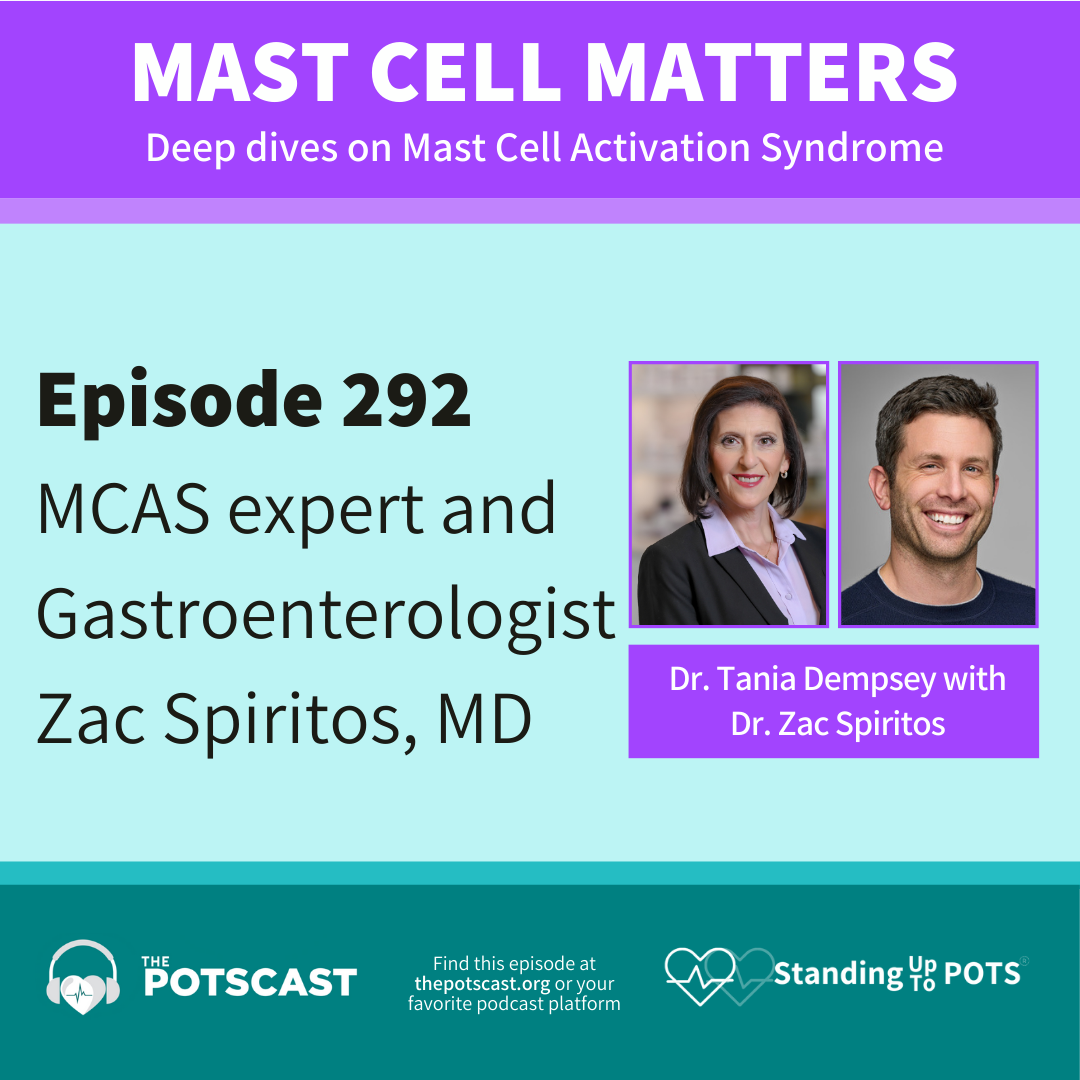
Zac Spiritos, MD, MPH on neurogastroenterology with Dr. Tania Dempsey on Mast Cell Matters
January 13, 2026
Dr. Spiritos is double board certified in gastroenterologist and internal medicine, and specializes in IBS, gut motility, POTS and the complex conditions and symptoms that go along with it. He and Dr. Dempsey discuss IBS, parasites, SIBO, CD117 staining, GLP-1 drugs for MCAS, his treatment approach, some promising news on the awareness front, and much more.
Episode Transcript
Jill Brook: [00:00:00] Hello, fellow mast cell patients and lovely people who care about mast cell patients. I'm Jill Brook, and this is Mast Cell Matters, where we go deep on all things related to Mast Cell Activation Syndrome or MCAS, with the help of our wonderful guest host, Dr. Tania Dempsey, a Johns Hopkins Med School graduate, world renowned mast cell expert, physician, researcher, and recently back from being a star presenter at the ILADS Conference, and a board member too.
Dr. Dempsey, thank you so much for coming today and which of your fascinating colleagues did you bring with you?
Dr. Tania Dempsey: Oh, I am just thrilled to have Dr. Zachary Spiritos here. And by the way, he also attended ILADS this year, which I was really excited to see. So we're gonna, we're gonna take some deep dives with the stuff he's doing, but we'll talk, maybe we'll talk a little Lyme too, right, while we're at it. Dr. Spiritos is a Philadelphian turned North Carolinian, having made his way south for college and ultimately putting down roots after meeting his wife. He graduated cum laude from Davidson [00:01:00] College before starting his medical training. Dr. Spiritos treats a wide range of GI and liver disorders with specialty interests in IBS, functional abdominal pain, motility disorders, and dysautonomia. This includes Postural Orthostatic Tachycardia Syndrome, POTS, and Mast Cell Activation Syndrome. He is also well versed in GI complications associated with hypermobility syndromes, including Ehlers-Danlos. Passionate about patient education and holistic approach to GI health, he integrates nutrition, lifestyle modifications, and gut brain therapies into his practice. I should say, he did his medical school at university of North Carolina School of Medicine, his residency at Emory in Internal Medicine, and his fellowship Fellowship at Duke University in GI. Welcome, Dr. Spiritos.
Dr. Zac Spiritos: I am so excited to be here and I've been listening to this podcast for like two years, and to hear you, Jill do that introduction, it was like, like being on like, let's get ready to rumble before a [00:02:00] boxing match. I was like, I got goosebumps. Like that was awesome. I'm so fired up. Let's do this.
Dr. Tania Dempsey: Oh, let's do it. Let's do it. So, you know what I'd love to start with actually is your journey. You know, so you, you decide to be a GI doctor. Why? Why? And then how did you wind up in this world that we're in?
Dr. Zac Spiritos: Yeah. I love procedures. You know, I think in residency I loved putting in central lines. I remember like leading the central line team. Everybody who was a GI doctor was really happy. I think you just get to talk about poop and make poop jokes all day and you know, it's great, and you don't take a lot of call and it's like low risk.
And then I kind of started doing it and I didn't love doing endoscopy. I just, I didn't love it. I just, it wasn't my calling. And everybody else around me loved doing endoscopy and I like taking off a big polyp here and there, or complex dilation, but beyond that, it just, it wasn't really filling my cup up.
And I loved the complexity of internal. I just love how layered it was. And I loved getting to know my patients. And I went to like Emory to go work at [00:03:00] Grady in inner city Atlanta, like know my patients, and work through like the socioeconomic complexities and like peeling back layers and trying to get people healthy and you know, all that idealistic medical student stuff.
And then I became a GI doctor. I was like, I didn't, I wasn't very fulfilled. I always love the quote unquote IBS world where effectively people have symptoms, but all the diagnostic tests are just unremarkable or don't necessarily point to why someone feels as lousy as they do. And so I think that that whole sphere of medicine really spoke to me because you got to, there's so many inputs there. There's mental health, there's sleep, there's hormones, there's diet, there's medications, there's motility, right? And so you, you just get to learn about all this stuff and, you know, talk to these patients about not just what was found on endoscopy. Yeah, that's part of it. But there's all these other inputs and ways that you can kind of help people, not only for their GI care, but their overall health and wellbeing. So I love that.
But then there's this one patient that, like, I, I don't know if she listens to this stuff. I don't think she does. But she moved from California, she was like in her twenties, and she came in with her [00:04:00] kid and she had IBS and like debilitating GI pain. And I, I tended to be someone who, like I was the third GI doctor that she saw. Like I saw these third, fourth referrals, right? And she had like iron deficiency anemia, and she had this kind of MRI that showed like maybe some terminal ileal inflammation that maybe suggested of something called Crohn's disease. And they put her on all these therapies and nothing worked and when they should work for Crohn's disease, but she also had like menorrhagia and she was bendy and had POTS and had migraines. And I was like, something's a little off here. And then I don't know how or why, but I read about mast cell, like that weekend.
I remember being like, this is new. I've never heard of this before, 'cause in training, like just never came, came across my plate. Internal medicine, fellowship, not a single time. I also like, probably didn't pay attention, a lot of attention to allergy and immunology. Not my bag.
So, I was like, this works. And I put her in Pepcid and Zyrtec and like two weeks later she had no symptoms. And I was like, oh, there's something here I don't understand. [00:05:00] And this was about three years ago. And, and then I started to be like, I'm just, I, I just wanted to learn more and I always had about 30 to 40 patients in my clinic that we were making little bit of gains here and there, but we weren't addressing the whole picture.
Like I was missing something and was mast cell the whole time. And so, if you build it, they will come. And I started seeing more POTS and I just started treating POTS because the local POTS physician was booked out years and years and years. So a good friend of mine, Alexis Cutchins, who's like, I think one of the most brilliant POTS doctors in the world, kind of trained me up on this. Obviously did a lot of reading. And so then I just started, I created this world of the dysautonomia trio plus a little ME/CFS, and that's kinda the world I live in now. So I see a lot of complex motility disorders where the gut's just not working very well, whether that's, you know, related to whatever causes POTS. And we, you know, we've talked about before I came on here. You know, Sjogrens, dysautonomia, AAG, which is autoimmune autonomic ganglionopathy. So I treat a lot of motility disorders as well, but kind of baked into that is also [00:06:00] Mast Cell Activation Syndrome. And, and yeah, the crazy complex world of that as well. So I'm trying to figure this out like everybody else is.
Dr. Tania Dempsey: Well, I think that makes you special, and I think that that's what you really need to, you need to have this curiosity, that, you know, I think a lot of other physicians around the country don't, don't have, right. To do, to do the work that we do you have to be curious. You have to constantly wanna understand, right. I think about it like, maybe I like doing puzzles, I don't know, but like, I just always wanna figure out how the pieces fit together, right. It sounds like you're, you know, doing the same thing.
Dr. Zac Spiritos: Yeah, I think I have a perfect mix of curiosity and anxiety. When I don't know the answer, I'm like, oh my gosh, I gotta figure this out. And so, yeah, I, I love reading about these things. I have few hobbies besides watching the Philadelphia Eagles, my family, hanging out with friends and, and reading about medicine, and it really makes me happy. And I get to hang out with brilliant minds like yourselves to kind of teach me. And and I'm standing on the shoulders of giants who paved this way and figured out that mast cell's a real [00:07:00] thing that causes a lot of debilitating symptoms despite not being in a single page in a medical textbook and training.
Dr. Tania Dempsey: Yeah. Isn't that crazy? But we'll get there. Don't you think? We, we will.
Dr. Zac Spiritos: Yeah, I think so. I mean, the prevalence is skyrocketing. And so I, you know, I think of the local UNC allergy group that does a phenomenal job taking care of mast cell as well, I think one of the few academic institutions that really recognize it for what it is. And they've been tracking the incidents and prevalence of it, and it's through the roof.
It's grown by eightfold in the past couple years, and that's just based on claims data. And you know, you always ask, is that just 'cause we're recognizing it more or is it because of, you know, COVID, right, and these viral processes that are just kind of flipping on this switch to where all of a sudden a lot more people have it.
I think it's probably been around for decades. I think it's just now, you know, I think we're, we're paying more attention to it now.
Dr. Tania Dempsey: Yeah. And maybe I'll add, you know, I think it was already on the rise from our environment, right? I think that there's some toxicity. And then I think it's like that perfect storm [00:08:00] and I think the COVID came, the COVID vaccines, however you wanna think about it, right? And yes. So it's gonna get worse, I think. And we all have to be prepared. You mentioned before we went on the show that you that you just gave a talk at Memorial Sloan Kettering.
Dr. Zac Spiritos: They reached out to me via Instagram, which is kind of, I can't imagine they bring in a lot of guest speakers via social media. But yeah, it's cool. You know, I you know, it's, I think it's really challenging for providers who have spent so many hours studying to then have something arrive in their clinic and they have no idea what to do with it.
Right, it doesn't fit into any box that we know of. It's people with symptoms that hop between organ systems with triggers that don't make any sense, like perfume giving you a migraine. Like what are we doing here? Right? You eat an avocado and you have hives. Like that inherently doesn't make sense. And all their IgE testing is negative. Like when you, when when we see patients like there's like, okay, there's the metabolic box, right? The cardiovascular syndromes, the diabetes, there's the autoimmune box, there is [00:09:00] the infectious box. And it doesn't like, yeah, it's in kind of in this autoimmune inflammatory process, but like there's no structure with which we can even comprehend what these folks are going through and how to think about them. And I think it, it, there's why there's so much pushback. Forget the fact that it's also young women who get this condition, who are inherently just not believed by the medical system. So that's just another layer to all of this.
But the more that I see these patients and I'll say, hey, you know, that patient that you sent me, I got them better on like, a low dose tirzepatide, which we can talk about as well.
Dr. Tania Dempsey: Yeah. We have to.
Dr. Zac Spiritos: Little bit of Pepcid and they're like, oh my gosh. And they've been on the PPIs, amitriptyline, Cymbalta, which they don't tolerate any of these things. People are starting to realize like, oh, there's something out there. Once you see it and put a name to it, like then you can't unsee it and then you see mast cell everywhere.
Dr. Tania Dempsey: A hundred percent. I, I've said the same exact thing. Yeah. So what did you speak out on to the, these docs at Memorial Sloan Kettering, 'cause that seems like a, like that's a good group to, to [00:10:00] spread the word.
Dr. Zac Spiritos: I was really excited. So I spoke about kind of mast cells, mast cell activation, how I approach it, because I think everybody has a different approach, right? Like we're all just kind of making it up, right? I mean, I, and we have these groups that we, we share ideas, so I've learned from colleagues, but you kind of find your own way of practicing.
And I tell them like, this is what I'm doing, but I'm kind of making it up here. And I do it, you know, I'm very thoughtful about this and I have, I track symptoms and I have symptom scoring to see what gets better and do one thing at a time and start low and go slow and all these good stuff. So I talked about what it is, my treatment algorithm, which is incredibly complex and changes on a week to week basis. And then how to recognize these folks in clinic and then what GI symptoms typically show up in the mast cell patient, how they differ from similar symptoms in someone who doesn't have mast cell, and then how to think them from a therapeutic perspective. And then offered some clinical trials, although that's kind of a paucity of data in this space. Clinical trials that at least give us some comfort that what we're doing is the right [00:11:00] thing to do for patients with IBS, but may have just underlying mast cell disease.
Dr. Tania Dempsey: And so how was it received? How was this information? What do you think? What, what was the audience? Were these medical students, residents, attendees? Who was, who was there?
Dr. Zac Spiritos: It was the GI department. So it was attendings and fellows.
So like not all heartburn is created equal, right. And so when you see, when you say heart burn, it's like PPI endoscopy. Like maybe. If that person is 23 years old, is not obese, does not have a hernia, also has migraines and seasonal allergies, maybe it's something else, right. And just to maybe let's broaden our differential diagnosis to not, it's not just all gastroesophageal reflux disease. Because yeah, that's common, but GERD has to make sense. Like there's a reason GERD happens. Like we have a pretty good valve called the lower esophageal sphincter that keeps everything in the stomach, right. That shouldn't, at the age of 23, that should be working fine. Yeah. If you have EDS, like that's a different conversation. There's common symptoms that we see in GI clinics that we're quick to say it's this, but in this [00:12:00] patient population, if you start to realize like, oh, this person is a little bit bendy, they have a little bit of dysautonomia. I need to interpret this symptom differently. And that's, that was the angle that I took.
Dr. Tania Dempsey: And they, and they received it well, it sounds like.
Dr. Zac Spiritos: I think so. I don't know, right. Like people, they think I'm totally nuts right now. So I, I try to preface everything by saying that, you know, this is all new to me, right? Like I love a good clinical trial. We don't have 'em, right? But what I do know is that I've lived in this IBS world for a long time and there's a subset of patients that don't play by the rules that we think should apply to them.
They don't necessarily respond to cognitive behavioral therapy and hypnosis and amitriptyline and Cymbalta and all the neuromodulators that we typically use. There's nothing that really shows up on endoscopy. And we'll talk about the CD117 because I have an issue with that as well. But I just, I think I just wanna say there's something there that we don't yet understand. I don't get it either, but I'm trying to, and these are maybe some breadcrumbs that kind of lead you in the right direction that are kind of low risk interventions that may make people feel a lot better.
Dr. Tania Dempsey: Well, you're [00:13:00] helping a lot of people by that approach because you know, I, I just, you know, I'm, I've been discouraged by the various specialties, not just GI but you know, I, I can say the same for endo and endocrine and cardiology. I can say the same for rheumatology. I mean, they're always, you know, the, the, the people in there who are curious and then there's always the people who are just, you know, following the party line, you know, what they learned in residency.
Let's just continue. And to know that you're starting to educate other GI doctors. Not just educate, I mean, listen, you have a huge social media presence and so you're educating a lot of people and a lot of people benefiting from what you're putting out there. I love your stuff. I mean, you are just incredible.
I wanna learn from you. But but you're also, you know, now educating other, other practitioners who are going to be, again, like seeing these patients. And you know what? They may not have believed it fully, but I will tell you when that one patient the next day [00:14:00] walks into their office. They will have a slightly different perspective than they had before they heard you, right.
So, so that may like move the needle. That's what I think. I think for me, like it's, it's like, just to tell you like a little story. When I, when I first started my practice, I didn't really know much about Lyme, even though I'm practicing in a really endemic area of the country. I heard a lecture on Lyme and and it really like, kind of made me think. And then I went into the office and then all of a sudden every patient that I see is starting, like, maybe they have Lyme, right. Which I had not thought of in the same way, right. So, so it's that, you know, you present the material and then the individuals have to like, take it and like run with it.
Dr. Zac Spiritos: Yeah, and maybe at the very least you have them recognize that there's something going on to the patient. Like sometimes the patients just wanna be seen for what they have. Like they don't wanna be told it's just IBS and eat more fiber and meditate, right? Like, maybe there's something else. And at least you can identify there's [00:15:00] something here, right? This is all real. We can't put our finger on it yet 'cause we're not there. This is like the fringes of what we know. And so, at least just maybe recognizing it goes a long way to give patients some validation, because that goes a long way too.
Dr. Tania Dempsey: Okay, so let's talk about the CD117, 'cause now I'm, now I'm super curious.
Dr. Zac Spiritos: Alright. So just as background. So in Mast Cell Activation Syndrome is very challenging to identify objective markers of disease for several reasons. And as a GI doctor, people ask me, hey, you know, is there anything I can look for on endoscopy to identify whether I have mast cell or not? And I think the answer has always been kind of, right. We have, you can take biopsies for around the, the GI tract, and I typically recommend taking biopsy from the stomach and the proximal small bowel and the terminal ileum, which is the end of the small bowel and the colon, and then staining it for CD117.
Okay. Why do I have a big issue with that? Well, I think at face value, we don't have great cutoffs as to what is abnormal and, and normal. Right? So we say 20. Okay.
Dr. Tania Dempsey: And based on [00:16:00] one, I think there was one publication.
Dr. Zac Spiritos: Sure, sure. But inherently it's not a clonal disease, right? Like it, it's a functional disease. These are twitchy mast cells. It's not a systemic mastocytosis process where it's an overproduction of these mutated cells. I care more about what they do. And so there's a couple papers that look at I think like the best way to look for this endoscopically, which is utterly impossible, what they did is they took biopsies from people with IBS and then they let those biopsies sink in oxygenated water for like 25 minutes and they take the supernatant, so that liquid, which is in theory all of the chemical milieu that those cells have, and then they apply them to a colon, kind of, like a colon outside of the body and see what it does to the nerves. And the patients with that IBS supernatant, these nerves fired. And say, okay, but what's in this that causes the nerves to fire? So it was serotonin, proteases, and histamine. [00:17:00] Okay. So the serotonin is made from enterochromaffin cells, which are these kind of enteroendocrine cells in our colon, but the other two are made by our mast cells, right? So you need a functional test, just like we have our functional tests for like the biomarkers, which are inherently insensitive, right? So I have now gone from, I don't even know what to do with this anymore. I'm not even sure I'm recommending it. Biopsies also cost the patient money. And so if we're gonna do so, and these patients have already spent like six mortgages on supplements and medications and testing. Alright, so if we're gonna do a test, this better be worth it.
And I just don't even know what to do with those tests. Look, if the mast cell count is like 70, like maybe you're gonna start looking for systemic mastocytosis, which is a clonal disease, that is a malignant cousin of Mast Cell Activation Syndrome. But I don't know. This is a beta tested theory and I'm going up against the Michael Jordan, LeBron James, whoever, whatever basketball analogy want for mast cell. So I'm just pitching this. I could be shut down a second. I'm very eager to hear your thoughts, Dr. Dempsey.
Dr. Tania Dempsey: No, I, I love this point, I've actually [00:18:00] brought this up to the, to the master Dr. Larry Afrin because I also didn't understand why there would be more mast cells on a CD117 staining in someone who has Mast Cell Activation Syndrome, right. Which is inappropriate mast cell activation and release of these various mediators. It's not a proliferative disease like mastocytosis. And he, the way he presented it was, well, yes, but, but there still is an increased number of mast cells that can happen in Mast Cell Activation Syndrome, but it's just not, they're not abnormal like in mastocytosis. So their appearance is not abnormal. In mastocytosis there can be like a lot of clumping, the cells look you know, there's a, there's a look to it apparently, like when the pathologist reports on it. So they're normal looking, but there's a, you know, again, a slight [00:19:00] increase, right. And so I guess his theory is that in patients with MCAS, even though we say they don't have more mast cells, they probably do, which is, which is also then contributing to the load of the the amount of, you know, again, cytokines, mediators released. Now it, it's an interesting argument. You know, I, I think I am somewhere in between the two of you, 'cause I can see both sides. So you know what we need to do? We need to actually have you both back on the podcast and go at it.
Dr. Zac Spiritos: You're gonna, you're gonna humiliate me on, on a podcast. Up against the Jedi? I've never even met him before. I mean, we talk, we email.
Dr. Tania Dempsey: Oh, you've never met him?
Dr. Zac Spiritos: I feel like when I meet him he's gonna wear like a robe and I have to go up, I have to kiss his feet. I'd love to talk to him about this, 'cause it's, it's fun to kind of pitch ideas 'cause we're all kind of learning from each other.
Dr. Tania Dempsey: Right, and we need to be open and we need to be able to, you know, argue these different points. But it's so funny that you said Jedi [00:20:00] because at our first mast cell meeting, our workshop in 2018, somebody presented him with a Jedi Star Wars shirt. The master, like the master like Jedi. Yeah. So like that's not, that's pretty much what people think of him.
Dr. Zac Spiritos: Yeah. Yeah. I mean, it would be kind of cool if he's sitting here just with like a light saber just sitting here talking to you. A nice little intimidation factor. Yeah. No. And so I think going over these studies, and there haven't been a lot of clinical studies on folks who have GI symptoms and it's specifics.
It's more often than not, it's more of a diarrhea phenotype than a constipation phenotype in Mast Cell Syndrome. A lot of these folks often have alternating. They say, I'm, I'm both. And we can talk about why that is.
Dr. Tania Dempsey: Yeah, let's talk about it.
Dr. Zac Spiritos: But in some of these studies, they will like I think only in the TI, in the terminal ileum, there's an increased amount of mast cells in folks with IBSD compared to controls. But the real big, the difference was in how close the mast cells [00:21:00] were in proximity to the nerves and also the kind of the supernatant, and that's where they found the really big differences. So, you know, but I, I'd love to hear, I mean, he's, he's been doing this for decades, so I'd love to hear his thoughts on it as well.
Dr. Tania Dempsey: Yeah. But he also understands that he doesn't know everything, right. And he's basing it on, you know, really a paucity of, of, you know, information. So I think he would be interested in hearing your, your response and your, your theory. I love it. I love it. So talk a little bit about this diarrhea, the constipation phenotype that you're seeing, or maybe both.
Dr. Zac Spiritos: I am sure in your clinic you're asking about joint pain and you know, thermo regulation and brain fog. And my one question is how often do you poop and what does it look like, right? Like, that's my job. Like, that's the world that I live in, take or to leave it, right. And as a GI doctor, people with the trifecta, we will, we will talk about their GI systems a lot because people with hypermobility and dysautonomia and mast cell have a lot of GI dysfunction. [00:22:00] Okay?
And so, you know, when I think of what GI symptoms happen with mast cells, you know, when mast cells want something out of there, it's like, get out, right? It's heat, it's nausea, it's diarrhea, it's joint pains. It's like, just get outta here, right? What happens though if that person is bendy with a visceroptotic colon, which means the colon that just kind of sags a little bit, and with some, some flavor of dysautonomia where inherently they have impaired parasympathetic tone, so their GI system just doesn't move as well as it should. So when people with POTS, they live in this kind of sympathetic overdrive, right? Their heart beats too fast. They have insomnia, which mast cell can do as well. So we use beta blockers to control that. They are in relative parasympathetic deficiency, so the GI tract doesn't move as well.
So a lot of people have gastroparesis, some flavor of small bowel dysmotility and colonic dysmotility as well. So you have someone who has kind of cramping and diarrhea from the mast cell, a slow moving colon that is also maybe a little bit saggier in the [00:23:00] pelvis, and also couple that with pelvic floor dysfunction, which is almost universally present in someone with hypermobility. So they have this very, very tense pelvic floor, which you typically see in, in the kind of the non EDS hyper-mobility community that typically affects women who are postpartum. And just that the trauma of vaginal birth can really make the pelvis and those pelvic muscles less coordinated. But in EDS, they develop pelvic floor dysfunction from a very early age 'cause the theory is in talking to pelvic floor physical therapists is that, you know, the hypertenicity comes about because it's trying to overcompensate for the lack of connective tissue elsewhere. It's like why the scapular muscles get so tight up here, it's just trying to keep everything together, right? So you have relative outflow, obstruction from a tight pelvic floor. You have a slow moving colon, a visceroptotic colon, and mast cell, right? And so that's how you kind of get a mixture of both.
Dr. Tania Dempsey: Gotcha. So what's your approach? So how do you figure it out and help them?
Dr. Zac Spiritos: You know, I, I let the patient lead me. Like, what [00:24:00] really bothers you today, right? And so if they say, man, I can't eat anything. Like, I eat like four foods and if I eat anything else, I react to it. I'm like, okay, so mast cells in the driver's seat, if it's, I get full really fricking quickly okay, and I can't poop for days. That's a dysautonomia piece.
Like, that's just slow motility. And why is it there? Is it postviral? Do you have underlying Sjogren's, right. Or do you have just horrendous POTS, at the same time. So I kind of let their symptoms dictate what's going on. So they may have mixed, but it doesn't really bother them, right. But if it's I go to the bathroom once every two weeks and it's a lot of loose stools. Like, oh, we gotta work on that, right? And so. You know, the traditional, if we talk about like, medications to help, let's talk about diet first, right? I think diet's a nice place to start. And so, you know, these folks have a lot of, they have a tough time with fiber. Really tough with roughage, okay. And then there is some of the, you know, avocados, tomatoes.
Dr. Tania Dempsey: Tomatoes are problematic, right, 'cause I think they're high in salicylates and then they're also high in they're nightshade, right? And then they [00:25:00] have histamine.
Dr. Zac Spiritos: Histamine liberators. So I think they, you know, the, the fiber piece is tough. So I always talk about, try to get, how do we get kind of a good a, a good amount of fiber in your system that doesn't hurt. And if they're really limited and scared to go outside it, then sometimes I'll use some fiber supplementation. I like partially hydrolyzed guar gum, which is a nice fiber supplement that is not super bloatagenic, so in those who don't have dysautonomia, you know, wheat dextrin and psyllium husk is, is normal, is is just fine in someone who doesn't have dysautonomia and mast cell. But in, in mast cell and dysautonomia, it just causes way too much bloating and discomfort.
So, that's a nice supplement that I use. And then, you know, and then you always wanna look for why you have poor motility if it's there. So if you have, you know, autoimmune condition like Sjogren's, which is the, you know, the, it's the leading cause for, for secondary dysautonomia. Do you have AAG, which is a horrible ganglionopathy that can cause dysautonomia. But if you just have slow transit from maybe, you know, you have EDS and, and things aren't propelling as well, just 'cause the connective tissue isn't holding the, the colon as taut. So it's just [00:26:00] tough for things to squeeze. You know, I use Motegrity a lot, which is a nice medication. It just helps with squeeze. The traditional laxatives like MiraLax and secretagogue Linzess tend to not work as well, just cause a profound amount of diarrhea. If they have really bad POTS as well, you know, Mestinon is a nice agent too. You kind of wanna use medications that check multiple boxes at one time, 'cause these folks often are on like a bajillion supplements. You say, okay, how can we, how can we kill two birds with one stone? So Mestinon is a nice option, but I think it's a really complex issue and it's taken on a patient to patient basis. And a good pelvic floor physical therapist.
Dr. Tania Dempsey: Yes, I think that's a really important piece for so many men and women, quite honestly. I mean, it's not, you know, we talk a lot about women having pelvic floor dysfunction, but I have plenty of men who have the trifecta, who also really benefit from some sort of pelvic floor therapy or, you know, intervention.
Dr. Zac Spiritos: And I always talk to my pelvic floor physical therapy colleagues [00:27:00] too. Like I always work with them because sometimes patients can't downgrade because they're too tight. Like you, they do all this visceral manipulation, but their, their pelvis is tight. So what do you do in that situation, right? So you look for confounders, is there pelvic venous congestion? Right. And sometimes you can use like, Valium suppositories that help at least get people some breathing room or if it's really tough to do those internal manipulations at home, 'cause it's too painful, a Valium suppository can really help. So I always like, I don't know a darn thing about pelvic health. I just don't. So I always talk to my pelvic floor colleagues, say like, just lead me, like, why aren't we making any progress here? Are we missing something, right? Is this, is there a huge rectocele there? Right. So people with hypermobility, they got a lot of pelvic prolapse, whether that's rectoceles, which is kind of the rectum is pouching into the, the vagina. Bladder prolapse. The rectocele can pop out of the rectum into, into the anus, so you get these like literally obstructing by your own colon and rectum. Is that taking place? So it's just, you just have to kind of understand what all the [00:28:00] potential variables are at play and then kind of pick 'em off. But it's certainly easier said than done.
Dr. Tania Dempsey: So, so go back to the diet. I mean, you mentioned some foods, but generally what are you recommending? Let's say the patient really has a limited diet. Has a lot of these GI symptoms. It's really, really uncomfortable. Where do you start them with the food? What's your approach?
Dr. Zac Spiritos: I think it depends on is mast cell driving the process or is slow motility driving the process? So when someone says, I eat and I get uncomfortable, I always ask, what makes you uncomfortable, right? So this takes me down a couple different avenues. Is it everything that you put in your body? Is it foods and liquids? What am I thinking, Tania? Everything hurts in their stomach and they lose a lot of weight.
Dr. Tania Dempsey: MALS.
Dr. Zac Spiritos: Bingo. Right? So if it's everything that hurts, MALS, right? Right. So in prior training, that's functional dyspepsia, right? That's what it, that's what the training is.
Dr. Tania Dempsey: Right, right.
Dr. Zac Spiritos: Give them a PPI, right. Turns out when they're losing 60 pounds and can't eat anything and they're begging for an NJ tube, [00:29:00] a PPI is probably not gonna touch that one.
So, but if they tell me, okay, I have some safe foods, and usually those safe foods are chicken and rice. I dunno if that's the same in your experience.
Dr. Tania Dempsey: A hundred percent.
Dr. Zac Spiritos: It's like the labradoodle of foods. It's completely hypoallergenic. And but if they have some safe foods, I'm like, okay, it's probably a mast cell driven process.
Okay. If they say liquids are okay. Smoothies are okay. Man, if I eat a salad or if I eat like a big pork chop, I'm in trouble, right? So gastroparesis, really tough time with uncooked vegetables and fatty cuts or fatty meals. So then, so that's, then you, then, then that drives what you talk about in terms of diet.
So the mast cell diet's really tricky. If someone's really limited, I don't find putting additional restrictions helpful. And they already have a very disruptive, tortured relationship with what they eat. To put more restrictions, I'm like, you know, maybe a low histamine diet and a low gluten-free and a gluten-free diet may help. And that's a different conversation of why that may help.
But at the same rate, like is that, are we sure that's a good idea right now, 'cause you're only eating like [00:30:00] six things. To add more rules, I think causes more anxiety, which can cause more mast cell degranulation. That's where I say, you know what, sometimes we just need medical therapy. And ironically enough, and this may be a good segue for the food intolerances, I've kind of gone away from the cromolyns, ketotifen a little bit. I'm using tirzepatide a lot now.
Dr. Tania Dempsey: Yeah, well I gave, I gave a talk at ILADS.
Dr. Zac Spiritos: And you, you guys wrote the paper like, this is paving the way for us validating, using these things. And 'cause you'll see, I mean, I goodness, I remember a patient advocated for herself and she goes, I really wanna try this, about four months ago. I was like, I don't know. I don't know. And then it worked beautifully and ever since then, you know, I just, it's, it turns out it's a really safe medication at microdosing. So even with people with gastroparesis, 'cause you gave a talk and you said, you know, perhaps in gastroparesis think twice. I would say absolutely not. There was an, there was a, at the ANMS meeting this summer, which is like the, the neuro motility, gastro society meeting every summer [00:31:00] there's the people in gastroparesis tolerate GLPs quite well. It all depends, like everything is at risk calculus, right. And so if you are using at a reasonable dose for the right reasons, then it's okay, right. So I, I think they categorically have different roles at different doses. And at a microdose, I don't think it touches your motility. And if you go up a little bit, it may do a little bit, but not significantly so. Like, once you get to above, you know, the starter doses that increase, like, yeah, you'll see some there, but the patient will tell. It's not subclinical. The good news is that you, if you start a low dose and they get a little early satiety, you stop it. But I've yet to see it at a microdose.
Dr. Tania Dempsey: Yeah. I've seen it like once or twice. And when I say microdose, I mean we're talking like zero point zero, like one milligrams that, you know, that one patient who like just shuts down, shuts down the entire GI tract, right?
Dr. Zac Spiritos: Can I push back a little bit there?
Did the patient complain of like overwhelming nausea or is it like [00:32:00] postprandial symptoms?
Dr. Tania Dempsey: That's a good question. Postprandial.
Dr. Zac Spiritos: Because I do find that when people have like a, like a horrendous immediate intolerance to it, it's the effect of the GLPs and the hindbrain.
Dr. Tania Dempsey: Oh yeah. The nausea. Yeah.
Dr. Zac Spiritos: But yeah. And so I have not seen it. And you do do this a lot more than I do. So believe Tania, not me...
Dr. Tania Dempsey: But it's one outta like you know, a hundred whatever, you know, hundreds.
Dr. Zac Spiritos: Yeah, and I, so I don't, a gastroparesis diet is not a deterrent for me. I think if someone has a round the clock chronic nausea from their mast cell, I'm a little bit less inclined to use that. But I guess you could use the counter argument that if their nausea is due to aberrant mast cell activity in the central nervous system and the vagal nuclei that maybe tirzepatide liberates them. So I think it's all, you have to have that conversation with the patient and see like what they're open to, right?
Dr. Tania Dempsey: It is so exciting. It is binding to the mast cells at these receptors and and really having a more powerful effect. There's no question about it. I mean, I presented a really great case at the conference. I, [00:33:00] I could have presented, you know, a hundred cases of, you know, the, these incredible responses to people who really are not responding, or hadn't responded to, you know, the sort of the traditional list of MCAS targeted drugs. And what I think is really interesting is that, well, like, well, what I'm doing now is for some patients, not even, I used to go through the list, exhaust everything, and then say, okay, now we're at the GLP-1 phase. Like you said, you're not even doing so much cromolyn or ketotifen, right? I'm doing the same. I'm jumping in a lot faster because the responses are so, yeah, so incredible.
Dr. Zac Spiritos: I think, you know, if everything's a risk calculus, right, and these medications are quite safe, I mean, not throwing ketotifen and cromolyn under the bus, but like they're not without symptoms. I would argue you have more symptoms than these medications. And if I, I've seen quicker benefit with these medications compared to those. But I will also say that there's no, there's no one trick [00:34:00] pony in all of this. So I tell people that this also may be a complete dud. This pathophysiology is so heterogeneous and complex and we have blunt ended instruments that are just not individualized to people's pathophysiology.
And so, yeah, like you try it, but I do think that with how quickly people can get better so dramatically with minimal side effects, I think it just makes sense to try earlier. But I, I totally agree with you.
Dr. Tania Dempsey: But you know what's gonna be exciting is in 2026, probably 2027, there are gonna be a number of new formulations of GLP-1s on the market, including this triple agonist, triple incretin retatrutide, which some people are sourcing through compounding pharmacies, which has the added glucagon receptor agonist activity. And so you know that the question is, is that going to be better for our patients or not, right. So I'm really curious to see. But one thing I heard anecdotally from the audience when I mentioned it at ILADS was [00:35:00] that the concern was that it seemed to work better from a mast cell perspective, but maybe drove the heart rate up a little bit. And so maybe exacerbated the POTS more.
Dr. Zac Spiritos: Hmm.
Dr. Tania Dempsey: I don't know. That's really anecdotal. That's, that's like, you know, a one off somebody who tried it in the audience.
Dr. Zac Spiritos: I think I remember that question too. Yeah. And also like the glucagon thing is interesting because, you know, this kind of reactive hypoglycemia that our patients get, like, will glucagon like offset that a little bit? I dunno. Like that's one of the most debilitating symptoms.
Dr. Tania Dempsey: Even with the tirzepatide though, I think the reactive hypoglycemia goes, goes away and that, and that was the case that I presented. I mean, you know, she was eating every two hours and then all of a sudden she's on tirzepatide and then she can go hours without needing a meal, right?
Dr. Zac Spiritos: And I wonder if that's the delayed gastric emptying piece where it's just like, just that glucose comes out a little bit slower, right? So in people that have dumping syndrome, which is categorically different, that people get this reactive kind of hypoglycemia. It's not reactive hypoglycemia, it's it's [00:36:00] dumping syndrome, which is different. But in theory, a GLP could work for that. But I do have a question for you, Dr. Dempsey.
Dr. Tania Dempsey: Yeah.
Dr. Zac Spiritos: Why do you think reactive hypoglycemia happens? Is it a histamine process? Because I've seen it get better with just Benadryl. And so is it like a, is it the histamine that is exerting its effect on like the islet cells of the pancreas causing this huge insulin surge?
Dr. Tania Dempsey: Oh, no, I, I think you're onto something. I do think that there is, you know, the reality is that as, as you know, we sort of talked about there are lots of mast cells in the GI tract. Whether there are more mast cells than there should be, right, is another argument. But like, there are right, a lot in the pancreas, in the liver, and the, right. And so it makes you wonder, I don't think anyone has shown this, but it does make you wonder whether the the stimulation of the mast cells leads to stimulation of the beta cells. And then obviously a release of insulin, which then will drop the, the blood sugar. And I think that, I mean, I think what's interesting is that there is this definite connection between Mast Cell Activation Syndrome and or mast [00:37:00] cells and metabolic syndrome and insulin resistance. And so there's this one piece of it, which is the reactive piece, which yes, does, does seem to respond to, you know, H1 blockers, you know, like, like Benadryl. I've seen it. But I've also, I, I just see these patients as definitely more insulin resistant in general. So I think their beta cells are pumping more insulin out anyway. And then I think it's like a, like almost a perfect storm. And I think these, you know, they show this in, in rodent studies. I, I wish they would show it in human studies, but they really can't. What they did was they had these mice that had no mast cells, right? They grew mice that were devoid of, of mast cells and they fed them a western high fat diet. And then they had these other normal wild type mice that, that ate the western diet. And those with the mast cells gained weight and those without mast cells did [00:38:00] not gain weight, right. So that's kind of, kind of crazy, right? So, so the mast cells are somehow especially I think if they're dysfunctional, are, are driving this insulin resistance, not just the release of insulin, but I think making the cells less responsive to, to the insulin as well.
Dr. Zac Spiritos: Do you think, do you think metabolic syndrome also, and insulin resistance also drives mast cell activation? You think it's bidirectional?
Dr. Tania Dempsey: I do, I do.
Dr. Zac Spiritos: Because I think metformin can help people's mast cell as well.
Dr. Tania Dempsey: Hundred percent.
Dr. Zac Spiritos: Because the mast cell also, like the mast cell PCOS conversation is an interesting one too. And that, and I, I wonder if like the mast cells increasing metabolic syndrome, increasing central adiposity, leading to more inflammatory milieu, making the mast cells worse.
Dr. Tania Dempsey: Yeah.
Dr. Zac Spiritos: Is that a thing?
Dr. Tania Dempsey: I think so.
Dr. Zac Spiritos: Okay. Because I just sit here by myself with these thoughts, right? And it's the only time I could like talk, like my wife doesn't wanna hear, my buddies don't wanna hear about this. My [00:39:00] wife wanna hear about this. I'm literally just like pitching you ideas.
Dr. Tania Dempsey: No, I love this. We gotta do this more.
Dr. Zac Spiritos: Wait, you hear my my take on SIBO. That's gonna make a lot of people mad.
Dr. Tania Dempsey: Oh, I was, I was, I just had that written down. That was my next question.
Jill Brook: Can I ask one quick question about GLP-1s before have move on? We get so many questions sent in about GLP-1s. We need to have a whole hour about it, and maybe we could have two of you back. But, but the biggest question that we get is people who already are underweight because of the reason you said. They're afraid to eat. They only eat five things. But then their doctor says, no, you can't go on GLP-1 because you're underweight. And their hope is, well, maybe if my mast cells were calmed down, then I wouldn't be afraid to eat. And so how do you feel about people who are already either at a healthy weight or even underweight, taking the micro doses of GLP-1s in order to calm their mast cells?
Dr. Zac Spiritos: That's a really good question, and I've asked patients if they wanna start tirzepatide [00:40:00] or semaglutide who are underweight and they feel very apprehensive about it. I hear that. I don't have a perfect answer here. But I think when I talk to a patient and try to piece together their story. Unique complaints, concerns, anxieties, and say, well, I think it's due to this, and if this responds to this medication, then it may make these symptoms better, right? And so I think it's, it's, it is incredibly valid concern from all parties. The good news is, is that, and I don't, I don't wanna make, I don't wanna make this sound so frivolous or just, I'm just very casual about these things, but you can always stop things, right?
Like, in this world of complex chronic conditions where data points are lacking and people are really sick and desperate, I think communication with the patient is so key. So I spend like four hours a day on the patient portal just being like, how did this work? Did this work? Did this not work? Give, gimme some feedback here.
And I, I ask patients to [00:41:00] track their symptoms very diligently so we know what's working. And if there's a, a, a concern about ongoing weight loss, so there's disordered eating, like that's also, yeah, I mean, I think, I'm kind of jumping around here a bit, but that's also a real piece too. Like if someone is so worried about losing more weight, then maybe that's not the right medication for them. And that's why biology and pathophysiology aside, like this all has to be a patient-centered decision. And if they're so worried about weight loss, then maybe it's not the right medication for 'em.
But that's why you have to kind of explain the pathophysiology. And if you start something that is anxiety provoking, then follow up in close order to make sure that you're on the right path and we're not moving in the wrong direction.
Jill Brook: But do you think the effect size on the mast cells can sometimes be bigger than the effect size on the weight loss at those micro doses?
Dr. Tania Dempsey: Yes. Yes. Even the patient that I presented at ILADS started with a BMI of 22 and, and a, I don't, 120 pounds, whatever it was. And at the dosage [00:42:00] that got her to basically, you know, total mast cell stabilization and improvements in so many markers she had, she landed at a BMI of 22 and like 120 pounds. It, it was, there was no change.
Now she was not particularly underweight. I have tried it in patients who are probably on the lower end of their, their weight. But if I micro micro dose to start, you know what I'll say is, look, it's very unlikely at the dosages that I'm gonna start you at that that's really going to lead to significant weight loss. And in fact, the problem with the GLPs in general is that there is this concept of increased antibody production with them. And so there are a lot of people who are on them at high doses who stop losing weight losing when they're like not at their goal weight yet. [00:43:00] And, and it's almost like it stops working. The, the antibodies are binding the receptors and stopping it. And so the point being is that they're great drugs for weight loss, but they may not be as good as they could be for a variety of reasons. So even though they're marketed as weight loss drugs, the way I'm looking at it is it's unlikely to touch their weight at the dosages where, you know, we're, we're getting. And in fact, I have patients, I have a patient who's you know, yeah, probably would meet the criteria for obesity who is on, not microdosed, but a low dose for her weight, which would be like, let's say five milligrams of Mounjaro or Zepbound. She has lost a few pounds, but the incredible mast cell stabilization that she's achieved, and the increase in brain cognitive function that she's achieved, she almost doesn't care. She's like, I don't, I I don't, I don't care. I just feel so good. And so I [00:44:00] lost five pounds, but like, maybe I need to lose more and maybe we could talk about it. Going up does produce a little bit more symptoms. But literally within hours of taking that dosage, her brain clears. She has brain fog, she has trouble finding words, she has trouble at her job. She, she like literally waits to that next injection and then within hours it's like clarity and she's ready to go. And so that, she's like a different person because of that. And so, so it's interesting. So the point being is that I think that, sure, that could cause significant weight loss in people who are taking 15 milligrams a day.
Dr. Zac Spiritos: I think it's like more of a weight, like bringing you back to your equilibrium, right? So like if profound systemic inflammation is driving your weight loss, then addressing it, probably fix it. And you see these in the opposite direction. You see people that gain tons of weight in like a week, this inflammatory edema where people gain like 15 pounds. I had a young woman who's like 20, she gained like 15 pounds in like 10 days. [00:45:00] And it's all this kind of inflammatory edema that gets better with this too. So it just kind of like, I find it just kind of like reregulate, like obviously if you overdo it, you won't, you will stop eating, right? But I think at the, it's, you know, for like amlodipine, right, you don't start amlodipine just kind of hike it up to the highest dose, right? You, you titrate it slowly and see how people feel. But I, I think, I think the point I was trying to get at before, and I think I I was not very articulate, is that there are a lot of people with disordered eating in this space and the thought of like losing more weight is really terrifying.
And I think that has to be baked into the equation of whether this is a good idea. Not just from like addressing the pathophysiologic mechanisms, but saying like, maybe this isn't the right thing for you right now.
Dr. Tania Dempsey: Right. You have to, you have to look at their emotional, mental state and, and, and absolutely.
Jill Brook: But I didn't realize that somebody could see the mast cell effects so quickly. So it's not like you have to stay on this for six months to know if it's affecting your mast cells. You might know quickly.
Dr. Tania Dempsey: Some patients it is within hours. I, I've seen it. Some patients it may be [00:46:00] within a few weeks. But it's rare that it's months and months to, to see a, see a response. What do you, what do you think, Zac? You too?
Dr. Zac Spiritos: Yes. I mean, yeah, they typically think of, of like two to three weeks is when I start seeing some progress, but I will dose adjust that like the three to four week mark, if we're not, if there's no side effects, you're not getting any better. But you know, a lot of the other mast cell stabilizers take months.
I mean, low dose naltrexone takes a long time. So it's like, well, we'll start this um, in March we may start seeing some benefits. And that's a tough, that's tough, right? And they're having these like wicked dreams the whole time.
But again, it's, I think it speaks to why I've, I, I, and to kind of, I think we're talking the same language because Tania today, like three patients, I said like, tirzepatide was like back here a couple months ago in my algorithm, and now it's like up here because the risk calculus just doesn't make any sense to withhold it.
Dr. Tania Dempsey: Yeah. So, so fascinating. Okay, so we have to talk about, before we finish, I wanna make sure we talk about SIBO, but I also have a question as we [00:47:00] talk about, like, gut, I don't know, I, I guess I'll throw, can I throw this all into the category of dysbiosis? So there's like abnormal bacteria. So SIBO would be abnormal bacteria in the small intestine. Dysbiosis maybe would be a better term for the large intestine. Maybe there's SIFO, small intestinal fungal overgrowth. And then I'm gonna throw parasites into this mix.
Dr. Zac Spiritos: All right. I wanna do the low hanging fruit things. I'm gonna just speak, honestly. I don't think parasites are that prevalent. I'll tell you why. So if you go camping in Nicaragua and you don't boil your water and you come back with some fatty smelling stools, you probably have a parasite. If you go camping in backwoods, even North America, and you, you know, you come back and you have foul smelling stools, you probably have a parasite. But chronic parasitosis is so incredibly rare. And you know, as someone who literally my second vacation, my, my vacation home was in someone's intestines, all I did was look in people's bowels, stomach, colon, their small bowel. Like that's [00:48:00] all I did is look in people's bowels. You know, I've had dozens of colleagues at Duke, at UNC, when someone finds a parasite, we send it to the entire department, right? De-identified information because it's like, oh my gosh, I found one. Right? It's not very common. So if you find one, great. It's not what I look for first.
Dr. Tania Dempsey: Can I ask a question though? Can you see amoeba? Can you see giardia? Can you see it?
Dr. Zac Spiritos: No, you can't see those. Right, so those parasites, yes. And I, I do find that there's, I mean, so everybody who has, so there was part of the ACG guidelines was to test everybody with IBSD for giardia. I've never found it one time. And maybe I'm not living in the right part of the country.
Dr. Tania Dempsey: You're using the wrong lab. We're gonna have a, we're gonna have a conversation offline and then just...
Dr. Zac Spiritos: I get people feeling better without ever treating their parasites. So that's where we have to, we have to, we have to have another conversation about this. This has to be whole, and we need to figure out why we're not seeing eye to eye here.
Dr. Tania Dempsey: Yeah. Yeah. We're not, because I'm just seeing, and I don't [00:49:00] know if it's the patient population, but the same could be, you know, said like when we, when we first connected, right, you didn't really think you were seeing a lot of, of tick-borne or vector-borne infections either. And you probably are. So I'm just saying, I'm gonna just play the seed and we're gonna have another conversation about parasites.
Dr. Zac Spiritos: Yeah, my, I think what I would look into next was the testing and 'cause like there is a test that I see all the time from a company that will remain, not named, everybody has H. pylori. Okay. Not everybody has H. pylori.
Dr. Tania Dempsey: No, I agree with that.
Dr. Zac Spiritos: I also would like to dig into like the testing, right? Like what, how are they doing their tests? Like why is mine negative and yours positive? Like why, like what is the methodology there? And that's where it's like, can we, we can harbor like it's possible, we can har harbor bacteria in parasites, like as passer byers and not being kind of the cause of all in this, but I, I would think that if you have a parasite, it is pathogenic.
And so that's where I'm like, that's where I'd love to see kinda the testing that [00:50:00] you use. And I'm, I'm always like, I never, I'm always open to learning more. I'll tell you what I believe, but I'm always opening to read, addressing like my stance on things.
Dr. Tania Dempsey: I know. That's what I respect about you. Yeah, yeah, we're gonna, we're gonna debate. Okay. So, so tell me about SIBO. What's your, what's your theory?
Dr. Zac Spiritos: Overrated. Completely overrated. Okay. So I care not about why SIBO exists, but why it's there to begin with. Okay. So we have this elegant, migrating motor complex that is like the Zamboni like feature that cleans our small bowel every 90 to a hundred minutes, 120 minutes. It's not, we're supposed to be able to clear waste in debris and bacteria. I don't care if there's bacteria overgrowth there. Sure, I I mean, we can treat it fine. Like it's not rocket science. You have herbs, you have antibiotics, right. But why is it there to begin with? Okay. And so I talk to people like, well, I treat SIBO because it leads to increased intestinal permeability. There's no data for that. There are, there are some data that say that SIBO, so there is some data that says that it does do that, but they don't control for why it's there to begin with, right? So [00:51:00] there's a huge prevalence of SIBO and Mast Cell Activation Syndrome. Okay? I buy, I buy all day and night that mast cell causing increased intestine permeability. I can wrap my head around that. The proteases, the kinases breaking down the intestinal lining. SIBO by itself, come on. Why is E. coli and Klebsiella breaking down the intestinal wall? Like that doesn't make any sense. They are incapable of doing that. Tell me why that happens, right? So if you say SIBO causing increased intestinal permeability, the question is, is is the reason SIBO is there to begin with causing it?
Right? And so that's what I think is the real important, that's, so whenever I ask someone says, I have SIBO, it's like, I don't care. Like you wanna treat it fine. But what I do know is that in people with Mast Cell Activation Syndrome and dysmotility, if you treat the SIBO, people get this much better, 10 to 15% better, unless you address why they have SIBO to begin with. And that's my shtick. I just, there's been very, very, very few times where I only treat their SIBO and people are like, wow, that was a game changer.
Dr. Tania Dempsey: Oh, oh, I, I, I agree with you. [00:52:00] Like I, I not sure that that is the, the place to start, you know, intervening. Like, I think it's a byproduct of their motility issues. I agree that, you know, when you do mast cell targeted therapy, they tend to tend to get better, I think. No, I think, I think you're right.
Dr. Zac Spiritos: It's not that tough to treat. It really isn't. I promise you. I do not think so.
Dr. Tania Dempsey: Well, there's people like, you know, Mark Pimentel and whatever, there are lots of people who are, you know, suggesting that, you know, we need, you know, I don't know, statin drugs to help prevent archaea from...
Jill Brook: Elemental diets.
Dr. Zac Spiritos: And so I have yet, and maybe I'm barking, I'm seeing the wrong patients here, but I've never had refractory SIBO where continuing to work on that was the way to go. And I just I think, and, you know, Mark Pimentel's brilliant, like he paved the way. He identified another type of SIBO, the hydrogen sulfide. Amazing work, right? And maybe, and I, I agree, [00:53:00] like treating IMO with Pepto and Rafaximin's probably not gonna do the trick, but what I really care about is why it's there to begin with, right? Because we know that it comes back, like it just will, right? And so I, you know, I just, I just think that you can either beat your head against the wall, trying a bajillion different therapies, herbs, antibiotics, or you can say, why is it here to begin with? Like, maybe let's get the bowel moving again. Maybe treat you once and then really dial in on that. And that's where I find the most success. But again, like this is just me, like crazy guy in my room with my own thoughts here. Like I don't have, so I'd love to, you know, I'd, I'd love to talk to Mark about this and see what he thinks, but that's where I and I think I do see a skewed patient population as well. Right. I see. I think I see similar patients that you see. I think I see a lot of mast cell, a lot of dysautonomia, a lot of motility issues. And if we work on that, things get better.
Dr. Tania Dempsey: Yeah. And I, and I would argue, you know, one of the themes we just had for this ILADS conference was sort of the terrain we'll call it, right? [00:54:00] And I think that, you know, for a lot, for a long time, people, let's say in the Lyme, tickborne infection community, those in the SIBO community, those in the I don't know, like, like any name an infection, right, that involves a part of the body, right? Anybody in these communities you know, really have this I guess I don't wanna use the term obsession, but a little bit of like, okay, we've gotta kill, kill. You, kill the bugs, you kill the organisms, and that is what's gonna make people better, 'cause it's the, the organisms that are causing the disease. And what I say to patients all the time is, yes, Bartonella may be really bad right now, but why is the Bartonella really bad right now? What is it about your immune system? You could have had Bartonella for 30 years. Why is it bad right now? The same with SIBO, the same with other symptoms, right? I think it's so important [00:55:00] that we think about what it is about the terrain, you know? Is it because the immune system, like the mast cells are not working properly? Is it because they have connective tissue issues?
Dr. Zac Spiritos: Beautifully said, because I'm pretty sure I have chronic vector borne illnesses, right? I live in North Carolina. I've been bitten by a bajillion ticks, but I don't have mast cell, right? Like my immune system is able to keep it at bay. And so that the, the why is really important, and I think inherently I stink at infectious diseases. I just do, it's my Achilles heel. So when I go to Lyme at the conference, I'm like drinking of a fire hose. I'm like, I can't make sense of any of this stuff. I'm inherently more comfortable with immunotherapy. Like, as someone who's treated a lot of Crohn's, a lot of UC, I treat Sjogren's, I put people in IVIG. Like that language makes sense to me, right? But when you talk to people like you who are very comfortable eradicating disease, like I think just, I just, I just, I take, I come at it from a different perspective and maybe we're both right. Like maybe you can accomplish the same goal with through, through [00:56:00] different mechanisms.
Dr. Tania Dempsey: But I think more and more, and again, I'm not gonna suggest that I don't treat infection right. 'cause that's a part of my practice. But, but more and more it's becoming, you know, apparent that these patients need a really comprehensive protocol that's not just about the killing. And maybe the killing comes out later. Maybe we don't have to kill, right?
I have patients that are positive for all these things and have been sick and have the symptoms, but I treat their mast cell and all of a sudden they don't need to be treated for their infections 'cause all their symptoms, I mean, I had an amazing, I had an amazing case of a, of a, of a young, like a kid, you know, a teenager, young teenager who had such severe autistic like symptoms, trouble concentrating, trouble socially, tested positive Bartonella, Lyme, Babesia, you name it, right? The initial approach when I first saw him for the first time early in my [00:57:00] career Lyme, antibiotics, herbs, gotta kill, we gotta kill, we gotta kill. Maybe he does better. I don't know. I don't see him for a few years. He comes back. Now I have the mast cell piece. Now I have a different lens, right? So I say, forget it, let's go at this a different way. And this was a kid who would come into my office and he would, he would, he was always angry. He, he never said hi to me, never talked to me, never looked at me. He would sit in the corner, the mother would do all the talking. And and, and I was like, all right, we're gonna try Zyrtec.
And he had a reaction. And we tried Allegra. We just went through, you know, one by one. And he's on Allegra for a month. He walks into the office. I'll never forget, I get chills every time I tell the story. He walks into my office, he sits at the desk in front of me, literally just sits there, looks me in the eye and says, don't ever stop that medication.
Dr. Zac Spiritos: It was in like, it was aisle C at [00:58:00] CVS.
Dr. Tania Dempsey: So those are the patients that teach me every day that everyone is different. And every approach is different. But the better we could can work on the terrain and the body, especially in this toxic world that we live in, where we're all being bombarded by lots of things. You know, I think that's, that is really what benefits patients. Anyway, I get off my soapbox.
Dr. Zac Spiritos: It's great. Those stories are so important because, you know, it's tough to come by wins sometimes. It really is. Like there are days where I haven't really made anybody feel better, right.
I'll go like a whole week and I'm like, oh my gosh. Like, is this a good idea? Am I doing the right thing? And it just makes you wanna learn more, right? And dig deeper and try harder. But those things, those are, those are important stories to share. Because we're always looking for tools in this world where inherently the data is unreliable, right? Like, you have all these amazing tests, like these labs that tell you that they, this person has Babesia and Bartonella, then why didn't they get better?
Right? And so you just have [00:59:00] to, and so when it's just every, the data that you, that you rely upon is just, you still not sure if that really is everything, right? And, you know, you, you talk about people with ME/CFS and they're all, the data is normal and they feel terrible and they can't work. And you're like, oh gosh. Like how do I even proceed here. When you get a win it's like, no, this is the reason why I do this. Important to tell those stories.
Dr. Tania Dempsey: Well, is there anything else you wanna make sure before we finish up that you wanna, any message for the audience?
Dr. Zac Spiritos: Don't sit on the toilet for more than five minutes. Don't scroll on the toilet. Hemorrhoids are a real problem. We gotta have a, we gotta have a talk about hemorrhoids.
Dr. Tania Dempsey: I know.
Dr. Zac Spiritos: Yeah, I mean, eat your fiber, get outside, hug your loved ones, get some sleep. And if you have chronic debilitating conditions, find, find a good doctor who believes you 'cause this is really tough and we wanna work with you. We really do. But yeah, it's it's a, it's tough out there, man. It's tough out there. But thank you for having me on here. I really appreciate it.
Dr. Tania Dempsey: Oh gosh, this was so much fun. So where can people find you?
Dr. Zac Spiritos: I have an Instagram account called Dr. Zac [01:00:00] Spiritos. We're on TikTok as well, on Facebook. My clinic is called Ever Better Medicine. We just started a couple months ago where we treat dysautonomia of all shapes and sizes, Mast Cell Activation Syndrome. We recognize and triage a lot of the issues that affect people with hypermobility as well. We dabble in autoimmunity too. I do not do Lyme, and I went to that conference. I'm not sure I ever will.
Dr. Tania Dempsey: We're gonna talk.
Dr. Zac Spiritos: I just, I'm glad other people are doing it. I cannot. It's way over my head. Holy cow. But we are very, quite busy right now. We are hiring a lot of, we have amazing providers that we're hiring in the next year that hopefully kind of enable us to see more and more people.
Dr. Tania Dempsey: Great, great. You're doing great work and I'm so, so happy to have you here today. Thank you.
Dr. Zac Spiritos: Thanks, Jill.
Jill Brook: Dr. Dempsey, Dr. Spiritos, thank you so much. This has been amazing. We love having you guys talk. We just, we could have you go for 10 hours.
Dr. Tania Dempsey: I know I could. We really could just keep going. We'll do a part two.
Jill Brook: Yes, please. We're just so grateful for your time and [01:01:00] expertise and just your compassion for this community. Thanks a million. Okay, listeners, that's all for today, so thank you for listening. May your mast cells be good to you this week, and please join us again soon.