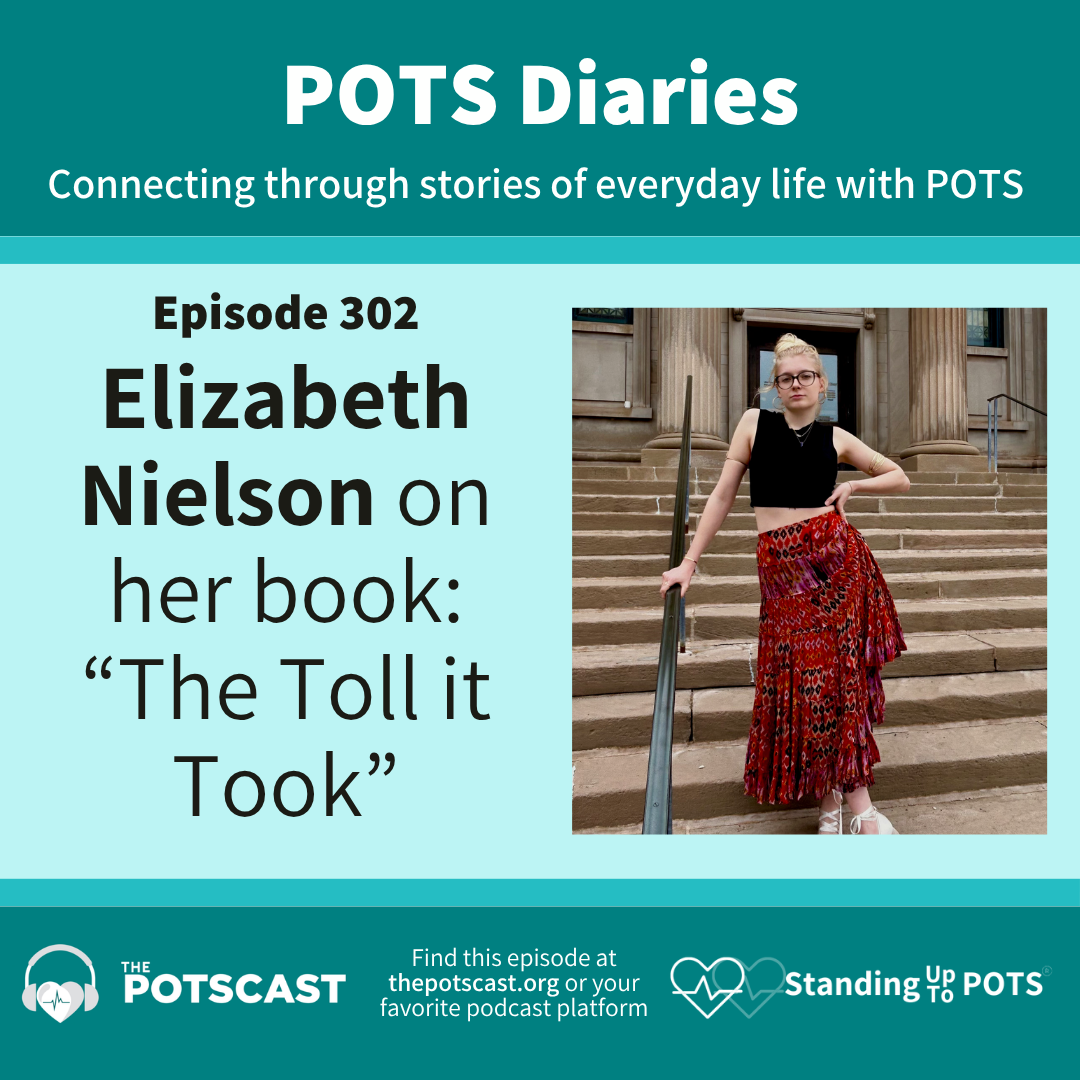
Elizabeth on her comeback and book: The Toll it Took
March 22, 2026
Elizabeth was a teen athlete when she first became bed bound with POTS and several other conditions including narcolepsy, epilepsy and gastroparesis. After 5 years of struggling to be heard or helped, and wondering if the struggle was worth it, she is now back in school, working full time, and becoming the kind of healthcare professional she wishes she'd had. AND she has written a book -- The Toll it Took -- about her experiences! Her advice: "Even if you don't feel like it, keep going."
Episode Transcript
[00:00:00]
Jill Brook: Hello, fellow POTS patients, and beautiful people who care about POTS patients. I'm Jill Brook, your horizontal host, and today we are interviewing Elizabeth Nielson about a book she wrote about her experience with POTS. Elizabeth, thank you so much for being here today.
Elizabeth Nielson: Thank you for having me.
Jill Brook: So for starters, can you just tell us a little bit about yourself? Where are you? Who are you?
Elizabeth Nielson: Yep. I'm a nursing student in my last year in Michigan. I decided to go into nursing based on my own experiences with healthcare and seeing what the patient experience looked like and noticing changes that I would like to implement from the other side of the curtain.
Jill Brook: Ooh. Okay. I'm excited to dig into that, but maybe before we do, we can just kind of set the scene a little more. Do you wanna share like how old you are?
Elizabeth Nielson: Yep. I'm 20 years old. I come from a big family. I've got five siblings, all girls. I was born and raised in [00:01:00] Michigan and stayed in Michigan for school.
Jill Brook: Okay. And how would all of those sisters describe your personality?
Elizabeth Nielson: Yeah, so I've got two older sisters and three younger sisters. I'm much closer with my younger sisters than I am my older ones. But we are all very similar, both in looks and personality. We've all got very bright blonde, Finnish hair. It's a big, loud family. So I think they would describe me as someone who is very affable, very talkative. My parents always thought that I was gonna be a lawyer when I grew up because I was so argumentative. So I've got a big personality for sure.
Jill Brook: Wow. Well, it's sort of amazing that you're only 20 and you already have like so much knowledge about what you wanna do with your life and where you wanna make a difference. And I'm guessing that comes from an experience you've had. So can I ask, how old were you when POTS or related things [00:02:00] started setting in.
Elizabeth Nielson: Yeah, so I was around 15 or 16. I was in my sophomore year of high school. I was a cross country athlete. I was one of the fastest girls in the state of Michigan. I competed at the state level. I was kind of in the prime of my athletic career, my social career. And that is when the symptoms of POTS kind of started for me.
Those are the first symptoms that I really noticed, and everything kind of escalated from there. So I actually had to end up giving up cross country and other sports. I couldn't run anymore. And eventually I got to a point where I couldn't go to school anymore. I was pretty much bed bound for a couple months.
My social life diminished. I was pretty isolated. Going from being in your physical prime to being bed bound and having to use like a shower chair and crawl to the bathroom and back, it's both scary and [00:03:00] dehumanizing. And again, I was so isolated because no one around me knew what was happening or how they could help, and I didn't know either.
So I didn't know how to ask for help. And so I ended up kind of keeping myself in that state of isolation more than I needed to because I, I didn't know how to come to other people and say, you know, I need help. I didn't have that skill yet.
Jill Brook: Wow. And so, I mean, that must have been horrible. I mean, what did you think was happening? You thought, what, I just need to, I just need to snap to, I just need to get with it or what?
Elizabeth Nielson: Yeah, I was really terrified. There were a couple months in there when I was so bad that myself, my family and my friends, we actually thought that I was going to die. I was losing my hair. I lost like 20, 30 pounds of weight. Again, I couldn't get out of bed. [00:04:00] We didn't know what was happening, but it was just, it was escalating so rapidly and nothing that we were doing was seeming to help.
We didn't know when it would end. So we were all pretty terrified. Most especially me 'cause it's so quick and so out of the blue. And I think that's what people without disabilities don't understand is that they'll see someone with a disability and they don't have the realization that that could be them, you know?
In 20 years, in a week, in five minutes, you go from, again, being in like the prime of your life as like a young fit teenager to being critically disabled in a matter of months.
Jill Brook: So how did it look for you? I mean, did you have a trigger that you knew, like were you sick and then this [00:05:00] happened, or was it just outta nowhere?
Elizabeth Nielson: It was fairly out of nowhere. A lot of my other disabilities, my gastroparesis, my epilepsy, my neuropathy, those started as a result of long COVID, and my cardiologist suspects that POTS was also a development from long COVID, but we aren't certain.
Jill Brook: Okay, so I know somewhere in here is, is this where you started having maybe not so great experiences with the medical system that inspired you to wanna be a nurse. Like, let's get to this part where you figured out you wanna be a nurse because you know how you want to treat people. Am I picking up the right story?
Elizabeth Nielson: Yeah, pretty much. Being on, on both sides, it's, it's both incredibly disheartening and yet also the most inspired and human that I've ever felt [00:06:00] because I have been there and not many people can say that. And so it gives me a real sense of not only sympathy, but empathy. And that's not something that a lot of healthcare professionals have.
It's not something that they can offer their patients. And so I feel almost fortunate to be in that position where I can hold a patient's hand and say, I get it, and I'm sorry, and I've been there. And I think that that is one of the most powerful things that, that I can give someone else.
Jill Brook: Wow, that's so great that you decided to make your, your misery mean something and be good for the world. That is awesome. So does this mean that you've made a good comeback and that you are no longer crawling to the shower and stuff like that?
Elizabeth Nielson: Yeah, it took about five or six years in total since the onset of my first [00:07:00] symptoms for me to truly be able to be like okay, I'm in a place where my social life is back. I'm in college full-time, I work full-time, and I've started exercising again. I don't think I'm going to be in a place, honestly, where my exercise capabilities are where they used to be. I think that that is something that might just be lost, but I am okay with that because as I wrote in my book, this was a big portion of it, it's okay if your life is not what you imagined it would look like, and it's okay to grieve that too because it's a loss unlike anything else.
This is one of the biggest things I struggled with when my life was being threatened and changed by illness, is you have this idea of your life, this is who I'm gonna be, this is what I'm gonna do, and then all of a sudden [00:08:00] that's not possible anymore. And you've gotta kind of flip on your heel. And it's what now?
Who am I now? What's my purpose? And it's devastating and it's confusing, but it did put me in a unique position where I can be like, what else is there for me? And I was able to explore things that I wouldn't have otherwise looked into. So it's still a pretty crappy position. It's not ever the ideal, but it's kind of looking for the light, you know, which I think is something that you, you kind of need to do.
You have to have that resilience and that optimistic outlook. You don't really have a different option.
Jill Brook: So let's talk more about this book. At what point did you decide to write a book?
Elizabeth Nielson: Yeah, so through my journey again, I was alone for most of it. I was scared, I was confused, I was lonely. I wanted someone to be able to look me in my eyes [00:09:00] and tell me again, I get it, I'm with you, and one way or another it's going to end up okay, even if it's not what you thought it would look like. I didn't have that, and I wanted to be that guiding light for someone else.
It's a great honor for me. And in addition, navigating the medical field in and of itself was very difficult. I wanted to provide a book that medical professionals could read and understand what it's like at the end of the day when we all go home and they get to move on, but we don't. And secondly, I needed an outlet to talk about and work through and come to terms with a lot of the trauma that I went through.
I ended up developing CPTSD from my experiences and this book became a way of coping and trying to grow past that.
Jill Brook: That's great. So I mean, so we're probably skipping over what, four or five years of real misery if it gave you PTSD. I mean, do you wanna give [00:10:00] us a quick snapshot of where you were when you were at, at your lowest point?
Elizabeth Nielson: Yeah. My lowest point was probably when I was bed bound and I didn't really go anywhere except for I went to PT three times a week. I did online school, and so I spent most of my time alone in my room, too tired to even watch TV or do any hobbies. I just kind of laid and, and stared at the wall. And even growing past that, when I started feeling a little better bit by bit, getting back on my feet, I was dealing with a lot of the mental stuff, even as my physical condition improved and that was harder than anything. So most of my journey was trying to tell myself [00:11:00] that it was worth it to keep going, simply. Because I never knew where I would end up. I didn't know that I could get to this position in my life where things started feeling somewhat normal again, where I felt like I had purpose and community, wasn't in horrible pain all the time. I didn't know that I would get there. I didn't know what my life would end up looking like at the end of the road, and I was terrified that it wasn't going to be something that I could cope with. Sometimes I would sit down and be like, what do I need right now to feel better? And I'd write a list of goals. For example, I need less pain. I need less nausea. I wanna try this med. Almost like a to-do list, because that gave me something to move forward to go for. And without that, I think [00:12:00] I'd probably still be staring at the wall.
Jill Brook: Is there anything that helped you most get outta that low point and maybe like, even get out of bed and start moving forward? Like, I don't know, a habit, a, a coping strategy, a medicine, anything.
Elizabeth Nielson: Right. Medication definitely made a huge impact on my conditions. I, I do take over 20 medications daily still, and I think that shocks a lot of people, but it's what I, it's what I needed and it's, it's what my body needed and I'm not ashamed to take tools and take resources that are out there to help me.
So medication was definitely a big one. I did do physical therapy for years and that helped me a lot. My biggest tip is to find things that work for you and to find things that make life easier, [00:13:00] even no matter how unorthodox it is, because it's okay to accommodate yourself. And so whether that's medications or whether that's using bracing for your joints or with POTS specifically, one of my biggest symptoms is heat intolerance. The second I get a little too hot, it's pretty much the end of the world for me. I get a lot of anxiety. I flush, I sweat, lightheaded, dizzy. It's just, it's intolerable. But I also love the outdoors and I love things like rock climbing and hiking and traveling, and it gets hot. And it's something that I really wanted to do and I didn't wanna give it up. So I sat down and I thought to myself, in what way can I accommodate myself so that I can keep doing the things that I enjoy without suffering through it? And that's when [00:14:00] I found these, these ice packs at like Walgreens or CVS, they're just snap ice packs. There's a chemical reaction and they get really, really cold, unlike the ice packs that you have to keep frozen. So whenever I'm going and I know I'm gonna be really hot and sweaty, I will pack a few of those in my bag. And when I get too hot, I open it, I crack it open, I'll tuck it under my arm or wherever where those major blood vessels are, and I cool down instantly. And I talk about that in my book, so I can continue living my life and have the symptom management and you know, and have my cake and eat it too, essentially.
Jill Brook: Yeah. Right on. That's great. Okay, so what else will we find in your book? I love that. So, so talk more about your book and what different chapters there are or different themes or whatnot.
Elizabeth Nielson: Yeah, it has a lot of medical terminology, but I do try and keep it mostly layman's terms while explaining things [00:15:00] that may not be so obvious, because I wanted readers to be able to go through the story and, and feel everything and see everything. And what was it like? What did it sound like? What did it smell like? I tried to have a very sensory heavy experience, especially for people who may have never gone through the medical experience, who may have a loved one with POTS and who are reading it. Essentially I wanted them to share in the experience and to feel the uncertainty and to feel the discomfort. So it is very medical heavy, kind of step by step. This happened and then this happened, and then that happened. And between all of that, I also created a very emotional world. Here's what I was seeing and here's what I was feeling. Here's what I was afraid of. At the start of every chapter there's an [00:16:00] epigraph where essentially, although I'm writing this memoir from the present years later, these epigraphs are little quotes that I wrote in the past as things in that chapter was happening, whether it's text messages or journal entries or something in my notes app. A couple of them are poems that I wrote. So you can kind of have a foot in each world. Here is, you know, me looking back. It's my hindsight. And here is what I was feeling as these events were happening. So you kind of have a well-rounded experience is what I was really going for.
Jill Brook: That's great. And is your intended audience basically anybody else who wants to kind of learn what it was like to go through this?
Elizabeth Nielson: Essentially, yep. Patients who are experiencing something similar, their loved ones, and also healthcare professionals. I wanted them to be able to develop their empathy. [00:17:00] And again, here's, here's the parts that you don't see when a patient's at home. All of the fear, all of the uncertainty, things that don't come across in your examination, in your 15 minutes.
Jill Brook: Yeah. And so was there anything specific that happened to you that you think kind of led to your wanting to go into nursing or that gave you PTSD or do you think that just anybody in that situation, like it, it wasn't that that specific mistakes were made. It wasn't that someone specifically mistreated you. It's just that the experience in today's system is so bad that that is the result that is pretty common.
Elizabeth Nielson: Yeah, I think that our medical system definitely has a lot of flaws. That's something that I could go on and on about. The most frustrating part [00:18:00] was not one single experience, but that none of the doctors I saw had any answers. And I saw a great deal of doctors across multiple states. And after long enough I began to think that I was going crazy, 'cause no way this was how everyone felt, right? But I kept having the experience over and over again of people looking at me in my eyes and telling me, you know, I can't help you. And they kept giving me this feeling that I was, that I was going crazy or that I was making it up. And no one would look me in my eyes and just say, you know, I believe you.
'Cause it's one thing to say, I don't know. And it's another to say, you know, you're lying to me. And that was definitely the most frustrating part, is going to these people who are supposed to [00:19:00] be the ones that can help you, and they just keep hurting you over and over again. So you develop this sense of fear. I don't wanna go to the doctors. I don't wanna go to the hospital. Sometimes I would have panic attacks before I went to the ER because there have been times when I went into the ER and, and came out worse. And so it is those repeated negative experiences where you just, you don't feel safe anymore. And you should feel safe with medical professionals, and that I find is rare.
Jill Brook: Yeah. Yeah. And so is that what you are basically on a mission to, to address when you become a healthcare professional?
Elizabeth Nielson: Essentially yeah. I think one, one thing that a lot of people think is that medical professionals are, you know, God, in a sense. It's easy to think that a white coat means [00:20:00] omniscience, but coming from a medical professional herself, it's just not true, because people are, they're people, and people are wrong often, and you know yourself best, so you have to fight for yourself because sometimes you might be the only one who will.
And that was what a lot of my time was spent doing, was fighting for myself. And it got to a point many times when I would be on the phone crying with my dad and I would say, I'm tired. I don't have anything else to give. I wanna be done. I can't do it anymore. And that was definitely a repeated theme.
There's a chapter in my book where I'm driving home from a medical appointment. It was three hours away. I had to wake up super early and he just was, he was not helpful at all. He was rude, he was [00:21:00] belittling. I was in and out of his office within minutes, and I'm driving home and I'm just staring straight ahead. I've got my hands on the wheel and I was like, I could, I just could be done right now. You know, I don't even wanna drive home. I don't want to, I don't wanna do this again. I don't wanna do another appointment. You know, I don't wanna take meds in the morning and in the afternoon and at night, and I just, I just wanna be done essentially.
And, but I kept driving and I think that is one of the most important things is you, you don't have to want to keep going. You're not always going to want to, there are going to be times when things just suck. And it doesn't have to feel okay all the time, but I always urge people, you know, just keep driving 'cause you will end up in a better place if you just keep driving.
Jill Brook: Yeah, yeah. Well, thank goodness you had the wisdom to do that [00:22:00] and how nice that it paid off. And now do you think you're in a better place than you even imagined you ever would be at that time?
Elizabeth Nielson: Yeah. In some ways yes, and in other ways, no. When you're in a position like that, it's very much survival mode. I didn't think that much into the future because I didn't think that I, I had one. So I thought very short term, is what's gonna get me to the next day. And I did that over and over and over again.
So I am finally getting into a place where I, I feel confident in looking ahead and planning years into the future. My partner and I had this one talk the other day and he said something very wise to me. He essentially told me that I got into a place where I, I didn't expect that I was going to live, and I came to accept that and make space for it and [00:23:00] plan for it. But as I got better, I still was in that position where I was just waiting to die, essentially. And so he sat me down and he told me, he was like, you have to start preparing to live again. You have to start planning again. And, and that was also a major, a major switch in my mind that I had to, I had to change my mindset.
Jill Brook: Yeah. Do you mind my asking, so you had mentioned some things besides POTS, and I think one of them you said was seizures.
Elizabeth Nielson: Correct. I have epilepsy.
Jill Brook: Okay. And so I guess, can I ask, do you have any sense, I know that sometimes like all these chronic illnesses can bundle together and it's hard to know which symptoms are caused by what, but do you feel like POTS plays a pretty big part in your challenges? Or is it just one of like a bunch of [00:24:00] things or...
Elizabeth Nielson: yeah, it definitely, it plays a role. They all kind of play off of each other. I also have gastroparesis, which means that my stomach doesn't digest food as it should be. But also one of my biggest triggers for both POTS and having a seizure is not eating well enough. So if I don't get nutrition, then I don't feel good, and I'm nauseous and I'm lightheaded, and then I have a seizure. And so they all play off of each other and so it's hard to keep everything balanced. It's a very fine line. And so they definitely do all mingle in, in kind of the worst ways.
Jill Brook: Oh, so I bet you went through some time at one point where you felt like you couldn't win. Like you do eat, you pay a price, you don't eat, you pay a price.
Elizabeth Nielson: There are, there are definitely days. There are a lot of times where it's kind of the perfect storm where there's a lot of different triggers, some of them within my [00:25:00] control and some of them not. And so it is kind of an endless battle. Some days but there are of course days where everything does just work out.
Everything feels good. I don't hurt, I eat okay. And what seems like just a perfectly normal mundane day is, it's just, it's perfect like a, like a golden dollar. And those days are, are worth it, but you also have to be careful to not overdo it and pay for it the next day. So it is, it is never easy is one of my main catch phrases.
Nothing's ever easy, but that doesn't mean that it's not worth it.
Jill Brook: Wow. So, so now that you wrote a book about all of your experiences, and presumably some friends and family and others have read it, what kind of feedback have you gotten? Did they say, you know, oh, this is what we thought you were going through? Or were they surprised? What [00:26:00] kind of, what kind of reaction did they have?
Elizabeth Nielson: So I did write a lot about both my friends and my family and their role, in my book. And so the ones who were with me, they, they knew most of it, the events, but they, they weren't so clued in into what was going on mentally and emotionally, and so I feel like they get a much deeper, a deeper understanding of what had actually happened.
And for people who, who weren't with me, I've had a lot of coworkers at the hospital I work at read my book and they're like, well, I never would've known. And I'm like, I know I work very hard to, to make you think that. And that's what I'm, that's what I'm going for with, with this book, 'cause that's what a lot of people with invisible disabilities suffer with, is people telling them, well, [00:27:00] you don't look insert. You know, I never would've known. And it's, it is, it's an invisible battle, and I wanted to make that battle visible.
Jill Brook: That's great. Are you up for doing some lighter questions where you do a speed round and just say the first word that comes to mind?
Elizabeth Nielson: Sure.
Jill Brook: What is your favorite way to get salt?
Elizabeth Nielson: Salt. I just will put a lot of salt on my food. My doctor recommended the supplements to me, but I feel like I take so many medications that I, I didn't wanna take more than I had to. So yeah, I just, I will salt my food heavily. I mean, everything. I will salt toast. Like it kind of grosses people out sometimes, but you gotta do what you gotta do.
Jill Brook: What is the drink you find the most hydrating?
Elizabeth Nielson: Ooh. I do like Liquid IV. I really do. I like the grape flavor.
Jill Brook: What is your favorite time of day and why?[00:28:00]
Elizabeth Nielson: I do like nighttime. I'm a night shift worker. I find it because it's, it's cooler.
Jill Brook: Yeah. Where is your favorite place to spend time and why?
Elizabeth Nielson: Hmm. Probably my bathroom. I know that's an interesting question. But I really like taking baths. It helps me with my joint pain and like my temperature regulation, so...
Jill Brook: Nice. How many doctors have you seen for POTS.
Elizabeth Nielson: Oh, I couldn't even tell you. More, more than I have fingers and toes, that's for sure.
Jill Brook: How many other POTS patients have you ever met face-to-face in the flesh?
Elizabeth Nielson: Three.
Jill Brook: What's one word that describes what it's like living with a chronic illness?
Elizabeth Nielson: Isolating.
Jill Brook: What is some good advice that you try to live by?
Elizabeth Nielson: Just keep driving.
Jill Brook: What is something small or inexpensive that brings you comfort or joy?
Elizabeth Nielson: My boyfriend got me this weighted dinosaur stuffed [00:29:00] animal from Target, and probably that. He brings it to me every time I'm in the hospital.
Jill Brook: Who is someone that you admire?
Elizabeth Nielson: My partner.
Jill Brook: Do you wanna say why?
Elizabeth Nielson: Because he has always been there for me through this and he, he thinks I'm strong, but he is the type of person who is strong when I'm not. And that is admirable.
Jill Brook: What is something you're proud of?
Elizabeth Nielson: Still being here.
Jill Brook: That says a lot when you've written a book. What's the toughest thing about POTS?
Elizabeth Nielson: The heat.
Jill Brook: What is an activity you can enjoy, even when you're feeling really POTSie?
Elizabeth Nielson: Reading.
Jill Brook: What's your pet peeve?
Elizabeth Nielson: Honestly, people who complain about things that I don't think really matters. Something that I've mentioned before is when you have an illness, it becomes hard to sympathize with other people to a point. There's this [00:30:00] saying that says you have 99 problems until you have a health problem, and then you just have one. And I find that to be very true.
Jill Brook: What is a gift that you would have sent to every POTS patient on the whole planet if you had infinite funds?
Elizabeth Nielson: Probably those ice packs, honestly. Lifesaver. I recommend them.
Jill Brook: Good endorsement. Do you have any tricks for falling asleep?
Elizabeth Nielson: Melatonin, honestly. And something I, I also have narcolepsy, so falling asleep is usually pretty easy for me. It's the staying awake that's not.
Jill Brook: Do you have any tricks for getting energy when you need it?
Elizabeth Nielson: I take two stimulants for my narcolepsy. And I am a huge energy drink advocate honestly. But outside of those, I find that the sunshine usually wakes me up.
Jill Brook: Ah, what are you grateful for?
Elizabeth Nielson: The people in my life and modern medicine.
Jill Brook: Have you ever had to sit down or lie down in a weird [00:31:00] or funny place because of POTS? And if so, where was the weirdest or funniest?
Elizabeth Nielson: Probably on a gym floor during a cycling class.
Jill Brook: Okay. I just have a couple more questions. What do you wish more people understood about POTS?
Elizabeth Nielson: That it's not just feeling dizzy or passing out. In fact I usually don't pass out at all. It's hard to describe what it feels like, especially 'cause it's so different for everyone and impossible to generalize. But it's systemic. And so it's so much more than just changes in your heart rate, your blood pressure, it affects your entire autonomic system like the control board in your body is just constantly short circuiting.
Jill Brook: Yeah, really well said. And why did you agree to let us share your story?
Elizabeth Nielson: I wanted to spread the word about my book and so that if my story resonates with people, that they can go out and, and get the book and have that moment [00:32:00] of kind of comradery between us. And I also just wanted to share with the POTS community, honestly, 'cause I think that community is, it's so important and it's not something that I had for a long time when I was really sick.
Jill Brook: Yeah. Yeah. Okay. So I don't think we've yet said the name of your book.
Elizabeth Nielson: So the name of my book is The Toll It Took, and that essentially symbolizes, you know, everything that it takes out of you. 'Cause it does, it kind of guts you.
Jill Brook: Yeah. Okay. And so it's out now, right? Where can people find it?
Elizabeth Nielson: Yep. It's available on Amazon, both as a paperback and the Kindle version.
Jill Brook: We'll put a link to it in the show notes. And again, your name is Elizabeth Nielson, N-I-E-L-S-O-N, if people want to look it up. And we're so happy for you. I mean, it [00:33:00] sounds like you went through hell, you kept on driving, you made it mean something, and you turned it into a book to help others, and that's just so impressive and so wonderful, and we just wish you all the best. We're so happy for you.
Elizabeth Nielson: I appreciate that. I appreciate your time today.
Jill Brook: Thank you so much. Okay, everybody, that's all for today, but we'll be back again soon. Until then, thank you for listening, remember you're not alone, and please join us again soon.