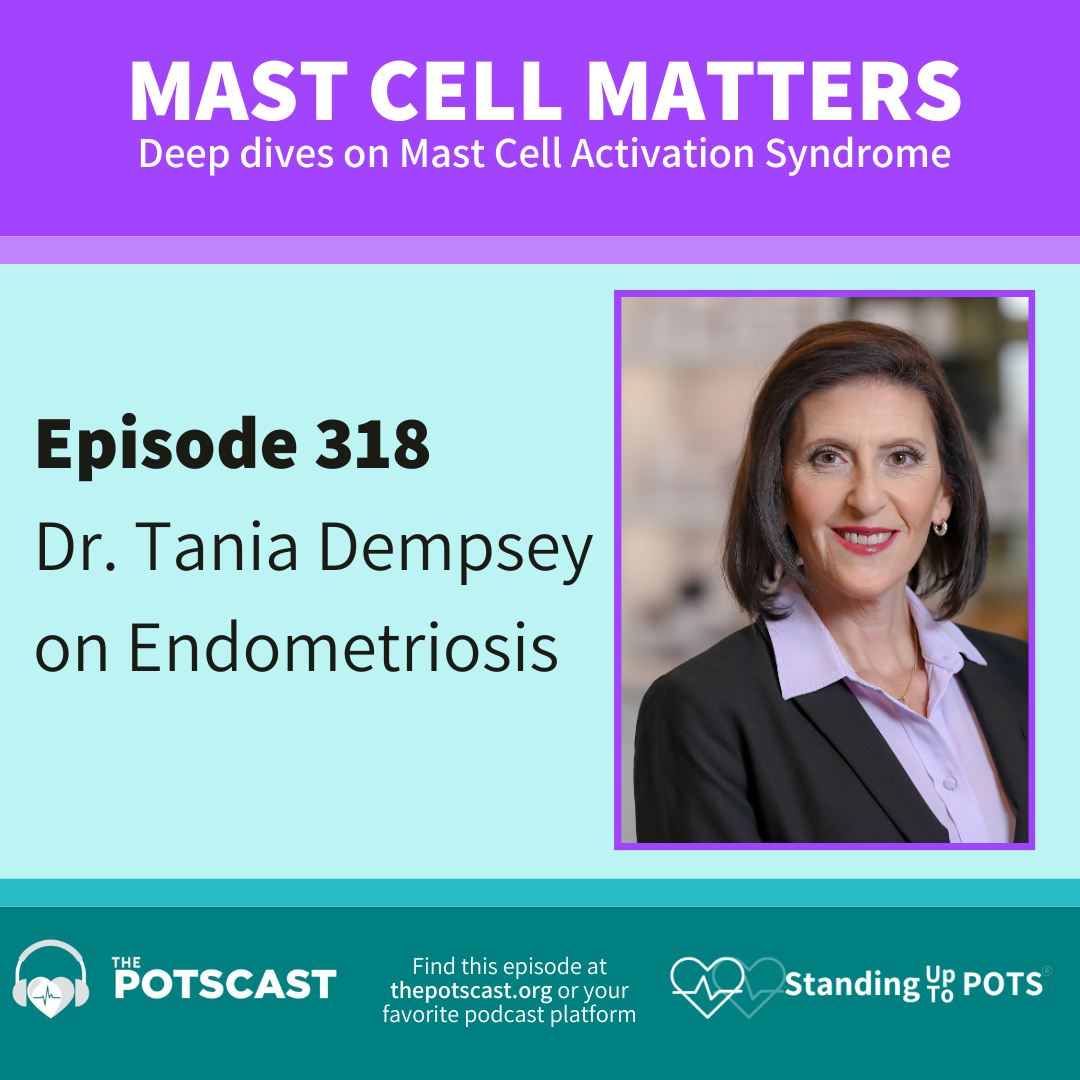
Endometriosis with Dr. Tania Dempsey as part of the Mast Cell Matters series
July 12, 2026
Is endometriosis related to mast cells, MCAS and POTS in some people? Dr. Dempsey explains why she suspects a link, how fertility, insulin resistance and pelvic congestion syndrome may also be involved, the mast cell targeted treatments she has seen help, and much more.
Dr. Dempsey's article that is mentioned: Successful mast-cell-targeted treatment of chronic dyspareunia, vaginitis, and dysfunctional uterine bleeding
Dr. Dempsey's website is https://drtaniadempsey.com/
If you have questions for Dr. Dempsey about mast cells and related topics, you can send them to research@standinguptopots.org.
Episode Transcript
[00:00:00]
Jill Brook: Hello, fellow mast cell patients and beautiful people who care about mast cell patients. I'm Jill Brook, and today we are talking about endometriosis and its potential connections to MCAS, POTS and related conditions with our amazing guest, Dr. Tania Dempsey. You may recall that Dr. Dempsey is a world renowned expert in complex multi-system diseases.
She's the founder of the AIM Center for Personalized Medicine in Purchase, New York. She's board certified in internal medicine and in integrative and holistic medicine, trained at the Johns Hopkins University School of Medicine with residency at NYU. And her clinic attracts patients from all over the world. But beyond her credentials, Dr. Dempsey has become one of this community's most trusted champions, somebody whose expertise, compassion, and persistence has made a huge difference to patients and their families, as I know it is going to today. I already know of some patients who are gonna be very excited about today's episode. [00:01:00] Dr. Dempsey, thank you so much for being here today.
Dr. Tania Dempsey: Oh, it's always my pleasure. I can't wait to, to dig right into this topic.
Jill Brook: So we have recently heard from quite a few people who have a diagnosis of endometriosis, some of whom are even scheduled to get surgery for it, and they desperately want to hear your thoughts. So I, I thought maybe for starters for, for those of us who aren't as familiar, can you just say like, what is endometriosis?
Dr. Tania Dempsey: Yeah. You know, it's a, it's actually complicated condition, and I think like what the way it's described by, let's say, gynecologists or gynecologic surgeons who are often doing the surgery, I think it's not complete. But I'll, I'll give you the rundown of what people think it is, and then I'll explain what I think it is based on what I know about quote unquote inflammation.
But basically it's tissue that's similar [00:02:00] to the tissue that, that is in the uterus, the uterine lining. We call that the, you know, endometrial lining of the uterus. Tissue that's similar to that, that's inside the uterus starts growing outside the uterus in the, we call, we'll call it, let's say the extracellular space or the, the, the, the peritoneum essentially.
And I say similar because there's, there's not enough research to, to say for sure if it's the exact same tissue. It looks similar. It looks like a estrogen sensitive type of tissue. But it's not clear if it's actually coming from the uterus. So there's something called retrograde menses.
So, so, you know when, when you get a menstrual cycle or menstruation, you know, you are bleeding from, it's coming out of your uterus through your vagina, right, and you're bleeding. In some, in, in some patients it seems that there's a possibility, [00:03:00] this is one theory, by the way. I'm gonna call this a theory because I don't think anyone actually understands fully if this is the root of endometriosis or this is why it's happening.
But one theory is that the, the tissue is actually going the other way. It's actually going up through the fallopian tubes and out into the space there, and then that tissue is sort of sticky and it's sticking to the, the intestines, the bladder. It could even go up and stick to the lungs. I mean, it, it can do a lot.
And the diaphragm. I mean, it could, it could go to a lot of places. That's one theory of why that's happening, so it's, it's like a retrograde menstruation. But I'm not sure that explains it fully. And and so the way I think about it is there's these, this tissue that's estrogen sensitive and inflammatory that is, again, sticking in places that it shouldn't be.
And, and causing fibrosis, scarring and, and really, and like [00:04:00] adhesions and things in the, in the, in the body, you know, outside of the uterus. And it is quite common in patients. First of all, the, the latest statistics I saw is something like 10% of women have it. And then I saw another statistic that's set up to 20% of women have it, which is an interesting statistic, 'cause I always think, right, when we talk about MCAS, 17 to 20% of the population has it. I think it's really interesting, right? So we're gonna talk a lot about the intersection between MCAS and endometriosis, but I would say that, that those numbers match up. And I, I would say that the majority of patients with PMOS, the newly called syndrome that used to be PCOS, but is now polyendocrine metabolic ovarian syndrome. Large percentage of those patients have endometriosis as well, and also adenomyosis, which we can talk about as well. But adenomyosis is like the endometrial tissue sort of going inside the walls of the uterus, and [00:05:00] also causes a number of, of, of issues, including pain being like a big, big problem. But in endometriosis, okay, so you have the, this tissue that's in areas where it shouldn't be. So it's going to be irritating. It's going to be in a sense, like, I heard someone use, use this term, I don't know if it's correct either, but it's sort of a interesting way of, of thinking about it, almost like internal bleeding, right?
If you're bleeding, if your endometrial tissue and the uterus is bleeding, you know, it could essentially cause this tissue to, to kind of, erupt essentially. That tissue itself is inflammatory. And then we know actually through some research that there are mast cells intertwined in the endometrial tissue.
And so the question is, are the mast cells actually part of the driver of the creation of this endometriosis like tissue or however you wanna call it, endometrial like tissue? Or, or again, is it like a chicken or egg, the mast [00:06:00] cell's there after the fact, or are they there before the fact and, and driving it?
So I think of, again, I think of endometriosis as inflammatory tissue that's in places that shouldn't be, causing a lot of inflammation, a lot of pain. Can affect fertility, especially if it's affecting the fallopian tubes and or stuck to the ovaries or it can cause IBS like symptoms. It can cause bladder symptoms 'cause it's wherever it's sticking.
But it's rooted in insulin resistance and metabolic issues. It seems like that is a driver of the tissue. And also, again, mast cells are driving it. We know mast cells drive insulin resistance and insulin resistance drives Mast Cell Activation Syndrome. And so I think of it as like a soup of stuff altogether and, and wreaking havoc. And it's really, really potentially a very serious condition that causes a [00:07:00] lot of debilitating symptoms. And women are definitely not taken seriously enough unfortunately. And so many women go through lots and lots and lots of doctors for many, many, many years trying to, to figure this out. The problem is that there is actually no good test for endometriosis. So it's a very clinical diagnosis and really the only way they can diagnose this is surgically, where they go in and they find a tissue. And so a lot of it is based on, again, the symptomatology, but the symptomatology overlaps Mast Cell Activation Syndrome so much that it is, I think,
I think we're doing women a disservice if we're just treating endometriosis as a gynecologic condition and that we're not thinking about it as a metabolic and immune problem.
Jill Brook: Wow. Okay. So I think that is one reason why a lot of people wrote into us and wanted to hear what you're saying because it sounds like if you go the conventional [00:08:00] siloed medical route of this, you would start with what some pain, some infertility, what, what other symptoms do people have, 'cause now people are probably wondering if they had some pain down there.
Dr. Tania Dempsey: Painful periods. It could be excessive bleeding during periods or even in between periods. Pain definitely associated with the period, but even pain in between. I, I've, I've seen patients with endometriosis that are really having pain throughout the cycle.
And and then they often have, again, these associated symptoms. So wherever the, the endometrial like tissue is, is stuck, will, will, will cause symptoms because it's, it's fibrotic, it's, it's like scar tissue. So if it affects, if it's sticking to the bowels, they're gonna have GI symptoms.
And if it's sticking to the bladder, they're gonna have symptoms similar to interstitial cystitis or they're gonna have symptoms like UTIs. They, they often [00:09:00] and that this is what I think is really interesting, I've seen this list of symptoms that I think again does a disservice for women because you hear things like, they have anxiety, they have depression, and it's like, well, do they really have that?
Or first of all, are they really frustrated because they're not getting a diagnosis? And second of all, if the mast cells are involved, we know that mast cells can cause this, this feeling of anxiety, but it's a physiological response from the release of cytokines and inflammation in the body. So that's why I'm just, I'm always so hesitant to, to equate that the, you know, what, what's, what is being called a, a mental illness where it's really a physiological response to, again, this crazy cytokine storm that's going on in the body. So the reality is there are a lot of symptoms associated with endometriosis. And again, that is why, and some of them are not specific, and that is why like MCAS, it's often, you know, undiagnosed and [00:10:00] women are made to suffer, right?
Oh, it is just a painful period. Oh yeah, lots of women have painful periods, right? You can, you can almost imagine what the conversation is like amongst you know, like you go to a gynecologist or you go to your internist, you know, it's always like, yeah, a lot of women have that. Well, maybe a lot of women have endometriosis actually, and, and that's actually not normal. How about that? You know.
Jill Brook: Right. Is there any particular demographic that tends to get this beyond just women? Is it a certain age group or anything? Like we hear about it a lot in POTS. It seems like in the POTS community there's a lot of people with endometriosis.
Dr. Tania Dempsey: Oh yeah, because a lot of the POTS community also has Mast Cell Activation Syndrome. So I do think it's very prominent in our mast cell patients. I would never say that all women with MCAS have endometriosis, but I would say that the vast majority of women with endometriosis probably have Mast Cell Activation Syndrome. Because, because if you have MCAS, you're not gonna [00:11:00] necessarily develop every single symptom or, or condition that's associated. But those conditions we know, are very much rooted in, in this. And at least we know from pathology reports that the mast cells are intertwined with this tissue.
So we know that the mast cells are involved on some level. So from my experience at least, a lot of patients with endometriosis are, are diagnosed, you know, that I diagnosed them via the consensus two criteria as having Mast Cell Activation Syndrome, and many of them also have other comorbidities that are associated, like POTS.
I also see venous compression syndromes very commonly with endometriosis as well. And also connective tissue issues like hypermobility. Not uncommon to see that all kind of interconnected. And then also hormonal issues in general, like PMOS. Often this is starting at, at puberty. You know, [00:12:00] many girls, young women are already having signs of it fairly early. But again, they're kind of discounted because, you know, oh, it's your first period or it's, you know, it's your first year, you gotta get adjusted. You know, you hear all this all the time.
And so I think it's actually starting fairly early in a lot of women. I do think it sort of tends to escalate. I think that it again becomes a little bit of, I don't know if it's chicken or the egg, which one comes first, but it's either the the endometriosis that's, that's driving more inflammation.
And so the more inflammation there is, the more pain and the more symptoms and the more issues. So maybe as they go into their twenties or thirties, maybe it sort of peaks. But that's also a time when a lot of women are interested in fertility and this is a common cause of infertility.
So that's a, again, like a, a a period of time when this is a very common diagnosis that, you know, starts to be found. Again as, as women are going through fertility treatments or, or workups for infertility. And then I [00:13:00] see it again like kind of spiking around perimenopause because when there are these fluctuations in hormones, which happens in other periods of a woman's life, again, it can help stimulate this tissue. 'Cause again, the tissue is estrogen sensitive. Mast cells are estrogen sensitive. And as estrogen is spiking and, and, and dropping very, very quickly in perimenopause, that probably also is another time period when a lot of women are suffering without understanding, you know, why.
Jill Brook: Yeah, so I, I know that there's a number of people who are gonna be listening to this episode because of their interest in endometriosis, so they won't have listened to all the back episodes about MCAS, and I think it's actually just good to remind everybody that when we talk about MCAS, we so often focus on the inflammatory or the allergic type nature of it. But there's that third part, the [00:14:00] unusual growths, right?
Dr. Tania Dempsey: Right.
Jill Brook: Can you talk about that and just remind people, and maybe maybe for the people who are, are new from the endometriosis world, what is it that's special about mast cells that makes it uniquely maybe interesting that it would be connected to endometriosis.
Dr. Tania Dempsey: So yeah, that's such a great question because when we think about MCAS, we think about three main themes that MCAS can present as. We know the inflammation is pretty much, you know, throughout. Like every patient who has MCAS has some level of inflammation. We know that there are some patients who have allergic phenomena, but there are also patients who don't, right? So that's, we say plus minus allergic phenomena. And then the other plus minus is what we call dystrophisms or, or abnormal growth and development. What's interesting about mast cells, and I think this is just like so, such an important point to remember is we always think about, especially if people have [00:15:00] MCAS, they're always thinking about mast cells as bad guys, you know, because it's causing their problems.
But mast cells are actually a very important cell in our body. And everybody, whether they have MCAS or not, has mast cells. And mast cells are actually specifically designed to help with growth and development in the body. So when we think about the growth of bones, I like to think about bone health a lot because a lot of MCAS patients have osteoporosis, for instance.
Mast cells actually, when they're normal, when they're acting normally, they release certain, certain chemicals that, that help stimulate the cells called osteoblasts to create more bone to help the integrity of your bone. And when the mast cells are dysfunctional and releasing loss of bad chemicals, they break down the bone.
They, they cause an increase in osteoclasts, which are the, the cells of the bone that break, break it down, [00:16:00] causing again osteoporosis. So, mast cells are really, really integral to, again, growth and development in various cells. We think of it as, and again, in normal mast cell function, people who have had normal mast cells, we will see, mast cells are important in the growth of an embryo. They're important for the implantation of an embryo in the lining of the uterus, right? So again, like we're, we know that there are a lot of mast cells in that area associated with that tissue and they help, they release these, these specific chemicals or mediators that help with implantation of embryo. So, like you think about it, like again, they are really, really important. It's when they get dysfunctional that they cause a problem. So they can lead when they're dysfunctional to things happening in a, in a bad way. So maybe they could cause miscarriage, maybe they can cause like growths or cysts or things in the body that are again, not normal, [00:17:00] not good.
I think about lipedema which is getting a little bit more attention these days, which is really good, 'cause a lot of women never knew why they had this. But, you know, lipedema is like lumpiness of fat in often the legs, sometimes the arms. And it's an inflammatory condition. It's not, it's not fat like we think of. It's an abnormal fatty like, cysts or, or, or nodules in the skin. But, it can grow and it can cause a lot of disability, a lot of pain, and can cause abnormal size of legs and arms and, and things like that. So women really suffer with it. But we know that the mast cells are involved in that, in that process.
So if we take it from there and then we say, okay, what could they be doing in, in endometriosis? They're releasing chemicals. They're causing, like growth to happen. So maybe they're promoting the growth of this type of tissue. Maybe they're, [00:18:00] they're causing scarring, scar tissue to form, adhesions to form.
I think about things that, that, that some women, I've had women who have had to go for, for some kind of surgery. I'll, I'll give you an example. I had a patient who had to have her gallbladder out. She had this sort of recurrent, she had like sludge in her gallbladder, not a stone, but sludge.
So they take her gallbladder out, and what they found, which, which we later realized was endometriosis, likely, was adhesions throughout the abdomen. She just had all these adhesions. And the surgeon was sort of like, I just went in for your gallbladder and I don't know why. There's no, like, you've never had abdominal surgery before, so why would you have these adhesions, this scar tissue all over the place.
And she's somebody who had, you know, issues during, during her menses. She had a lot of pain. She was very disabled during her period. She had migraines, she had all these other symptoms that we then when we started putting together, [00:19:00] realized, wow, this is, this is MCAS. Probably drove her gallbladder issue to be honest, but also probably she had unknown endometriosis all her life.
And she was like in her fifties when, when her gallbladder's taken out. She was already at menopause, but she still had the after effects of that scar tissue. And we know that that mast cells actually can drive that.
Jill Brook: Right. Wow. Okay. So I guess maybe this brings us to what recommendations do you have. If somebody has a diagnosis of endometriosis or they suspect that they have endometriosis and they either already have a diagnosis of MCAS or maybe just a suspicion. I know there's at least a couple people listening who they have a suspicion, but they don't have a diagnosis yet, so they're really wondering what to do if they should go ahead and take care of the endometriosis surgery first, or if they should find out if they really have [00:20:00] MCAS first.
Do you have any thoughts on all that?
Dr. Tania Dempsey: Yeah. I mean, without knowing their cases specifically, you know, I don't, I never wanna like go against another doctor or another doctor's recommendation, but at least I can tell you what I would do with my patients, right. I would want to stabilize them the best that I can. I would want to stabilize their mast cells and their inflammation. Number one, because if they do need surgery, they will recover better after surgery if their inflammation is lower during the surgery, you know, before the surgery, let's say. So number one, you know, it, it, it is good to know what your underlying inflammation is like, and, and whether MCAS is the, is the at the root of it because there are so many treatment options for MCAS that can then prepare you better for going into into surgery, right? So that is my preference. Now, sometimes it's unavoidable. The pain is outta [00:21:00] control. There are too many other symptoms and you know, and I understand that. And so you gotta do what you, you know, if you trust your, your surgeon, you gotta, you do what they say. But it is always better to see if you could find some information out before, prepare for it and then go for it, right?
So I think it comes down to whether this is an urgent emergency type of surgery versus an elective surgery. I would not call endometriosis surgery elective, but I guess I just wanna say that sometime that is something that could wait a little bit for the body to actually kind of go into it in, in, in better shape.
So that's always my, my preference. There's a lot of interesting research now on GLP-1s for endometriosis. There have been a few studies that, and, and papers that have come out on this. One paper was a retrospective kind of paper looking at, actually it was a, it was a literature review, so they went back to look at other [00:22:00] papers.
So it's not a ton of research, but I will say what they're finding is that women with fertility issues and women with endometriosis seem to have lower levels of GLP-1 in the tissue, where they're having the problem. So in the endometrial endometriosis tissue, they often find lower levels. Again, this is in research studies.
I don't think this can be done, you know, after, let's say women has a surgery, I don't think they can measure this. But, but the thought is that using GLP-1 drugs could replace what they're missing, and maybe that is going to help. I would argue that the reason it's probably helping is because of the mast cells in that tissue that respond to GLP-1s very well and then stabilize causing decreased inflammation.
And if you have decreased inflammation and decreased production of cytokines or release of cytokines from the mast cell, then it should lower inflammation and maybe help [00:23:00] control the endometriosis. The question I have, I don't know the answer to this because I just don't, we just don't know. We don't have any studies.
Can endometriosis actually be reversed or controlled, you know, with mast cell targeted therapy? Can we avoid surgery if we go in and do all this stuff, right? We don't, we don't know yet. I have a few patients though who I, I have one patient I saw the other day that is so compelling. And she has said, please tell my story to everybody, I just wanna help as many people as possible. This is a young woman in her twenties who I am pretty sure has endometriosis, but we haven't proven it, right, 'cause I don't have a test. I can just tell you that she had a lot of pain, a lot of bleeding. Her periods were just awful for a long time. I also suspected that she had adenomyosis and she's somebody that the gynecologist had tried [00:24:00] birth control pills, and then they tried an IUD, which her body was basically rejecting, and that we had to pull that IUD and it was a mess.
She was in a, in a bad, bad place. She has MCAS. She also has vector-borne infections, and she has really bad Bartonella and Babesia. And, and I've been seeing her for about 10 years. So this is, you know, what I say to patients is, you know, it's like, my patients are like an onion and I have to like peel layers away, right, until I can get to that, to that root. And so for her, it's been a long journey, but she is, you know, I would love to say she's a hundred percent, she would love to say she's we'll call cured, based on a conversation I had with her two days ago. What we have found with her is that when we treated her infections and we did a lot of SOTs, she did not do well with antibiotics.
She didn't do great with herbs. But we did SOTs and we did SOTs for just about every strain of things we found. Every SOT we did brought her into a better state. The more Babesia SOTs we [00:25:00] did, the better her periods were. A little bit less pain, a little bit less pain. Still bad, still bad, but like a little bit less, a little bit less.
And then we just hit the jackpot when, like, she was about, let's just say she got 80% better. We still have things to work on. Other symptoms she had, lots of anxiety, lots of impulsivity, ADHD, lots of other like disordered eating what else? I mean, lots of stuff. She has skin issues. Acne, she has PMOS.
I mean, it was, it was a mess, right? So I'm, again, I'm, I'm peeling the onion. She went on a GLP-1 about six months ago, and it literally fixed everything. I mean, again, I I, I don't wanna give people false hope, right? I can just tell you that it was just profound, and I see this so many times. The GLP-1 just literally took away her impulsivity, helped her ADHD. She feels actually, when she doesn't [00:26:00] take her Vyvanse, which she's been taking for ADHD, she used to feel awful and not being able to function if she skipped a day. Now she skips multiple days and forgets to take it because her ADHD is so much better on the GLP-1. Her periods are totally regular.
She has no pain. No pain with her periods at all. In fact, I was talking to her while she was on her period and she usually would be like, I can't even talk, you know, like she would cancel the appointment because she couldn't even function. She worked all day, talked to me and said, yeah, you know, I have, you know, it's like I'm on the fifth day, I'm almost done, it's no big deal. Her, her disorder meeting, pretty much, pretty much done. You know, and she is functioning the best that she's ever, ever functioned. And, and I look at that and I think, okay, I can't prove she had endometriosis. I don't know the extent of it, but I suspect endo, I suspect adenomyosis, I, I suspect well, PMOS, we know she had. MCAS we proved with consensus two testing. [00:27:00] We knew she had these other infections. And as we just, again, pulled the layers of the onion away and then we topped it off with the GLP-1, it's like everything fell into place. So my hope is that maybe we will have an answer for endometriosis and prevent women from needing surgery.
I, of course, would never promise that, and I would never say that, you know, that's where, but I'm hoping that's where we're going, you know? That would be amazing.
Jill Brook: Wow. Yeah. So we actually had a lot of questions just have you seen people be able to avoid surgery when they took mast cell directed therapy? Is there anyone else besides this one patient? I mean, I know you published paper with, it wasn't exactly endometriosis, but it was some other kind of similar symptoms.
So maybe you can maybe mention that too, but like anybody else besides this one patient that you've seen do well?
Dr. Tania Dempsey: Yeah. I mean, I have, I have so many patients with, again, suspected endo. Many of them I think have adenomyosis. Many of them have had [00:28:00] MRIs for various reasons and, and it's an incidental finding. They call it incidental. It's not so incidental, obviously, because it can cause a lot of pain, a lot of issues and infertility issues and lots of other things.
So I, yeah, I mean, it's a big part of my practice because, you know, I treat MCAS. MCAS is an inflammatory condition. I've always been interested in women's health. I've been treating PCOS or now PMOS for 30 years. So the more I've learned, and I'll be the first to tell you, like, I didn't know this stuff, you know, 10 years ago, 20 years ago, 30 years ago.
I, I suspected a lot of these things, but I couldn't, couldn't figure out what the connection was. I suspected everything was interconnected. I just didn't know that that meant the mast cells are at the root of it all. So the point is that the more I'm tuned into this, the more I'm seeing it, and the more I'm seeing it, the more I'm finding that there are things that are helping patients get control over [00:29:00] their, their symptoms.
Now, maybe my patient population has, maybe it's a, it's a milder, milder form of endometriosis and that's why, you know, truly I think I've had maybe one or two patients in the last five years who have needed surgery for endometriosis. So I don't know if it's, again, my patient population and I'm seeing patients who are milder there, but, but actually pretty severe MCAS overall. But I just find over and over again that when we are able to find all the pieces, figure out the mast cell stabilization, figure out the triggers, you know, and, and everything falls into place. And with every woman, it's different. I do wanna be clear on that. It's not always the same path. But I do find that that often the hormone piece, whether we call the hormone piece or the inflammatory piece or the, the endometriosis piece does seem to get better.[00:30:00]
Whether it's enough for some women to avoid surgery, we don't know. But I will say with my, again, I said I think I've had two in the last five years who have actually needed to take that step and, and, and do surgery, right? So, again, I have hope, but I don't, you know, we don't know, we don't know enough. But I can just tell you from my experience.
Jill Brook: Yeah. So one other question we got was from people who, they have a diagnosis of POTS, they have a diagnosis of endometriosis. Now they're learning about Mast Cell Activation Syndrome and how that is one potential underlying cause of both POTS and endometriosis. They're looking at getting a diagnosis and they're, they're learning about the whole, you know, consensus one versus consensus two thing.
And so the question is for the purposes of a diagnosis, would endometriosis and POTS qualify them as having mast cell symptoms in two different systems.
Dr. Tania Dempsey: [00:31:00] Yes, it would definitely fit that, the symptomatology, right? Because, because what we want with MCAS, listen, I think this is a, a area that the consensus one people, I think put a little more, too much stock in, you know? Because if patients have, let's say allergic symptoms they just assume, oh, that's one system, they can't have mast cell activation syndrome. But I don't know, I know a lot of patients who have allergies and if you keep asking, you will find other systems involved, right. But if you're an allergist, maybe you don't wanna go there. Nothing against allergists, but I'm just saying that they don't seem to wanna, like, dig deeper.
But generally we're looking for two or more systems that are involved to support that diagnosis of, of MCAS. And yeah, so, so endometriosis, POTS, I would say would qualify. Ideally, we'd also want to have some mediators tested to also support, you know, the [00:32:00] diagnosis, because finding the mediators and then kind of then tells you, yeah, the mast cells are actually activated and they are causing this problem.
The reality is that although I really stand by wanting patients to get the testing done, and listen, Dr. Afrin and I, who work together, you know, we've, we've worked really hard at creating a system in our office to get the testing done by the right lab. It's processed correctly. Everything is done very, very carefully.
And so we have a very high yield getting positive results. But I think outside of our office, it's not that easy. And so I, I am still, you know, a fan of the clinical diagnosis. If you have two or more systems involved that are potentially mast cell related and you respond to a mast cell targeted therapy of some kind, I, I think that's pretty compelling for me.
And I think that's okay if [00:33:00] that's all patients can get, you know?
Jill Brook: One other question came in about the publication that you had with Dr. Afrin and Lila Rosenthal and others, where you talked about some symptoms, I think we had an episode about it where we talked about mast cell symptoms down there, and there was like, basically when the lady part have mast cell symptoms. Under what circumstances do you consider suggesting that a patient try putting mast cell stabilizers directly on their private parts?
Dr. Tania Dempsey: Well this is a, this is a really great topic because, you know, the issue really is that we know that mast cells are basically in every organ in the body. And we do have a lot of mast cell in the, in the skin, in the, in the vulva, in the vestibule, in the vagina, in the uterus, right?
And, and, and everywhere in the, you know, again, in the gut, in the in the lungs, in, you know, every, [00:34:00] every system essentially. Heart, blood vessels, et cetera. So, so the question is, you know, if you, if you put mast cell targeted therapy on the area that's involved, you know, can you control symptoms? So what we did, so this paper was Successful Mast Cell Targeted Treatment of Chronic Dyspareunia, Vaginitis and Dysfunctional Uterine Bleeding. And it was a case series where we talked about, we looked at, you know, different cases.
One of my cases was a a woman with dysfunctional uterine bleeding, with PMOS and just basically bleeding for forever. She was trying to conceive. She wasn't ovulating. There were a lot of things that were causing problems. And she did not, we did not think she had endometriosis.
She didn't have pain. She just was bleeding excessively and becoming very anemic. And so she had gone to her gynecologist and endocrinologists and, you know, they were all [00:35:00] suggesting different things to her and she really, really wanted to see if we could address it differently. And the, the thing with her was that we did not prove that she had consensus two. She didn't specifically meet consensus two criteria from Mast Cell Activation syndrome. But at the time, we, we didn't have the ability to test everything that we can now. But she had a lot of symptoms. So we just said, okay, what can we do? So with her case, actually, I used just oral antihistamines with her.
My thinking was, if we can get this systemically, will that then help, you know, the bleeding. And, and it did actually. I think she did Claritin, maybe Claritin and Pepcid for like a month or two and, and the, and she just went back to cycling. It was like, kind of, kind of crazy. That was like one of my first patients that I'm like, oh my God, these antihistamine are kind of crazy in a good way.
But the other cases in the, in the paper we did use things like [00:36:00] suppositories, vaginal suppositories, vaginal douching with various mast cell targeted therapies. We used diphenhydramine, which is Benadryl. We used Cromolyn. Those were the main ones.
And we saw, you know, some improvements in dyspareunia, like I mentioned, some other, other symptoms. Now I was involved in another paper. So I was involved in a sort of a consortium. We published a white paper on, basically it was an executive summary of vulvodynia therapies. What we did was we really tried to look at all the possible treatment options for vulvodynia. And primarily there's a particular type of vulvodynia that's called neuroproliferative vestibulodynia. So there's a, there's an area, and I think we talked about this in a prior podcast. There's an area sort of around the [00:37:00] urethra that's called the vestibule. And there's a, there's a subset of, of women who get this pain there and they're found to have what's called neuroproliferative vestibulodynia. So pain in the vestibule where there's a lot of nerve endings. And all the research has shown that there are a lot of mast cells that are in that area of the nerves. And so the thought is that the mast cells are releasing chemicals and causing nerve growth, and the more nerves, the more pain.
And the current treatment for that is surgery. And they just literally cut the nerves out. Not the most pleasant thing to, to put women through. So the question we had as a group, so they, they brought me in as a mast cell specialist, again, because this seems to be a mast cell problem. And, and we met with, you know, numerous urologists, gynecologists people very interested in this condition.
And, you know, what we talked about was [00:38:00] can you use topical treatments, particularly mast cell targeted treatments on that vestibule area and calm down the mast cells and help control the pain and maybe reverse it. And so there was one study done by a professor in I believe in Israel who was looking at ketotifen and he found that ketotifen topically might have some, some, there may be some improvement.
But it wasn't clear if it was translatable to, to sort of all women, right? He wasn't sure. A lot of the, the testing was done, I think animal studies mostly. And so right now based on our white paper and based on some of the, the drugs and, and treatments that we came up with as potential targets for this, there's gonna be a study looking at topical ketotifen to that area which I think is really, really exciting.
But that brings me to the fact that, you know, we've used topical ketotifen. I've done [00:39:00] suppositories, you know, suppositories, vaginal suppositories of ketotifen. Suppositories of benzos like Valium, which can help relax the pelvic floor. And we know that benzos are really great mast cell stabilizers. So there's a lot of things that can be applied to that area that I think can help a lot of symptoms that may not be the answer for everybody, but I got, you know, a little sidetracked there.
But I was really excited about this work. And I love the fact that this group of doctors were, were really onto the mast cell piece. And what also was exciting was not just the fact that they were finding the mast cells in that area, but the fact that they started asking patients questions related to Mast Cell Activation Syndrome. 'Cause the question is, is this just a mast cell, you know, driven phenomena, or are these patients who have systemic problems? And so what they're, they're starting to find again, anecdotally, and hopefully they'll, they'll publish on it, but they're starting to find that some of these women [00:40:00] also have systemic symptoms consistent with Mast Cell Activation Syndrome.
So anyway, I think it's all, you know, exciting and hopefully we'll get more answers.
Jill Brook: Yeah. Wow. That is really hopeful. And yeah, thank you for participating in all those things. I don't know where you find the time to do it, but we have one more question. And so people obviously are very excited to delay surgeries and see if they can try a mast cell targeted treatment and see if that helps.
But we had a question for people who are scheduled for, for fertility preservation procedures, i.e. retrieval and egg freezing where they feel like there's some urgency. And of course it takes a long time to get in to see a mast cell doctor sometimes. And so we had a question come in that do you think that it is important to delay that until you know if you have Mast Cell [00:41:00] Activation Syndrome or have mast cell stabilized. My understanding is it's what, like 10 days of hormones or something and then you're sedated and they kind of go in and take the eggs.
Is that something where, if it's kind of urgent, do you have any thoughts on whether it's okay to go ahead and do that, even if you might have MCAS? Or is it better to wait and get a diagnosis and control mast cells first?
Dr. Tania Dempsey: Yeah. It's a, it's a tough call. I, I've had many patients who have had to go through that. They do better, you know, they can prepare better for it. Because it is, it is really, what's the word I'm looking for? It is a very heavy type of procedure, even though it sounds like, oh, all these women do it, it's no big deal.
But in women who have Mast Cell Activation Syndrome, there is a sensitivity to hormones. You're pumping the hormones. First you're suppressing, and then you're pumping hormones and you're trying to stimulate the ovaries to produce a lot of eggs. [00:42:00] A lot of women with MCAS actually wind up having a lot of eggs and they almost like stimulate the ovaries almost too much in some cases because if they also have PMOS, they also have that tendency to have more follicles that can develop.
You pump these hormones in, you increase estrogen levels, you increase a lot of hormones. And and so in the long run, actually it's good 'cause you'll get a lot of eggs potentially. Whether they're viable is a different story, but you might just get, you know, a lot. But the problem is that a lot of women feel like they go into a pretty bad flare because all of a sudden then the hormones drop and you know, then they go through like change, change in hormones can trigger mast cells.
It's not just the the going up, it's the going down. Right? So it's change in anything, right? Mast cells, we know, barometric pressure changes, weather changes, changes in the hormone levels. And so a lot of them then go into a [00:43:00] flare afterwards. And so if they know what mast cell targeted therapies actually help them, what they can use in a flare, it's gonna be better.
The other thing I'm gonna say, and I can't prove this either. My, my thought is that if you have less inflammation going into that, the eggs are going to be more viable. And I, and I think the other piece of this, that's probably even more important. Not, not to like sound like a broken record 'cause I feel like I talk about this all the time, but many women with MCAS, or at least suspected MCAS, some evidence of insulin resistance, whether they have PMOS or not, there is insulin resistance almost across the board.
Some women will realize that they get hypoglycemic a lot, their blood sugar falls, and they have these times during the day where they feel awful or they have spikes in blood sugar when they feel awful. Some women don't feel the fluctuations, but it's happening internally. [00:44:00] It is driving inflammation because the insulin levels, insulin is being pumped from the pancreas.
The insulin is going up and down. Insulin binds to the mast cells and, and, and causes the mast cell to activate more, releases more cytokines. So once this inflammation is happening and insulin can go to the ovaries and also affect the hormone balance at the level of the ovaries. So in my opinion, just opinion, right, and you gotta do what's right for you, the better you can control your insulin resistance going into this, the better the outcome is gonna be on the viability of the eggs and also in how you, you get through the, the procedure.
Jill Brook: Wow. That's so much great information.
Dr. Tania Dempsey: Thank you.
Jill Brook: Dr. Dempsey. Thank you so much. This is gold. That's all the questions we have. Is there anything else that you wanna say about any of this?
Dr. Tania Dempsey: You know, I think, look, there's some good news. Okay. We are, we are working on, one of, one of the [00:45:00] frustrating things I know that a lot of women have when they're dealing with these issues is finding somebody to help them, right? And somebody who is well versed in all the things that I'm talking about.
So we are working on a, on a directory of sorts through our ISMCAS.org organization. So that will take some time, but the hope is that we will be able to have a resource for patients who are struggling, listening to this, trying to find somebody. Hopefully, you know, we'll be able to vet these people.
We'll be able to understand better what their specialties are, and maybe that will help. Right, I'm excited about that project, so I'm just putting it out there. Although I think it's gonna take it a little time to put this together, because it's just, it's, it's so frustrating to not be able to, well, I can't see everybody and I want to see everyone and I wanna help everyone. So, but there's too many people who need, who need help and who need somebody to look at things in this, in this way with a little bit of that mast [00:46:00] cell lens, maybe some other lenses too. And so I'm hopeful that we will get there soon. But in the meantime, I think, you know, listening to this podcast, you know, educating yourself the, the most, the best you can, getting as much information so that you're armed with it, so that when you meet with different doctors, different practitioners, you, you, you interview them, you see how knowledgeable they are. They don't need to be more knowledgeable than you, they need to just be open to listening and learning. And hopefully you find somebody who can, you can partner with that can then help you figure out these things, like whether you should go through surgery, whether you need to do some other, other targeted therapies through the mast cell stance, through another issue. Whatever, whatever is there, you want somebody by your side who can help. And so I always encourage people to, you know, be their own advocate. It's unfortunate that that's the way medicine is these [00:47:00] days, but no one knows you like you know yourself.
Jill Brook: Awesome. That's, that's so wonderful to hear Dr. Dempsey. This was all just incredible, incredible information that I don't think is available anywhere else. And so thank you for staying late. I know you worked a long, hard day and then you stayed late to do this for us.
Dr. Tania Dempsey: It's my pleasure. It's my pleasure. I think this is a really important topic. And I think it's more important than ever, to be honest with you because finally women are are talking about women's health issues, endometriosis, perimenopause, PMOS more than ever because they deserve the medical care.
I, I, I was listening to this podcast earlier, it was very interesting, about you know, men and women in medicine and, and in, in, in patient care. You know, thinking about how if a man came in with anxiety, pain in the testicles, and all these other symptoms, right, that women are dealing [00:48:00] with every day, right. They find a cure pretty quickly, probably. Just saying, right. And so, but I'm encouraged, right, like, more of us are talking about this, we're gonna get there and we're gonna, we're going to, you know, figure this out. So I'm very passionate about that.
Jill Brook: We're so grateful that you are, you just helped so many, and we'll let you get home to your family now, but thanks a million, million, million for all this information.
Dr. Tania Dempsey: My pleasure. My pleasure.
Jill Brook: Okay, listeners, that's all for now. We'll be back soon, but until then, thank you for listening. May your mast cells be good to you. Remember you're not alone, and please join us again soon.