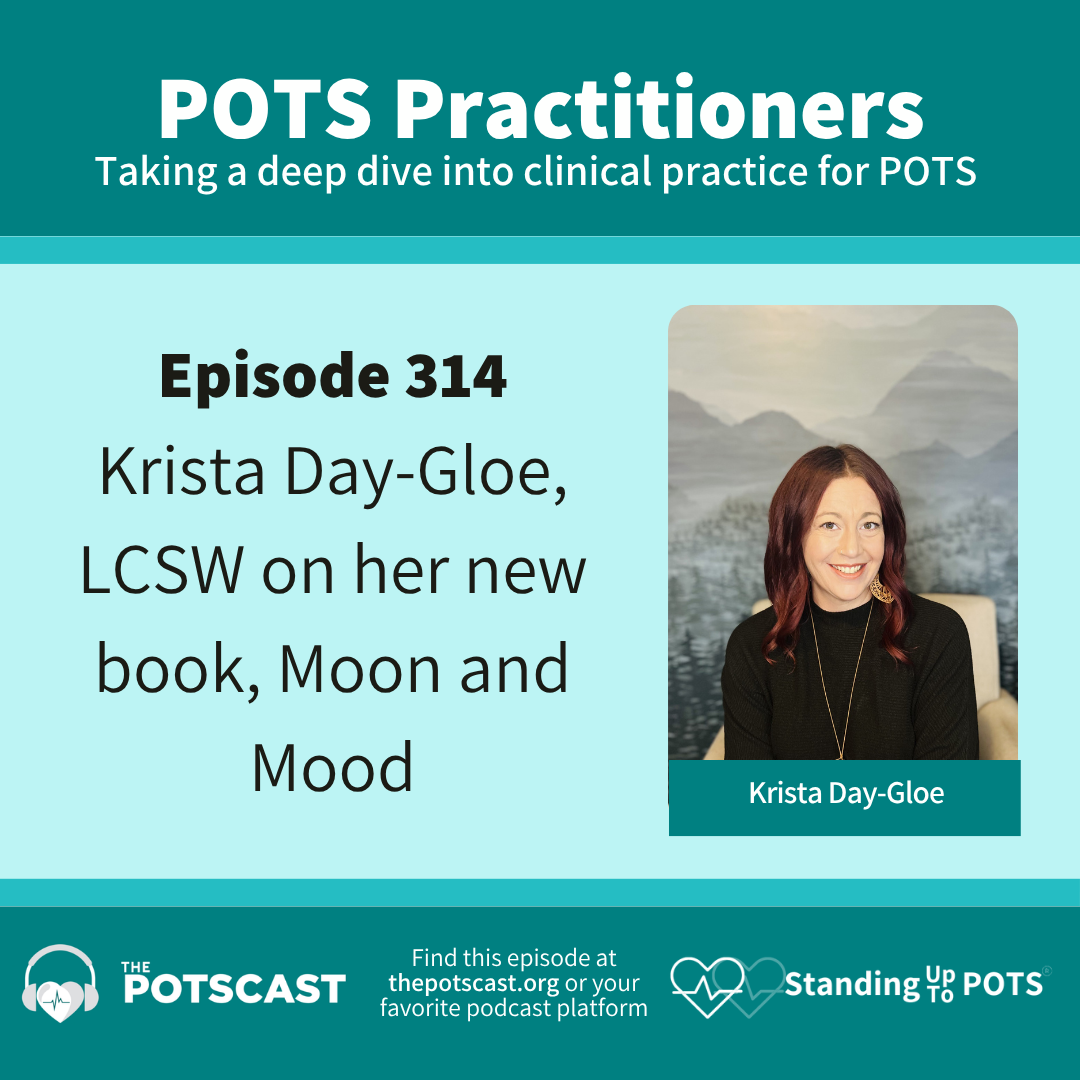
Moon and Mood: Tracking and managing hormone shifts with Krista Day-Gloe, LCSW
June 16, 2026
Krista Day-Gloe is a licensed clinical social worker and therapist who focuses on the mind–body connection. She’s the author of Mood & Moon: A Body-Led Guide to Understanding Cycling Bodies, a practical guide and tracking workbook that helps people connect hormonal shifts with mood, energy, sleep, digestion, and nervous system states—so they can recognize patterns and build supportive routines through each phase of the cycle. In this episode she shares practical information about understanding, tracking and managing the normal hormonal shifts that can affect so many symptoms. She also has a generous discount code for listeners (see below).
- Krista's Website: https://healingrootswellnesscenter.com
- Mood & Moon Workbook: https://healingrootswellnesscenter.com/body-led-books/mood-moon/
- Body-Led Mental Health Blog: https://bodyledmentalhealth.substack.com
- Hormone Literacy Initiative: https://healingrootswellnesscenter.com/hormone-literacy-initiative/
50 % discount code for digital products: POTS
Episode Transcript
[00:00:00]
Jill Brook: Hello, fellow POTS patients, and beautiful people who care about POTS patients. I'm Jill Brook, your horizontal host, and today we are learning about how normal fluctuations of hormones, as in part of the menstrual cycle, can shape mood, sleep, cognition, appetite, lots of symptoms, and how these shifts can feel louder when dysautonomia is involved. Also, how we might use this knowledge to better manage our symptoms and ourselves. Our guest today is Krista Day-Gloe, a licensed clinical social worker and therapist who focuses on the mind body connection. She's founder of Healing Roots Wellness Center and she's the author of Mood and Moon, A Body Led Guide to Understanding Cycling Bodies.
It's a practical guide and a tracking workbook that helps people connect hormonal shifts with mood, energy, sleep, digestion, nervous system states, and so much more so that they can recognize patterns and build supportive [00:01:00] routines through each phase of the cycle. So you may recall that Krista visited us in episode 1 62 where she discussed the intersection of chronic illness and disordered eating.
She is very, very knowledgeable about POTS and related issues and the challenges commonly faced in our community. Krista, congratulations on your new book, and thank you for being here today.
Krista Day-Gloe: Thank you so much for having me. I'm so excited to be able to talk with your audience again. I've loved being on your podcast before and so I'm just really excited to get to talk about this and get to teach a little bit more to your audience as well, help them understand things that probably they already know, we just maybe haven't been given, like the knowledge or the tools to really kind of like put it all into place.
Jill Brook: Yes. Well, so I was fortunate enough to get to read your book and it's beautiful and it's packed full of wonderful information, and then it gets really practical and there's a workbook aspect. But I guess maybe you could start by kind of giving us like an overview, like what made you decide [00:02:00] to write this? Who is it for? What's the big picture?
Krista Day-Gloe: Yeah, definitely. So I'm gonna take us all the way back, like before I even became a social worker, is how far I feel like the story needs to go back. So I knew I was gonna be a social worker my whole life. My mom was a social worker. Like this was just bound to happen. And yet, whenever I went to my college tour, the social work department didn't show up.
And so everyone's like, you should just go to nursing. Like, you're gonna get paid better. You're gonna have better hours. Go to nursing. And so somehow I got talked into it and I was like, okay, I'll go to nursing school. I went to nursing school for about like a year and a half, and I was like, all right, this is not for me.
I am not precise enough. I'm not that type A person that's really, you know, you say five mls, I'll be like five ccs, five liters, close enough. So I was like, all right, nursing is not for me. But what I did love, the chemistry, biology, like gave me panic attacks, physiology though, I was just like drawn into physiology.
I loved understanding how the body worked and [00:03:00] so fast forward, I went and got my social work career, decided nursing was not for me. I was working within the disordered eating population and my story became a little bit more personable whenever my husband got SIBO, so small intestine bacteria overgrowth.
And so we had gone into traditional medicine and just been kind of told he's fine, eat more fiber. I was like, my husband's lost 40 pounds in three months. That's not, that's not okay. Right? And so we got into the world of functional medicine and just started really understanding, I was like, wow, it's the physiology meeting the mind-body connection. And so, I brought my practice into a functional medicine clinic and I got this amazing opportunity to work with a dietician functional nutritionist. And as we're working together, we started, you know, she started teaching me more about hormones.
You know, in the functional world, I feel like hormones, that's kind of the, the bread and butter things that we learn, right? But I didn't learn these things. And so she was kind of teaching me along the way. And then COVID hit. I [00:04:00] moved back to Kansas City at the time. And Jess Dorsey, the dietician I was working with, we decided to do a webinar on hormones and mood. So we've got this little webinar, you can come and look on our websites and find it's a six part series. And as we were creating the series, I was like, this is so much information, Jess. Like, how is everyone gonna get this? They're not all gonna find it. And I was like, I wanna give them a tool.
I wanna give them something that's, that they can take physically into their dietician, into their doctor and say, look it's happening every time at this part of my cycle. And so what started brewing my head was just the tracker initially. Being able to have this hormone chart that had kind of three or four months stacked upon each other with the hormones at the bottom, just so that we could just see, oh wow, like you're really, you're having more symptoms on ovulation. Hey, we can try some different things at different times. And so just seeing that giving something to the practitioners. And as I was writing, I was like, well, I probably need to write a little bit about like how to use the tracker.
And I was like, well, [00:05:00] people keep asking me about like the different phases and then basically it just turned into a whole workbook where, you know, I was like, oh, it'll just be like two or three chapters. And then I was like, wow, this is a whole book over a hundred pages now. So, it just kind of started with me wanting to give a tool to people.
And now it's, it's still, it's this magical tool that I'm just so excited for people to have, to be able to start learning more and, and taking these things that maybe seem random with their health or their mood, and actually giving them some more understanding and making sense of things a lot more.
Jill Brook: Yeah, and I think it's maybe a lot deeper than people might suspect. It's not just like, oh, you're on day four of your cycle, you might feel this way. You go through a whole bunch of different hormones and what they do and how they affect your brain and your body and your appetite. Do you wanna talk a little bit more about like who are sort of like the main players?
Krista Day-Gloe: Yeah. So we've got so many different hormones, right. And like you said, the main players, right, is what we can maybe focus on here with our time. You know, this book is for assigned female at birth [00:06:00] individuals. The book is really designed for women to understand the impact of their hormones, right, and so the main kind of key players with hormones, the two that I think just time wise that I wanna focus on today are estrogen and progesterone.
And so estrogen, when I was in a training once, you know, I was talking about estrogen kind of makes us feel more confident. Estrogen, it gives us more clarity. It gives us this more creative space that's during this time. And as I was presenting, somebody's like, so kind of like Beyonce energy and I was like, yes, like Beyonce energy, right? So from now on my brain is like stuck as like, estrogen is like Beyonce, right? She's got this like confidence, right? But as we'll get into it, she can kind of mess with some, you know, mast cells maybe later on, right? So estrogen is, is really, we're gonna see it rise at the beginning of the cycle.
So, you know, if we're looking at the cycle, we're gonna have kind of the first part, the follicular and the last part, the luteal. And so estrogen's kind of dominant more [00:07:00] in the first part. And so this is where we're gonna see estrogen, it's gonna help us feel more clear, more creative. When it comes to mast cells though, and for some of my chronic health people, it can destabilize our mast cells, right? And so that's gonna affect our chronic health issues. Estrogen also, it helps us feel more satiated with our appetite. And so at the beginning of our cycles, we're gonna feel fuller easier. We're gonna go and have a meal, and we're gonna feel more satisfied by that meal. When progesterone kind of flips and kind of takes over at the end of the cycle, progesterone can soften our digestive system so it can slow down our digestive system, which means that we might feel more distended or more bloated, so we might be having more symptoms of edema even, just because the natural cycle shifts in our body.
Progesterone is also going to be, it's, it's calming into our system. So again, it's gonna calm that digestive track. It's gonna maybe help with some of our POTS because [00:08:00] progesterone is actually gonna maybe stabilize us a little bit within that time period.
With progesterone, whenever progesterone comes in at the end of the cycle, progesterone's really different. Progesterone is gonna do something to our satiation where it's actually gonna make us crave more carbohydrate rich foods, which I think many of us are in tune with. We kind of know that we're going to like crave things differently in our cycle, right? We have like the infamous like PMS wanting chocolate, right? And there's actually a biological reason. Progesterone really shifts that. And so when estrogen comes down, our satiation doesn't feel, we don't feel as satiated by this. And so the example I like to give is I am a fellow neurodivergent gal, and I like to eat the same things pretty repetitively, right?
And so, at the beginning of my cycle, I'm gonna eat my steak salad. Let's say that I'm eating at that time of the month. That's my anthem meal that I'm gonna eat over and over. During the first two weeks of my cycle, I'm gonna feel pretty satisfied by that salad. And the second part of my cycle, like I'm gonna be going back and digging in the [00:09:00] pantry for like, where are some crunchy potato chips?
Or, oh, I want something sweet afterwards because it actually, progesterone and the ways that our body is working, we're shutting different linings. We actually need a couple more hundred calories at the end of our cycle. And so this is where I think of going back to kind of our other podcast we did with disordered eating.
This is really, it's such a big impact for so many of our individuals to understand we are supposed to eat more. We are supposed to have more caloric import during this time. This is also though the time that our digestion might be a little bit wonky. And so this is where I think of with my, my chronic health patients, right?
This is when, this is not the time to go and test some foods out, or this might be when we're more reactive to the different foods. And so this book was really designed and being able to help. So often the, the clients that I have, especially as assigned female at birth, we feel like our symptoms can somewhat feel like random.
It can feel like I don't get it. Like I was fine this week and I ate this food this [00:10:00] time, but now I'm reactive. And so I think that there's such a big missing component and understanding how this natural cycle every single month for some of us that are, you know, cycling on that 28 day cycle, how influential and how much more we can predict when we see the patterns over time, right? I am more hungry. Hey, let me go get some different foods for that time. You know, or hey, I am more satisfied with that food. Or, you know, we can talk about meds here in a little while, is that, you know, once we start really understanding where we're at, we might work with our providers to adjust our medications.
You know, I have a lot of my clients that will take more H1 blockers during a luteal phase knowing that we're gonna have more of a drop during that time period. And so there's lots of different things that we can start doing once we start noticing these patterns.
Jill Brook: So you just used a phrase about a phase. You talk about four phases and how they kind of each have their own distinct vibe. Can you talk about that? So like, how many are there, you know, [00:11:00] why are they different, and what kind of, what are the vibes.
Krista Day-Gloe: Yeah. So we've got like our follicular phase, and the way that Jess had kind of taught me is follicular F is first and luteal last, right? So we've got our two major components, right? And this is where about day 15, 16 is whenever luteal phase starts towards the end here.
And so we've got those two major ones. Then we've also got the menstrual cycle within our follicular phase. And so that's right, the very first part of our cycle when we're using the tracker that I built, that's gonna always be day one, 'cause your menstrual cycle is gonna start when your cycle begins.
And then we're gonna gonna get into ovulation. That's gonna be around day 14. This is when we're gonna have spike in a lot of different hormones. And this is also where when we look at chronic health issues, sometimes it's about the hormones, but sometimes it's about the spikes or the dropoffs of these hormones, right?
And so if we were on screen right now, I would show you the hormone drop off of what happens maybe after day 14, day 15, right after this. And so when we look at these [00:12:00] different areas, right, we're gonna see different phrases are gonna have different reactions. The one that I really like talking about that most people aren't familiar with is the term divorce day.
And so this is where kind of, this is kind of the beginning of the luteal phase. And when we look on a hormone chart, I like to point out right before this, there's all these X's. Like estrogen is dropping and progesterone is rising, and luteinizing hormone is like dropping off the side. And so there's just all these hormones that are just all over the place and I'm like, X, and there's a big X that comes on to this day, right?
And the way I like to describe this is, you know when like the dishes just hit differently on the, on the, in the sink. And you're one day, you know, you walk by the dishes in the sink and you're like, oh, okay, I didn't have time to do 'em, that's fine. We'll get to 'em later. And then one day you're just like, how disrespectful.
No one appreciates me. Like, why am I, why do I even try? Right? And it's just these real big feelings, right. And this is where our hormones are just going up and down and all over in these different places, right? And so many [00:13:00] women, we don't know that this is when the luteal phase starts and things can feel really intense for a day or two, right?
This is where many of my clients that have PMDD self-harm. This is where we can start predicting that we're even maybe going to have self-harm urges, suicidality that can pop up. There's a lot of things that can become very predictive when we look at this divorce day. So the divorce day normally is around 10 days before our cycle, so it's a little bit after ovulation.
And again, it's encompassed in that luteal phase. And divorce day, you know, when we talk about PMDD and self harm, many of my clients, when we just start tracking this, it's not that we really do anything different, it's just that we know there's an end to it. We know that most of the time what will happen is that our mood will typically lift once we start menstruating.
Some of us, the menstruation, we have lots of pain and, and different things, so maybe it might not lift, but when we start understanding these patterns, we can really start giving ourselves that [00:14:00] impermanence understanding, that, hey, this feeling won't last too long, right?
Jill Brook: And can you just say what PMDD is for people who are wondering?
Krista Day-Gloe: Yes. Premenstrual Dysphoric Disorder. And so this is when, what I can say too with research is, is that we don't have a lot of research a hundred percent on our 28 day cycle. I go into my book as to lots of different reasons, but I think the main reason is we're kind of complicated.
We got all different kinds of hormones going on throughout the month, right? And so science likes to have very few variables, right? We have 28 variables just by every single day having things different, right? And so with PMDD, they're starting to find out with research is is that it's more so maybe a reaction to GABA and having a reaction where it doesn't synthesize GABA correctly. And so where we have a big push of progesterone at the end of the luteal phase, right, whenever this divorce day starts, it has a really significant rise. And this is where for some people with PMDD, research, again, [00:15:00] we're a little limited, but it's more so pointing that we have a negative interaction with GABA, and GABA is produced by progesterone.
And so for some individuals, this is where we can work on adding in more increased SSRI during the time. We can have different medications that we can support during this. You know, we're not gonna use extra progesterone during this time period. And so there's lots of things we can do with medications, but a lot of times PMDD, most of the time, most of my clients, it's just understanding, hey, this makes sense why. Work was the same, the drive home was the same, but all of a sudden something feels so big, right. We can also go to, to the, you know, typical site too, of just, for many of us, it's the day that we might feel like we wanna end working for someone or the traffic is just so much harder for us, right? And we might have these big feels that come up and maybe the next day we're like, woo, sorry guys, I dunno where that came from.
And a lot of my claims before we know this, we would have a lot of shame, because we just didn't [00:16:00] understand that there was this day that was gonna kind of have this ugh feeling. And that maybe the feelings, maybe we don't wanna waste them that day 'cause maybe we're feeling a little bit more ramped up.
But most of the time they're feelings that most women maybe have been pushing aside for a couple days or a couple weeks, right? And our body's like, nope, I'm gonna make you feel them right now. And so maybe that's the time that, again, just the dishes hit differently or the thing that's just kind of irks you about your partner or about your boss.
And just again, understanding, hey, you know, one of my clients, you know, just, she was like, I was just about to give it to my coworker. And she's like, Krista, I just went and looked on my app. I saw it was divorce day. And I was like, all right, I'll just wait until tomorrow. She just waited until tomorrow when she felt more regulated.
And she didn't have to do anything different. It wasn't because that she was gonna sleep better. Maybe it was that she slept it off, but more so she just knew it was a harder day. And she had bigger feels that day.
Jill Brook: Right, right. And I assume that some people experience this a lot more than other people, and I assume it can also probably [00:17:00] change over a lifespan. Like what do you, what do you see? Is this more younger people, older people?
Krista Day-Gloe: You know, I'm gonna say it's probably, you know, within our range of, you know, once we start cycling, this is gonna be a thing that many of us are gonna have. And like you said, it's gonna be to a higher degree for some than others, right. What kind of stress level are we at when we get into perimenopause, right, and things are more, you know, our, our hormones are just not as patterned, right? We might have more of these spikes of feeling like divorce day. There's actually research where we see that as estrogen goes down, this is where divorce rates go up during perimenopause. And so we can see, you know, that there are some spaces that hormones, right, we know estrogen can give us more it can turn out more of our, our brain centers for empathy, right?
And so as we're going and we're decreasing that estrogen, right, this is where perimenopause, we might feel, you know, I might have tolerated some of those things before, but no, really not as much [00:18:00] anymore. Or I'm gonna be a little bit more thinking about myself versus making sure everybody else is taken care of first, kind of the idea.
And so as we move through our, our different transitions, right? With menopause, then we, we stop cycling with our hormones. However, I will tell you I have many clients that have had hysterectomies that are in menopause, and if we keep tracking, most of my clients will, if we're not cycling, we track with the moon.
So maybe we'll track, maybe first day new moon just as a calendar holder for ourselves. Many of the women that I see that are in menopause, we still will cycle. Our hypothalamus, our pituitary glands are still working, they're still cycling things, and so many of my clients, I have a client that has a hysterectomy, we take testosterone 'cause we're in a gender affirming body and we still, they're like, I'm on the divorce day, Krista. Like, we know we're here and we don't have the, the physical parts that are still supposed to help us cycle or that research just says that shown us [00:19:00] really, truly that we still do somewhat cycle, but it's just gonna be a lot less during menopause.
Jill Brook: Okay. And it's more hormones too, I think. You know, we've been focusing on the estrogen and the progesterone, but you also talk about insulin and cortisol and luteinizing hormone and some that I had never given any thought to.
Krista Day-Gloe: They all affect each other, right? Just like the mind body connection. Right? So when our luteinizing hormone is off, that's gonna throw off our progesterone, which isn't gonna throw off our menstrual cycle, which this is gonna throw off our sleep, which isn't gonna throw off our mood. Right?
There's just this line, right, that's gonna keep affecting one another. And when we get into things like with POTS, right? So we're gonna have different time periods. Whenever I was, you know, preparing for this podcast, I was wanting to look up research again and just, you know, make sure I had some of the good statistics and things going on and I was, I was interested whenever I kind of came across that so much of the research points to that we're gonna have more struggles in the morning [00:20:00] times because of the way testosterone influences and cortisol influences our vasovagal.
And so we're gonna back up here and we're gonna talk about assigned female at birth, we have 28 day cycle. I call us the moon. And then our assigned male at birth, we have the sun. We're gonna have a 24 hour cycle. And so with that 24 hour cycle, what happens for an individual that has testosterone is we're gonna have a rise of cortisol and testosterone starting about four o'clock in the morning. That's gonna peak around 10, 11 in the morning and it's gonna slowly decline in the afternoon. And cortisol runs just kind of parallel to testosterone just a little bit under it when we look at the graph. And so when I was thinking about, okay, so the research is showing that, you know, we might have more dysautonomia in the morning times, when I started then looking at what estrogen is doing, it says, okay, this might work for the beginning, for the follicular phase. We might have more of the dysautonomia in the morning time, but whenever things switch and when estrogen is really [00:21:00] climbing, that might not be the case anymore.
We might be having, you know, afternoon struggles more so. We might be having, you know, nighttime waking up more. We might be having more struggles, not just in the morning times. And so, as I was looking at the research, we know most research, again, is going to take away variables. And so most research is based on the assigned male at birth 24 hour cycle, right? So being able to back up and understand, okay, this is what the research is showing, but is that accounting for us cycling bodies and knowing, okay, that might be true during a certain time period, but then what happens typically is we, you know, when we look at the research, we do have more flares, let's say, of MCAS during the ovulation.
We are gonna have maybe some more flares during the luteal phase whenever progesterone is really in charge and estrogen is dropping during that time period. And so it's really paying attention to, again, knowing that we have a lot of tools and we have a lot of information, and [00:22:00] knowing that a lot of this has been kind of used as the template for the, the 24 hour cycle, and so being able for us to understand that, hey, we might still follow, you know, we might have a rise in cortisol that might be affecting us, but that might really show up differently week to week or day to day for us.
Jill Brook: Right. So I guess, so one interesting thing is that in the world of like aging women, I think progesterone gets a little bit of a reputation for just being very beloved for helping people relax and sleep at night. So it's, it's again, a good reminder that different people, different stages, different issues, different reactions to some of these hormones. And that kind of makes me think about how if anybody's confused at this point and they're saying, oh my gosh, there's so many different hormones and so many phases, and they can all have so many effects. I think the whole point to your book is that, sure, you can understand that all academically as much as you want to, but at the end of the day, the [00:23:00] tracker is where you can figure out what your body's doing and if you don't wanna care about why that's okay. Right. You can just kind of find out.
Krista Day-Gloe: Yeah, it absolutely is. Right? And so that's, I made my tracker free online. So just the tracker itself is just a two-page tracker that you can print out because I know some people wanna get into the science and some people are like, yeah, let's talk about it and let's, let's figure it all out and, right.
And some people are, yeah, like, just, just help me figure out my patterns. Right. And the thing is right, is that each of us are gonna have different patterns. Right? I was, I was sharing this with a new client and she's like, but wait, I don't feel more confident on ovulation. I was like, hey, that's gonna give us information, that's information for us.
And let's see, is that true every month? Is that, is that, you know, environmentally influenced? Right? But we can, once we start tracking, right, like you said, there is a lot of information in the workbook and I definitely, I think I made it so it's more relatable 'cause I do think whenever I'm like, why am I as a therapist teaching people about hormones?
[00:24:00] I'm not an an endocrinologist, I'm not a doctor. Like what's going on here? Right. And for a little while had a little of that imposter syndrome, right. And I had somebody point out that they see me as a bridge. As a way to be able to take maybe something, let's say for the book, is being able to take something that's really science heavy and maybe bridge it to make more sense and make it a little bit more understandable.
I love getting to bridge functional medicine and traditional medicine together. So, yeah, there's a lot of information and we can take a little bit of it. Just downloading the free tracker. You know, and you don't even have to have the free, you don't have to use my tracker, right? This is, we have apps, we have so much more information out there. What's hard with the apps though, is we just don't see it stacked every month. Like, oh yeah, like every month I am struggling with mood on day 18. But we can still find that, you know, using our apps and stuff too. And so I think most of the things that I hope that I teach mostly women is, is that we've already known these things.
We know that the [00:25:00] pattern doesn't make sense, but it does, there are some things that fit and, and that fall into place, we just haven't maybe put our finger on it. And so I think more so is, is that we do already know these things. We already know we're gonna, hey, I sleep worse, you know, a couple days before my cycle.
And so it's more just kind of giving us the solidification that, hey, it makes sense. Other women are in the same place. This, this is what science tells us. And so it, it kind of helps us, right? I teach my clients a lot is that when we see unknown, there's like an equal sign and it's unsafe, right? When we have known equal sign is safe, right?
So once we kind of know it. Again, we've already known these things. It's more so somebody, I feel like I hope to give permission to know these things are valid and they're true. And your cycling body is meant to be different each day. But when it comes to chronic illness, it can definitely complicate things.
It's not as complicated as, yeah, getting down into the science and understanding the vasovagal responses of each of these hormones, right. It's [00:26:00] more just understanding, gosh, I feel different at different times of the month, and maybe there is some pattern to it.
Jill Brook: Yeah. And one thing I really like about your book is that you have a lot of practical tips, kind of that based on what people find. So I don't know if you wanna kind of maybe talk about some of those, but it could, it could either just do with when you wanna schedule certain kinds of things or just practical solutions.
You have some great stuff about brain fog. Maybe you can just kind of talk about like some of the things people can do once they have this information and maybe what you're seeing in, in people who use it.
Krista Day-Gloe: Yeah, yeah, definitely. You know, I think there's so many different things. I get really excited when, when we are starting to understand that, yeah, like different coping skills are gonna be used at different times. You know, so maybe during the beginning of my cycle, like I feel creative, this is when I'm gonna write my book, this is when I'm gonna do my social media posts.
This is when I'm gonna feel creative, right, in these different ways. And that coping skill probably isn't gonna feel as good later on in the month. Right. And so I've broken down in the book different things [00:27:00] that maybe, you know, a bath, let's say is a nice coping skill, but that doesn't work on day 18, right?
Like, maybe you need to go out and like go, you know, scream into the abyss for a moment, and that's okay too, right? And so understanding that throughout the month we're gonna have different experiences. Brain fog. Whenever I get into the chapter of really breaking down, you know how it really affects us, I start with the fact that it does not change our intelligence. Our hormones don't do anything to our intelligence. We remain the same as we were before. But I will tell you, coming into this podcast, this is the first podcast I've had that is not on my most ideal day of the month. I have been scheduled on my podcast or my trainings on day like 13, where clarity is I, I feel like I've got clarity, my word finding is great. Coming in today's podcast, I was like, oh my gosh, am I gonna have word finding issues? I know the stuff. I know what to say. I'm gonna have a little bit more fog because I'm a couple days outside of my cycle, [00:28:00] right? And so that's gonna help me though understand if I do mess up, I'm gonna give myself a little bit more leniency.
Not gonna shame myself. But I am gonna have a little bit more understanding of, wow, I was really energetic in that training versus like this training, I was having a really hard time remembering what this slide was even about. Right. And so understanding, again, our intelligence hasn't changed.
My brain did not access things any differently. It's just that when we have progesterone, when we have these big dips and falls of hormones, right, it really is gonna affect how we see, how we sleep, how we engage so much with the world. And so I've got some tools kind of at the end, you know, breaking down each phase and what, what can I do?
What kinds of things are helpful, right? So I've got a big list of all different kinds of coping skills, and some of them are taking baths, some of them are setting boundaries, right? Coping skills are different for each of us, and we're gonna be able to access them differently. So whether that be individual or whenever I'm training my other therapists or physicians and doctors, right?
[00:29:00] We're gonna have different things that we can do with our clients, right? With a dietician, maybe we're gonna work on trying some new foods in the follicular phase, but we're not gonna, we're gonna go straight to safe foods at the luteal phase, right? So one example I really like to give, I have a couple clients that we've worked on specifically with SIBO and MCAS flares, is that often we'll have some nausea that will come either right before the cycle when we're having this big dip. Everything kind of drops off right before the cycle of hormones or right when the cycle starts. And so I see this cascade of I feel nauseous, so I don't eat. When I don't eat, I don't have the calories, I get a migraine.
Whenever I have a migraine, my belly starts to hurt and then I don't eat more, and then maybe my SIBO gets increased. Right? And so we've got this full cycle and so many of my clients, it's saying, hey, I know that you wanted to like add those new foods in, but let's just go straight to your safe foods, right?
So one of my clients we just went to just [00:30:00] straight up toast and applesauce. That's their two safe foods. I'm not a dietician. And working with their dietician, right, we made sure that we're gonna get enough calories. We eat as much toast, as much applesauce, if that's what's gonna feel okay in your belly at that time. That then stopped the space of them going to not getting enough food, then getting to the migraines. So now we don't have the migraines. So now we're in the follicular phase and now we can start thinking about, okay, let's add some new foods and let's test some things out for a week or two. And then we might come back where we're going to ease off some of those foods for a little bit, knowing progesterone's gonna mess with our digest a little bit. Many of my clients, we even schedule things like, I was thinking about one of my clients, we scheduled her going into grocery stores. Right. So going into the grocery store, knowing that we're gonna have some, some dysautonomia with some of the, the ways that you know, going into Costco versus somewhere like Sprouts. Knowing we are not going to do that at all during her luteal phase. She's gonna process that at the beginning of her cycle. She's gonna go into those grocery [00:31:00] stores. I have a client that just crossing over a bridge really messes with vertigo, right? So we're not gonna go downtown during luteal phase now. And so just knowing, hey, this is when I'm gonna go downtown to go do those things I wanna do.
And we can plan our life a little bit more around some of those, those pieces, right? So much when we're in chronic illness, it feels like it comes out of nowhere. Right? We're, we're feeling good one day and all of a sudden we feel tanked the next day. And this does not, by all means say hormones are everything, right?
We have so many different things that are underlying this, but hormones I think are something that are majorly underlying, that we're very much just overlooking and just understanding that this pattern is here and we can work with the pattern, right? We can lean into the safe foods. We can pull back, right?
I'm not gonna do EMDR with somebody most likely during the luteal phase. I'm gonna probably do more trauma work when we know that we are feeling more capable and more confident in ourselves.
Jill Brook: Yeah. Well the other thing that comes to mind is that if someone were to were to track this [00:32:00] and to find out that they were this affected by their hormones, that might be a good time to talk to their doctor because there are some, some POTS specialists who do find that giving hormone therapy can really help with POTS.
I have to admit, as somebody who has not been as severely affected by hormones, as I hear you talking, I'm thinking, oh my gosh, these poor people, they kind of are almost ruled by their hormones and what they can do day in, day out. And I guess part of that question is, at what point should somebody seek help?
And I guess this is, you know, in general about hormones, but also about the PMDD and the self-harm that you were talking about. But I guess I'm not sure how much is natural and normal, and at what point should you be seeing a doctor about them just hurting your quality of life too much.
Krista Day-Gloe: Right. I think that would probably be the major piece of, you know, when we're seeing okay, maybe our pattern is okay and you know, we know during ovulation things are gonna be [00:33:00] triggering so we stay at home. Right. I think if it's not affecting our life, then that's okay. You know, if we're realizing that I don't wanna go out ever, and like I'm too scared and I feel like I'm always reactive, that, you know, I think that that's gonna be a time that we're gonna wanna reach out. With our hormones, I think when we typically see, okay, I'm, I'm more satiated during this time or not, whenever I see somebody that's in the opposite, or whenever I hear somebody that's telling me I don't feel good at ovulation, I feel really crummy during ovulation. Whenever we see things that don't necessarily fit the mold, doesn't mean that necessarily anything is wrong, I would wanna reach out as well. That's typically after a couple months of tracking patterns with my clients. If we start to notice that the patterns aren't really following some of the traditional patterns is when we'll notice that. PMDD, I think the same kind of thing, right?
So if we are understanding that this is happening, we have the surge and we feel like we can feel in control of it, versus if we're still [00:34:00] noticing with these surges, they don't feel controlled, or we don't find that maybe we get a kind of relaxed state once maybe the menstrual cycle starts. If we're finding that we're finding self-harm, suicidality is happening all of the time, right, maybe that would also gimme a clue that something also might be going on with that person's hormones as well too. Right. And there's so many things that we know hormone replacement therapy, we're just starting to like, I think, scratch the surface of what we can do with hormone replacement therapy.
And, you know, sometimes it's hormone replacement therapy, sometimes it's meeting with a dietician and looking at just where's our stress with our food, and are we overeating at a certain time? And hey, does that make sense? And can we lean more into that again? You know, I think it's more of whenever it feels like it's affecting our lives.
You know, and I think it's also when we go to the doctor, it's asking to maybe run some of these hormones. Right, and, and saying, you know, many of the doctors will say, well, we can't really do much about them, is typically the response I'll get from [00:35:00] many, you know, Western docs. And most of the time if we just say, okay, well I would still would love to run them and just so we can get some running information, right.
This is always a helpful thing to do is get a baseline information on your hormones so that when we start maybe going into perimenopause, we'll also note, hey, that doesn't, that number didn't fit my body. My body used to sit at a higher number. Right? My hope is a couple of years from now, these are gonna be common practices, right?
The more that we're starting to research and understand and give more, give more space to understanding how, how much the 28 day cycle affects things like diagnoses, assessments, treatments.
Jill Brook: Right. Well, yeah, hormones are big deals and and I'm 53 and I never had a doctor test any of mine until just in this last year. And I found that, you know, like four out of the five they tested were, you know, really low and, and I thought, oh, isn't that interesting? They've gone all this time not knowing, and it, you know, seeing many, [00:36:00] many different doctors.
Krista Day-Gloe: Not having anyone think about this. Right. And so I know for me, whenever I'm with any of my chronic health patients and with our doctors and groups, I let them, we all know, hey, we found this really great thing that, hey, you know, just at ovulation or at, you know, the end of the cycle.
And so I'm hoping that, you know, being able to talk about this and again, normalizing that this doesn't have to, we don't have to know every nitty gritty piece of science behind it. It's more so of just understanding that it makes sense that we cycle and that we're not the same, and that that absolutely would make sense that it would affect our health, especially when we're struggling with our health.
Jill Brook: Yeah. Yeah, absolutely. I'll just say one other interesting thing that connects with this is that to your point about how this is becoming more studied and more well understood, I saw an endocrinologist who directed me towards an app where you can measure your salivary free cortisol anytime you want.
And so you can start to [00:37:00] see the patterns of when is it too high or too low. And they don't have it yet, but they're working on progesterone and testosterone also. It's called eli.health and I think it's still in the beta stages and it is not a substitute for medical testing. It's, it's a wellness tool.
But my endocrinologist is actively encouraging people to use it to learn about their cortisol and and I'm learning about how cortisol is so highly related to mast cell activity 'cause cortisol is basically, you know, a steroid that calms it. And so anyway, I feel like we're on the brink. There's all these great things, great tools, and your book is one of 'em.
And I really feel like to anybody who feels like they're all over the place or who can just tell that their POTS or their are other conditions are, you know, related to their cycle, I think that they would get so much out of reading your book. It's so clear, it's so beautiful. It has [00:38:00] so much information.
I feel like I, I'm not sure we did it justice today because it, it has so much good practical information packed in there and so many wonderful practical tips that I feel like, I feel like I would just encourage people to check it out if they're at all feeling like they're a slave to their hormones.
Krista Day-Gloe: Yes, absolutely. And I think even just, you know, even if we don't feel like a slave, it might even just feel like, oh, that makes sense, that like, I didn't sleep as well tonight, right. Like that can even, you know, I think this is where so many of us, when we look at hormones, and we think about like, okay, so when they're, when they're no longer working or when something's awry, and this is where I made this book, 'cause I want all of us to know that we're, we're just gonna be different throughout the month. And there's so many really cool things about that that we can lean into versus like fighting up against, right? It just helps us feel so much more in control of ourselves when we understand when those things are happening.
And so, yeah, I'm excited 'cause within my book, whenever it did start just as a [00:39:00] tracker I'm really excited now that it is, you know, attainable and it is something that, you know, it's, it is a workbook and then we've got, you know, a couple hundred pages, but it's a very short little book, right, that's gonna give us a lot of information for so many different parts of our life.
And I'm just excited to see all the little conversations brewing, whether it be from my book or you're talking about this app. I was just with a women's group and we were talking about how perimenopause, we're just getting so much more research and how the instability is affecting us, and we're seeing, you know, that, yes, ringing in the ears is a symptom. We're getting just so much more information. And so, yeah, I'm excited to be part of that, that group of people helping educate us along the way.
Jill Brook: Wonderful. So where can people learn about you and find your book online?
Krista Day-Gloe: Yeah, so on my website, so HealingRootsWellnessCenter.com. I'm in the process of what's called global distribution. So by the time, you know, somebody's listening, it might be on Amazon and you know, some of those, you know, TikTok, Facebook shops, all of those different kinds of things that are in [00:40:00] there. Currently, it's on my website.
I also, just because I love writing and I love educating, I also write blogs. And so, folks can find me at Body Led Mental Health on Substack. And that's a great way also just I post a lot of articles whether it be about perimenopause, MCAS, ARFID. There's lots of different information that, my hope is, is I know I can't teach and, and see every single individual, so my hope is, is that some of those blogs or this workbook can reach the folks that I can't necessarily reach face-to-face.
Jill Brook: Wonderful. Well, we will put all of those links into the show notes. So if people just take one thing away from today's episode, what, what should they remember?
Krista Day-Gloe: Your cycling body is totally normal and it makes sense. It's totally normal. A hundred percent. I hope that we all can stop shaming ourselves for the things that our body is just doing naturally along the way.
Jill Brook: That's great advice.
Krista Day-Gloe: And I definitely, I wanted to offer all your listeners you know, right now the book is out.
But I do [00:41:00] have digital products as well, and so I'll give a, I'm gonna give a discount for 50% off of those digital products. So if you just type in POTS, so I'll put that in as well into the website so that your folks can get access and then they can get it right away. You know, the book takes a little time to get to you.
So hopefully we can get that. And you can always come to my website at HealingRootsWellnessCenter.com and you can get that free principal hormone tracker as well. Just so you can start putting it on your fridge and start tracking right away.
Jill Brook: Oh my gosh. That's so generous. Krista, thank you so much. It just, you do so much for this community and I know that you are so engaged in so many aspects of it and we just really appreciate you and this is just one more amazing resource. So thanks a million.
Krista Day-Gloe: I'm really grateful to be here and, you know, ditto to you as well, 'cause anytime, you know, somebody has reached out on the podcast or they, they've talked about it and they're like, oh my gosh, you got to talk to Jill. Oh my gosh, that's so great and I've learned so much. And so I know too it's really exciting to know how, how impactful I know your podcast has been and I know that your [00:42:00] listeners are just getting so much information.
So thanks for getting all of us on your podcast so that we can share all of this with all your listeners. I like to be the person that's talking about the things that no one is talking about. I love being in that space.
Jill Brook: Awesome. Well, thanks a million.
Okay, listeners, that's all for today, but we'll be back again next week. Until then, thank you for listening. Remember, you're not alone, and please join us again soon.