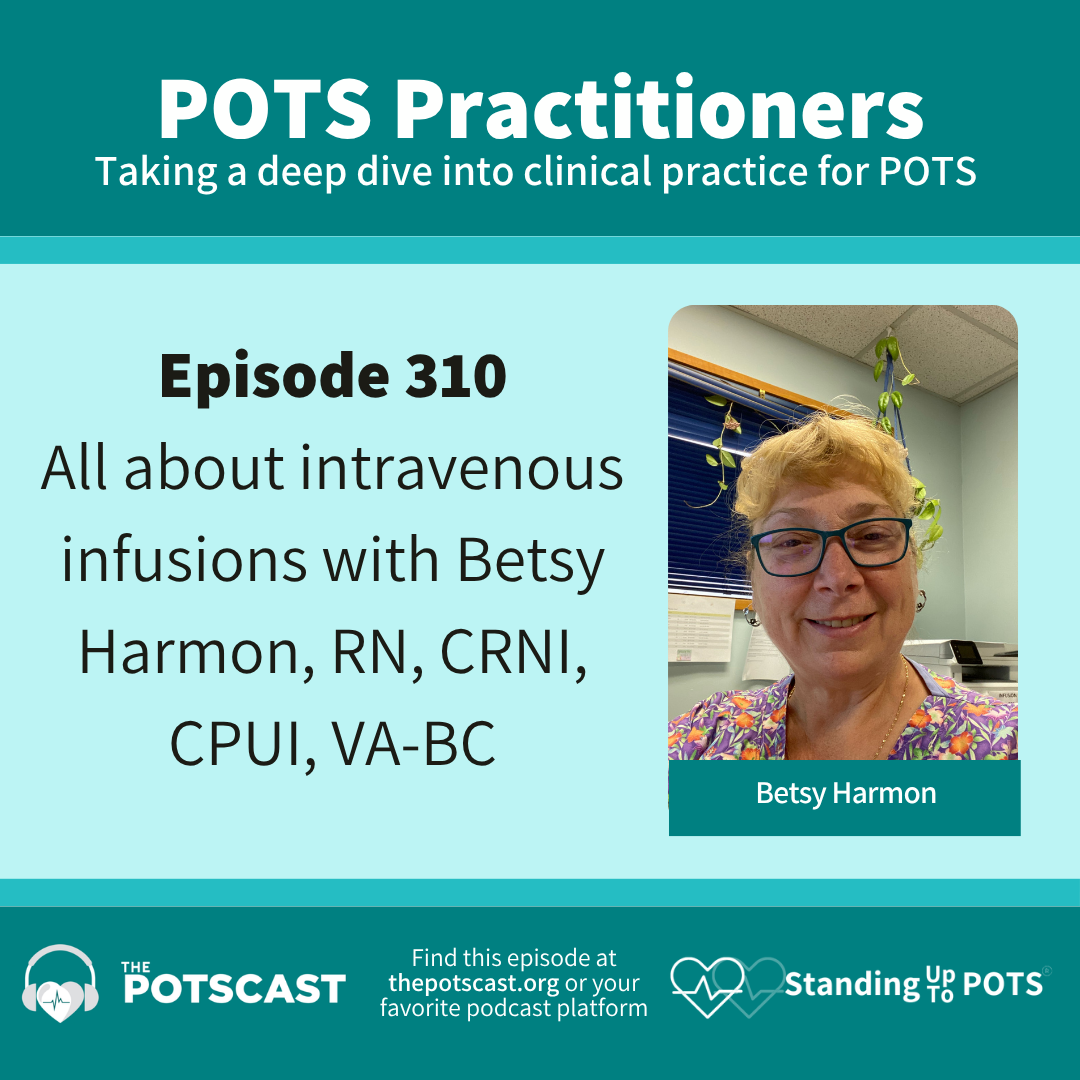
All about IV Infusions with Betsy Harmon, RN, CRNI, CPUI, VA-BC
May 18, 2026
Betsy Harmon, RN, CRNI, CPUI, VA-BC has been an infusion nurse for over 20 years and runs the Alaska Infusion Center in Anchorage, Alaska, where she oversees and administers all types of infusions to a wide variety of patients. In this episode she shares the many factors that go into safe and effective infusions, what infusion nurses are looking for and thinking about as they care for infusion patients, what patients can do to help infusions go more easily, and answers listener questions about infusions. Betsy is also a special guest because she is the nurse that cancelled a dinner date to work late giving Jill the emergency infusion that got her on the road back to better health when she couldn't stop passing out and fainting.
Episode Transcript
[00:00:00]
Jill Brook: Hello fellow POTS patients, and marvelous people who care about POTS patients. I'm Jill Brook, and today I'm thrilled to welcome a truly extraordinary clinician with over 33 years of experience as a registered nurse and over 19 specializing in infusion therapy. Nurse Betsy Harmon literally changed my life, like saved my life 10 years ago when she canceled a dinner date with her husband to stay very late and give me my very first infusion at a moment when I desperately needed it, but was terrified of infusions because they seemed so invasive.
But her calm, caring, capable confidence kept me grounded. She gently carried me through my rock bottom of health issues, and got me on the mend. And over many hours of infusions after that, sitting in her chair, I came to see what an absolute dynamo she is, [00:01:00] effortlessly managing usually about four infusion patients at once, checking on everyone, finding veins on the first try, literally every single time, simultaneously working the phones to secure insurance approvals or to even fight insurance denials. She was willing to fight to get patients the care they needed. I remember cheering her on while I could hear her on the phone with insurance. But Betsy has worked across multiple infusion settings in Alaska.
She runs the Alaska Infusion Center for many years now. She has worked at the Alaska Native Medical Center and her background as a travel nurse has given her some incredible experiences and adventures around the world.
So to me, Betsy truly embodies the best of medical care, exceedingly capable, while also being deeply personal, warm and compassionate. Betsy is the kind of nurse everyone hopes for, and today she's here to share her expert insights into [00:02:00] intravenous infusions and to answer some listener questions about infusions.
So, Betsy, I wish I could hug you through the computer screen. Thank you for being here today.
Betsy Harmon: Thank you so much and yes, you are very oh, so kind. Thank you so much. You, you, you make me sound, I think a lot more than I am, but go for it, girl. You know, if, if it's what I give you back, that's my goal.
Jill Brook: Well, well, I, I guess we'll get to some of these things more, but I just feel like you just know your stuff like nobody else and you just are so good at doing everything, but also like getting the psychological side of it. And I just have to laugh because when I was no longer in Alaska getting infusions with you, I went to a large infusion center where they literally had like nine nurses doing the same amount of work that you had been doing on your own.
And they were not even as like calm and confident is you. And I just remember [00:03:00] sometimes getting, you know, a few tries to find a vein, which is fair and everything, but they, you know, would be nervous and swearing. And I remember feeling like, oh no, don't, don't you panic 'cause then you're gonna make me panic. I was like, oh, Betsy never panicked. Betsy always made me feel so calm. I feel like you were like born to become a nurse, but like what made you to decide to become a nurse and an infusion nurse?
Betsy Harmon: Well, that's kind of funny because I didn't start out to be a nurse. My father was a doctor, general practitioner, family practice doctor that did house calls as I was growing up. We didn't have an answering service. When he left the office, the switch went flipped on the phone and it rang at home instead.
So he would go do house calls at night if needed be. My mother was a nurse and she was still a stay at home mother until she went back to help my dad in his office, after all of us got out of the house and were in college. But I actually went on and started and [00:04:00] did music, piano performance for four years, and realized that what I was doing from Montana as a
21 year-old, 22, you know, what I was doing at that age or getting exposed to every kid in New York City was getting at, at the age of seven or was getting that type of stuff. And I really realized that at that point I did not want to be a starving artist all my life.
I like to travel, I like to do things. And I was home and my dad mentioned, you know, you could talk to my friend who is a nursing instructor. I worked with her when she was a OR nurse at Sacred Heart Medical Center in Spokane, where he had done his residency. So I talked to her and I applied and got accepted to University of Washington at Pullman, but then went on to the last two years at Intercollegiate Center for Nursing Education in [00:05:00] Spokane, Washington. And it, it clicked. It clicked. I started neonatal ICU. I then was a travel nurse. I was planning on heading to Hawaii. Well, there was another plan for me somewhere, because Hawaii had all of its nurses when I was in California and they said the travel company called me and said, we do have a travel assignment in Alaska.
It's for three months and it's January, February, March. And I was like, oh. Then they said the magic words, we pay round trip travel upfront. Because paying your travel, usually you had to pay for it, and then they took and repaid you back. No, they sent me a check for 1350, $1,350 upfront. At that time, 35, 36 years ago in January, $650 got me on the ferry from Bellingham, Washington to Haines Junction.
My mother came with me. [00:06:00] She didn't drive, she made me drive. But we hit Haines and it was 35 below. We stayed with my dad's cousin. We got to Tok the next day, and it was 70 below and we stayed overnight and I would get up every two hours and turn my car on. Finally just turned it on and left the key and then locked it with the other key and went back to bed. And got to Anchorage where the whole month of February did not get above 10 below. My mom stayed with me for about two weeks and got me moved into my apartment and stuff like that. And as I drove her to her plane and dropped her off on the 14th of February, I was coming back from the airport to my apartment and went, Betsy, what are you doing here?
You could go back, it'll only take you a week to drive out, less than that, you have your money. Well, I stayed and it turns green in the spring up here, and that hooked me. [00:07:00] I worked my natal ICU assignment and then on to ER, but stayed pool in the neonatal ICU for the next three years. I was a flight nurse for six and a half years and have done ER, education, natal ICU and I got turned on to doing infusion nursing because I was good at IVs. And I ended up out at Mat-Su Regional and was ending up working 110 hours a pay period and wasn't happy.
So I resigned and my husband said, we're not gonna lose the house, we're not gonna go starving and anything like that, but just take your time and figure out what you wanna do. Well, I was home for about four weeks and went, I have to find a job. You know, I needed that. And so I started looking infusion places and I ended up here. It was the spot to be.
Jill Brook: Wow. Wow. And I mean, just [00:08:00] for people who don't know what being a flight nurse is, can you say a little more about that?
Betsy Harmon: Okay. So most people from the lower 48, most people think a flight nurse is in a helicopter. Well, up here, helicopters can't go very far. If you take the state of Alaska, superimpose it over the lower 48, Ketchikan is down by Miami, Anchorage is near Tulsa, Oklahoma, Barrow, or it's known as Utqiagvik right now, you'll hear it called that, up where the north slope is in the oil fields are, is above the Canadian Minnesota border, and the Aleutian chain goes out into the Pacific Ocean between Los Angeles and San Diego. Somewhere around there. That's how large the state is. We could cut the state in half and make Texas the third largest state. They don't like to hear it, but that could happen. But we flew in a Conquest turboprop because it takes a short runway and a lot of small villages, you have shorter [00:09:00] runways. Down in the lower 48 and some of the places that do long haul medevacs, do a Lear or a Citation, but we used a smaller turboprop. And it would be a nurse and a paramedic or a nurse and a nurse, and we would fly out to remote areas of Alaska because we only had 15 hospitals in the state, and only the four that are in Anchorage were any big surgery hospitals that could take people long term, could take care of ICU patients, could take care of babies that were preterm and stuff like that, so we would fly out and bring them back.
Jill Brook: Yeah, so it's really just you guys. Nobody else.
Betsy Harmon: We do have protocols, which we would follow when we were flight nursing. And we could reach a doctor in the ER who was our medical lead for the day. Or we just went by protocols and sometimes that's what happened. So, yeah.
Jill Brook: So how does somebody become an infusion nurse? Like, how did you learn to access veins? And since I know that you are like literally [00:10:00] famous for accessing the toughest veins, I know that like when you're in, in a building and they need somebody to get the impossible vein, I know that you're the one they call. So like, what, what's the secret and how'd you learn to do it?
Betsy Harmon: I don't know that there's a secret. I, I do know that it's not for everybody and not every nurse is a good IV nurse. Even though they may be working as an IV nurse, they may not be a good IV nurse. As a nurse, when I put a tube into anybody, there's always, if I put a tube to their lung there's, there's a hole to follow and a tube to follow. If I were to put an NG down to their stomach, you can go in through the nose or the mouth and it goes to the stomach. Same for colonoscopies or anything, or a, or a catheter for a urine, you have a tube to follow. Infusion is the most invasive thing that any nurse does to her patients, and it is all by, a lot of it is by visual. Some of it's by feel. Some of it's by help with vein finders or ultrasound. And you have [00:11:00] to be able to, in your mind, think, okay, this is when you look at your hand and you see the blue streaks. Okay, how big is it? Does it look like a thread or does it look like a pencil lead? You know, if it looks like a pencil lead, I love you. You're great. I could sit across the room and probably throw it and it would fit. You know, it's, it's one of those. My husband has great veins and he calls me Elvira because I, I like to massage them, but that's me. But there are people that due to their, their medical condition and stuff, whatever, their veins are thread like, or their veins move. Or because they are afraid of needles, when you say they're gonna be a poke, they just clamp down. They don't teach you this in nursing school. Unfortunately, they don't. I think that the public population should arise up and say, excuse me, the most invasive things your nurses do that take care of people, you're not teaching them. Where do they learn?
School says, oh, they'll teach you in the [00:12:00] hospital. The hospital says, oh, they'll teach you in school. Well, it's back and forth. I was very lucky as a student nurse that I got a day with one of the infusion nurses who had been an infusion nurse for over 25 years at Sacred Heart Medical Center. And literally she drug me everywhere around the hospital.
It's 10 stories. And we went everywhere. And she taught me tricks, she showed me things to do. I then started realizing that I was pretty darn good at IVs. I, I mean, things, things clicked. I could feel the little sponge that was underneath that, or I could see, or I could take and use an infrared light that was meant for it to take and see through a baby's palm.
And I was very good at it. And it was like, call Betsy, she can get it. And it just, it's something that comes natural for me and I'm just really good at it. Not everybody is, there are some people that will [00:13:00] say, I can't hit the broad side of the barn.
Now there are days, I will tell you, if it's not my day, I will say it's not my day and I may have to poke you twice, or three times. I hate when I have to do that. But honestly, if you have a nurse that says, oh, I never miss, I'm sorry, you want to ask for another nurse. Everybody misses. Oh sure, I can say I've gotten a vein every time, but did I go through the vein, did I poke it and it blew? Oh yeah, I still got the vein, but I can't use a vein that I went through. I can't use a vein that I blew. And now is a big red, big bruise on your hand, even though I get blood return. No, it's, it's not gonna work.
And I ended up finding out, we were looking to do PICC lines, which is an IV line from like your upper arm to sit just above your heart for long-term IV antibiotics. We started a program at, at the Alaska Native Medical Center, and I got to know a lady named Nancy Moureau [00:14:00] who has PICC Excellence and she has classes for nurses.
And so I started looking at taking classes and introduced me to the Infusion Nurses Society, which is the standards of practice for every nurse. Doesn't matter if she knows about it or not, but if something happens and a nurse causes a problem with an IV and she is sued and does not realize that this standard of practice can be held against her, it's a bad thing.
A lot of people say, well, they didn't teach us that in nursing school. Well, I tend to tell nurses, nursing school students, you are paying for them to teach you everything about this, and if they don't do it, why are you paying them? You know, you are purchasing something. You need to know about this. I have given some talks and every once in a while they call me back over here, up here to talk to either the UAA students, the University of Alaska Anchorage students, or I've done talk for Charter [00:15:00] College for the nursing students. And there's a home health agency that just contacted me that in the beginning of the new year, wants me to come talk to their home health nurses about how to, what to look for, tricks of the trade, different things that I have learned over multiple years of working different places.
I mean, starting an IV on a baby is totally different than starting an IV on a, a full-term baby versus a preterm baby that's 24 weeks. Also starting an IV on a very obese person versus a very frail little old lady that you can see all the veins and the skin is leathery and tears just when you almost touch it. Starting an IV on an IV drug abuser who uses all their veins and comes in and you now have to find a place to start an IV, and hopefully you can draw blood out from that IV and then it will hang for a while before it gives up and you can at least get some [00:16:00] stuff in there.
It just, it's, everybody is different. And you know, I will always ask, where do we start on your IV today? Where do you want it? Left arm. Right arm. I start low and go high. And it's, it's a matter of if you want it in your left arm, I will look at your left arm for everything under the sun before I go to your right.
If I can't find anything there and I see something in the right, we're going to the right because you deserve to get an IV the first time, if at all possible.
Jill Brook: That's great. That's great. And I know that I, I witnessed you educate a lot of us patients while we were in your seats and so that there were times when patients I think would sometimes be more knowledgeable than their, you know, later infusion nurses about things because you're good educator.
Betsy Harmon: You need to be, you as a patient that will be getting IVs or they get IV regularly, so you get IVs [00:17:00] monthly or weekly, you know, it's, you deserve to have the best, the best IV, and if you're getting it weekly, you should advocate for a port, which is under the skin on your chest, which they just access with a needle.
It's done sterily. You wear a mask, the nurse wears a mask. It's a whole sterile procedure. A port is placed at your chest and it's done in the OR or day surgery, and it goes up and comes down and it sits just above your heart. It's something that if, if you're being accessed weekly for infusions, whether it's IVIG or whether it's fluid, you should be advocating for that because that, once you have that, alls we have to do is come in, clean your port off, masks, put on sterile gloves, drop everything on a sterile field, and when the, when the, when the chlorhexidine is dry, we can [00:18:00] feel the port, we access your port with a Huber needle and put a sterile dressing over it and go for it.
And the thing is that you can, it's patients that have cancer have these. It's not only for patients that have cancer. Ports are for people that that have no veins or have because of their medical conditions, like a lot of people with diabetes don't have really good veins. It's just a common nature of the disease.
People that have congestive heart failure or COPD, they have very tiny veins. A lot of it because they've been on a lot of steroids and prednisone, and that leads to little tiny fine veins that look like literally like thread underneath your skin. It doesn't work. I mean, we have, yes, we have small needles and small catheters to put in, and I only use the smallest they make.
I don't use a larger one for anything that I give. Now I can put a bigger one in if you want, but it's not [00:19:00] necessary, 'cause the standards of practice, say the, the largest catheter for the therapy required, you know. And it can go through that.
And you should advocate for yourself. You shouldn't have to live through three to five pokes every week that you go in to get your infusion or even every month. That's not fair. And for somebody to say, oh, well you don't have cancer, you don't need a port. No, no, this is vascular access 1 0 1.
This is, you need to have something that is secure so that you have a secure access so that you can get your treatment, get in, get out, and get on with your daily life and you're living that this allows you to do.
Jill Brook: Okay. That was one of the questions that listeners had, so thank you. We have a bunch more questions from listeners. The first one is just a general, is there anything patients can do to make their veins easier for you to access?
Betsy Harmon: Well, I know I'm preaching to the choir. I tell people all the time. [00:20:00] Water, water, water, hydrate, hydrate, hydrate. None of us drink enough water. None of us. I can tell you there, there maybe is, oh, maybe 5% of the population drinks enough water and I'm talking eight to 10 glasses of water a day, or the 16 ounce bottles needs to be at least five to six of those a day is, is adequate hydration. We don't do that. Now, that's just water. If you are a coffee drinker, think of it this way. Put your arm out in front of you. That's level, that's zero in the morning when you wake up, you have a cup of coffee, go down five inches.
Okay? You're already below zero. Have a have a cup of water. You're back up to zero. Have another cup of coffee, you're down. You gotta take and put two cups of water in you to even get above. So you gotta look at things that are diuretics, tea, black tea, especially. Coffee. A lot of the of the [00:21:00] jolt drinks, the, the high energy drinks.
Now there is a thing, there is another thing that I tell people, and we've had some pretty good results with, and people have found their little, little recipe, should I say. It's either Drip Drops, IV Hydrate, it's the, the therapy, the electrolyte drinks that powder that you can put in the water and drink it.
I have one patient, he drinks one before he goes to bed, one in the morning, and when he gets to me at one o'clock, his veins are just perfect, are great. And we don't have any problems. Otherwise, yeah, we have problems. But if you can hydrate starting the morning and you have an infusion in the afternoon or at 10 o'clock that morning starting when you get up, you've done nothing.
No, you need to start 24 to 48 hours ahead of time and your health overall will be better if you have more water. Now, granted, yes, there are days, like I said, on the pot calling the kettle black. I have three to five bottles of water sitting on my desk, and I might get through one. Some days [00:22:00] I do pretty good.
Other days I don't. So I chug water on the way home or to, or to work, you know. I tell people, little bit of salt wouldn't hurt. That keeps the fluid in your veins. That's the IV Hydrate. The electrolytes keeps the fluids in your veins, in your vascular system so that you, so that it doesn't go out to the rest of the body and it keeps it that way.
Those are the things that I tell all my patients to do.
Jill Brook: Great. Okay. And then also you had mentioned like some, some little gadgets or things that exist to help find veins. Can you say what those are?
Betsy Harmon: Yeah, there is multiple different things. Most of them are a thing with an LED light. I have what's called a venoscope, V-E-N-O-S-C-O-P-E. I got it 20 some years ago. I carry one, one lives here at home and two live at work. One lives in a bag and comes to work with me, just back and forth in case my one at work doesn't work.
And, but it has an [00:23:00] infrared and it's like got two prongs and it's like a, I call it my vein finder or it's like a stud finder for veins. You know, the little stud finder that you take and move across in the wall to find your studs to put your picture up. This takes and can look on your arm and see where your vein is, 'cause it shows up blue on that. There's other things it has infrared that it holds a light above and it shows down with an infrared green light and it shows green on the back of your hand or your arm where the veins are. That just shows where the veins are. The venoscope, with mine, you have to think in 2D, straight and down, because the lighter the blue is the further, the deeper it is.
So you have to, in your mind, be able to think 2D. That, oh, I have to go at a different angle to get it, versus it's not at the surface. Where the infrared one that's green on your hand, that has, it's on a big stand and can hold that way. Those are great. You still [00:24:00] have to train and the nurses have to work on it.
And there's also ultrasound, which for, that's for way deeper veins. And that is for like, if you're getting a PICC line or you're gonna have a midline which goes in your upper arm and doesn't go past your shoulder or you're just really a bad IV stick and you're in the ER and they need to find one. They will go for the ultrasound and give you, it looks longer, it looks like the length of a pen, of a pen that they're gonna put in you. You're gonna have to go down a ways to get to the vein, but you want to make sure that you have more than a centimeter in the vein to keep your IV going.
Otherwise, they do something or they give you lots of IV fluids and what does it do? It pulls it right out. Or if you are in the hospital and you have gotten lots of, you've been fluid hydrated and you've been fluid resuscitated, and you're really puffy 'cause your body's not working right, and you just are puffy and you can push on your hand and you have a dependent edema. Well, I [00:25:00] can go in and I can put pressure on that and move all that edema away, put an IV in, and I can walk away and be out at the nurse's station charting, and it worked when I was there because I had pushed all the edema away. Within five to 10 minutes, all the edema has come back to that space and pulled the IV out.
So I need a longer catheter to stay in the vein. So with your, with your fluid, it doesn't come out. So you have to, these are little things that you have to think about when you're, what is it gonna be used for, is it gonna be used for contrast? Is it power rated, 'cause not all IV catheters are power rated. Because when they put that contrast in you for a CT, it goes in at 350 PSI. It's like what your, what your scuba tank is put to. That's the pressure in the tank. That's the pressure they use to put that contrast in to get it into your vein and out around your body in the time it needs to, to do that fast CT slices to show the contrast in your body. So it has to go in [00:26:00] very fast.
So if it goes in that fast, if you hold a hose and turn it on and just let it trickle, it just hangs there. You turn it on full blast. It wants to come back, and then all that contrast is gonna go into your tissue. And then you've got an even bigger problem because it can cause problems and it can necros your tissue.
Not all the contrasts take and, you know, sometimes it takes surgery to take care of it and sometimes it kills the tissue and some just, even certain medicines are very devastating if they infiltrate into and you don't have a good IV. I kind of went off topic, but there is, there's LED lights that you can take and put underneath your hand.
Now you can do with a regular flashlight, but that is not rated to sit on the skin long before it gets hot and you end up burning. So it's an LED light that is made for the medical procedure. You can take and put it under a kid's hand like, like they would hold up a [00:27:00] hairbrush. It would look under there and you'd look on the top of their hand and all their veins show up because their hand is so small.
Little old ladies, little old men. It does that too. If a smaller person, you know, and then you've gotta think use the other stuff for patients that are little more fluffy.
Jill Brook: So we had a lot of patients write in with a question of, of they don't necessarily have good veins or easy to see veins in their arms or hands, but their feet sure have some nice big veins that bulge out. Why not use those?
Betsy Harmon: Okay. Two things. Standards of practice. Yes, in kids, because they're moving, babies basically are moving all four things and they're not walking yet. The, the incidents of having an adult have an IV in their foot or their leg, it's more painful to put it there. It also can cause clot problems and thrombophlebitis [00:28:00] and higher risk of infection because it's more, you're moving it more and stuff on that. Patients that are quadriplegic or older CP kids that are large, because they don't move a lot, we will put sometimes in there, but you don't want to routinely put something in your foot because if you get a big and bad infection there or something infiltrates into your foot, and it's also you have a bigger problem of a deep vein thrombosis because in your arm you have a shorter distance to the heart. Leg, you have what, couple feet? Three feet on some people. There are people have really long legs and to get it up to the heart. And it causes complications. And if you get a, a deep vein thrombosis or get a clot there, you can get an embolism that floats. It can do it in your arm, but not a lot.
It, it just is something weird. But you don't want to get a pulmonary embolism from a clot from a vein in your foot that [00:29:00] floats to your lungs, and then you end up having to be in the hospital and on heparin. And then when they get you out, then you have to give yourself heparin shots for three months to get rid of this.
And you're on meds for up to six or eight months. After that oral medications to take and make sure that this, this is all gone and that you don't have a problem with clots. They're just more susceptible to damage and stuff. And they, they just, they can just create problems, more problems, and where your upper arms, you're closer to the heart.
Think about how far it would have to come up your foot, all the way up to your heart. If it's on your foot, how far is that if you were to pull out a tape measure? You know, it, it takes a long ways to get there. And unless you're bedridden and not moving a lot, and no, there are other places that they say, well, well, no, I'm gonna, not gonna put in like a central line or a port.
Well, standards [00:30:00] of practice say that I should not put something in a patient that's moving up and about and put one in their foot. And there are white papers out there for, on chest, on surgeon, for surgeons, for nephrologists and for all sorts of other doctors that, that say, you know, there are some patients that they need to put in a central line in their neck or their chest before they take and put something in the foot. And a lot of times patients that are really, really, really sick need one because the medicines they're giving need to go directly into a central vein, not a peripheral one in your hand.
And what I mean by that, it's like, the inside of a vein is the tissue there, it's a smooth tissue. It is the closest thing you can say, it's closest to the sclera of your eyes. So think of, [00:31:00] would you throw vinegar or bleach in your eyes?
Jill Brook: Heck no.
Betsy Harmon: Okay. There are medicines out there, vancomycin and morphine, that are similar to vinegar. Everybody can tell you, have you ever gotten a morphine shot in your IV, and then they felt it burn the whole way up. That is doing damage to your vein and the inside of your vein. There are certain medications that are, that in the FDA use for them says central line only, and those medications, or that if the pH is not between 5.5 and eight or six and eight, you need to be thinking, okay, A, how long is it gonna be there?
B, can we make it through this many days or do we need to go for a deeper, larger vein and stuff, because yes, you can take and get it into a vein, and you might be able to get something and you [00:32:00] might have to hydrate somebody up to get something more the next day. Or you put a large catheter in their neck or their chest.
Jill Brook: And the reason for that is just to dilute it faster so that the, the, the pH or whatever is not quite so strong.
Betsy Harmon: You have to worry about the pH and the osmolality of your medications. And certain things have, it's so toxic to the inside of your vein that it can, it can take and totally, it can like give the inside of your vein a sunburn. Does the sunburn hurt? Yes. Does the sunburn take a while to go away? Yes. A friend of mine, he was getting chemo, and this was the second round that he's had to go through. First time he had a port. No problems. Life was good, you know, 'cause I pushed for a port. Second time they said, oh, no, no, this, this is easy week, just give it to you, it's once every, every, you know, you have to do these, and it's once, like every three weeks. Okay. [00:33:00] He called me after the first one said it wasn't bad. Hurt a little bit when she poked and a little bit, it was a little uncomfortable. I said, what did they give you? And he said, vincristine, and I said in a port, no, in my vein. They started at one down in his hand. I said, no, you get a port. Well, they said they could give it this way. I said, no, they can't. It's should be central line only. Well, the next time they said, no, no doc said give it this way. So they started one in his forearm. He was being a nice patient and not, not saying no to the nurse. Well, it ached the whole time.
It hurt the whole time. He now has the one vein that goes from his forearm, he can feel like, it feels like a pencil underneath there. He can feel the vein. It is sclerosed the whole way up. You can feel it all the way up his vein, up his arm, through the antecubital area, up the, in underside of his [00:34:00] arm, in his axilla as it dumps into the chest.
They cannot, that vein will probably never be able to be used again because they gave a medicine that should have been central line only. It should have had a port. And, you know, and I, and I kind of screamed at him over the phone and he said, okay, okay, okay, okay. Well they decided that that was not the right med. They moved him to a different med. But now he has one arm that he, the one vein, the biggest vein there is unusable. Because of that. As a nurse, you need to know the pH. Can it go through peripherally? And, you know, are you willing to risk your license for it? I'm not.
Jill Brook: Yeah.
Betsy Harmon: This is, and why do something to my patient that's gonna hurt them more? I'm not, I don't wanna do that. That's not what I became a nurse for.
Jill Brook: Yeah, yeah. Okay. So, so a few more questions. [00:35:00] People are curious about the kind of like normal things that you do during an infusion such as like checking the blood pressure every once in a while. Like, are you looking for anything in particular or is there something specific that you worry about or...
Betsy Harmon: It's kind of like when you go to the doctor's office and they do a set of vital signs before they do. It's like, are you in the norm on your blood pressure, your temperature, your heart rate, and your respirations? 'Cause there's a set norm for blood pressure one 30 over, one 30 over 70 is it right now, and is where you're supposed to be. Under one 30 and below 70 is kind of the new one, although that has changed all over my, my nursing career. And if you have a high heart rate, why do you have a high heart rate today? Why aren't you sitting down around 70 to 80? You know why. You lead a very sedentary life, I know that you don't go out and you're not a big, you sit at a desk all day. You're, you don't, you don't work out. You sit at a desk all day and [00:36:00] you have a heart rate of 120 when you come in. Did you just walk the stairs? No, I took the elevator. Okay. Did you drive here? Was it bad driving?
A heart rate of 120. You, you wanna get a baseline of where they're sitting at the beginning. Now, some medications, if you have a reaction to them, can cause your blood pressure to go up or down. It can cause your heart rate to go up or down. Or, a histamine reaction that you are having an allergic reaction to the medication can cause it, so that's why we do them at the beginning and at the end. And that's why, you know, the nurse always comes around, how you doing? Just like the waitress. How you doing? You know, any problems? A shortness of breath, do you feel, you know, and it's, they may ask funny questions and say, and I know you've heard me probably say, okay, do your ears itch?
Do you have any welts? Are you scratchy? Does your, is your throat sore or anything? Because allergic reactions can show up multiple [00:37:00] ways. They don't just show up as a rash or whatever. Your tongue can feel itchy, your ears can feel itchy. And then all of a sudden bloom, you're not breathing. Well, I need to know that, I need to know that your ears are itching before you can't breathe. And so that's why we ask. And if it's on a medication that can cause blood pressure changes. Yeah, I'm gonna take and do your blood pressure a couple times during it. It's standards of practice and it's a lot of times protocol of how the medication is giving. Because if we're, if we're giving certain medications, we start at a low rate and move it up, we speed it up so that, you know, 'cause when you look at the pump and you see at, at, you have this giant bag, and at 25 mils an hour, we'd be there till tomorrow to give it, where we wanna get it to you in about three hours.
So I need to start at the protocol, start at the, the, the rate, and move it up every 20 minutes to half hour, whatever the protocol is, [00:38:00] and do a set of vital signs to see how you're tolerating. If I move it up and your heart rate has gone up and your vital signs are changed, we may stay at that other one and move it up slower, instead of going per protocol. Each patient is different. And so that's why we take and do that. Some people don't go to the doctor a lot or they get sent in for something or they just, they've been on Remicade for their, for their rheumatoid arthritis for years.
And so they see their regular doc once a year and their rheumatologist once a year and they get their medications every month. Well, their disease process may have changed. Things may have changed in their life and they have high blood pressure now. And I seeing them over each month, I can look back and go, wait a minute, what's up? Your blood pressure's up. It's been creeping up. I've had a couple people go, you know, my doc wouldn't have noticed it unless you sent that to him and showed him what my things were. And I'm now on a blood pressure medicine and I feel much better, and I don't have that pounding in my [00:39:00] ear and I'm not getting headaches.
Well, you didn't tell me you were getting headaches. You didn't tell me you had pounding in your ear. Or people start taking, they get on a health kick and they decide that they're gonna take ashwagandha, they're gonna take turmeric, they're gonna take foxglove, they're gonna take everything under the sun because Dr. Google said it was a good thing to do. Well, all that can take and affect your medications. Even if they're over the counter or their natural stuff, they can still affect you and you need to tell. If you start a new vitamin, you need to tell your infusion nurse that you started a new vitamin. You do.
Jill Brook: Okay. So I have another question about your method. After you would get my infusions going, you'd always talk to me for a little while and sometimes you would like, show me photos from your latest travels or tell me stories of like your early travel nursing days or whatnot. And they were always amazing. Always great. I always loved it. But I mostly appreciated it so much because it kept [00:40:00] me from getting anxious at the beginning of an infusion, 'cause especially on those first few ones, I think I was just like, I don't know what I was worried would happen, but I, I was pretty afraid of them. But I always wondered if that was like a strategy that you use on people that you could tell are anxious, 'cause like you knew that we were at risk of having an anxiety attack if like, you didn't kind of like, I don't know. Like I remember seeing pictures of your cool African animals on your safaris and being like, oh, oh, this is gonna be fine. And I know you did that with other patients too.
Betsy Harmon: I talk to patients because, okay, certain meds come in, in bottles, and alls I have to do is pop the top, make sure it's the right medicine, plug the tubing in, do the tubing and hang it up. Other patients get medicines that I have to mix, and so sometimes it takes a while to mix and patient like, why, why, wait a minute, she just got hers started, why can't I do that? That's because your medicine is different. Some comes in a powder that you have to make liquid, other one is in a liquid, but you have to measure out the right amount to put in the right [00:41:00] size of thing. So you kind of have to figure a thing to do.
Plus, you'd be amazed at how many people have what I call or what in the business we call white coat syndrome. You walk into a doctor's office, you see the doctor's white coat, your blood pressure goes up, your anxiety goes up, you really don't wanna be there. They're gonna tell you you weigh too much.
You're not eating the right things, you're not taking your medicine right, you're not exercising right. And you immediately go into panic mode. I don't want you to be in panic mode. And for the mere fact that you could be there anywhere between 20 minutes or 15 minutes, or just five, 10 minutes for a shot or four to six hours, you know, depending on what medicine you're getting.
And so I have to get you into a, what's going on in your life? Here's what's going on in mine. Hey, you know, it's kind of that everybody knows I'm a dog person. I have, you know, and here's all, all about my dogs and everything that, and people have sent me pictures of their dogs. [00:42:00] And actually one of my clients helped me get my last dog and stuff.
And so we talk about dogs a lot and we talk about different places we've gone or I have a patient says, well, I'm going to here. Can you find me an infusion center? Or, I'm moving to here. My job has changed and we're moving. So you can, so it's, you have lots of things to talk about and it's partly trying yes, to keep you at ease because a patient that is anxious is going to have everything under the sun. Betsy, I feel tickling. Oh, I, no, no. I, I'm breathing too fast. No, I'm, they get, you can literally talk yourself into having a reaction. And that, and I, that I do not need, because when you have a reaction, I then have to call 9 1 1 and go through my whole protocol and well, yeah, you do get to see all the cool firemen in their, in their turnouts. But it makes, it makes a, it kind of like halts thing for everybody else to, for me, getting you out the door and then I have to go call [00:43:00] whichever hospital you're going to and, and give report. So it's, you know, I don't send people out. I don't like people to have reactions. And if I can keep you as comfortable, you know, hey, here's a blanket, here's a pillow.
You know, there's water in the fridge. You know, you wanna bring something to eat, bring something to eat. My infusion room is the only room in the whole office exam rooms of, of exam rooms and treatment rooms that everybody gets to bring their phone, bring their computer, bring food, or bring, you know, it's, it's that they can do.
And I let them use it. Oh, here, you need to sign onto the wifi. Here's the code, here's this. You know?
Jill Brook: Oh, I remember you just created such a nice atmosphere in there that I don't think I appreciated as much at the time 'cause it was the first infusion center I had ever been to. And so now that I've been to a few more, I do realize that, that it's, it's really a precious thing to kind of foster a nice atmosphere where everyone's friendly and talking to each other and [00:44:00] comfortable.
And and I think that really does make a huge difference. And as, as you know, like I responded so well to my infusions that I got written up and published, and I really think it was because of like how you did it. I think I responded better than other people do because I, I feel like there was so much, I don't know, like magic put into the whole experience that I, I didn't freak out and I didn't have some of the maybe bad reactions that are common and stuff like that.
Betsy Harmon: I think also it's not that other people don't care about their patients. Some people see nursing as a job. Just, it's a job. It's their way to do. They can travel around, they can do this. They don't matter where they move or where, whether where their family moves, they will always get a job. I tend to see this as my, this is my calling.
This is what I do. I mean, it's, it's, I want my patients to learn, know about things that they could say yes and no to and have the best thing. Because when somebody says that I went to the [00:45:00] ER the other day and they poked me 15 times, I just inside, I want to scream and I wanna turn to their family and say, why did you let them get poked so many times?
No, they can't. Don't let them do that. It's, it should not be. This is something that you're gonna have to live with for the rest of your life. I should not make it a thing that you hate to do. It should be, oh, I go see Betsy. Yeah. And then I go off, you know. I go see Betsy and I'm able to function for the rest of the week or the rest of the month until I see Betsy again.
My symptoms are at bay. Or, oh, they started coming back. So we talk about, okay, do we need to change the dosage? Do we need to, what do we need to do? What are you doing at home that's different? You know. Are you now doing more ADLs, which is activities of daily living, and can you do more? So yeah, that may factor in, are you drinking enough water here again?
Water, water, water. It's like, don't drink so much that yes, you be, your electrolytes get oh so [00:46:00] screwed up because you can drink so much water that your electrolytes get screwed up, but then you're going to the bathroom way more than you need to be anyway. And you know, I tell people, start early in the morning, push water until about two or three in the afternoon and then whatever you drink for dinner, you know, don't push.
But then you won't be up all night going to the bathroom. And so I've gotta make it good for them to be able to come back and not dread getting the medication every time that's helping them.
Jill Brook: That's great. It's so great. I wish, I wish more people felt like that. I love that.
Betsy Harmon: And it's really funny because I do have doctors that will call me back and say, I read your note the other day and I learned more in your note about my patient and what they're doing than I did at their last office visit. And I'm like, are you not talking to them? I'm sorry. I can't just walk in, do this and then walk back out.
No, I, I wanna know what my patients are doing because if they're doing something that is either helping [00:47:00] or detrimental, I need to know. I'll hear them say, oh yeah, I started a new medication. Didn't mean to eavesdrop, but you starting a new medication. What is it? I need to know because it needs to go in your chart. Does your doctor know about it? No. Is there a reason why? Well, it's over the counter. No, no. You need to tell your doctor. Little things that can affect your whole wellbeing. You can either derail yourself or work with me and we will get you going, you know.
Jill Brook: Yeah. Yeah. Well, I, I think it's cool that you have the bandwidth to do all of that and to keep caring and not get burned out. And I mean, I, I think a lot of nurses do get burned out, right? Like, how do you not get burned out?
Betsy Harmon: Well, part of it is I love what I'm doing. And two, the docs that I work for are incredibly fabulous.
I have one guy, an older guy who brings a new DVD every, every seven weeks when he [00:48:00] shows up and he watches, sometimes it's an old, you know, an old B movie. Or, or sometimes it's one of the newer ones and he knows where the DVD player is, and he goes and gets it, sets it up. And we do a little chatty and then he goes watching his DVD and I just poke in and you know, but you have to be comfortable where you're getting your infusion and you have to feel like, I think you have to feel like they care.
And I want you to know that you're just not a number to me, you're not a number. It's not moving you through to get the next person. It has to be comfortable for you to come back and not be anxious, hate the fact that you're coming there. Yes, you can hate the fact that your disease has done this to you. That is, that is okay, and it's okay to do that.
That is quite all right. But you shouldn't hate the fact that you hate your treatment. That is making you better. You should be able to incorporate that into your life. And it should be no more than [00:49:00] a blip. And if I can make it a two hour blip, once or a three hour blip, once a month, once every seven weeks, 10 weeks, or every two weeks if necessary, or weekly, if we need to do that. If I can make that blip a lot easier for you, that's my job.
Jill Brook: That's great. That's great. And so, so tell me what are the best and worst parts about being a nurse and what's the hardest part of being an infusion nurse?
Betsy Harmon: The, the best part of being a nurse is the smile on the patient's face, the little smirk that they get when, when another patient pipes up and tells them, oh no, you can't do that. And it's something I told everybody in the room and somebody pipes up about that. Knowing inside that most of my patients, the best thing is, is knowing that most of my patients would follow me if I left and moved the state. They would say, I'm moving with you.
Worst thing is, [00:50:00] is I don't like to cause pain to patients and I have to do it to do my job. When I have to do it for kids, I take and I tell everybody in the clinic, I've got a kid coming in today and they may be at 12, but you know, excuse me, they can I give 'em the option, you know, I said, you have to hold very still for me to get this. But you get to choose. We'll look at a couple spots and we'll get to choose, but if it hurts, don't move. But you can scream as loud as you want. And so all of a sudden, this, this scream will come out, but it's, I hate causing pain. I hate when the patient gets infusions and, not that it doesn't go right or it's, it's, they had an expectation that all of a sudden they would get the infusion and boom, they'd be fixed.
And they call me back in two days time and say, this isn't working. And they're absolutely, I don't like that. And so that's why I tend to [00:51:00] spend a lot of time with my patients, teaching them about what it will do, what are the signs and symptoms and stuff. And one thing I do hate is I hate Dr. Google. Dr. Google has, it has some good things, but Dr. Google has a lot of bad things. And, well, I read it on the computer, so it has to be true. Okay, yeah, no. Just 'cause it's on the computer and it's out there on the wide web. No. Patients that won't listen to the suggestions that I give or that, and if they know more than me, fine.
They know more than me. I, I, there's not a lot I can do for that. That's, I, that's not a hate, but that's a frustration on that. Knowing you have a patient, a frustration is knowing you have a patient that they know they're not a good IV stick. And you, when you call them the day before or two days before and it remind them of their IV, of, of their appointment time and say, please hydrate, please hydrate, please hydrate. And you come in and they sit down, they've got [00:52:00] their coffee or their jolt drink or their caffeinated drink. And now you say, how much water have you drank in the last 24, 48 hours? Well, I had a cup of water this morning for you. Frustration when you don't wanna participate in your own care, that's a frustration.
The best part is seeing people like you, Jill, go from somebody who literally couldn't drive, barely made it up the elevator to my third floor infusion room. And I saw you go from somebody who was like so dependent on somebody else or everybody else to do a lot of things and know that you were hurting because of it. And saw you with the treatments that we gave you. You were able to start driving, go cross country skiing. You weren't laying down in the doggy beds in the back. You were now sitting up in a, the front seat with a seatbelt on. You know, things that [00:53:00] I see the patients that they, that they actually get their lives back and that, that they didn't think that they ever would, or they'd been told that, well, no, you're just gonna have to live with it. Or advocate for a patient to, okay, they don't say anything to their docs about that I'm getting symptoms. I'm getting the infusion every eight weeks, but I'm getting symptoms back at week six. Wait a minute, that's means three weeks before you get your next infusion, you're, you're, no, we need to look at this and figure it out. I want you to tell me that. That is because I'm your, I'm the one that sees you 24 7 or all the time your doctor doesn't. Your doctor may be in the very office or building that your infusion center is in, but they don't see you every time because you can't, your doctor can't see you for an appointment and you have your infusion on the same day. Like patients that have [00:54:00] iron infusions, they come in and they're already dragging bottom because their iron is low, they have no stamina. They are tired all the time. Their hair's falling out. They're, they're chewing ice, they're having heart palpitations, they're having restless legs, having a bunch of things, lots of different things. Once we get your iron up, those go away. And I say, now, don't wait till they come back. Keep a list of everything. You have to be partaking in your own and care.
And so it's like, I won't see you again after some of the infusions. Some people like you, I see once a month because of your condition. Iron infusions, I don't. I see them, then they go away. But I tell them, write these down. And when they start coming back, call your doctor and say, I need lab drawn because I think this is it and we need to address it, versus being so low that you're back in my infusion chair again. And so it's making, I think the best thing is, [00:55:00] is being able to teach the patients that they can be an advocate for themselves and that no, just because a nurse walks in and says, I'm gonna poke you, you can say no. You have the right and a family member, if you are not able to do it, to say no because you are so sick and they wanna dig and dig and dig, your family member can say, no, stop.
You need to be an advocate. Your spouse, your significant other, your family members, your sister, your brother, whoever comes with you needs to be that advocate and, and look out for you when you cannot. Because when you're in pain and you are sick and you end up in the ER, you are not thinking and stuff. Everybody deserves a voice and everybody deserves somebody to fight for them. And that is my calling. That is what I do.
I have one nurse right now that covers for me when I'm on vacation and she gets a little anxious at times. I'm not Betsy. You don't have to be Betsy. You just be you. And [00:56:00] the patients will say, oh. And I had one gal that they would go, oh, you know, she starts the IVs good, but she's so slow. And I was like, you know, I know you don't wanna be there.
I know it's in and out. We wanna get you here and, you know, it's bad when you know that I, I know that you have a two hour to three hour run, and I have all the patients and all the chairs around you that are coming in for 20 minute infusions and out the door at 30 and you're like, I want what they have. No, I can't go that way. Sorry, it doesn't work.
I have, I have to be able to help you. Whether it's holding your hand, whether it's giving you information, whether it's starting your IV on one stick, whether it's hollering at your family that no, they need to do this or, you know, whatever it is, it's if it makes your life better and you get to capture what life can be or could be or that you [00:57:00] wish it could be, and you can capture some of that back, that's all I want. That's all I want for my patients.
Jill Brook: That's beautiful. That's beautiful. And I hope there's other healthcare practitioners out there listening or young budding practitioners who, who listen to you and say, oh yeah, you can be that way.
Betsy Harmon: Yeah, I do hope so.
Jill Brook: Thank you so much for being who you are and all the work that you do. I'm so thrilled to hear that you think this is still fun.
Betsy Harmon: Yes. And thank you for having me on. This is, this is, this is the new one on me. This is the first being on a podcast.
Jill Brook: Well, thank you so much Betsy. And listeners, that's all for today, but we'll be back again next week. So until then, thank you for listening. Remember, you're not alone. Remember, there's amazing people like Betsy out there, and please join us again soon.