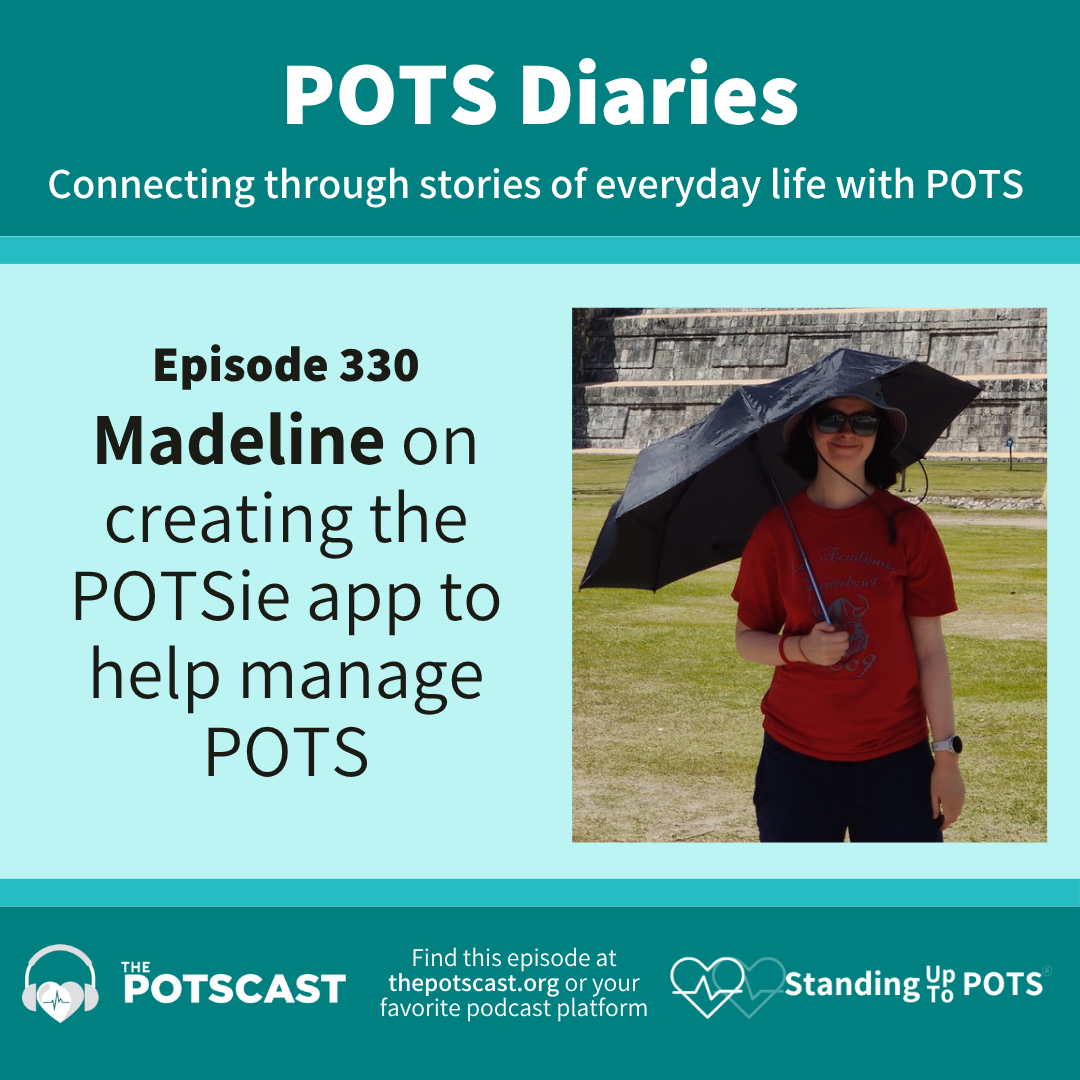
Madeline on creating the POTSie app to help manage POTS
October 04, 2026
In this episode, Madeline shares her experience of living with POTS, from diagnosis to the daily routines that helped her improve over time. She talks about how exhausting it can be to live with a condition that often feels like a full-time job, and how creating simple systems made her POTS more manageable. That experience led her to build POTSie, a mobile app created to help others reduce the mental load of living with POTS and make daily life a little easier.
You can find her app at https://potsie.io/.
Episode Transcript
[00:00:00]
Jill Brook: Hello, fellow POTS patients and beautiful people who care about POTS patients. I'm Jill Brook, your horizontal host, and today we are interviewing Madeline LeClair, who is the founder of POTSie, a mobile app designed to make daily life with POTS easier to manage. After being diagnosed with POTS in 2022, she experienced firsthand how exhausting day-to-day management of a chronic condition can be, and as she worked to improve her symptoms, she built daily routines that reduced the mental load of living with POTS and made the condition less daunting.
And so then drawing both on her lived experience and her background in software, she created POTSie to help others build those same kinds of supportive routines and to make daily POTS management feel simpler. Madeline, thank you for being here today.
Madeline: Thank you for having me, Jill.
Jill Brook: So maybe we can start by just having you tell us a little bit about yourself.
Like where are you? Who are [00:01:00] you? How old are you? What is this background in software?
Madeline: Yeah, not a problem. So where am I? I'm located in New York City in the United States. I'm currently 34 years old, I think, but I try to stop counting eventually. I was diagnosed with POTS back in 2022, and it really changed my entire life and basically how I live my day-to-day. So I wanted to make an app that would help people manage their POTS because it was just such a large portion of my life for so many years, and I felt like the daily tips and tricks that I learned really could be applied to most chronic illnesses, 'cause I have a few others, and so I just find myself repeating the same habits over and over.
So I guess I'll back up a little bit. I think I always had POTS ever since I was a kid, but I didn't actually know what it was. [00:02:00] Every now and then, I would pass out on, like, school field trips, or I passed out in the middle of class once, or, and actually in my first job at Taco Bell. That was a fun day.
There was a very long line. They were very angry. But one of the things that I really loved was, like, walking around the city, and I was an avid hiker. But I would always end up getting, like, nauseous outside, especially when the weather was warm, and I would end up g- like, not being able to walk. I'd have to sit down on the street.
My heart would be, like, beating in my ears. It was very distressing. But I didn't really know, like, you know, what it was. It always happened around lunchtime, so I figured, oh, maybe I should have just eaten lunch. And then after I sat down for a while, it would always go away, and I would go about my day.
Well, fast-forward to 2021, like late 2021. I actually got sent to the ER for another condition which actually presents exactly like [00:03:00] POTS. So what had happened was I was having really terrible heart palpitations 24/7. I was having chest pains. My heart was, like, pounding in my ears. I had a tremor that was just chronically going through my hands and my entire body and I was wired, like, all the time even though I was exhausted.
So I ended up in my endocrinologist, who eventually, like, helped me fix that issue. But the symptoms didn't go away. Like, they they came, like, roaring back like after I was starting to roll off my beta blockers. So my endocrinologist, thankfully she referred me to a cardiologist, and after a very long wait period, 'cause this was COVID, and a couple months of testing, my cardiologist said, "Oh, you have POTS."
Thankfully, she knew what it was, and she recognized the very awkward experience that I was having of, like, almost [00:04:00] passing out in the middle of the night when I was getting up to use the bathroom as basically a drop in my blood pressure due to me getting out of bed. So even though, like, back then I was able to figure out, like, "Hey, this is what I have," I wasn't really ready for what it meant to actually have and live with a chronic illness.
Jill Brook: Yeah, and before we get into that, can I ask you to back up even more and tell us, like, so, so you already were pretty functional though, so you said you had a background in software. Like, what was your life like in addition, what, what did you do besides pass out?
Madeline: Oh, yeah. So I really just like to walk around New York City. I call it frolicking. I would spend, like, hours outside. A lot of, like, in the United States, San Francisco and New York, they're, like, two really big tech hubs. So in software, like, you normally, you move to one of those two coasts, and I really like the hustle and bustle of New York.
For [00:05:00] me, my background, I don't wanna get, like, too technical into software 'cause it does get really confusing even for me. I've been in the industry for about 10 years. I don't do a lot of mobile development. POTSie's actually my first mobile app. But everything's, like, a very similar flavor to each other.
Like, mobile and web are very similar. And it's all like reading a book. So I just basically wanted to use my skills to make something that would help others, and selfishly myself, like, manage my own POTS. I use my app almost daily still, even though I've been working on it, I think, for about three years.
Jill Brook: Yeah, I know that you have said that POTS can feel like a full-time job that has to be managed. Can you talk about that?
Madeline: Yeah. So I really equate, like, managing my POTS, especially when your symptoms are bad, to what it feels like at the end of a really hard work day. So we all know that POTS comes with, like, those, like, symptoms, [00:06:00] brain fog, for some heart palpitations, trouble standing up. So your body's in that, like, fight or flight mode, and it's really physically exhausting.
But on top of that, there's also the mental load. Like, for me, when I was diagnosed with POTS, I didn't know if my life would return to normal, like, back to what it used to be because, like, six months before, I was literally walking around Iceland staring at an active volcano. And then when I got POTS, I had to spend Christmas literally lying on the floor because I couldn't make myself dinner.
So it's like that mental load is really terrifying as well, and they kind of feed into each other. So when you're already so stressed out and you're already physically exhausted, even having to do simple things. Like my doctor told me probably what I assume to be the common spiel of, "Drink water, increase your sodium intake, [00:07:00] exercise, wear compression garments," and then she gave me a beta blocker, so, "Take your beta blocker."
Even those simple tasks can feel really daunting. There were days where I didn't even wanna, like, shower 'cause I was like, "Oh, is this going to make me nauseous? Like, am I going to be able to get up to use the bathroom, or am I going to have to run back to bed and flop on my bed before I, like, pass out on the floor?"
So with POTS, like, just those little extra things that you have to do, it's very mentally draining. And then all of the micro decisions that come with basically the illness, it's something that we don't talk about a lot. Like, if you're going outside, "Oh, do I have my water? If I get sick, where can I sit down?"
Like, do I just sit on the sidewalk? Which I don't know about anyone listening, but if you've ever been to New York, the New York City sidewalk is absolutely disgusting. Do not sit on it. There's gum [00:08:00] everywhere. So, like, just trying to figure out those little things. It's like, it's very draining, and literally that's why I think it's like a full-time job.
It's like something you have to do, but people who don't have POTS or other chronic illnesses, they don't have to do it, so they don't always understand.
Jill Brook: Right. Right. Yeah, and it sounds like you became a fan of routines, which is something that I, I used to be a nutritionist, and it was funny because back then I really would push the idea of routines on people just who needed to change their eating habits, because it takes all the thinking out of it, and it takes the emotion out of it, and it takes the willpower out of it, and it just gets it on autopilot.
And I think it was really smart that you figured out that routines were, were key. How did you, how did you discover that?
Madeline: Yeah. So I discovered routines because of two main reasons. Number one, [00:09:00] I needed to increase my water intake 'cause I did not drink 64 ounces of water a day. And number two was for exercise. So they were two very drastically different routines, but I noticed that, oh, hey, this is actually quite helpful to me.
So for water, before I got POTS, I actually used to drink probably about 32 ounces of water a day, and then one to two cups of coffee, which then got scrubbed out when I got really bad POTS. So what I ended up doing in order to up my water intake is I would set deadlines for myself. So I said by 1:00 PM I had to drink the first 32 ounces of water, and I normally did the first, even the first 16 within 40 minutes of waking up.
And then by 6:00 PM I had to do my second 32 ounces, so that way I would always hit my 64 ounces by the end of my [00:10:00] workday, and then anything else was just kinda like extra icing on top. The other thing that I did was I took my water bottle or my cup, whatever it is I was using, and then I always had it on my desk right next to my computer monitor, because we software engineers, we don't really get up from our desks a lot.
We're just here typing all day. So this way I would always see it, and when I needed a break from work, it was right in that line of sight that my eye would go to when I went to grab, like, something to fidget with. And so in this way, I really helped get my water intake up, and it was pretty easy for me to remember.
Because I had those, like, deadlines in my head, it was super helpful, and it made me much more consistent. The other routine that I really thought was helpful was exercise. I know a lot of doctors tell their patients to exercise, and it can be really difficult, especially if you never exercised [00:11:00] before.
I never went to the gym, and I wanna say when I say I never went to the gym, I, like, never, ever, ever went to the gym. I had, like, no muscle. I, I didn't even know how to use a treadmill. So when my doctor eventually gave me, she gave me the Children's Hospital Philadelphia protocol, when she gave me that, I was trying to figure out, like, how do I incorporate this every day?
So I had to find a time that worked for me, and then every day that the protocol told me to go, I would go to the gym, but always at the same time. That way I knew, like, okay, it's 9:00 PM. I, I don't know why, but I'm a nightly exerciser. It's 9:00 PM. I've had my dinner two hours ago, so I know I'm not going to have that, like, lightheadedness that I would get at times from the rush of dinner, and then I was also well-hydrated 'cause it was the end of my day, and I was extra salted because I would just be eating handfuls of [00:12:00] salt at dinner.
So those two routines really helped me stay consistent over honestly like a two-year period. And then my doctor had told me, "Give your exercise about five months before you start seeing improvements." So I think without that consistency every day between the water, the salt, and even taking my beta blockers, I try to take them at the same time each day, without that consistency, I don't think my recovery would have been, like, as quick.
Jill Brook: Yeah, and then I think the other advantage of doing it that way, in the same way, at the same time, in the same place, in the same order every day, is that it becomes so automatic that you barely think about it, right? It's kinda like putting your underwear on. It's, it's not like an ordeal. You don't think about it, you just do it.
Madeline: Yeah, that's a really great point. So that was the other thing I loved about routines is 'cause it reduced the mental burden that I had to basically think about every day for managing my POTS. Because even if I [00:13:00] was in the middle of a flare, even if I was, like, not at home, I knew that like, oh, okay, it's 1:00, did I drink my first 32 ounces today? And then the answer hopefully would've been yes. Sometimes life does get in the way, but it made it just so much easier to stay consistent, and then also feel like I was returning back to my old life because I didn't have to chronically think about my illness or make those little micro decisions that really would drain me.
Jill Brook: Yeah. Yeah. Okay, so how did this turn into an app?
Madeline: So it turned into an app because as many software engineers do, we're quite lazy. We want to reduce the amount of work we have to do to almost nothing. And I still found myself, even with, like, these routines, even trying to do it on a daily basis, I still found myself having to do work to manage my POTS.
So there was two things that I actually kept notice popping up. [00:14:00] The first one was that when work would get really busy, I would forget how much water I had drunk because I personally would always use glasses. I don't know why. I would just use jelly jars. But I would just forget. I'd be like, "Did I drink one cup already, or did I have my third?"
And so I wanted a way to better track my water, and then also I like to see numbers go up. So I was like, "Okay, this will give me a little bit of joy." The second thing was at the gym, every day I had to download the same PDF from Google, and I suppose I could have just gone into my phone and found the already downloaded file.
But honestly, back then, I didn't know how to do that. I'm just not that tech savvy sometimes. I can write it, but sometimes I cannot use it. And so I got so annoyed having to go find this PDF and then find the month of the exercise program I was on, and I knew that there were other exercise trackers out there, but there was [00:15:00] nothing designed for the Children's Hospital of Philadelphia protocol. For anyone who's not familiar with it, it's literally like an eight-month protocol, and for the first month or two, almost, like, every day is different. And then, like, even when you get into month three, there's like, you do like slight differences each week.
So there was no way I was gonna get that in an exercise tracker, but I really wanted something just to tell me, "This is what you've done today. This is what you're doing. Now go do it." That way I could further reduce that mental load. So I had looked around online. I saw that there were a lot of, like, daily health trackers, but when you're in the middle of a flare, you don't wanna have to think about how do you use an app.
So when I started to make POTSie, like, those were my first two features. It was water, salt, sodium, and then exercise tracking. And I wanted to make it so simple for people to use [00:16:00] that even if they were in the middle of their worst flare, they could still be reminded of what they needed to do, and that way it would help them do what they needed to do.
Jill Brook: That's great. Do you wanna describe the app a little bit more? Like kinda exactly what it does and how it works.
Madeline: Yeah, so what the app is, it's essentially you can download it from either Google Play or the Apple App Store. And it's just a very basic, it's like a basic tracking app. It will help you keep track of your water and your sodium and then your exercise. If you have any symptoms, people will log their symptoms and what they think are the triggers so that they can save that information and then send it to their doctors.
A lot of people also like to track their medicine in it, which I recently added, along with blood pressure. So they like to send the information to their doctors. Some people just like to see the numbers go up. For me, I'm, like, using that exercise tracker [00:17:00] every day. I try to keep the design, like, really clean and simple so you don't have to think about, like, what section do I need?
Everything's just laid out on the home screen for you. And then I'm always adding to the app. So it's it's a solo design project that I made. It's free to use, and then when people reach out to me, 'cause sometimes people send me emails like, "Oh, can you add this? Can you change this?" I always try to incorporate it where I can, so it's really a community-driven app, and it helps people the most.
My main goal for the app is that when people are sick, they use it, but then when they start to feel better, they eventually, like, taper off of the app. And so it always makes me happy when people email me and they're like, "Oh, this helped me improve my POTS," and then I find out they don't use the app anymore.
I'm like, "Yes, I helped another one."
Jill Brook: They got it on autopilot, so they don't need the reminder anymore.
Madeline: Yes, exactly.
Jill Brook: Oh, that's great. Okay. And so you said the, it's, it's free for people to use?[00:18:00]
Madeline: Yeah, so it's a free app. There are some, like, premium features that you can download, but I really wanted to strike a good balance between, like, free features and then paid features to help me keep up with, like, the servers and all of the annoying things that you have to do when you run an app like this. The main optional features right now are for people who want to, like, track their water. You can add basically your own default amounts to the home screen, and then there's optional features for essentially, like, daily notes. And then you can also do daily logging of triggers.
So a lot of people, when they use the app, they want to see like, "Oh, what do I think my trigger is?" So I have, like, some pretty common triggers in there. Like, oh, I stood up, I had caffeine. There's heat. But also for anything that's, like, very specific to you, like I took a shower that was way too hot or another one is just like, oh, I don't know, I [00:19:00] walked up a hill for too long, something like that.
Anything that's just, like, really specific to you that doesn't apply to everyone, you can add them.
Jill Brook: And then am I remembering correctly that there's also an option to, like, create a three-month or a six-month history, like a report
Madeline: Yeah, so you can also export your results to your doctor. So there's two ways you can show your doctor your results. So if you want to export everything, it is a premium feature, you can export, like, all three and six months and just send it to them in a CSV file. But when you're in the office, the other way that if you don't wanna upgrade, is that you can always just go back and show them, like, week by week what happened, because I know a lot of doctors, they sometimes don't always want, like, all the data.
They just wanna see, like, "Oh, how have you been feeling in, like, the last couple of weeks?" And so that option is always available to everyone, and [00:20:00] so you can show, like, all of your history just to your doctor that way.
Jill Brook: Wonderful. Any more, any more apps that you're thinking of making after this one, now that you've gotten used to making these tools for yourself and others?
Madeline: So apps not yet, but there's actually a couple things that I am working on currently to add to this app. So for POTSie, people often ask for heart rate tracking and watch integration, and that one I just, I just got an old watch from a friend, so I will be adding this for different watches like Garmin, the Apple, I think like the, the Apple Watch so that people can track things like their heart rate and easily monitor other things that affect your POTS like your sleep.
And then the other thing that people have asked for a lot is the ability to add custom exercises to the app, because it really is convenient to see basically like your water and how you've been feeling, and then have your exercises in one place. So that one is something that I've been trying to figure out how to [00:21:00] architect and design to make it as simple as possible, and so I'm hoping that I'll be able to get started on it either this month or next month and release it soon to the general public.
Jill Brook: How exciting. So have you personally sort of been able to feel like you're back to a somewhat more normal life now that you have exercise and salt and hydration on autopilot?
Madeline: Yeah, so I actually, I do feel like my life has returned to I think, I would say about 80% normal. So I'm pretty happy with that number. I'm no longer apartment bound, which I was very happy with. The other thing is that, like, I can kind of go out and do more activities. Like, I really like to swing dance, so I can now swing dance.
Jill Brook: Oh, yay.
Madeline: Yeah, it's really fun. For anyone who's looking for a hobby, I highly recommend it. I also like to travel a lot, so I've been able to travel with my partner again, even flights that, like, used to scare me 'cause I was always worried I would get [00:22:00] sick. My POTS does flare up, though. Even with these routines, it still flares.
Recently I got both the flu and something else, and so whenever I get sick, like, in some way, it always flares up pretty heavily, and then it takes, like, a little bit of time to calm down. But when that happens, I always return back to my routines. I always know, like, okay, within a week or two after getting better, now I need to start going back to the gym.
Now I need to start using my app again. And I find actually when I'm either traveling or when I'm just, like, not feeling well at all, that's always when I go back to using POTSie the most. 'Cause even though I've had it for three years, even before others had it, I always end up returning back to it just to make sure that I'm on track with my routines.
And so though I found that, like, always returning to the routines when I'm not feeling well really helps speed up the recovery for me.
Jill Brook: Oh, that's great. That's wonderful. Okay, so we have to ask [00:23:00] now so what's your favorite way to get salt?
Madeline: Oh, I just eat the salt. Like, none of you can see this because it's just voice, but I've got this thing called a salt pig. It's literally just a giant container of salt, and I just, like, sprinkle it on everything.
Jill Brook: And what's your favorite way to hydrate?
Madeline: I, I'm boring. I just water bottle. Actually, there is this place in New York, they sell, like, little 10-ounce water bottles. So I always have that with me when I'm on the go. It changed my life because I was always getting thirsty on the go. So I'm just always carrying a water bottle around with me, especially in the city.
Jill Brook: And have you stuck with the CHOP protocol or have you sort of graduated to different exercises that you like better now?
Madeline: So I still stick with the CHOP protocol, but I have started incorporating more weight training because I also have back issues, and I was told you need to start strengthening your back. But I'm always returning to the cardio days, so that's [00:24:00] also why I selfishly want custom exercises. Also received emails that people, they want their custom exercises too for the app, but I also, like, I desperately want custom exercises and so I can, like, incorporate the CHOP and the weight training into it, and that way just have everything there
Jill Brook: Wonderful. Well, what a productive way to make your experience help yourself and help others. That's really lovely that you did that. Do you have any sort of, I don't know, final thoughts for people, what you hope they take away from the app?
Madeline: So my final thoughts for anyone out there listening is that routines are really helpful. For a long time, I was really sad about my POTS until I really started getting into the flow of my routines, and it really started to reduce that mental load, and it helped me personally feel better. So if you're feeling stuck, you're feeling overwhelmed, try just finding, like, one thing a day that you can do [00:25:00] to just help your POTS. And we're not all perfect.
We all make mistakes. Some days you may stick with it, some days you won't, but for me, over the long run, it really helped, and I hope it helps others. I hope POTSie really does help others.
Jill Brook: Wonderful. Well, Madeline, thank you so much for sharing your story and your creation with us. We'll put the link in the show notes. It's potsie.io or I'm guessing you can also just search for the POTSie app on your phone, yeah?
Madeline: Yep.
Jill Brook: But the link will be in the show notes to make it extra handy. And yeah, just thanks a million and all the best.
Madeline: Awesome. Thanks, Jill.
Jill Brook: Okay, listeners, that's all for today.
We'll be back again next week, but until then, thank you for listening. Remember you're not alone, and please join us again soon.