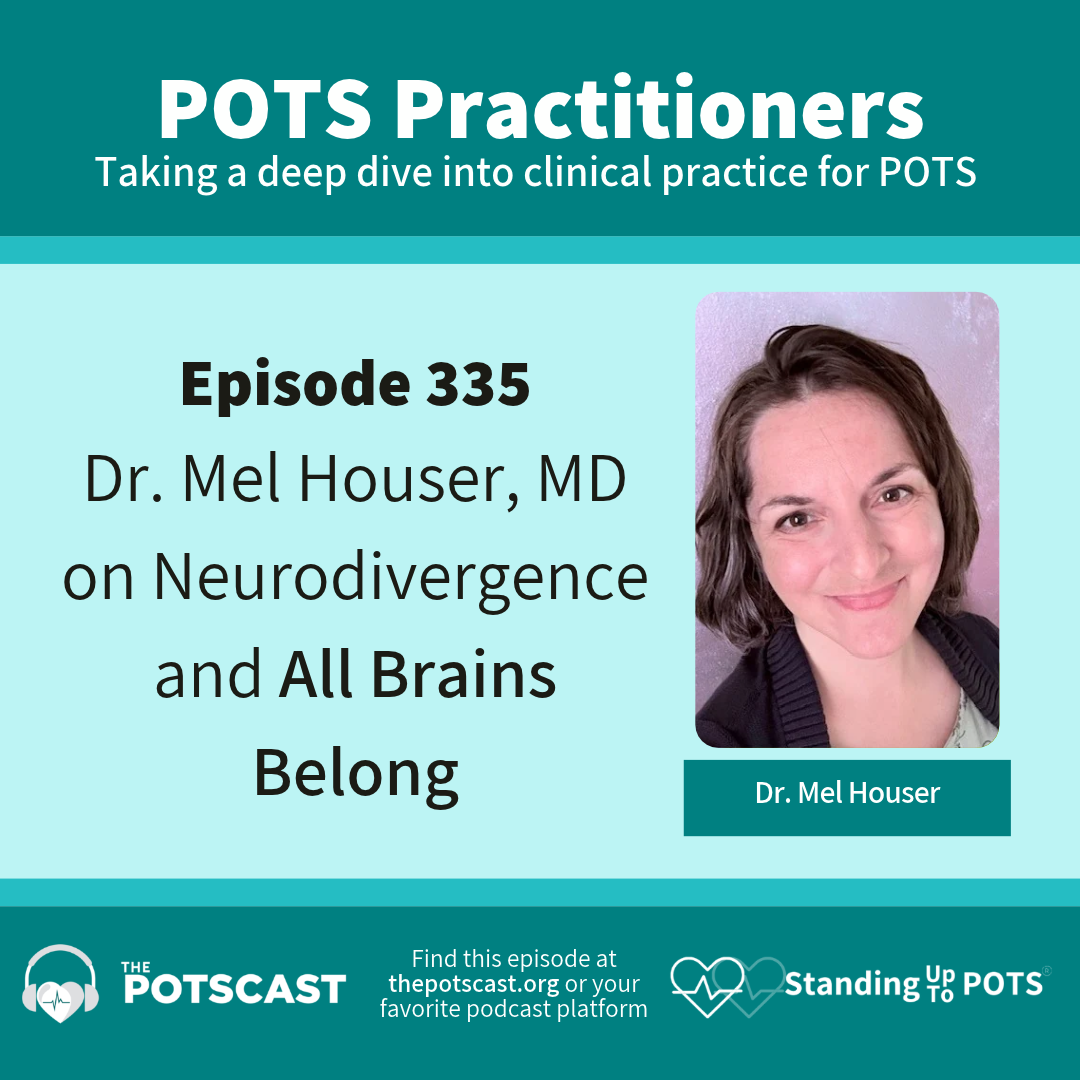
Mel Houser, MD on neurodivergence and All Brains Belong
November 08, 2026
Mel Houser, MD, is a board-certified family physician and the founder and Executive Director of All Brains Belong VT, a nonprofit community health organization pioneering neurodiversity-affirming healthcare.
In this episode, Dr. Houser discusses what healthcare can look like when it is designed for different brains and bodies rather than expecting every patient to communicate, process information, and participate in the same way.
We explore the overlap between neurodivergence and complex chronic illness, including conditions such as POTS, MCAS, ME/CFS, Long COVID, chronic pain, and migraine, and why treating these conditions as interconnected rather than isolated can lead to more effective care.
Dr. Houser also shares practical ways clinicians and healthcare systems can better accommodate neurodivergent patients and explains why belonging and community are important parts of health. We discuss All Brains Belong’s free virtual Brain Club® as well as the organization’s free resources for clinicians, patients, families, employers, and community organizations.
Learn more and explore resources at All Brains Belong.
Other mentioned resources and links:
- Dr. Houser's book coming out in October, 2026: A Failure of Imagination: How the Healthcare System Fails Neurodivergent Patients--And What We're Doing Instead: https://allbrainsbelong.org/book
- Everything is Connected to Everything: Improving the Healthcare of Autistic & ADHD Adults
- Autistic & ADHD Healthcare Clinician Guide
- Brain Club®
- Universal Design for Healthcare, Employment & Community Events
Episode Transcript
[00:00:00]
Jill Brook: Hello, fellow POTS patients and beautiful people who care about POTS patients. I'm Jill Brook, your horizontal host, and our guest today is Dr. Mel Houser, a board-certified family physician and founder and executive director of All Brains Belong Vermont, a nonprofit community health organization pioneering neurodiversity-affirming healthcare.
Dr. Houser's work focuses on helping neurodivergent people, many with chronic health conditions such as POTS and associated conditions, receive care that actually works for their brains and their bodies. Dr. Houser, thank you so much for being here today.
Dr. Mel Houser: Thank you so much for having me. It's an honor to be here. I'm a huge fan of the podcast.
Jill Brook: Oh, that's so kind. So maybe for starters, you can just tell us more about your background and how you came to specialize in complex chronic illness and neurodivergence.
Dr. Mel Houser: Definitely. So I'm a family physician. I care for young children through [00:01:00] older adults and probably for the past seven or so years have mostly cared for neurodivergent kids, adults, often multi-generational families. Five years ago in the context of receiving my own autism and ADHD diagnosis I left traditional healthcare to try to do better for this community who often struggles to access healthcare.
That's before I knew anything about complex chronic illness. What we found here when we started this nonprofit practice really co-created with our community based on what patients here in Vermont were looking for and what we're unable to find in, in, in other settings, we found that who came to the practice were not only neurodivergent, but had, you know, far higher rates of complex chronic illness, including POTS and related conditions.
And in fact here we are five years later and more than 87% of our practice are folks with POTS, MCAS, ME/CFS, long COVID, et cetera.
Jill Brook: So do you think that that means that there is a link? [00:02:00] Like, that is something that doesn't get talked about, I don't think, in the mainstream POTS literature at all. But can you talk about like, like how much are those connected, and what's connected to what?
Dr. Mel Houser: Yeah, definitely. So there's literature linking each of, you know, we'll call this the constellation of intertwined medical problems that I'm sure your listeners are well acquainted with. But there's literature linking each of these things to, as more common in folks you know, both autistic people and ADHD folks.
And of course, these conditions are also linked to each other. And so you're absolutely right, the way that this gets siloed. You know, clinicians who care for autistic and ADHD people, for example, they may know that there are some medical conditions they see a lot. They may not know what to, like, how to manage them, but they may know, "Oh, yeah, yeah, yeah, I've, I've, I've seen that," or, "I've heard that."
And I think that, you know, if you speak with clinicians who are mostly caring for POTS and related [00:03:00] conditions they will probably acknowledge that they have a lot of neurodivergent people in their panel. They are not, you know, the same. Not every person with POTS is autistic or ADHD by any means, but these conditions are more common in autistic and ADHD people.
Jill Brook: Can I ask a question that might be silly? I guess, what exactly does it mean to be neurodivergent, and how do I know if I am?
Dr. Mel Houser: I love the, I love the question. So neurodivergent refers to the at least one in five people whose brains learn, think, or communicate differently than the, quote, "so-called typical brain." There is actually no such thing as a typical brain. We're really talking about brains that diverge from neuronormativity, which is the one mainstream lane that society most often caters to.
So for example when we think about you know, some of the main buckets of society, like healthcare, there's a lotta one-size-fits-all. You must pick up the phone to make an appointment. You must fill out [00:04:00] the 20-page packet to become a new patient, like all of those things. And in schools and in workplaces and even in social relationships, there's often like this is the main lane, and if you can't fit into that box, you may really struggle.
So some people have certain diagnoses. You know, we've mentioned autism and ADHD, but dyslexia, dyspraxia, traumatic brain injury, bipolar disorder, like all, all the, all the, all the things. But many people don't have diagnoses, and they may just be struggling if their access needs, meaning what they need for full and meaningful participation, if those things are not met by their environments and their routines and the people in their lives.
And so, I guess the, the point is not to, you know, invite, you know, we're not looking for like deficits or things wrong with, with brains. It's really just, yeah, my brain works differently, and there are some things that are really hard, and there are some real strengths that come from having a brain that works differently and approaches problems differently, et cetera.
Jill Brook: [00:05:00] Yeah. So it sounds like you decided to leave sort of the McMedicine one size fits all, and try to be a better fit for these patients. And so, like, what kinds of things do you do differently in your world now for, for your patients?
Dr. Mel Houser: Definitely. So we use something called universal design, and that means offering everything we do in multiple flexible different ways. So every patient, regardless of their diagnosis or whether they disclose any kind of disability, everybody gets a menu. You get to pick from your setting you know, indoor, outdoor, in your car.
You can choose your seating, your lighting, your temperature, a range of communication, sensory and executive functioning supports, and these things are all just offered to everyone, and most of the people that we serve have never been asked what they need to feel comfortable in healthcare. And so a lot of these, it's like, "What do you mean I get to pick these things? What do you mean?" And it's an opportunity to, like, try [00:06:00] stuff. Like, you know, I didn't know that it would actually be helpful to have a written agenda prepared for me for my appointment. I didn't know that would be helpful, but now that I've tried it, yeah, I want that every time.
Jill Brook: Wow. So who writes this agenda? This sounds like a cool idea.
Dr. Mel Houser: Right? You know how it is. You know, all of a sudden there's like five minutes left in the visit, and you now realize your visit's over, and people have that experience in healthcare all the time, especially if they're trying to fit into the 15-minute visit. The other thing that's different about our practice is that when you think about how it's not just healthcare, it's everything, right?
So it might be difficulty making friends. It might be difficulty, you know, accessing school or work. Like, we're really trying to wrap around people to provide more holistic support for all these things that are, you know, they're not medical care, but they are certainly part of health. We also have a community-based model, so patients, when they come here, they're coming because they're looking to meet other patients.
So in addition to medical care folks have opportunity to participate in community groups and, [00:07:00] you know, free community programs where they have the opportunity to meet other people who are going through similar things. And as it relates to POTS and related conditions, which the majority of our patients suffer from, they think they're the only ones.
They're the only ones suffering in this way. No one else feels this way. They feel broken. What's wrong with me? Why does my body not work? Why do I have 40,000 things wrong with me? It's like, well, you actually don't. You have one thing. It's your neuroimmune system that is responding to threats in your environment.
You know, maybe, maybe you've been dealing with this for, for a long time. Maybe this is new since you got COVID or got COVID again. But these are folks who are at various stages of identity formation and identity adjustment in coping with complex chronic issues. And I think that when you hear your own experiences reflected back to you through the stories of other people, that's so health promoting.
You feel less alone. You realize you're not broken. It's these systems that are thwarting you. It's [00:08:00] not you, it's the system.
Jill Brook: Wow, that sounds amazing. And especially because you hear about how loneliness is, you know, supposed to be more unhealthy than smoking nowadays. Sounds incredible to have a place where you can meet other people who have similar situations. You have on your website a quote, I think it might be from your daughter "There's no wrong way to be a person."
Dr. Mel Houser: Yeah, when my, when, when my son was five they concluded, you know, in hearing back, like, what they thought I did for a living, I'm not sure what they thought I did for a living, but like, "Yeah, there's no right way it would be a person." Like, yes, my sweet little love. Yeah.
Jill Brook: Yeah. That, that sounds like just such an amazing thing. So can you talk more about All Brains Belong, the nonprofit? Like, is this something that people can become part of or learn from or...?
Dr. Mel Houser: Yeah, definitely. So, besides medical care, we have all kinds of community and education [00:09:00] programs that are open to anyone, and they're free. So you can visit our website allbrainsbelong.org and, and check out what we have. So for example, we have a weekly program called Brain Club most Tuesday nights at 6:00 Eastern where we have community panels sharing lived expertise on various topics of everyday brain life.
And so complex chronic illness is discussed regularly at Brain Club, and so there's a lot of folks with POTS and related conditions who are talking about their experiences. We have a whole bunch of educational tools, including a couple of years ago we had a multidisciplinary clinician work group working with more than 100 autistic and ADHD people with POTS and related conditions, and really looking, diving deep into the literature on not only what the best practices are, like people can access that, that's fine, that's in the literature, but what are the unique experiences of this patient population that might be different from the population [00:10:00] studied in the literature?
So what we see in our patients is, like, certainly they're not like quote contraindications, but we see more common patterns of side effects that maybe other people don't experience. And so, you know, for the, remember the ninth time we had a patient who was started on a serotonin norepinephrine reuptake inhibitor end up in the ER with a POTS flare, we took note of that.
Like, what is that? Well, I think this population is responding to norepinephrine differently than other people. That's so interesting. That's not something that I had any training in. That's so interesting. And there's, you know, a million examples of that, you know, whether that be, you know, folks who have unrecognized connective tissue disorders who didn't know about that, and maybe they got started on a muscle relaxant for chronic pain, and now all their floppy connective tissue got floppier 'cause they actually have EDS, and they didn't know, and their doctor didn't know, [00:11:00] and now their floppy connective tissue in their airway got worse where their unrecognized sleep apnea got worse, which now made their dysautonomia worse, which made their pain worse, and like this is, this is what goes on here.
It's these internal conflicting needs. And so, we put together a free educational guide for patients and primary care clinicians to work through these problems together of like what, what are the known treatment strategies that make my salient symptoms better without making the rest of my constellation of intertwined medical problems worse?
And so that's what the guide's about, and you can check it out on the website.
Jill Brook: Oh, that is huge. And we will put a link to that in the show notes. So that's that's the allbrainsbelong.org/all-the-things, and that's with hyphens, all hyphen the hyphen things.
Dr. Mel Houser: Yes. Yeah, and, and within that there's then a page for community members, families, and a page for clinicians. So it's allbrainsbelong.org/clinician-resources. I know you have a lot of clinicians who listen to your podcast. So go, [00:12:00] go right to the clinician-resources, and there's a free 16-page evidence-based management guide.
Jill Brook: Oh, that's huge. Yeah, because some physicians might feel a bit overwhelmed by what you're talking about. Like, wow, that sounds like a lot to deal with.
Dr. Mel Houser: Right. Like the guide is written as a, like, kind of like a primer for primary care. Like, you know, there are people who don't have access to specialists who know about these conditions. So it's a conversation tool for patients to work directly with the primary care clinicians that they, they, maybe they even have really good relationships, long-term relationships with, but they just don't know.
They just don't know about POTS and related conditions.
Jill Brook: Oh, fantastic. So, so basically is your recommendation that patients could print this out, bring it to their care provider.
Dr. Mel Houser: I will actually give a little bit of a caveat. I would not print out the 16-page guide. What I would print out, there is a one-page letter that introduces the project to their [00:13:00] primary care clinician, and it just, like it respects the clinician's autonomy, and patient prints that one page out, walks in to an appointment, like I wouldn't send it between appointments.
People don't have time in the, you know, 15-minute visits, and not being able to eat lunch or pee or get home to your family. Bring it to an appointment and say, "Hey, I learned about this project. I think it might apply to me. Can we look at this together during my appointment?" We've gotten feedback, you know, from all comers on social media like, "Hey, I did that thing, and that was actually really helpful, and I had a really helpful appointment that day."
Jill Brook: Oh, that's a great idea. That's a great idea. So I guess one thing that I know that you have said before is that everything is connected to everything, and I was wondering if you could talk about that more.
Dr. Mel Houser: Definitely. So that statement could apply to so many different things, right? So it might be that health is more than healthcare, so your [00:14:00] experiences in community, at workplaces, in schools, coping with your identity transformation of becoming someone with a complex chronic illness. Like, all of this is related to your health, like in bidirectional relationships, right?
So, there's that. There's also, of course, like what we've just talked about in terms of the constellation of intertwined medical problems, in terms of, you know, a lot of times in primary care, someone will come in, and they know, they know in their bodies that their racing heart is connected to their brain fog, and is connected to their digestive symptoms, and connected to their pain, and their headaches, and all the things.
Like, they know that, but they'll come in, and they'll say, "Hey, could these things be related?" And, you know, I think medical education honestly, like, socializes this very harmful practice, which is to say, "No, that's not related. Like, I know as an expert that that's not related," whereas the patient is the expert.
So, like, we're not trying to evaluate whether or not what someone says is [00:15:00] true. We assume it's true because they said it, and they're the expert in their own body, so we just believe them. And I think that that's also really important for healthcare.
Jill Brook: Yeah. So I, I know that right now there's gonna be listeners who are like, "Oh my gosh, I want somebody like this as my physician." And I know that there's only one of you, and you're in Vermont. And I guess do you have any tips for patients who do feel like they're so complex and they're neurodivergent, and their brain doesn't work like normal people's brains, but they do have to, at least until they find their unicorn doctor, they have to keep going to a physician who's in the normal system with normal insurance coverage.
They only have their however many few minutes. Do you have any tips for them to kind of like do their best that they can under those circumstances?
Dr. Mel Houser: Definitely. So you can come to our website and you can access [00:16:00] all, all the things that everyone here has access to, and you can ask for them, right? So if you, for example we have a new project coming out at the end of the month. It's a universal design toolkit, universal design for healthcare, universal design for workplaces, universal design for community gatherings.
So you could go to, say, the universal design for healthcare toolkit. It's free. It's all free. Everything we do is free. And you can look and say, "Huh, I would never have thought to ask for," like in the example we gave earlier of the written agenda. You know, "Hey, Doctor So-and-So at my appointment today, can, can we actually write out how we're gonna spend the next 15 minutes together? That would really help me."
Or, hey, maybe I call ahead of time and I say, "Hey, do you think that you could ask Dr. So-and-So, you know, what information they might be gathering today? I'd like to think about that in advance," right, for some more processing time. So you can get some ideas from the menu of what you might ask for.
And, and also if picking up the phone and talking to the front desk is not accessible, it's [00:17:00] not accessible for me, so I, I get that. So maybe it's even that you come to your appointment and you ask for something next time. "Next time I come," I'm at the appointment already, I don't have to call. I'm there.
"Hey, next time, what do you think you might wanna know about that I can keep track of so that I can show up here?" So there's that. There's of course the printing out the letter and introducing the Everything's Connected to Everything project to your primary care clinician. There's, you know, just sharing resources even.
So, you know, we do, you know, not only Brain Club, and by the way, you can access the past five years' worth of Brain Club episodes. They're all recorded, so you can search by topic and find something relevant to you. But if you find a Brain Club about, about healthcare, for example, and you know, when you go see your primary care clinician, "Hey, there's this program. You know, I really think you'd be interested in this episode where there's patients who have medical conditions like mine talking about what it's like," and passing along that link. Or, you know, any, any other project that you find on our, on our website, just sort of spreading the word. 'Cause we, we have a lot of clinicians who, you know, yes, they [00:18:00] might formally be bringing us in to do trainings for their medical practice but they're also just checking out free resources. And we hear from clinicians all the time, "Hey, a patient sent your stuff to me, and I thought it was really interesting. Thanks so much."
Jill Brook: Oh, cool. Okay. So people can go, go to your website and they can, they can start actually joining these things.
Dr. Mel Houser: They can come on Tuesday nights, and so it's just, like, a great way to meet other people who are going through similar things. And once a month, we do something about healthcare, and once a month we do something about employment and, and so you sort of get a rhythm of things. So on the, the healthcare week, you're pretty much always gonna find somebody with POTS and related conditions.
Like, that's what, that, that's who comes to Brain Club those weeks. And so, yeah. But you look around and, and just hearing people share their stories and you're like, "Ah, I never had language to describe what I'm going through. That is exactly what it feels like."
Jill Brook: Mm-hmm. Oh, that sounds amazing. So it's incredible that you have created this and made it available for people so widely. I'm wondering if we can get back to some of the stuff you said earlier, which I thought was [00:19:00] so fascinating and I haven't heard spoken enough about, which are some of these connections between things like POTS and autism or ADHD.
Can you talk a little bit more about what you're seeing, or, like, where is there evidence and where are you just noticing connections? And is there anything known? I mean, sometimes we hear about how EDS might have some connections to autism, so is that sort of the underlying basis for all these connections, or does anybody know?
Dr. Mel Houser: Yeah. There's a, there's a physician researcher Dr. Jessica Eccles who studies the relationship between hypermobility and neurodivergence, and so has, like, really kind of spelled out the mechanism by which these things get, get related via the neuroimmune systems. And healthcare tells us we have to fragment out the body parts, right? Like, you know, is it, is it my POTS, or is it my mast cells, or is it my this, or is it my autism? Like, I think about this as the neuroimmune system runs [00:20:00] through the whole body and is gonna have different manifestations for different people under different conditions.
I would say that, you know, not only, you know, do autistic and ADHD people have different physiology, have, like, a different neuroimmune system, which is why, you know, let's even take another example, if you look up risk factors for long COVID autistic and ADHD people are on that list.
Most people don't know that they are at increased risk of long COVID until they've gotten long COVID. And that's, that, that's really important. So it's like this vulnerable neuroimmune system that under the right conditions and the sort of the stacking up of assaults against the neuroimmune system, I think that's how we then start seeing you know, the development from, like, subclinical kind of prodromal symptoms that people sort of navigate, and then now I can't function.
And when you think about, you know, if you are a neurodivergent person living in a world that is not designed with you in mind, whether it's [00:21:00] healthcare or your job or, you know, your social relationships, that is going to be really activating your nervous system. And when we think about how the nervous system and the immune system are our, you know, are our initial defenses against threat you are living in a world that is threatening all over the place.
And then, of course, you layer on the complexities of, you know, living at the intersection of all kinds of other aspects of identity that are marginalized and thwarted and harmed. And so all of these, all of these are harmful to your health.
Jill Brook: Yeah. So a lot of people with POTS will have a lot of cognitive symptoms, and they might wonder like, how would I know if I had ADHD versus just my POTS making my brain have issues? How do you know, and is it important to know, or are there different things you would do?
Dr. Mel Houser: So, I'm gonna take that question and work at it backwards. So is it [00:22:00] important to know? For many people, not all people, their neuro type is a part of their identity. There are often clinicians who are like, "Oh, you're an adult. You do, quote, well enough. You don't need to know if this is autism or ADHD or..."
By the way, it's there's a huge overlap of both of those things too. "So you don't need to know that because, you know, you've made it this far." Like, that is profoundly ableist, and, and a harmful thing to say to a patient, in my professional opinion. So someone always has the right to know how their brain works, right?
How would that not be helpful to you to understand your own brain, how you move through the world? But then layering on your question around, like, if I've got brain fog or cognitive symptoms, how do I know it's my ADHD or my POTS? Like, I don't know that you can, right?
And, you know, in, in, in our community it's almost always both. And so when I think about, you know, why is somebody tired, right? Like, the differential for why somebody's tired. So yes, we need to make sure there's [00:23:00] not something metabolic going on, you know, is there a micronutrient deficiency? Is somebody anemic?
Is it their thyroid? Is their blood sugar all over the place? Like, all those things. Do they have an unrecognized sleep disorder? You know, do they have, you know, chronic inflammation from something? You know, do they have ME/CFS? Like, all, all, all these things, but also a lot of times what gets skipped is the cognitive demand, right?
And so whenever demand exceeds capacity, there are going to be symptoms, and if you are living in a body that, you know, doesn't make enough energy or use it appropriately, and, you know, in the case of ME/CFS, for example, and you are living in a body that doesn't tolerate being upright very well and doesn't have good blood flow to your brain, like, all those things are gonna make you feel pretty terrible.
And the idea of, like, discerning, you know, how much of this is my mitochondria versus how much of this is my, my bad blood flow to my brain, like, I don't know that we are [00:24:00] gonna be able to distinguish that. We have to sort of assume that it's, it's the whole cluster, and so sort of screening for the rest of the cluster, much like, you know, if somebody knows they have POTS, but they've never heard of MCAS, like, maybe we should talk about that.
Or maybe somebody knows they have POTS, but they've never heard of ME/CFS, and they actually have it. I think in the Everything's Connected to Everything framework, it's like, all right, if you look at some of the other comprising conditions that belong to this constellation, not everybody has all the things.
But they may have a few more things than the ones they know about, and it's worth sort of talking with their, their medical team of like, "which of these should we be thinking about for me?"
Jill Brook: Right. Right. And you also said something really interesting toward the beginning about how you were noticing that your population maybe has more bad reactions to certain things or it has some similarities. So I, I guess, is there anything else that you have noticed that either you have [00:25:00] been surprised by how often it works in your population or how often it backfires in your population?
Or do you think there's any underused tools that you think are pretty good in this population or, or, I don't know, free associate on any of that?
Dr. Mel Houser: Yeah, no, I love this. I mean, the first thing that comes to mind is, maybe I shouldn't be surprised, but I am surprised at how impactful it is to connect with a community, right? Like, so somebody has, you know, rip-roaring mast cell disease, and POTS, and long COVID, and all the things and they're really isolated.
And connecting with other patients here, yeah, we might also find a, you know, medications or supplements or pacing or any number of strategies that are helpful but I think that the isolation piece is so impactful. And so when we can address that, people still have the [00:26:00] same conditions, and maybe they're even on the same medicines, but their health is different.
They feel different. And that, that is, that is really important. I'd say, you know, some of the other things that, that we think about you know, and certainly looking through the Everything's Connected Everything guide, you'll see some of the, you know, the medicines that we commonly reach for.
But one of the the tools that I find really helpful that is definitely worth, I think, if there are patients listening to have a conversation with their clinicians about guanfacine. So guanfacine is certainly, like, part of the toolbox for, for, you know, management of, let's say for example, hyperadrenergic POTS.
Maybe somebody thinks about guanfacine for that. Or, you know, certainly there's literature base for treatment of long COVID, you know, from an ME/CFS standpoint. Like these things are known, but if someone's not seeing a specialist in these things and they're working with their primary care clinicians, like this is, that's a, that's a primary care medicine.
Likely their primary care clinician, you know, is more, more, I mean, not, you know, not everybody's the [00:27:00] same, but, like, probably gonna have some familiarity and some comfort in using that medicine, and is worth asking about. Because I think that when somebody has a nervous system that reacts to everything and, and, and, and does so in, like, disproportionate ways, and of course your nervous system cross talks to your mast cells.
And so sort of if we can get the nervous system to, we don't want, we don't wanna not have a response to threat. We want the threat to go away. We don't wanna not have a nervous system response, but these big responses are, are probably driving a lot of symptoms, and we've found that medicine to be very helpful, and I think would be, you know, worth talking about with with treatment team.
Jill Brook: Oh, that's a great tip. And is there any area of research or new treatments out there? I don't know. Is there anything, what are you excited about when you...
Dr. Mel Houser: I wanna go back, and I wanna tell you what I'm excited about, 'cause I was gonna tell you what I'm excited about before you even asked me.
I need more processing time, so I need to like, oh, yeah, now I, now the thing from three minutes ago, now I wanna say it. Your episode on excipients was [00:28:00] the best.
We think about excipients here all the time. We spend so much time. And so, I, it was, it was really great to be able to reach out to Jeff Allen after I heard on your podcast, and now I'm like I joined the pilot group for ExciIQ. And, like, we are having the best time with that tool because like, this is really hard, right?
So it's hard for everybody who is having excipient reactions. But I think that for people who also struggle with executive functioning, this can be a nightmare. So the idea of me telling you there's something in your medicine, and we gotta, like, find all these other options, and we gotta, like, look through them, and you gotta call your pharmacy to see if you can get this one because this one doesn't have dye or this one doesn't have sodium lauryl sulfate or, or whatever. People just struggle.
So we're doing a lot of the supports you know, with people to navigate these things because it's just, it's just too hard.
Jill Brook: Oh, that's fantastic, and I'm so thrilled I'm hearing more people talk about excipients lately. I actually [00:29:00] saw a Facebook post by Dr. Zach Spiritos where he was talking about excipients, and I had to laugh because his, his posts are always funny anyways, but he referred to a lot of excipients as schmutz, and I just had to laugh at that I'm so glad that people are kind of more widely getting the word out that those make such a big difference, and it's a little bit sad that there's so many excipients and it's so difficult to know what's in our stuff.
Dr. Mel Houser: Yeah, Totally. And this is not, like, specific to neurodivergent people. I mean, it's really anybody with an immune system that reacts to stuff in disproportionate ways. You know, much like, you know, I, I wouldn't say that the treatments are different at all for neurodivergent people with POTS and related conditions.
I think the, you know, some of the examples I gave you before are, are standard cautions, you know, whether that be the, you know, I gave you the example of SNRIs or, or, or, you know, I think I would just say that it's, it's just that often folks are seeing clinicians that [00:30:00] don't see enough of these patients, and so because this is our population, we tend to see these trends that maybe got diluted in general primary care.
Like, I was prescribing SNRIs there also, but I probably just didn't see the patterns in the way that I do because, you know, most people here have mast cell dysfunction, or most people here have dysautonomia.
Jill Brook: Yeah. So I, I know we have a lot of clinicians who also listen, and I wonder if you have anything you'd say to them about what it's been like to leave the traditional old practice you were in and to kind of start this novel type of thing?
Dr. Mel Houser: Yeah. I mean, and it's interesting, I, I just wrote a book that's gonna come out in, in November. It's called A Failure of Imagination: How the Healthcare System Fails Neurodivergent People and What We're Doing Instead. And the concept is that there are some things in the healthcare system that clinicians just sort of assume like, "Oh, this is how it is. It's healthcare, it's broken. I'm kinda stuck like this." [00:31:00] You're not stuck like this. And you don't need to leave the insurance system. We take insurance. Like, you, you can do all the things and reach the same population, but you can do it your way. And so, the, so the book covers, you know, how do we do healthcare here?
How do we do workplace stuff here? How do we do community gatherings here? And then it also has a toolkit for, you know, what, what can a clinician who maybe wants to start their own practice, how do you do that step by step? Or if you are in a workplace, if you're a workplace leader and you want to change your culture, how much you think about doing that, or starting a nonprofit, or, you know, any number of these things that you can replicate all or part of this.
Jill Brook: That's amazing. I feel like you've thought of everything.
Dr. Mel Houser: I don't know about that, but this is the book that I wish existed five years ago, and it's really like building the plane while flying it, and, you know, it's because so much of this has been co-created with our patients. Like, so much of, of what we do here is, like, specific and local to our community and what our community needed, but there's a lot of things that [00:32:00] generalize and can be replicated in other systems.
Jill Brook: Wow. I mean, so basically it sounds like you just embraced a lot of complexity. So you have complex patients with complex interrelated conditions, and you decided to make your own kind of practice that is a more complex thing to do than to do the plain old McMedicine.
Dr. Mel Houser: Definitely, and the, you know, our model today is not at all the model we started with. So, you know, we knew we wanted, you know, we wanted to do things besides healthcare, and we knew we had to think about, you know, helping people make friends, et cetera, and address the loneliness piece.
We knew about that. But we didn't know, we didn't know anything about POTS and related conditions, and I didn't have those conditions then. So six weeks after starting All Brains Belong, I slipped on the ice and landed on my head and got a traumatic brain injury. Can you imagine this? I just, like, quit my job in, in traditional [00:33:00] primary care, and I was working as a volunteer doctor doing all the things, and then this happened.
And that is what kicked off, I probably had POTS since puberty but like, you know, and maybe got worse during pregnancy, but, like, mostly was doing okay, and then not okay. Not okay at all. And I have ME/CFS now, and then I got COVID, and you know, now I have long COVID. So part of this really immersion in this constellation of intertwined medical problems was, like, I got these problems.
So like, part of it was really trying to figure out how to, how to deal with this. Like, I am also a patient. And so, you know, being part of the community myself with other people navigating similar things, it really has helped flatten the hierarchy. Like, I'm learning together with my patients, and that has been really special and I think really impactful, and has resulted in a different type of healthcare than would've been possible otherwise. [00:34:00] So you, so, so you started saying you're, you're you're our horizontal host. I'm your horizontal guest.
Jill Brook: But isn't that amazing? I mean, I, I'm so just grateful that people like you are not only fixing it for yourself, but for everybody around them, and that's what's eventually gonna make things better for everyone in this community. And wow, you're just doing so much. So okay, I feel like we just need to summarize because we've covered so many things that you have available for people and that they can participate in or learn from, and stuff for patients and practitioners alike. So I know we need to let you get going, but, but people can go to your website...
Dr. Mel Houser: Yes. You can go to allbrainsbelong.org, and maybe we can link some things in the show notes. We can link the Everything's Connected to Everything project, we can link Brain Club, and we can link the book at allbrainsbelong.org/book
Jill Brook: And it sounds like you're just freely [00:35:00] giving away all of your knowledge and everything you've learned, and so that if other people are interested in kind of changing their practices to be more accommodating to neurodivergent people, they can basically look at the roadmap that you've set up and and start implementing things as soon as they like.
Dr. Mel Houser: Exactly. Because to think that healthcare has to stay the way that it is is a failure of imagination, and that's why we, that's why we called the book that.
Jill Brook: So maybe just to end on, I guess, what would you say to all the patients out there who just feel like they're too complicated and they're just too much for everybody?
Dr. Mel Houser: Yeah, I mean, that's almost everybody here says that when, you know, every time I see a new patient, that's exactly what they say. And it's like, you're not alone. You're not alone. You're not broken. This is the system thwarting you. You're not too much, and you have value. And so [00:36:00] even when your health conditions interfere with neuronormative standards, you know, of productivity or whatever, those are broken systems.
You have value just by being a human being, and I think that connecting with other people who get it, that is what's gonna allow you to shift your sense for safe, not safe. And you can obviously it's a huge privilege to be able to opt out of unsafe environments or harmful environments, and a lot of people don't even know that it's the environment that's harming them, and they just think it always has to be this way, and it's their fault. And that's just not true.
Jill Brook: Oh, Dr. Houser, this is amazing, amazing stuff. Thank you for everything you've created, and gosh, I'm sorry that you had your traumatic brain injury. But my gosh, what you've made it turn into, and and I hope everybody out there is just checking out all the links right now. So [00:37:00] thanks a million. We're excited to keep watching your work, and just thank you for all you do, and all the best to you and your whole practice.
Dr. Mel Houser: Thank you so much, and thank you for all the work that you do.
Jill Brook: Okay, listeners, that's all for today. We'll be back again soon. But until then, thank you for listening. Remember you're not alone, and please join us again soon.