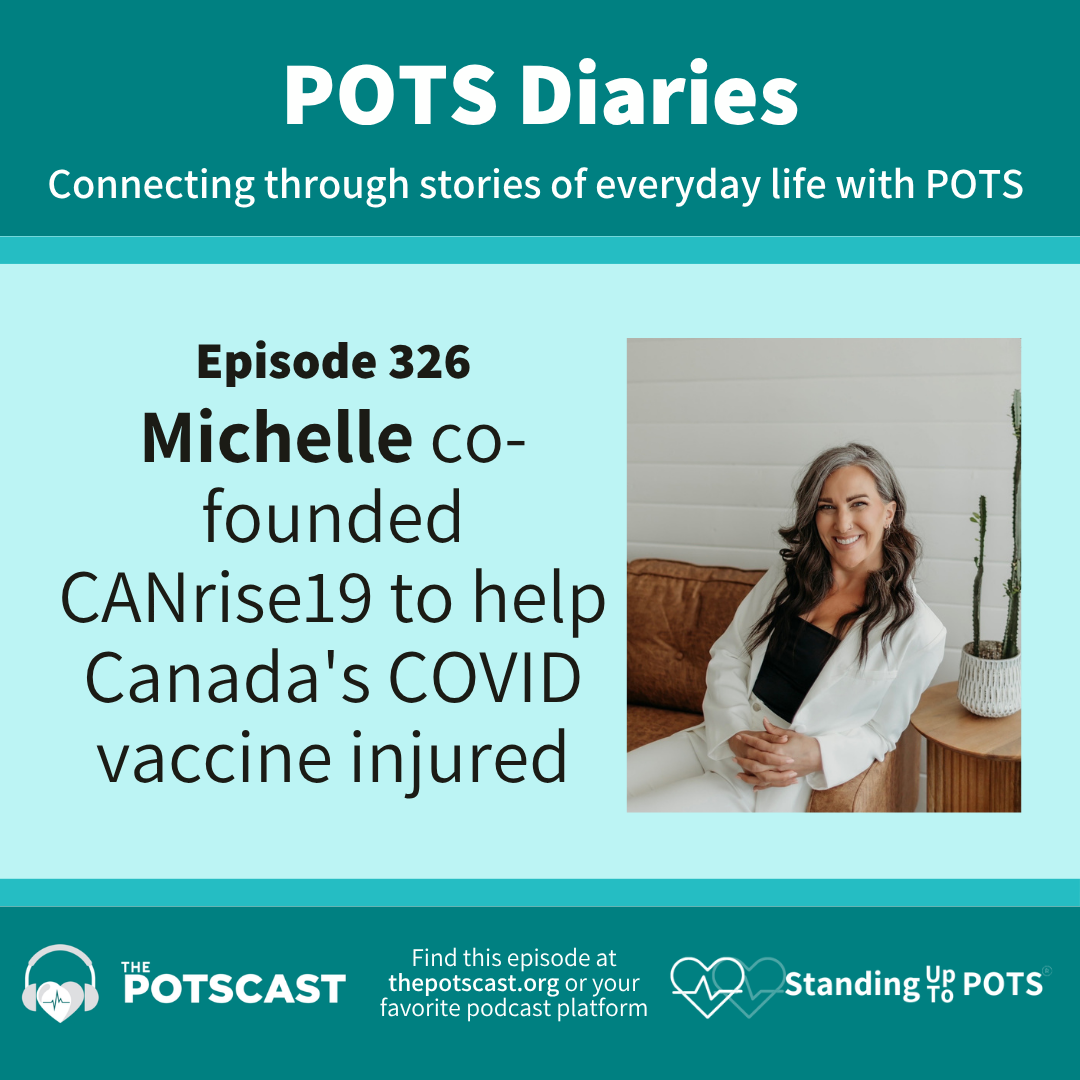
Michelle co-founded CANrise19 to help Canada’s COVID vaccine injured
September 07, 2026
Michelle was a busy mom, business owner and back country adventurer whose life changed dramatically in the 36 hours following her second COVID shot. After finding little help locally in Canada, she traveled to the US for visits with leading specialists in dysautonomia, MCAS, small fiber neuropathy and more. She recounts some of the treatments she has had—including IVIg, EBOO, and even brain surgery—and challenges encountered. She ultimately co-founded CANrise19.com, a non-profit to bring support, awareness and fellowship to other patients in her situation.
Michelle will be testifying at the Allison Inquiry. On September 8, 9, 10 and 11, 2026, the Allison Inquiry will be listening to the testimony of Canadians injured by a Covid-19 vaccine. The Inquiry will be broadcast live from Parliament Hill in Ottawa. The Allison Inquiry represents the first time that Canadian lawmakers will be listening to Canadians about their experiences with the Covid-19 vaccines.
Episode Transcript
[00:00:00]
Jill Brook: Hello, fellow POTS patients, and magnificent people who care about POTS patients. I'm Jill Brook, your horizontal host, and today we are speaking with Michelle Wharton, who is a patient and founder of CANRise19. Michelle, thank you so much for joining us today.
Michelle Worton: Thank you for having me, Jill. I appreciate it.
Jill Brook: So maybe for starters you can just tell people where you are and and maybe just kind of some basics about maybe like your life before all POTS and associated things entered your life.
Michelle Worton: Yeah, yeah, yeah, of course. Yes. So I actually live in northern British Columbia, so I live in Canada. And prior to my POTS diagnosis, I was a practicing dental hygiene practitioner. So I practiced in dentistry for over 20 years. In 2015, I actually opened my own dental practice. So not only was I a practitioner, but I was a business owner.
So I opened that practice myself, built it [00:01:00] from the ground up, and by the time I sadly I say quote unquote, medically retired, because it wasn't really by choice, it was just I can't practice any longer because of my conditions. That was 2023 was the last time I was able to practice clinically and the practice was sold.
So not only was I working clinically, I was on the board of of directors for our college, so on our regulatory board. I coached my children in soccer and spent my time in the back country skiing with, you know, skin skis and hiking and wherever you'd find me, I was pushing the limits.
Jill Brook: Yeah. Sounds like a busy, full life.
Michelle Worton: You better believe it.
Jill Brook: Then what happened?
Michelle Worton: And then life changed radically, to say the least. So in 2021, so the onset of my conditions are controversial, to say the least. In Canada, by the end of [00:02:00] 2021, of course, we're navigating through the pandemic. And COVID-19 vaccine mandates were very heavily rolled out in Canada. In British Columbia at that time, by the fall of 2021, any employees that were employed by regulated authorities, like by the government, were mandated to be vaccinated. And by the latter end of 2021, health officer Bonnie Henry started tailoring that mandate toward any regulated healthcare professionals. So that included myself.
So my first dose was the middle of November, and within an hour of that dose, what we later would realize was that all the onset of dysautonomia and POTS. So, cardiac related issues, high heart rate, blood pressure, tightness in my chest, general unwell, difficulty maintaining upright positioning, dizziness.
And it didn't really quite go away. It kind of subsided a little [00:03:00] bit. I kind of chalked it up to like just not being comfortable with the position that I was in. And the next month I received my second dose and within 48 hours, roughly 36 hours, a severe onslaught of neurological related issues.
So blurred, tunnel, double vision, hotspots in my legs, kidney related issues, incontinence, balance related issues, allergic type related issues, you name it. And so from the tail end of 2021, December, 2021, honestly, Jill, until present day the, I say buffet of symptoms and conditions that I continue to be diagnosed with has still not ended.
Ultimately I finished working, like I said, clinically, February, 2023. The amount of times that I've been either hospitalized because of the symptoms, it's too many to count. And [00:04:00] then all throughout 2022, the amount of times I either had to cancel work or reschedule days because it was just the symptoms were just too unpredictable and I just couldn't manage.
But unfortunately by 2023 our attempts were to try to manage the tachycardia. And so we made the attempt to introduce a beta blocker. They were treating me for MS because the neurological symptoms mirrored MS. They didn't really know what to do with the cardiac related symptoms. They suspected POTS, but it's very difficult to get care for POTS in Canada.
I still actually don't have oversight from a POTS specialist in Canada. I actually received care in the US for pretty much every condition I've been diagnosed with, even still to date. And so they did try a beta blocker nonetheless.
Jill Brook: Do you mind just saying what some of those other conditions are so people have a more full picture of what you're dealing with?
Michelle Worton: Yeah, for sure. So in August of 2024, so it took me going [00:05:00] back to the United States for diagnosis, immune mediated small fiber neuropathy, POTS, dysautonomia, and then POTS, MCAS, acquired connective tissue disorder. So not hypermobility and EDS, but because of ongoing inflammatory response and immune mediator response acquired connective tissue disorder.
Are you familiar with Dr. Anne Maitland?
Jill Brook: Of course. Yeah.
Michelle Worton: She's my immunologist.
Jill Brook: Okay. Wonderful. I'm so happy you have access to her.
Michelle Worton: So that's who, that, this is who I saw. So when I went to the clinic in Utah, I went because I wanted to see her. And, I'll try not to jump around too much, but the only reason I saw her was because throughout this entire sequence of events, I ended up developing a brain cyst eight months after my injections.
And that led to brain compression. And I could not get care in Canada. So I didn't only have a brain cyst, [00:06:00] I also still, and now have a new brain cyst in my pituitary gland. I have cysts in my liver. Gallbladder come and go. Pancreas come and go, breast and cervix. And still, they can't tell me why this is happening.
Dr. Maitland is hypothesizing that it's ongoing inflammatory response and immune dysregulation causing tissue damage, hence the acquired connective tissue disorder. So when I underwent brain surgery in the United States, I couldn't receive care in Canada, they did a brain biopsy and that tissue showed proliferated mast cells.
I had never heard of MCAS in my life, ever. And so that's what got me started thinking what on earth is this? This is December, 2023. So I started researching MCAS, and I asked to see an immunologist in Canada, and they wouldn't send me to one. They wouldn't even, they disregarded my request.
So [00:07:00] I found Dr. Maitland. I found one of her lectures and I found her in Utah. So I went to Utah and I was there for 36 hours, Jill. I left with those diagnosis. So Dr. Brent Goodman is my neuromuscular specialist. He diagnosed me with small fiber neuropathy, POTS, dysautonomia, multifocal nervous system disorder.
Dr. Maitland, again, like I said, acquired connective tissue disorder, immunodeficiency, subclass IgG deficiency.
Jill Brook: Wow. So you just have a lot going on.
Michelle Worton: Piles, and it's all a self perpetuating condition. So if MCAS flares, POTS is worse, small fiber neuropathies like, and, and sadly, when I was diagnosed in August of 2024, the neuropathy at that point in time was just my hands and feet.
I actually never saw a neurologist in person in Canada [00:08:00] until May of 2025. So you have to keep in mind I experienced an adverse event, which they're saying an an adverse immune response, which just has never subsided. I never saw a neurologist in person like almost four years, like three and a half years.
And so by the time I saw a neurologist in Canada, it's now mid biceps and mid thighs. So I have 80% sensory loss in all four of my limbs. So I can't feel hot, cold, pressure, touch. I can feel you touch me, but I can't tell you what sensation that is. So not only do I have POTS related issues, like with imbalance and orthostatic related issues, I actually just can't feel where my feet are placed.
And then I can't maintain upright positioning because of the tendon and ligament issues from the connective tissue disorder. And this is from a woman who used to spend her life in the back country. So, I'm trying to figure out how to work with this body that's [00:09:00] absolutely failing me. And then when I think about the visual acuity and the tactile like acuity that I had prior to this being a dental hygiene practitioner, it's surreal, honestly. It's surreal. And so even now, still today, I'm fighting for care in Canada. I'm kind of this unicorn and I really don't wanna be. Canadian doctors really don't know what to do with me, you know, when they do their testing in Canada. They can't check a box.
I don't fit into a particular box. You know, my labs in Canada that they run, they come back normal to them. The immunology labs that I ask to run, they say they don't run them. And then if they do, they don't know how to read them. And so it's very challenging to say the least when you're experiencing like conditions like I have.
And there's not a lot of research or funding provided for these types of conditions in Canada. And it's often disregarded. It's a good thing that I have the medical background that I [00:10:00] have because I can fight with science. Because they would very much rather just blame this on anxiety rather than blame it on the fact that these are conditions that are real and present, right. And, and even knowing how credible Dr. Goodman and Dr. Maitland are, I still cannot get doctors in Canada that will work with them. They won't, they say that's not policy to work with international doctors and they're in the United States. Unbelievable.
Jill Brook: So you spent your own money to come to the United States?
Michelle Worton: Yes. So I actually sold my dental practice. Yeah, I sold my dental practice. The brain surgery itself was $148,000. Yeah. So I sold assets, sold my practice, there was crowdfunding. They raised $74,000 in 31 days, Jill. Unbelievable. And I was [00:11:00] $80,000 in debt before I even sold my practice because I was like paying for medical care.
I wasn't working. I was trying to run my business. So by the time I sold my practice, the money was already gone and then I still had to pay for the surgery. Plus it was just over $200,000 to stay in the US for, you know, extended period of time. We had to go back to the US for my three month follow up.
The trip back to the states to see Dr. Maitland and Goodman was about $35,000. I've had EBOO, I'm not sure if you're familiar with that. I've done everything you possibly can think because of course my conditions are also compounded because I still have subclass IgG deficiency and I'm immunocompromised. So on top of that, my entire immune system, Jill, the only robust immunity that I have left is to the mumps and chicken pox. And that's only because I had those viruses as a child. [00:12:00] None of my vaccinations as a child are even present because my entire immune system's been completely wiped out.
And I've been advised by Dr. Maitland and finally the immunologist in Canada, that based on my response I cannot actually get another vaccine again, because it's, it's too unpredictable what that response will be. So it's like I'm a glass house, like I have to be very careful. It's a completely different life.
It's a completely different life. And these conditions are very progressive. So of course, while we know that there's lifestyle management for POTS and MCAS and hypermobility syndromes and conditions, the small fiber neuropathy and the immune related conditions, we don't know how to stop these conditions.
It's very difficult to say the least. I'm currently on immune modulation therapy, so it's called subcutaneous immunoglobulin. So I do infusions weekly at home. We try to do IVIG in the [00:13:00] hospital. I have had a very severe reaction to the IVIG. I ended up with aseptic-like meningitis. My immune system is just so depleted and it's also hyperactive, so it just sees everything as harmful.
It's doing its job. It's trying, its very best to protect me, but at the same time, it's just, like everything is, everything is it's, it's defending itself as best its can. But yeah, it's, it's a, it's a completely different life, I'll tell you that much.
Jill Brook: The EBOO treatment that you mentioned, that's pretty extreme. I mean, my understanding is that's something that desperate people do. Maybe I'm wrong. Can you, can you talk about where you did that and what that was like and if it helped?
Michelle Worton: Yeah. Yeah. So I live I live about 14 hours north of Vancouver. So 14 hour drive north of Vancouver. So we flew to Vancouver. They have to do a certain blood test to make sure that, 'cause they essentially filter two liters of your blood when they do the treatment. It's a closed system.
They can filter up to two liters of your blood. So they have to do the [00:14:00] blood test first to make sure that there's not like, I hope I don't butcher it too badly, but they wanna make sure that your red blood cells don't rupture during the procedure. And it's a genetic marker and I didn't have that, so that was wonderful.
So they do 250 mLs first and they inject O3, so ozone to, like oxygenate your blood. So what the filter does in the closed system when they actually hook you up is the filter can take out some particles. It's not like, plasmapheresis or PLEX. I've been fighting to get that procedure basically from the very beginning. It's heavily gate kept in Canada. Like I'm still fighting with the government to try to get access. And I've looked at Seattle. It's $25,000 for two treatments. Like we can't do it. We just can't. Anyhow, I did the first treatment with EBOO. It was $1,200 and we had to stay in Vancouver. I had a horrible mast cell reaction.
Horrible. Like I hadn't even left the clinic, and we did the full [00:15:00] two two liters, I didn't realize it because I had a sweater on, but I just had like bullseye, like we got back to the Airbnb and I was just like scratching myself to pieces. So I took like all the Benadryl and prednisone, like trying to get everything under control.
Thankfully I did. Called the naturopath and she's like, oh my gosh, like it could be like a detox response, but because you have MCAS, the next time we do it, we'll only do one liter, not two. And so we did one liter, but because the filters are so expensive, you still have to pay the same amount of money. But it doesn't mean you're not gonna get a benefit.
So we did one liter. I didn't have the reaction, but I can't say that I noticed an improvement. Because the MCAS reactions are so bad, it's such a systemic response, everything flares. POTS gets worse, neuropathy gets worse. I've literally tried everything.
Jill Brook: And for people who don't know what EBOO is, is that, that they actually like kind of take blood out of one vein and kind of filter it and [00:16:00] put it back in another one?
Michelle Worton: That's right. So you're hooked up to two IVs. So you have one in each arm. It's a large gauge. It's not as large as plasmapheresis. And so the other thing that's happened with me throughout this is I have substantial endothelial damage. I used to, I used to administer needles in my profession.
I have a significant fear of needles now, because I've had to get so many and because I have so much endothelial damage, they have a very difficult time accessing IVs. And so it was very difficult for them to be able to get a good IV when they were doing the procedure. And I'm talking like with IVIG, I think it was in a week with five IVIG treatments, and that's one IV per treatment.
I probably had nine attempts to get five IVs. With EBOO, I think I had six attempts and they needed two IVs. But you're willing to do anything to get better, right? Like [00:17:00] literally. But yes, with EBOO you have two IVs, one in each arm, one where the blood comes out, the other work goes in. When it comes out, it goes through this whole system goes through a UV B light, plus the filter, then ozone's injected and it comes back into your body.
And it is like an oil change. Like when you see what's coming out of your body, it was like black. And then what was going in was like so bright red. It was unbelievable. I couldn't even believe the color that was coming out of me. It was shocking. Shocking. I really just prayed it was gonna help. It wasn't the answer.
And then it was difficult because, I mean, that was, it was, it was $3,600, right. Plus staying in Vancouver and flights.
Jill Brook: All the energy it takes to get there.
Michelle Worton: Yeah. Correct. Yeah. So it's been, we're, we're continuing to try, I'm not losing hope, but like anyone that has POTS, let alone anyone that has [00:18:00] POTS and the triad or pentad, that it's collectively, it's very difficult to navigate, especially when you don't have a team that's there to support you. It's very challenging.
Jill Brook: Yeah. Yeah. I mean, it just sounds like you have worked so hard to do everything that you can possibly do, and it's disappointing that you don't have much local support. But I guess a testament to your strength is that you have co-founded a nonprofit to try to bring support to others. Do you wanna talk about that?
Michelle Worton: Yes, of course. Indeed. So throughout this experience, that was one thing that I couldn't find in Canada was support for COVID vaccine injured Canadians. And it was very difficult for me to speak out about it because firstly, I was immersed in healthcare and I [00:19:00] really wanted to make sure that this actually was what this was.
So I tried to rule out everything else and then ultimately I had the support of physicians being like, yes, Michelle, this is actually what this is. I am in the appeals process with the compensation program in Canada as well.
Jill Brook: So they denied you the first time around? Is that what that implies?
Michelle Worton: They did. The three they had on their medical panel, two of their three medical panel experts agree that there was a temporal relationship between the onset of my symptoms and the vaccine timeline, but they didn't feel like my conditions are from the vaccine.
So my, my case manager was like, please appeal. Like please appeal. And so here's the difficult thing that lies in causality, is that if it is not documented in a clinical trial, there is no causality. So if POTS, small fiber neuropathy, MCAS, hypermobility, vision loss, you know, like I have peripheral vision [00:20:00] loss, substantial peripheral vision loss, blurred vision, like difficulty focusing, you name it. If it's not reported in the clinical trials and it's not on the insert, it's not causality. And I'm not sure how aware you or your listeners are, but I know individuals through being like founding CANrise19 and, and being a part of a global coalition of like other countries that have similar organizations, I know clinical trial participants that they have same, the same conditions as I do, and they were extracted from the clinical trial because they had side effects. And that is where it becomes very tricky. And I know in the United States more is unfolding as we're speaking right now with the FDA and CDC more particular with myocarditis and stroke as opposed to the neurological issues.
But sadly, while there's the neurological related issues is more prevalent than the cardiovascular [00:21:00] stroke related issues, but none of them were reported. So we'll see. I mean, I do have a very strong case, but that's where I am with the appeals process. But when I was in the States, I had to get a VPN to fill out my paperwork and I couldn't find anyone in Canada.
And I also couldn't find any peer review papers. This is up until like August of 24. And all of a sudden all of these people started showing up when I put like, use this VPN to fill these, 'cause then you have like a different IP address for your phone and your computer. I was like, what the heck is going on?
It actually registered how much censorship there is in Canada. I started seeing people all across Canada that were injured. I started seeing people in the US. I started seeing peer reviewed papers. I was like, oh my gosh, I'm not alone. I was like, I was blown away and up until I had to go for brain surgery, that's when I started speaking out because I was like, dammit, if this is what it's coming to, I am not not saying something. [00:22:00] Like this is outrageous, that like my life has come to this because I did what they told me to do. I believe that bodily autonomy and informed consent is the very foundation of like what we get to decide in medicine. That was entirely taken away from us. I worked in healthcare for 20 years. It's a very foundation of practicing medicine. So that's where it was very difficult for me. But all of a sudden, all of these people, I was like, oh my gosh.
And I couldn't find a scientific based organization. So I met another injured in Canada, Julie Woods, and we made one. And so that's what we did. And so we decided instead of staying quiet we decided to join forces. And with the help of React-19 and Brianne Dressen and Joel Wallskog we created CANrise19.
And here we are today. So we're a registered nonprofit. We are still trying to achieve charitable status in Canada. So that's very difficult. And so we've [00:23:00] been running formal support groups, it was a year in February. And so we've got our support groups running. We have a underground railroad of medical providers that we don't share publicly because if someone's willing to help vaccine injured Canadians, we do not want to share that information publicly because we wanna hold that sacred.
We're so thankful that we have practitioners that are willing to help. And then if and when, I wanna say if and when, we achieve charitable status, we are building a medical care fund. So React-19 today has granted roughly, I think $1.6 million in medical grants to Americans for medical care where the government is failing.
We wanna do that in Canada, but unless we achieve charitable status, people generally don't want to donate if they can't get a tax receipt, unfortunately. We've tried our best to, you know, have different campaigns. We have [00:24:00] merchandise we sell for CANrise19. That's through our website.
But really once we achieve charitable status, that's when hopefully we'll be able to get some donations coming in. And like I said, our ultimate goal is, is running the organization, but then having that medical care fund. And all of our volunteers are exactly that, we're volunteers. Like none of us get paid. And all of our volunteers are injured Canadians. Like all of us share the same story.
And that's what's like so impactful is we're spread out, and Canada is huge, like the United States. If you go on our website, so canrise19.com, similar to react19.com, you can't make these stories up. None of us have ever met and we are just echoing the same message. Like when you start to read everyone's story, it's devastating, but it's, it's like you're reliving your own life, because they're so, so similar. And so we've [00:25:00] taken this terrible experience, terrible experience, and we've turned it into something good as best as we can. This last week actually has been incredibly busy. We've finally, after a year and coming up to a year, I guess now of being a registered nonprofit, sat down with some political party leaders and had some meetings.
So I'm not sure if it's gonna go anywhere. But we finally have been able to have some meetings and talk policy and, and, you know, asking to see if we can have a working group with, I mean you guys have like your, you know, Democrats and Republicans. We've got Conservatives and Liberals. Liberals are leading here in Canada, so the conservative party here seems like it's the only party that might be willing to do something. So that's who we met with this week. And so we're, we're optimistic that we can see some meaningful change similar to what we're seeing in the United States. And that's the only thing we can do is try.
So, yeah, we're pushing for funding and research [00:26:00] and trying to get some measurable steps to help Canadians get access to care. And a substantial amount of vaccine injured have these conditions, Jill. Like so many injured have these conditions. And all three of these conditions. It's unbelievable how many, not so much the hypermobility, but POTS, MCAS and small fiber neuropathy. Those three, we see a lot of. Substantial.
Jill Brook: And so the politicians that you met with, they, did they acknowledge what you've been through?
Michelle Worton: This is what's difficult. They know. They know that we exist. The Liberal party knows that we exist, but the Liberal party won't acknowledge publicly that we exist because they won't admit they made a mistake. What are we supposed to do about that? Because the cost of admitting that they made a mistake is too high.
Jill Brook: [00:27:00] Oh, I'm so sorry.
Michelle Worton: Yeah. It doesn't mean we're gonna give up. We're not gonna give up. That was the most disappointing thing that we had heard, was that. And our discussion was Canadians need healthcare, and we need a compensation program that is not failing Canadians first and foremost. But what we also need is to make sure that this never happens again.
So this is a matter of like ensuring Canadians now receive the care that they need and deserve, but also we can't face this again, like the burden that we're witnessing on the healthcare system in Canada. And my immunologist and allergist in Canada, he doesn't believe in MCAS. And so I don't test, I don't test high tryptase and they never test me when I'm in a flare either. And I'm also on like a, I've been on a [00:28:00] huge protocol for MCAS for two years.
So I'm on H1, H2 inhibitors, I'm on prostaglandin inhibitors, and I'm on leukotriene inhibitors. I've had been for two years. So he wants to do a 24 hour prostaglandin test. And so I, I, I get the test and I get the containers and the lady's like, are you on aspirin? And I'm like, yes. And she's like, okay, well you're gonna have to go off it for two weeks.
And I was like, absolutely not. And she's like, well, you're not gonna get an accurate test. So I take everything home and I email my immunologist/allergist, and I was like, just so you know, like in order for you to get an accurate test, I need to go off my medication. I'm not doing that.
So in order for me to give him an accurate test, this is what I need to do. And yet he's coming at me with like, well, this is really just a, this isn't a real condition. Like MCAS is not a real condition. So that's the support that I have in Canada, right. And yet I respond and have responded incredibly well to the protocol [00:29:00] I'm on.
And I had a brain biopsy that showed proliferated mast cells. I had the what's that KIT 816 for mastocytosis. So I don't have the genetic disposition. Dr. Maitland did that. But that's the care that's available, that I have experienced in Canada, that this young lady experienced in Canada. And I won't get too much in Julie into Julie's story, but Julie's story is very much the same as mine and much very, like, very similar to many members in our community.
It's devastating. Between the access to care, what is offered for care in Canada, censorship and how dismissive these conditions are. The lives of many Canadians is put at risk and we don't have, we don't have the resources in Canada to get the care that we need, and we don't have the funds to get to where we can get proper care.
Jill Brook: Talk a little bit more about what people can do. Is it too late for people to join your nonprofit and join your support groups? Or what, what could people [00:30:00] expect?
Michelle Worton: Oh yeah. No, no. Never too late ever. Absolutely not. So, the best resource is our website, so www.canrise19.com. On there we've got a patient section, patient resources. You're welcome to share your story. You can share your injury on there. That includes sharing your lot number.
You can register for support groups. We will be gearing up here pretty soon to run those. Included in that are confidentiality agreements. So what people need to realize, it's, it's a safe, supportive community. What's said in the community stays in the community. It's eight to 10 weeks. It's very guided.
We go through topics, we have strategies, techniques. We've got, you know, it's very very supportive. On top of that, we've got, like I said, we've got our provider lists. So depending on what province you're in, we can connect you with other individuals that are in your same province. We can also connect you with providers that are in your province.
So, incredible resource. At this point in time, we are not [00:31:00] accepting medical grant applications. Again, we are in the process right now. We're hoping to hear back from the federal government for our charitable status application. But when we do hear back once we have that funding coming in and we're established, then we will be looking at accepting medical grant applications.
And that will be a very robust review process for looking at what that grant approval looks like. But yes, absolutely check out the website. You can also find us on Facebook and Instagram. And then we're also always sharing peer reviewed papers, literature on both of those social media platforms.
And there's a whole section on our website that also includes links to databases. So React-19 has a huge database with peer reviewed papers, and our Australian partners, they have another database with about 4,000, maybe even 4,200 peer reviewed papers now. So, it's an incredible resource that once you visit our website opens up a world of opportunities.
But yes, [00:32:00] absolutely, you don't have to go through this by yourself.
Jill Brook: And say again what your website is.
Michelle Worton: canrise19.com
Jill Brook: Okay. And we'll put that in the show notes so that it's convenient for everybody.
Michelle Worton: Please.
Jill Brook: And Michelle, you just have so much strength to go through this yourself. And I guess a shout out to your family too, because between everything that's happened...
Michelle Worton: Oh my gosh. I have two, I have two small kids and a spouse. And my children were eight and 10 when this started. It's unbelievable. Yeah. Like when you think about, when you think about resilience and you think about outcry now. Yeah. The, the amount of, excuse me, the amount of compassion my children have is extraordinary.
With that being said, the amount of, and I don't throw the word trauma out loosely by [00:33:00] any means, but there's work that we have had to do as a family for sure. Because an experience like this does not just touch the individual. And I'm sure for anyone that has experienced any type of chronic illness or, or anything that's changed their life, they know what that means, right?
Like, whether that's a spouse or a friend or family or parent that's caring for someone that is suffering from a condition similar to what we suffer from, there's this huge ripple effect. And so, yeah, my, my, my partner, my spouse, my children, my mom, my family, my friends, shout out to them.
Jill Brook: Yeah. Yeah.
Michelle Worton: And God, first and foremost, for me. Without a doubt, yes. Yeah. That's where my hope comes from.
Jill Brook: Well, I'm, I'm just so impressed with what you've gone through and what you've managed to [00:34:00] accomplish for yourself, but then to also turn it into a nonprofit that is going to help others have it easier in the future, hopefully. And so, I just have so much respect for what you're doing, and I know that ev everybody listening is just sending you all the best.
Thank you for sharing your story with us today, and thank you for founding an organization to help others.
Michelle Worton: Well, thank you for having me, Jill. I appreciate it and thank you for having the, the podcast to share our stories.
Jill Brook: My pleasure. My pleasure. Okay, listeners, we'll put the website in the show notes so that it's convenient and I hope you enjoyed today's conversation. We'll be back again next week, but until then, thank you for listening. Remember, you're not alone, and please join us again soon.