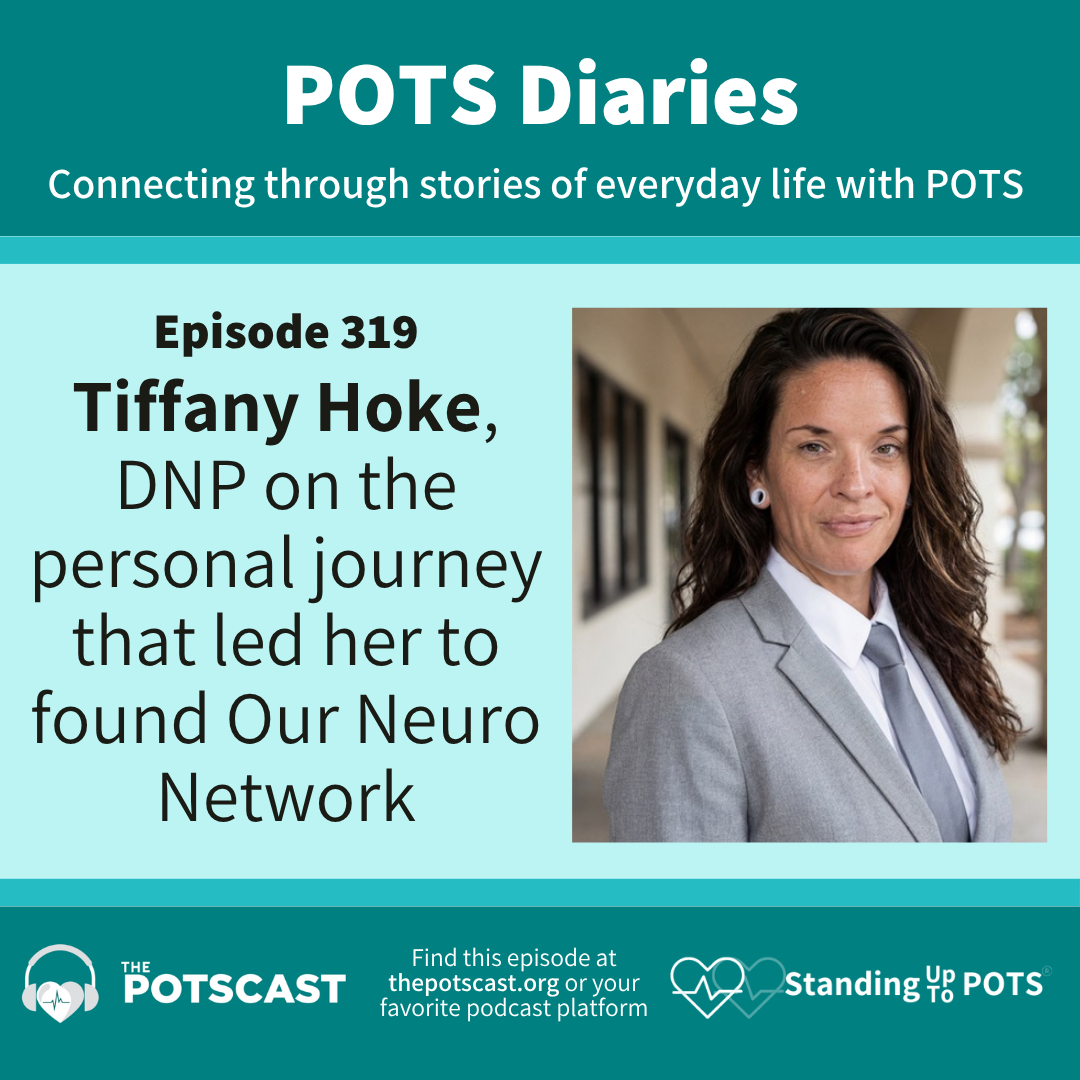
Tiffany Hoke DNP, Complex neurovascular patient turned expert helping others
July 21, 2026
Tiffany, a Doctor of Nursing Practice (with 6 other nursing/neurological credentials), relates her epic journey to uncover her own - and her family history of - neurovascular, neurometabolic and genetic issues contributing to her POTS and many other symptoms. After multiple discoveries, surgeries, stents, dietary and lifestyle modifications Tiffany reports being again functional, happy, relatively pain-free, and pursing her passion to continue gaining expertise in neurovascular and neurometabolic conditions and helping others via her consulting/coaching/clinical services at OurNeuroNetwork.org. Tiff's information is below:
Tiffany Hoke DNP, RN, RNP, APRN-RX, AGACNP-BC, SCRN, CNRN
Our Neuro Network
Neuroscience and Neurovascular Nurse Practitioner | Coach | Consultant | Podcast Host
Website: www.ourneuronetwork.org
Episode Transcript
[00:00:00]
Jill Brook: Hello, fellow POTS patients, and marvelous people who care about POTS patients. I'm Jill Brook, your horizontal host, and today we are speaking about neurological and neurovascular symptoms of dysautonomia with Doctor of Nursing Practice Tiffany Hoke. Tiffany is also a board certified adult gerontology acute care nurse practitioner, a certified neuroscience registered nurse, and much more. We'll have her tell you about it.
She specializes in neurological and neurovascular care. She's CEO of Our Neuro Network based in Hawaii, where she serves as a nurse practitioner, coach, consultant, and she even has a podcast. She has expertise in complex neurological conditions including cerebro-spinal fluid disorders, cerebral venous conditions, headache and migraine, Mast Cell Activation Syndrome, hypermobile connective tissue disorders, and more. [00:01:00] Tiffany's work is also deeply personal. She has lived experience with these issues, which fuels her commitment to advocacy, education, and compassionate evidence-based care. Tiffany, thank you so much for being here today.
Tiffany Hoke, DNP: Oh, thank you so much. What a wonderful introduction.
Jill Brook: Well, maybe you can start by telling us a little bit more about your background and how you became an expert in this area and about Our Neuro Network.
Tiffany Hoke, DNP: Oh, I'd love to. Thank you for asking. I think it's important for us to share our stories because storytelling can be so very powerful. And for me as a nurse practitioner, I get the most information when I actually sit down with patients and hear their story. And it's so informative. And I think that I envision the future progress that we make, much of it will be from sitting down to hear the stories of [00:02:00] patients and their expertise, because patients are the, the experts. They're, they're the ones with the most knowledge about this condition. They may not have the words to explain everything in medical sense but for the most part, they're right about what is happening in their body.
And, they're looking for answers, you know, scientific explanations. Looking to make sense of things so that they can have a better quality of life. But I believe if we go in with an open mind and actually sit down and listen to someone's story, that we learn so much. And I think if we all took time to hear one another's stories as, as patients and providers, that we would get so much further as a community.
And I see that starting to happen in the community at large, where we're all sitting down at the same table. And there's growth from that. And I'm really excited about it. So thanks for asking. So I became interested in neuroscience because my mother was affected by these conditions. And back then we [00:03:00] did not know what they were. We knew that my mother had a subarachnoid cyst and temporal lobe epilepsy and chronic migraine. And she was a very brilliant woman, but I saw her suffer greatly throughout her life with these disorders. She would have exacerbations that would impair her ability to work, and ultimately she had a progressive and focal neurocognitive decline.
And at age 44, she passed away from what I consider to be neuropsychiatric complications of her disorder and that she completed suicide. And I say it's a neuropsychiatric complication of the disorder because when patients have intracranial pressure disorders and or venous outflow disorders that impair the ability of the venous blood to drain from their brain, it can affect the stability of their limbic system, your fight or flight system, the system you use to make decisions. And when the very organ that you use [00:04:00] to make decisions is impaired and cannot function optimally, you sometimes make decisions out of character for yourself or decisions that you otherwise would not have made if that system were stable. And for my mother, because at the time, you know, when she was alive, we were not aware of these conditions. You know, we're just now learning how to recognize these patients and the treatment options available, and we're still fine tuning some things. But back then people weren't recognizing the signs of intracranial hypertension or high brain pressure, or spinal fluid pressure, or intracranial hypotension or low cerebral spinal fluid volume or pressure. And so many of these patients would get diagnosed with other things like for example, frontotemporal dementia.
But mother very much had a, had a progression toward the end of her life of someone with frontotemporal dementia and [00:05:00] Parkinsonism in that she started to have progressive cognitive dysfunction, flattening of her affect, and monotonous voice and depression with a mask like appearance of her face, a shuffling gait and balance disturbance.
She went from being able to be upright to needing to lay flat or, or stay bedbound or needing to use accessible devices at 40 years old. And that was a drastic change from her baseline. And, you know, all the while she was suffering with worsening headaches and migraines that limited her.
And I remember her teaching me about the brain, you know, as a, as a young girl telling me about, I knew what the hypothalamus was, you know, and she, I remember her telling me, something is wrong with my hypothalamus. And I was like, who says that? Or what is this hypothalamus?
And we'll talk more about that. And so, I was aware, you know, I knew about neuroscience and I was educated from, you know, a [00:06:00] young girl, 'cause she educated me on what she knew about her body. But also that there's something more happening here, Tiffany, and I saw her really fight hard to get the answers.
But ultimately her disease progressed and and she passed away. You know, I knew at the time of her death that there was more to the story, that something happened to her that we did not yet know, that there was a reason that her decline was so much more abrupt and that it happened the way it did.
That what we knew was not a sufficient enough explanation. And by that time, I had already went into a nursing school and was a neuroscience nurse because I wanted to learn everything I could about the brain to try to understand her condition, maybe help her and other patients like her. And after her death I took a break for about a year just to, to process. Because here is the one person I wanted to help the most, and I couldn't help her in time. You know, I couldn't [00:07:00] figure it out. And, you know, of course we cannot judge ourselves for what we do not know, you know? I, I know so much more now, but you, you, you cannot do that to yourself.
It's not compassionate, you know. It is because this happened that I know this now, you know? So, that's when I decided to begin to go back and get my advanced practice degree and become a nurse practitioner and focus in neurocritical care. And I spent the next five years in neurocritical care and learning and, you know, I got what I call my dream job in Hawaii at Queens Medical Center as a neurocritical care nurse practitioner. And that time really was a wonderful experience for me because it gave me so much more knowledge and insight. Because in a Hawaii, it's very rural and there's lack of access to expert care.
There's no neurology fellowships in Hawaii, so the nurse practitioners run the neurocritical care unit in collaborative with the [00:08:00] neurointensivists. So nurse practitioners practice at their highest scope of practice with interdisciplinary support. But it really empowered me to use my degree at its full scope and access the resources so that I can deliver evidence-based expert care to a population that would otherwise lack access to it.
So that was essential. That was an essential stepping stone to do what I'm doing now with Our Neuro Network. Well then, lo and behold, I started to become sick and it was terrifying because I was showing the exact progression of disease onset as my mother at the same ages. And we did not yet know what happened to her.
And so I was faced with what is this? What is happening to me and how do I stop it? And to tell you the truth, it still took me, I still had to see countless providers before I got answers. Even with my knowledge of neuroscience, I treated intracranial [00:09:00] pressure disorders every day, every night, yet I did not recognize that process happening in my own body over the course of my lifetime because it presents a little bit differently, chronically. When your brain has time to accommodate pressure changes, you would be surprised at the pathology it can tolerate.
That's why we see sometimes patients with huge tumors who are still walking and talking. Now, if someone were to suddenly have a brain hemorrhage that occupied that space, they would be comatose. But because this person had their whole life to accommodate, they were resilient and you'd be surprised, the wonderful thing is that life wants to continue. And so we can overcome or work around or adapt to really wild things. And it's good for us because it means we're still here, but it doesn't mean that there's not some differences we start to notice, right? Like this day is not like the others. And for me, it, it was clear to me that [00:10:00] I was not like the others. So in 2016, I developed a poorly differentiated thyroid cancer.
At this time I was about 185 pounds heavier than I am now. I had struggled with obesity my whole life. I would say I'm the hungriest woman in the world. You will find no one hungrier than I am. That includes not only for food, but also knowledge and answers. So sometimes your, your struggles and your burdens, they can present strengths as well.
The very thing that is wrong with me. Wrong with me, I say that, I don't even like that word. My difference, that it makes me unique, it also gives me gifts. And now that I'm aware of where it is, I can use the gifts and mitigate the challenges a little bit better. I'll tell you more about that as we go along. With the thyroid cancer, that, that type of poorly differentiated had a five year prognosis of a 50% survival rate. So I was terrified that I wasn't even gonna, you know, make this.
But, you know, I had already started suffering with [00:11:00] migraines and headaches probably seven to eight years before the onset of my malignancy, but I normalized it. And that everyone in my family has migraines. There's a reason for that. That's not normal. If you come from a family where everyone has migraines, there's a reason for that.
There are people in this world that never have a headache. Can you believe that? And we actually study them and we learn they have certain genes. And by studying those genes, we're gonna use that information to help patients who do suffer. But there are genetic reasons why people have migraines, and it runs in families.
And not only genetic reasons. There's some epigenetic reasons. Like there may be certain dietary habits that a family has that may increase their risk, certain activities, they may live in an area or they have certain exposures. There can be all sorts of things. But if you come from a family that suffers with migraines, there's a reason for it.
And it should not be perceived as normal and that it has to be that way. There is help and treatment available. And so for a long time I [00:12:00] just thought my headaches were just normal. But when they started to get pretty severe in grad school, even before the thyroid cancer, I started seeking help.
Got an MRI, which was normal. I was convinced I had a brain tumor. The old name for, for intracranial hypertension is pseudotumor, meaning that it mimics a brain tumor and that you wake up with a early morning headache oftentimes, that gets better as you're upright throughout the day and your brain is better able to drain.
And I was started to have visual problems and eye pain when I would move my eye. So I was convinced I had a brain tumor. And then the MRI was negative and I was like, what? So then I go about, and I moved to Hawaii, and then I get the cancer, and then my headaches really kick off. And in addition to that, I started to get severe facial pain.
And then about two weeks after my cancer treatment, I woke up with a sudden onset of right facial paralysis. And I thought, oh gosh, I'm a goner. My cancer's metastasized to my brain. Because sometimes we think the worst thing, even when we're an optimistic [00:13:00] person. Thankfully, I was wrong. And here's the thing.
I recognize that I am human and I can make mistakes. I have been wrong before. I have been convinced I'm right about my body and been wrong. Thankfully I was wrong then. But for the most part, I've been right. So when I listen to patients, I try to pretend like they're the expert and that they know most.
But also we all have to acknowledge we're human and we're doing the best we can with the information at our disposal. And we're not perfect. We're not computers. So we always have to preface with, I believe this is correct, but I could be wrong, right? I use evidence and I use observation, and I make the best conclusion.
So that said, when I had the facial paralysis, you know, it be, it was atypical. Most facial paralyses, if they're from a viral cause, should start to get better within six to eight weeks. And if you have one that's lasting beyond that, you should really be looking for other causes like malignancy or tumor is the [00:14:00] number one.
Or there are plenty of other causes. So the facial nerve exits the skull base right by the jugular foramen, where the jugular vein exits the skull base. The, the foramen, or the hole, is called the stylomastoid foramen, right by the styloid bone. So the facial nerve runs right by the jugular vein. So patients that have congestion near their jugular vein, particularly those whose jugular vein may be compressed by the styloid bone against the the lateral mask of the first cervical vertebrae, so the top bone in our, our spine, the first bone there, and then a bone in the skull, will sometimes sandwich the jugular vein in between them.
And then when we turn our necks, it compresses it, kind of like a pincher, like a nutcracker, that can happen in other parts of the body. It, it, it kind of pinches that vein. And and if you have someone who has a lot of muscle or other bone [00:15:00] there, it may be more compressed. And if you have someone who has metabolic problems or venous problems, like, like say someone has an increased risk for a clotting disorder and they get blood clots, all of that can congest, the venous system, and it becomes engorged and congested there, and inflamed. And over time, that can actually erode the skull base and compress the facial nerve. And for me, that is what happened. When they removed my thyroid gland because of the cancer, it was enough to shift my jugular vein anatomy. And my muscles,
and my bones, I was already compressed there and already at risk. But the shift there was enough to really trigger an increase in venous pressures, which then congested my jugular bulb and compressed my facial nerve. And then when you add radiation into that. Radiation always causes inflammation.
You [00:16:00] know, we think that things like surgery and radiation cure us. They're actually very offensive to our bodies. They're always an insult, and it takes time for your body to recover. We do these drastic things to bodies and hopes that we liberate them and facilitate a recovery later on. But the recovery from things like radiation and surgical treatment actually happens months after the actual event, after the body's inflammatory processes have settled down.
So in the two weeks after my cancer treatment, when I had the radioactive iodine, I've had a surgery that shifted things, I have underlying genetic disorders like clotting disorders, inflaming things. I had an undiagnosed disorder, which I'll tell you about soon, clouding the picture. And then I had the muscular and the bony compression of my jugular vein, and then that was all enough to cause my facial paralysis.
So that was in 2016. After that, it was during that time I started having worsening severe headaches and mood changes, you know. More irritable [00:17:00] and you know, I consider myself a calm person. But I was just irritable. And I had to minimize my social interactions and stimulation and the lights would bother me.
It was just like I was on edge, you know. And it affected the health of my relationships. It was, it was a very difficult time, you know? You know, my marriage ended at that time. And I think, you know, patients who deal with these problems that affect their, their intracranial pressure, what is not talked about often enough is how it does affect your, your mood and, and your relationships. And the way the brain responds when the pressure is too high or low in the inflammatory cascade that happens.
And what patients have to do to stabilize themselves sometimes is counterproductive to socialization. For example, in the ICU, when someone's intracranial pressure is high, you minimize stimulation, you turn the lights down, [00:18:00] you keep their neck neutral, you keep everything nice and calm. Well, when you're a young adult, living an active life, to behave that way is considered abnormal. No one is doing that. Like everybody's go, go, go, go, go. So if you are a type A person in a go, go, go, go, go, go, go, go type job and you have an intracranial pressure disorder, you are gonna go, go, go and exacerbate yourself. And then you're gonna have to take time away.
And then sometimes if we don't know what's happening, it affects our relationships. But thankfully now I know what's happening and I can better care for myself and keep myself in balance. And it's a whole nother bright side of the story I'm gonna get to, believe it or not. So fast forward after this, suddenly one day I flip over into, wow, I'm having trouble being upright.
I am, when I'm standing and walking, I'm dizzy and I am walking like a giraffe. Like I'm gonna tilt a whirl. What is happening? You know? [00:19:00] And that was in 2018. And, at the same time, I'm noticing every time I'm using my arms that it's exacerbating the condition. Numbness and tingling in my arms. And I'm getting prominence of my vasculature on my chest and on my shoulders.
Jill Brook: Meaning that your veins pop out?
Tiffany Hoke, DNP: Yeah, like bodybuilders want them to, right? But, but there's, but that's actually abnormal for some patients. It can be a sign of sometimes tumor or increased pressure in the venous system. Now, I had been trying to, with a cancer diagnosis, I tried to lose weight and I was successful to a, a degree.
I would lose like a hundred pounds here, but I would always gain it back. And I tell you, I would do everything that they would tell me to do. I would restrict my diet. And some of those things actually made me worse. And I'll share with you why soon. I was convinced I was having symptoms of venous thoracic outlet syndrome. Meaning that when I would use my upper [00:20:00] arms, I would start to have the numbness and tingling and then that engorgement of my collateral vessels and it would make my headache worse.
And so I got assessed for that and it did show it on imaging, but people are so used to not looking at that. They're like, yeah, it's there, but we're not gonna do anything about it. We don't think that's it.
Jill Brook: Define the venous thoracic outlet syndrome. Is that when basically the circulation is getting cut off? Can you explain it just so our listeners know what you're talking about?
Tiffany Hoke, DNP: There are three types of venous thoracic outlet syndrome. There's arterial thoracic outlet syndrome and venous thoracic outlet syndrome, and then there's nerve thoracic outlet syndrome.
So it can affect your nerve, your artery, your vein, or all three. So oftentimes the thoracic outlet area is very kind of narrow and there's a lot of major anatomies that runs through there. Our subclavian vein, our subclavian artery and then the brachial [00:21:00] plexus, the bundle of nerves that control their arms. All run through the chest area. And so in that little window of the chest, it's kind of in between the first rib and the collarbone that this bundle of nerves, arteries, and veins run. And, and that's great until that area gets too narrow, then sometimes those things can be compressed. And if they're compressed severely enough and long enough, someone can start to have problems with either arterial blood flow, problems with getting blood to the arms, so it might look be painful and, and pale. They might have problems with venous return returning blood from the arms to the heart. That is actually the more rarely diagnosed. It, it's like the lesser diagnosed, but I believe it's under recognized, right? So sometimes we see in literature, this is rare.
Is it rare or is it rarely [00:22:00] recognized? I, I kind of believe that. You don't know how frequent something is unless you're actually studying and looking for it. I think it's probably more common than people think. But you know, veins operate, they're not like arteries. Veins are loosey goosey, flippy floppy.
They're like floppy channels. They feel, and they close and they reroute however we need 'em to. They're really resilient like that. Arteries, pretty much all of them need to stay open or we're gonna have some problems, right? They do reroute, but they're firm and rigid and hard to compress.
Well, veins are easily compressed. So to have a compressed vein in and of itself is not a problem. It's a problem if it starts causing a problem, symptoms that correlate to that compression. And it, it is our belief in the community that, you know, it's not a venous compression alone that is a problem.
If the person can't tolerate the venous compression, 'cause veins are a helper system. They drain metabolic [00:23:00] waste. They drain pressure and fluid from the head. Well, you can maybe able to tolerate a compression here or there, but if you have an underlying reason for having an accumulation of waste products or if you already have a intracranial pressure that is high because of molecular reasons, you might not be able to tolerate having your vein compressed.
So that's why you may see someone with a compression and stenosis at the same place mine was, and they could be asymptomatic because they don't have my underlying inherited disorders that are fueling the fire. So that is why you'll hear some people argue, you know, there used to be a debate of whether or not these should be treated, and they're still kind of debating that sometimes.
But it's really important to look at the whole picture and listen to someone's story, 'cause if you can hear their story and see that they're having symptoms that relate to that vein, and also the nerve where that vein is. So for example, when I explain my facial nerve, we [00:24:00] know the jugular vein anatomy and we can see that it's congested.
And so we can see how they're tied together and we can pinpoint it. So then we know that that's the culprit. We call that localization of findings. So then it's not some hypothetical, this is evidence-based. It corresponds to a cranial nerve and you can see it on imaging and it matches my story. So it's valid.
And so with the venous thoracic outlet syndrome what can happen is the first rib in the in the collarbone, the subclavian vein runs in between those two, kind of like a little sandwich. And when we use our arms, raise our arms or do anything with them, that space narrows and it can, it can close off the subclavian vein.
And there are some people where even when they're at neutral, their subclavian vein is severely narrowed and already struggling. But for patients, if they have already, if they [00:25:00] have intracranial pressure disorder or if they have cerebral venous congestion, meaning that the veins in their head and neck are not functioning or draining optimally either because they're compressed or they could have underlying metabolic reasons why there's sludge in there.
If you take someone and then you actually compress their subclavian vein too, well what happens to that blood when it can't drain from your arms? Where do you think it goes? It's gonna find a way if it can't get through this way, it'll take the back routes often through the posterior collateral veins in our head and neck.
So what was happening, my jugular veins were occluded because of my condition. I had bilateral internal jugular vein stenosis, bilateral subclavian vein stenosis that worsened when I moved my arms and turned my head. So anytime I was upright and active, blood couldn't drain from my head very well.
[00:26:00] And all the venous blood that wanted to go to my heart, if it can't get through the main road, it's taken the back road up to my head and to then come back down through the other way. So, basically one problem worsens the other problem because my blood flow was taken the already congested route. Does that make sense?
Our veins operate, it's a system. It's not just, you know, we have to start looking at people as whole persons, not just one vein, not just one area. It's all connected. And so when the system is overburdened with waste products and compressions it stops being the helper that it is and it starts to worsen the problem because we need you to be open and flowing and not inflamed.
Jill Brook: And is this problem worse in people who have the Ehlers-Danlos Syndrome or the hypermobility syndromes?
Tiffany Hoke, DNP: Yes, because our, our veins are [00:27:00] connective tissues, collagen vascular network. This problem's also worse in patients with neurometabolic syndromes or alterations in how they process their nutrition. Because our body is made up of what we put in it. And, and if our underlying genetics are not organizing those nutrients in a meaningful and stable way, you know, say for example, if someone has an alteration in how they process B vitamins, well that's important to your neurological development and neurological health. That can further compound the picture.
So, you know, I, I think what was frustrating for me early on is I was looking for one magic answer. I was looking for one magic solution. And, and I, when I started to understand how complex it was, it wasn't just one thing, it was everything. It was how it's all connected. And when I understood how it was all connected, that that was more helpful to me.
Fast forward, in [00:28:00] 2022, I finally presented, I had to go into the ED because I was just so severely, had such a severe headache, and vision, hearing and balance disturbance. And, you know, I was treating myself like I would treat an ICU patient and I was like, Tiffany, you're at home.
You should probably go to the hospital. You know, you need to stop being your own doctor and let other people help you and ask for help. You know, there was a while for about four years that I stopped asking for help because I was not getting the answers and I was not feeling heard because I wasn't going to people with knowledge about these conditions.
So I was feeling dismissed, and it's not because people were intentionally dismissing me. They did not have the knowledge to help me. And so for about four years, I did everything I could myself. I optimized my diet. I hired a personal trainer. I lost some weight. That helped some, but I was actually getting worse sometimes when [00:29:00] I was working out, right, with exertion.
So finally I was like, you have to go in and ask for help. You know, you know, my mother presented to the ER three times in the two weeks before her death with a chief complaint of headache, hearing vision and balance disturbance. And on retrospective review of her records, they documented her to have a developmental delay and be of quote, unquote low intellect. This is jaw dropping to me when I was reviewing it, because my mother had a high IQ. She was brilliant. So they clearly misunderstood her baseline. They assumed that she was presenting with these features, that was how she had lived her whole life, but that that wasn't the case.
And unfortunately, when someone has a altered cognition, they sometimes lose the ability to advocate for themselves or tell their story. And their [00:30:00] story that's written for them in the record. And sometimes that record is wrong. And unfortunately they attributed my mother's presentation to ex chronic and lifelong condition and not to an acute problem that needed treatment.
But the truth is what really happened is she had developed a CSF leak and she had her tonsils of her cerebellum were herniating down through her foramen magnum. It looks kind of like Chiari malformation.
Jill Brook: The brain is actually getting smooshed, right?
Tiffany Hoke, DNP: Exactly. So she had spent years in high pressure and she had jugular venous stenosis. We didn't know this then. We only knew it by going back to look at her records after she had passed away years later, when I had the knowledge to go back and look. We could see that her brain spent years under high pressure. She had multiple venous compressions and then her, her transition into not being able to be upright is very classic for [00:31:00] intracranial hypotension or low CSF volume that often occurs from CSF leak, which can happen, especially in patients with hypermobile connective tissue disease like hypermobile Ehlers-Danlos. And in fact, I've had a few family members diagnosed with Hypermobile Ehlers-Danlos syndrome. I fit the criteria for it, but I know it can be attributed to my other condition I'm gonna tell you about.
I promise I'll get there. So we're very much in my family hypermobile and flexible and a Beighton score, I think it's like six or something like that. But, you know, we can see now that my mother was, was suffering from a treatable intracranial pressure to disorder, but unfortunately the medical system did not have the knowledge or the capacity or the resources to recognize the problem, and she slipped through the cracks.
So when it started happening to me, and I wasn't getting very far, for a while, I got scared. I got scared I was gonna be called crazy and like, you know, I had a doctor be like, maybe you [00:32:00] should see a psychiatrist. You've been through a lot. I was like, yeah, I think I will because I have, and this is hard, but there is still something happening, you know?
And then, you know, thankfully we figured it out. So I went into the ED, I got connected to Dr. Ferdinand Hui. He is a neuro interventionalist at Queens Medical Center that trained at Johns Hopkins. And he specializes in cerebral venous disorders and cerebral spinal fluid disorders in addition to other arterial problems too.
But he's really passionate about cerebral venous and CSF disorders. And he right away recognized, yes, she has cerebral venous congestion. She is in intracranial hypertension or high brain pressure, and her mother probably had this too. And then sure enough, we reviewed my mother's imaging together and he confirmed, yes, this is very consistent.
We see this in families and I'm gonna help you. And then that was in 2022. And then since then I have had this is all in stages, right? We [00:33:00] never do all these things at once because the body doesn't like a lot of changes at one time. You have to perform an intervention and give appropriate time to heal.
But I've had over multiple stages, bilateral internal jugular vein decompression with removal of the styloid bone so that my jugular vein could be freed and not compressed. Then that wasn't enough because I had lifelong compression, and I have mixed connective tissue disease. My connective tissues do not have the integrity that others have.
Those veins wanna stay compressed even if they're liberated. They want to go back to where they were. So I had to have stents placed after the removal of the bone to open the veins.
Jill Brook: So stents in your neck basically.
Tiffany Hoke, DNP: Yeah. Basically the neuro interventionalist goes in through your femoral vein. They can actually go in through the arm too.
They go in and they [00:34:00] put from the inside of the vein, they deposit a stent that expands open and opens up the vein. And then over time, the vein integrates it into the wall and it becomes a part of you. And then that keeps that vein open because if I didn't have the stent, it wants to go back to where it was and stay collapsed.
Now they have to remove the bones first because if you put a stent in there and you leave the bones in place, those bones can crush the stent when you're turning your neck and it can actually cause cranial nerve problems. So it's important if someone's doing a stent in that cervical area to, to make sure the styloid bone is out of the way so that their cranial nerves aren't compressed later on when they're turning their neck.
So, basically I had that done. But before that was done, I had my venous thoracic outlet. So I had a, a right then a [00:35:00] left. They removed a segment of my first rib and the anterior scalene muscle, and that freed up and created a window for my subclavian vein to be open. So the first, very first thing I had was a right anterior scalenectomy and first rib removal.
And then that helped. Even that first surgery, I could tell a dramatic improvement in my venous pressures. I woke up without a headache for the first time in many years, and I was, I was just sitting on cloud nine. I remember Dr. Hui coming to me and he knew the trajectory of this disease and that one intervention is not a great healer. It is multiple interventions. I have a lifelong disease, so I will have to manage the rest of my life. Now I've gotten far with lifestyle interventions and I have reached a new state where I'm very happy with my progress.
But surgery, one surgery was not a magic fix for me. It took a lot of things and a lot of lifestyle interventions to get me [00:36:00] here. And so I, I like to give people hope, like it can get better, but it's not gonna be easy, but it can get so much better.
Jill Brook: So let me just review. So you started out having surgeries on your chest and ribs to open up so that the blood could flow there. Then you had stents put in both sides of your neck so the blood could flow better there.
Tiffany Hoke, DNP: Yes. Yes.
Jill Brook: And then, wow, what else did you need to do?
Tiffany Hoke, DNP: So what happens is when we start to lower the venous pressures, we start to elicit or uncover occult or hidden spinal fluid leaks that have developed. Because what happens when your brain pressure is very high for 40 something years? The, the pressure will find a way. And, and for me my CSF pressure was high enough, it had eroded my skull base over the years and I was leaking spinal fluid down my nose, down [00:37:00] my throat, a cranial spinal fluid leak.
It feels like postnasal drip, you know. I remember in yoga class sometimes I'd be doing yoga and like water dripping on my mat. I was like, oh, that must be from my shower. This is before I had a clue about what was happening in my body, and it was when my migraines had started. So that was already back in 2008.
I wasn't diagnosed with this disease until 2022. So I had evidence. Retrospectively, I've had been having these problems for so long and my body has been accommodating and I could only get so far with sheer willpower. Sooner or later I hit a wall and had to ask for help. And thank God I connected to people who had the knowledge and the resources to help me because that made the major difference for me. I had access to care and support and resources.
So my goal is how can I make sure everyone else has this opportunity? And not only that, how can I make it better? Because it still took me too [00:38:00] long. It should not take multiple decades and lifetimes. It shouldn't take me 14 years. It shouldn't take this long, even for me. But I'm the lucky one.
I am far luckier than most of our patients who, who are desperately seeking answers. And it's because of my knowledge that I knew what to ask for.
Jill Brook: I'm so sorry that you had to go through this in order to understand it, but i, I can hear listeners right now saying, so who is the patient that should contact you? What are the symptoms? Because obviously you had so many and tons of people have migraines and you know, so like what are the symptom combinations or severities that make it time for somebody to get checked out by somebody like you?
Tiffany Hoke, DNP: So in addition to the procedures we talked about, I've had now three, three repairs of my spinal fluid leaks through my nose. And each time we [00:39:00] repair, the leak comes back, and then we move on to treating the next vein.
So right now I still have two more venous compressions in my abdomen. I have my left renal vein that is compressed called Nutcracker Syndrome. You may be familiar with that.
And my left iliac vein is compressed. So the people could be like, well, why do you keep doing this?
The reason I keep doing this is you can put a picture of me five years ago and one now, and you wouldn't recognize it looks like two different people. It is night and day. My quality of life now is so much better than it used to be. I don't wake up with a headache every day anymore. I can do some of the things I love, but I'm limited.
I can only be upright for a certain period of time before I need to rest. I am limited. I want to do far more than my body allows me to do. But I've made progress. With each intervention, I get a little bit closer. So I'm still willing to continue to walk this path because it's, is, I see the benefit. And each, each procedure, I consider the risk [00:40:00] and the benefit.
But I will tell you this. In addition to those surgical procedures, some of the things that have yielded the most therapeutic effect upon my quality of life have been some of the daily things I do to support my homeostasis. And the reason I started doing those things is sooner or later, Dr. Hui and I were like, I'm pretty complex, huh? And we're like, yep. And I said, I would like a genetics consult because I know this is inherited. This is exactly what happened to my mother. Sure enough, it came back. I had a autosomal dominant inherited neurometabolic syndrome called melanocortin-4 receptor deficiency.
And I'm like, what is that? I'd never heard of it. I had to look it up. Well, the melanocortin-4 receptor, we'll call it MC4R, is a receptor in your autonomic nervous system. Primarily, most of them are located in the hypothalamus, exactly where my mother said, I've got a hypothalamic problem.[00:41:00]
My mother she knew she had a problem in her hypothalamus before the melanocortin-4 receptor was discovered. I think that is amazing. And to me it is a testament of how, how knowledgeable patients can be. She knew, like she knew where the problem was. She was able to isolate it in her own body, knowing this is really out of sort for me.
That's because she knew her appetite was abnormal, her sleep was abnormal, her thirst, her urination. hypothalamus is your body's thermostat. It's your clock. It regulates the things that you don't think about, your autonomic functions. So the melanocortin-4 receptor is responsible for energy homeostasis throughout the autonomic nervous system. It's responsible for satiety. So when, when a normal person that has a normally functioning receptor is hungry, they eat, their receptor [00:42:00] binds to a chemical called alpha-MSH, and it says, mm, you've eaten, you're satiated, and I'm gonna sprinkle anti-inflammatory chemicals all over your central nervous system and you're happy.
For me, when I eat, my receptor is broken and it can't bind to the alpha-MSH. When that doesn't happen, it's a lack of a therapeutic engagement. So no matter what, if I was eating carbs, it was driving my insulin level through the roof, and I was never, no matter what I ate, I was never feeling full because the hunger signal would never be satiated. So that was why I had insatiable hunger, and it's why I had, it's a monogenic, single gene cause of hypothalamic obesity. And is very much related to conditions like Bardet-Biedl syndrome, which is a another MC4R pathway disorder that causes hearing vision, imbalance disturbance.
Most of the patients that have Bardet-Biedl syndrome are obese. [00:43:00] They may have retinitis pigmentosa, or blindness and Usher syndrome. So it all goes together. I believe some of those patients actually suffer from intracranial pressure disorders and that it's not been investigated.
Because when you have these children who cannot speak and engage because they have communication barriers, they often struggle with behavioral problems and headaches. Their parents will say he's flapping his head and something's wrong. I wonder how many of them have intracranial pressure
Jill Brook: can't tell
Tiffany Hoke, DNP: Exactly. So for me this one gene, you know this, this receptor controls osmotic balance. Well, our cerebral spinal fluid works through osmotic gradients. You produce and absorb spinal fluid. So my receptor is a cellular reason why my intracranial pressure is high. I probably overproduce spinal fluid.
There's still a lot we don't know. I learned all of this through reading reports about mice. So in the reports about [00:44:00] mice, I was studying them, and I read that they have hypoglycemia because their bodies don't have the normal counterregulatory response. If you go without a meal and your blood sugar drop, your glucagon's released from your liver. My body doesn't do that in a timely manner, and it makes me have hypoglycemia. I started wearing a glucose monitor and I learned my sugar was dropping into the thirties with activity and at night, and it directly correlated with my neurological symptoms of headache, hearing, vision disturbance. I would have more slurred speech. I would have more brain fog, because your brain needs so much energy. It needs ATP, and if you don't have it, you're gonna notice. And so there were some of my symptoms I thought were related to intracranial pressure, were actually related to hypoglycemia. And I was completely unaware because I was born with a disorder and I [00:45:00] accommodated. So once I started wearing my monitor, it was clear to me and I started reading the reports that carbohydrates are not my friend.
That worsens the problem. And it was clear to me that a ketogenic diet, having a second source of energy, of ketones, was more stable. It lasts longer in the bloodstream and it doesn't cause the insulin spike. So I switched over to a ketogenic diet for neurological reasons. And with that, I've stopped having hypoglycemic episodes and my brain fog has markedly improved.
Jill Brook: Your brain was getting no circulation, no blood, no blood sugar.
Tiffany Hoke, DNP: Yes, because you can you imagine, what do your veins need to, to work? Your veins need ATP too. Like everything we're talking about needs ATP. So I view my problem at the very basic an alteration of cerebral energy homeostasis that manifest in [00:46:00] multi-system dysfunction because all of my systems need energy.
Now we focus on the veins because that's a helper system we can manipulate and operate on to actually help the problem. But if you just keep opening vein after vein and you don't correct the underlying energy problem or the hypoglycemia, people are still gonna be suffering. So that is, I believe, one reason why we have difficulty with treating this disease is we need to reserve our surgical interventions for, you know, they're very helpful in life changing lifesaving, but we always need to be thinking what are the underlying cellular, immunological, neurometabolic, genetic reasons that this person is having this condition and how can we optimize them? And, and for many patients, they may be similar to mine or may be different.
The melanocortin-4 receptor, you know what else it does. It controls mast cell apoptosis. It tells, normally, it tells your mast cells when they need to die. Well, if you get too many [00:47:00] mast cells, they get too angry, don't they? And they turn into Mast Cell Activation Syndrome. So that's why I had all the symptoms of Mast Cell Activation Syndrome.
And because my melanocortin-4 receptor is going wild and, and not, not taking care of them. But through ketogenic diet, I helped stabilize my mast cells. They don't, they're not as unhappy. And then I've also been on the H1 and H2 blockers, 'cause the MC4R also regulate histamine function.
So you start to see, so I started studying the one thing and the multiple pathways in which it was connected, and I realized, wow, this is connected to my mast cells. And these are all these overlapping phenotypes we're talking about in our community. And, and, and not everyone is gonna have a MC4R deficiency, but you can actually mimic an MC4R deficiency by putting someone on an American diet because the American diet [00:48:00] will cause metabolic syndrome.
Jill Brook: So can I ask how common or how rare is this genetic variant?
Tiffany Hoke, DNP: Far more common than you'd think. One in 500 people can have a melanocortin-4 receptor deficiency, and there's other mutations along the pathway that fall into that. And, and you know, with genetics we're just barely scraping the surface. We have yet to do a population-wide whole genome study of our patients and really study things.
I believe if we did that, some of the genetic variants of currently undetermined significance, I would believe would be tipped over into significance because I have some other mutations that are supposedly carrier states, like for Usher syndrome that we talked about that are there. I also have a methylenetetrahydrofolate reductase deficiency, MTFHR, that about 30% of people have. But I have heard, and it's my impression from the community, that far more of us are carriers [00:49:00] of this than in the general population. Well, that can cause elevated homocysteine levels. It can cause alterations in folic acid levels. My family members, because this is autosomal dominant, 50% of them, I have counted 16 people in my family that I believe had the condition. None of them have been tested yet.
They're still learning this information, right. It takes time to digest. But you know, 16 of them. There, there are some that have been diagnosed with Chiari and had treatment for that. You know, they've gone down the various treatment pathways that were available to them in their area at the time.
But they were found to have barely detectable B vitamin levels. Well, B vitamins are essential for your neural development. And, and if you had a barely detectable B vitamin levels in utero or in childhood, what did that do to the integrity of your dura mater? We don't know that, and so I believe it's important to really do [00:50:00] a thorough history. And for people with complex conditions, offer the genetic testing that is available and optimize nutrition. Individualize that to each patient. Because had I known that carbs were my biggest culprit, I could have made this dietary change. If my mother knew this, I would've been raised on this diet and how much of this could I have, have avoided?
What if at birth we screened for this condition and knew that this person, just like PKU or phenylketonuria patients have to avoid certain proteins and whatnot, they could have if, you know, start at birth, avoid this, and then you avoid the hyperinsulinemia, 'cause what happens with MC4R deficiency, you get increased bone muscle.
Well, that causes the bony and muscular compressions. That's why I looked like a bodybuilder. People used to ask me, are you a bodybuilder even before I was lifting. Is because I really good [00:51:00] at growing mass. Well, that's not always good when you want your veins to be open, you know? If I were to have that diet from when I was young, how would my body have developed?
Would I had, have avoided those hormonal fluctuations? We don't know. But I just think that once I learned, I had an alteration of energy homeostasis, I started paying attention to my diet. And then next thing is my sleep. Your sleep is, your medicine. Wastes are cleared from your brain when you sleep, ideally seven to eight to to nine hours. Below that, you're not gonna get clearance of waste products.
That's gonna worsen your intracranial pressure and your cognitive function. And so once I started actually getting good sleep, I started experiencing, you know, augmenting my recovery in, in amazing ways. And it really took seeing that on paper for me to do what I, I tell my patients to do, get good sleep and, you know, eat healthily.
I know that sounds simple, but it [00:52:00] really was a game changer for me because your autonomic nervous system resets itself overnight. And if you're not nurturing your sleep, you rob your body's the ability of of homeostasis optimization.
Jill Brook: Wow.
Tiffany Hoke, DNP: You had asked a question about symptoms of what patients should...
Jill Brook: Yeah. You know, at what, what point do they need to see somebody with expertise in these areas?
Tiffany Hoke, DNP: I would say if you suffer from headaches on a daily basis, you should definitely ask for a consultation to a headache and facial pain neurologist if it's available to you. The thing is, more and more primary care providers are seeing headache patients, and if you're not getting those headache free days, we should be looking more because you do not have to live with a daily headache.
There's a reason for it, and, and you do not have to suffer. And so that is one thing. I think that when something is wrong, you know. And if [00:53:00] you're seeking answers and you're not getting them, don't stop. Don't stop. Don't give up because you will meet many people along the road who do not have a knowledge or capacity to help you, and it's not intentional that they delay your progress. It's just that they don't have the capacity. But that doesn't mean there's not a reason. You and you will meet someone eventually who can help you find the reason. And if you're having trouble finding that person, you can call me and I will do everything I can to help you. Now I have a, a coaching and consulting service that I can help anyone anywhere that they live, regardless if it's another country or this one.
Now that isn't a clinical practice, it is solely coaching and consulting. So I'm not writing orders or whatnot, but I am, you sharing with me information and I'm helping you make meaningful use of it and, and providing insight and [00:54:00] advisement that you can then take to your care team to facilitate things.
And it's kind of just like a coaching and consulting service. I can look at your images and that sort of thing and review just like I would for my patients that I see clinically. The reason I do that is because I'm not licensed in every state. I can't practice in every state, but I can still offer coaching and consulting services to help the community because the barrier right now is access.
People need help and they're desperately searching for it, but they don't know where to go. And then if there's only a handful of experts around the country and they're booked and filled out until months down the road, where do you go now for help? Well, I, I'm trying to help through that service. So and so I have a on my website, you can go and book an appointment.
And if there happens to not be a time slot available with your time zone, just email me. I'm very flexible. I've got it in two different blocks to get most of the time zones around the [00:55:00] world because I've learned there are people suffering with these conditions around the world.
We are not alone. And that's the one thing I want people to know. You're not alone, you're not crazy. There is an explanation. It may take time, but I'll help and I'll walk with you as we learn together, and other people will too. And believe it or not, when you do that and when you have someone who says, I don't know yet, but I will do all I can to help you, you can get so far. Because that's what my experts did with me.
My experts, even though they're, they're the most knowledgeable in the country, they didn't know what to do with me at first, but they were willing to walk with me throughout the unknowns and learn. And we have come so far and now look at what we're doing. We're collaborating together to make these services accessible to others.
And I think that's just a, a beautiful testimony of what you can do when you invite patients to sit at the table with you and you work together as a team. We are a team, [00:56:00] and it's really amazing how far you can go. Because my life now is so good and I am so happy. And, my pain, I, I hardly have pain. My pain is like nothing compared to what it used to be.
And if I do get it, it's very manageable. I know exactly what I need to do. It may involve position changes, it may involve sleeping. It may involve vagal nerve therapy. It may involve treating my hypoglycemia. But I know, and I have an algorithm. And patients need someone to walk with them, coach them. It takes time. You need more than 15 minutes. You need like two hours. And on a weekly basis to learn and go through these things. And I'm also through the podcast trying to make free content accessible, and there'll be videos and things on YouTube. I'm gonna create a library of just free resources because there are all sorts of things that we can all do that can help optimize our [00:57:00] cerebral venous outflow, help optimize our autonomic nervous system health.
The daily actions you do on a daily basis are far more powerful than you realize. And I only learned how powerful they were because I had no other choice. For a while, I was in denial. I was in denial. It took me about a year to acknowledge that. And then I thought, well, I don't like that. And I went to the articles and I read about the mice, and then I was like, well, maybe I'm hypoglycemic and maybe I can correct that. And then like, don't believe everything you read and we can always make progress.
The key thing is to understand how things are working on the cellular level and then go from there and you can get further than you think.
Jill Brook: Wow. Well, boy, you are just such an example of, you know, sticking with it and staying strong and being smart and figuring it out and hanging in there. And I'm [00:58:00] so happy to hear that your life is happy and relatively pain free compared to before.
And that's amazing. And, you know, it's, it's so interesting to hear your story where it started with the venous compressions in the head and neck and, and thoracic outlet area because the POTS community, we're hearing so much right now about venous compressions in the pelvic area. So the iliac vein, the Nutcracker syndrome, some of those things. But, but we have, in my opinion, started to hear about people who get those addressed, but know they have more compressions now and more compressions, and you kind of have more had been a little worried like, oh boy, you know, so at what point does it stop, you know, is it that some of us have veins that just wanna be compressed everywhere? But what I'm hearing from you is that you kept going, you kept doing it, and it, they didn't go on [00:59:00] forever.
Tiffany Hoke, DNP: Well, yeah, I don't know, after we treat the remaining two compressions there are no other compressions that I know about to treat in my body. If we found one, I would consider it. Because with each decompression, I feel the decreased sensation of venous pressures, and I can tell from the robustness of my leak you know, after each decompression, my cognitive status has improved.
That's the only way I've been able to even go back to work and create Our Neuro Network you know, is because of the improvement in my neurological function from the cumulative effects of my surgical, medical and lifestyle treatment. It's all of it. And people want the one thing, and it's like, it's not just one thing, it's everything, but everything, it does help.
Jill Brook: Can I ask a couple more questions that I know that our listeners are wondering as they hear your story? Did you tolerate your stents okay? Have you had any issues with stents over time?
Tiffany Hoke, DNP: No, all of my stents have been very [01:00:00] beneficial and resulted in very notable improvement in my headaches and venous pressures. And and now I will say this, my condition in and of itself causes me to be at risk for cranial neuropathy. It's documented in the papers that mice with MC4R deficiency have increased risk for, for nerve damage with nerve compression, like nerve palsy.
And that's evidenced by all of my cranial nerves. I've had dysfunction with paralysis at one time. I've been cross-eyed from sixth nerve palsy. I've had seventh nerve, my eighth nerve with my ears. I've had a vagal nerve palsy with my vocal cords. I've had a little shoulder. I had an accessory nerve palsy. All of those run, those nerves course through the areas of my brain where veins have been congested.
They localized to that area. But genetically my cranial nerves have deficient MC4Rs. Their energy systems are inefficient. So what happens if you stress [01:01:00] a nerve that's inefficient and then you do surgery right by it? Like you think it's gonna make it more angry? So I did after my stent. After both stents, after my left stent, I had an exacerbation of my accessory nerve palsy.
But I'll tell you this, I was already having accessory nerve palsy before that stent was put in because my shoulder, my scapula, would wing off, like when I was doing exercises, it was weaker. And I kept wondering why is that? Well, and so anytime you have surgery, it's gonna exacerbate, it's gonna be stressful.
So when that stent is put in, that compresses that nerve. And so we educate patients, you may get shoulder weakness, but it usually gets better in six to eight weeks. And it did. Now it's back to baseline and I'm rehabilitated. I think I'm maybe even stronger than I was before. And then with the right stent, right jugular decompression, your vagus nerve, you know, we have to move that.
And we [01:02:00] put monitors on it. But my vagus nerve was already spasming. I was having spasmodic dysphonia, or you know, spasming in your vocal cords, and I was getting treated for that years before I had my operation. So when we go in there and we move something that's already inflamed, after my surgery, I had a deviation of my uvula.
Meaning that it, it moved over 'cause that vagus nerve keeps it, and then also your vagus nerve. It does so much, right? I had exacerbation of my POTS. I I had to restrict all visitors because I, if lights would come on, people come in and my heart rate would go to 180. It's because when you paralyze a vagus nerve, your body then has less ability to regulate your parasympathetic nervous system, and you may appear anxious and tachycardic, but it's because that nerve is actually not functioning. It's not anxiety. So our patients that get labeled as being anxious, some of them just have vagal dysautonomia. And it, it is not their fault. It's that their vagus [01:03:00] nerve is inefficient. Now there's things that we can do to optimize it.
Now that got better for me, again, in six to eight weeks. I'm back to baseline and it resolved. But here's this thing, these surgeries are not without risk. Patients need to go to, to people who have experience in this. These are tight areas of operation with very critical structures and nerve, and they're at risk to have permanent damage.
And so you have to transparently discuss these risks and the benefits and go to someone who's done it before and be aware of what you're walking into. Because, you know, it's not without risk. You have to make an educated decision. For me, the benefit has been worth the risk and I'm very grateful I progressed. But I also had a, a very skilled and knowledgeable team that was highly experienced and I had to wait to see them.
But it, it's, I would much rather wait to see them than to rush into it with someone [01:04:00] else that lacked that experience, if that makes sense.
Jill Brook: Absolutely. Absolutely. Well, I am so glad that things have turned out so well for you and I'm, I'm sure that, that I just cannot even imagine the amount of effort and grit and time and just everything that you put into coming out of this well, when you just got so unlucky with so many things.
But, but this is wonderful and, and I I'm sorry that you had to be the person to go through this, but how amazing for the community to now have someone like you with the expertise. I mean, we didn't even talk about, you have seven different degrees after your name and I don't even know what half of them stand for, but people can check it out on your website.
And so you also have, you know, obviously so much lived experience with this and which is, gosh, what an asset to have all of your knowledge and compassion available to us. That [01:05:00] that's really amazing. So can you tell people again where they can find you online?
Tiffany Hoke, DNP: Yes, you can go to www.ourneuronetwork.org. And, and even though I have all those letters behind my name, I'm gonna go get more because I'm going back to get my PhD to do some very specific research in this community.
Because here's the thing, even though I know all this, there's so much more I do not yet know. And we, our community, we need all the help we can get, all the funding we can get, the most knowledgeable minds we need to collaborate and we cannot do it alone. I have an alteration of energy homeostasis and must use my energy wisely.
And that means I'm must ask for help. And that includes going back to school and connecting with wise mentors so that I can get further with my efforts, 'cause my goal is to help our community and to use my energy for the greatest good. And so, that's what I am grateful for the opportunity to [01:06:00] do.
And I am so grateful for my life. I wish my mother was here, that is one thing I would change. But everything else, my life is just beautiful and very fulfilling and I do what I love and what an amazing thing to be able to do what you love and to know what you're gonna be doing for the rest of your life.
And to be someone who has a genetic alteration of satiety, usually I'm never satisfied. For me, Tiffany Hoke to say I'm satisfied, I think that's success. And I am very satisfied with my life.
Jill Brook: Beautiful. I couldn't say anything better. So we'll end it there, but Tiffany, blessings to you. Thank you for this time that you've given us and we're excited to you know, be in the community with you and see what else to learn going forward.
Tiffany Hoke, DNP: Yes. Please let me know if I can ever be of service or, or help you with any other podcast or anything. I would love to collaborate and I welcome anybody to reach out and contact me. They can email me through my website. There's podcasts, there's [01:07:00] blog. I love to connect.
Jill Brook: Wonderful. Wonderful. Well, okay, listeners, that's all for today, but we'll be back soon with another episode. And until then, thank you for listening. Remember, you're not alone, and please join us again soon.