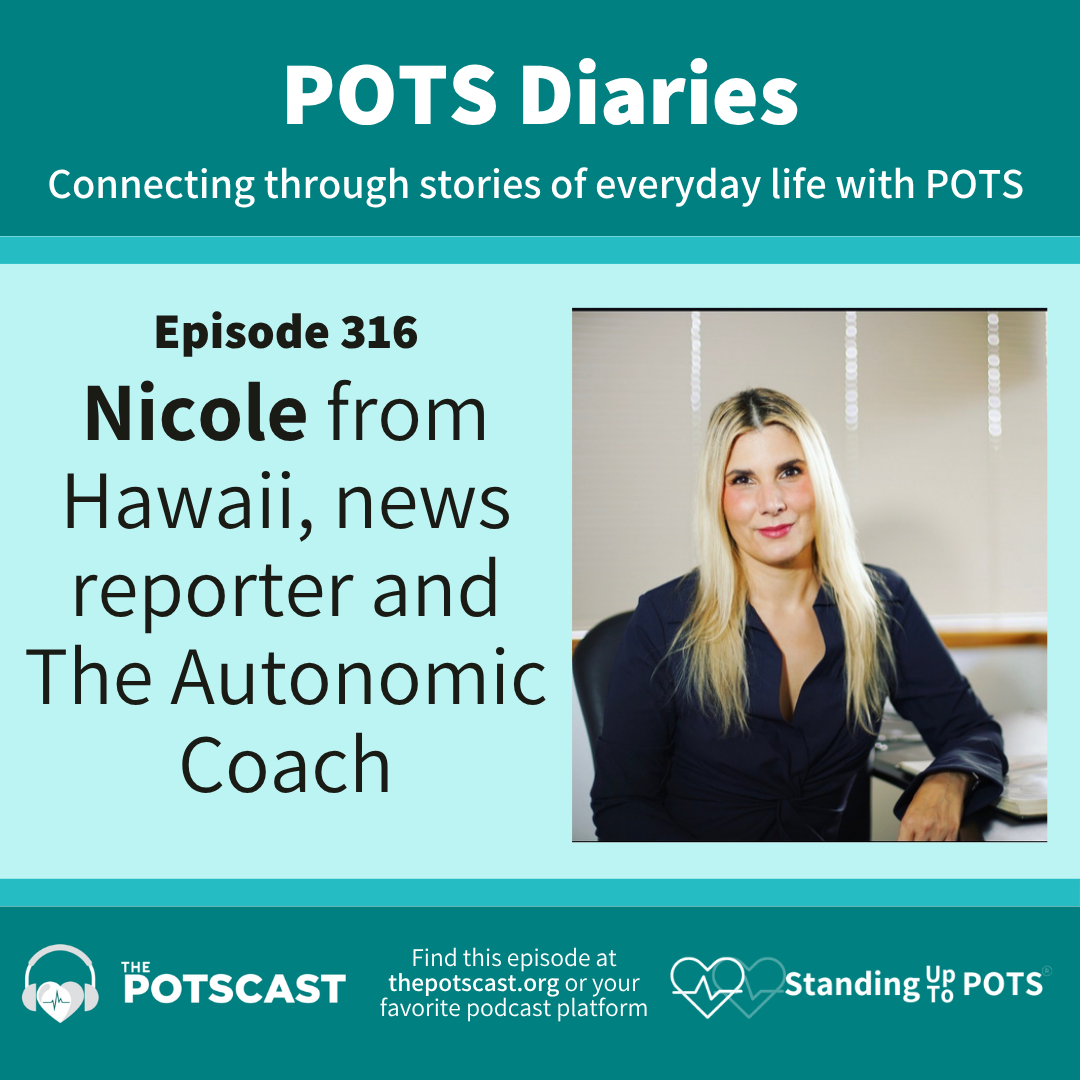
Nicole, The Autonomic Coach and news reporter from Hawaii
June 30, 2026
Nicole is a live morning news reporter (on her feet from 1am to 9am!) and horse lover in Hawaii who has dealt with type 1 diabetes, cyclic vomiting syndrome, POTS and more. In this episode Nicole describes her journey and how she is using her communication skills to help patients as "The Autonomic Coach" and to help educate about dysautonomia, including speaking to healthcare practitioners earning their CME credits.
Episode Transcript
Jill Brook: [00:00:00] Hello, fellow POTS patients, and marvelous people who care about POTS patients. I'm Jill Brook, your horizontal host, and today we have an episode of the POTS Diaries with Nicole. Nicole, thank you so much for joining us today.
Nicole: Oh, thank you so much for having me, Jill. I'm excited to be here.
Jill Brook: So let's start by just learning the basics about you, including, I think you're our first person from Hawaii. So how is Hawaii and what else
Nicole: No, Hawaii's great. It's really, really good. I'm born and raised here, fifth generation. It's kind of funny. I've kind of lived everywhere, but it's great. And right now we're expecting this hurricane, right? That's supposed to hit like Tuesday. But I, I think it's gonna, it's gonna weaken and slow down.
So I, I'm gonna say it's great now, but we we're kind of bracing. We've been in the news so much lately, you know, just from one thing or another. And I'm just kind of hoping we're not in the news again, 'cause I, I just covered a story with the tsunami. I am sure you saw that. That was wild. But it's nice, it's, it's nice here. I'm lucky.
Jill Brook: Wonderful. Okay. And you kind of alluded to it, but you [00:01:00] aren't just paying attention to the news 'cause you follow it. You are the news kind of. Well, tell us about that.
Nicole: Okay. Yeah, so I'm a, I'm a morning show reporter. I started my career in the news, oh goodness, like 20 years ago, worked my way up. Started as an intern, desk assistant, associate producer, that was like a combo role, then was hosting shows. Left, I got diagnosed with type one diabetes, actually. And this was in my, in my twenties.
So then I left, I took a break. Then when I went to my second station, that's when I got diagnosed with POTS. So now I'm circling back here and I'm on, not my third station, 'cause this is my original first station where I started, where I was there for like four or five years. But listen, I don't know, I don't know what it is about the news, so I'm just kind of bracing myself.
But I, I think I'm gonna be okay. I'm hoping.
Jill Brook: Wow. Okay. Well, I guess we'll get to this in a second, but before we move on about your POTS journey, what else should we know about you? For example, like how would your friends or family describe your personality?
Nicole: So it's interesting, 'cause I'm very extroverted [00:02:00] and I'm not that way only because of my job, but I just am that way as a person. I love finding out about people. I love hearing people's stories. But at the end of the day, I'm very much an introvert where I'm literally like in my bedroom, watching One Tree Hill or watching all like the, the 90210 comfort shows that like calm down my nervous system.
I was reading, like, we watch, we, we repetitively watch shows because they're familiar, familiar to us. And I didn't even know that. So my husband's like, let's watch this, let's watch that. I'm like, no, no, I'm, I'm gonna go watch Grey's Anatomy for the 50th time from the beginning. So, you know what I mean? So I very much like have to shut down at the end of the day.
Yeah, and I'm a, I'm an equestrian, so I I do have a horse. She's awesome.
Jill Brook: Well, that's a good tip. I had actually not known about that, that rewatching shows was a good way to relax.
Nicole: Yeah. It calms down the nervous system, 'cause we've seen the episodes, like we know what Brenda and Brandon are gonna do. So we're not like heightened. We're not like, oh my God, what's next? What's next? So it's like that comfort thing. Isn't that interesting?
Jill Brook: That is [00:03:00] interesting and I noticed that I'm drawn to TV shows that have very little conflict, which is kind of hard to find, right? Find things without violence, find things without anything, you know, too terrible going on. So I also see the value of rewatching shows where you kind of, at least if you know in advance what's happening, and it shouldn't stress you out too much.
Nicole: We deal with so much, like why would we wanna watch anything with conflict? Right, and then my husband and I are completely separate in the way of shows. So we watched Lilo and Stitch last night. I have never balled my eyes out in a, in a movie so hard since like ET when I ran out of the theater when I was a kid. But normally he's in the living room watching, I could just hear all of these, I mean, just like sounds of who knows what, and I'm in, in my peaceful other room, just watching the chill.
Jill Brook: So normally we like to ask people like, what was your life like before POTS hit? And then what was your first sign of POTS? Like, what was going on in your life?
Nicole: So I was reporting and I woke up one day and it was in 2017 and I literally could not walk up my driveway. My heart [00:04:00] was pounding out of my chest, it came out of actual nowhere. I went to the emergency room where of course they told me that I had a very high stress job and it was just anxiety. So what ended up happening, I would go to work every day, I would be okay, like during the day, you know, reporting and stuff, in terms of gathering information. But when I have to go deliver and front my story or do a live report, my heart would be beating so fast, I would leave the studio and I would lay on the couch outside of the studio because I, I truly like, couldn't breathe.
My heart was beating so fast. So I also have cyclic vomiting syndrome, which I've had since I was a kid. And I would have like cyclic attacks, I'd say once a year, twice a year maybe. But these were aggravating them so much that I would literally vomit my guts out, be on the news, throw up, go to the hospital, be in the emergency room, and then be admitted for DKA because with type one diabetes, you know, and this was with like perfect blood sugars, right?
I was in DKA with perfect blood sugars because of dehydration from all the vomiting. [00:05:00] So I was in ICU like a good six times in 10 months.
Jill Brook: And what is DKA?
Nicole: Oh, diabetic ketoacidosis. So that's what happens, basically in, in a type one diabetic vomiting is very dangerous, dehydration is very dangerous because we're insulin dependent.
And your ketones, you start producing, your body starts producing ketones. So if you vomit more than once, more than twice. You, you're gonna go, you're gonna need supplemental hydration for sure. So it was one of those interesting things where, so I was in ICU and then they were trying to figure it out, right?
They sent me to reproductive endo, neurology, they sent me pretty much everywhere, and nobody could really nail it down. My endocrinologist was like, your sugars are spiking at this certain time. Like, what's it from? And, and I'm like, I don't know. She's like, there's some sort of stress going on.
I'm like, I'm not like, but she could kind of see it with the, the adrenaline spike. She kind of identified that, but it was at that point that I had to seek care off island. Clearly I couldn't work. That was a done deal. I mean, you can't be in the hospital, but, I will never say type one diabetes is a blessing ever because it is [00:06:00] extremely hard to manage.
I have an insulin pump that makes things slightly easier, but you can't be in ICU six times in 10 months and have people call you crazy, have people call you, you know, anxious. Of course they call me anxious and I was like, yeah, of course I'm in this hospital. Of course I'm anxious. You, you know what I mean?
But I didn't have to go through that extremely painful process of 5, 6, 7 years of being told I was nuts because I was literally near death, right? So that got me a diagnosis more quickly pre COVID, than the average person with POTS.
Jill Brook: Okay, well I feel like I almost need to have a bell that I ring every time this happens where, where, what counts as a victory in our world is sometimes so shocking and a little depressing. So you are saying that you had a silver lining of being near death because it made them take you a little bit more seriously and it sped up your diagnostic process.
Nicole: A hundred percent. Yeah. Yep.
Jill Brook: Oh my goodness. Okay. [00:07:00] So how long did it take to get an answer? And once you had an answer, did they have things that really helped you?
Nicole: So, yeah, so I ended up having to go to the Cleveland Clinic, 5,000 miles from home, right, to actually get a di a diagnosis, which I did get. And I have hyper adrenergic POTS with the catecholamines through the roof. So for me it's really more of that yeah, I need the hydration, yeah, I definitely need liquid IV and in small amounts, but for me it's that just overproduction, right, of norepinephrine and that really high dopamine. So they, they got me the diagnosis and, you know, put me on a ton of meds, you know, beta blockers, all the, all the different things that you, you would use that, that really stabilized me. So I came home to Hawaii and I, it took me a good year and a half though.
I obviously failed the initial cardiac rehab program, which I would say 99% of people do. So you know, I met with an exercise physiologist who was wonderful. But, you know, I came home and, and soon realized that like the plan put in place was absolutely not gonna work for me.
So I [00:08:00] developed my own plan. So I decided, okay, I have to get reconditioned, but I, I need to do it in a place where I love. So I would go to the barn. Now obviously I could not ride but at least I could walk amongst the horses and, and, and be in a place that felt like I felt very connected to.
So my husband would take me to the barn and I would walk. So I would start you know, 10 minutes a day and I would gradually increase it. So I would say it did take me like a good year to, to say that I was better. I mean, the medicines helped me become better immediately, but to recondition myself, it was, it was, it was a, it was a process for sure.
Jill Brook: Yeah. Okay. So what's the story on the cardiac rehab that you failed and now work at? Or what's, what's that story?
Nicole: What it was is, you know, they give you these cardiac rehab programs that are like, work on the recumbent bike, do all of the things that you are after being in ICU and being, I was think I was like 105 pounds at that point. I'm five, like five, almost five seven. So there was no, I was so frail [00:09:00] that I did not have it in me to do any type of cardiac rehab that you would consider a traditional cardiac rehab model. And most patients don't from my experience, after having gone and, you know, taken a position at the Cleveland Clinic where I was working with patients one-on-one for an almost four years.
Jill Brook: Okay. Yeah. So smart. So you just figured out your own routine that works better and made you happy, and I'm sure it made your horses happy.
Nicole: Yeah, yeah, definitely. I remember pre-diagnosis, I would literally saddle up my horse and I'd be laying in front of the stall. It took everything outta me to saddle and tack up my horse, and then I couldn't ride. And then I'd be like gasping for breath. My heart would be pounding.
And, and you know, my instructor was like, get, there's nothing wrong with this horse. Like, get off. And she'd get on and she's like, he's fine. Like, why are you so anxious? I'm like, I'm not anxious. Like my heart is beating out of my chest. You know? So, and we all know how that feels, right.
Jill Brook: Yeah. Yeah. Okay. So once you regained your conditioning, what then?
Nicole: Okay, so then [00:10:00] I ended up taking a job at the Cleveland Clinic, and that was, that was great because my role there was to to be a patient liaison. That was my title. It was to be a patient liaison to help people you know, that come through who are basically broken you know, emotionally, physically, the whole nine.
Right? It's the last stop on the bus. Nobody wants to be there. I mean, it's not like going to Disneyland, right? It, but it's, it's like the last hope. These tertiary care centers are really the last hope for people that can't get a diagnosis in their home, in their home state, which I'm working to change. Which I'll get into that later.
So it, it was one of those things where I got there and I was there for like a good 14 days because I had to see endocrinology. I had, you know, neurology, I got a diagnosis. And then once I went through all that, took the job there. So basically me being a patient liaison, it was like an, an unbelievable lesson in everything that patients go through, that I kind of walked alone, that people, when I got there, they didn't have to [00:11:00] walk that road alone, right? So then I would set up calls with, with patients and, you know, do 45 minutes or whatever. I ended up getting my, life coach / health coach certification, and actually went on to, I'm gonna be board certified soon.
But, but it was interesting. So I was with a physician and really in immersed in these appointments to where people, so they would feel safe. So they would feel like, you know, listen, I, I know where you're at, 'cause people come in terrified, right? They're terrified. I know. I was absolutely terrified, right. Having to fly to go do all that. So that was, it was helpful for many people.
And unfortunately, sometimes it involves tough love, but you've gotta get 'em through it. So, so that was, that was my job. It was, it was highly rewarding. And to be at a, you know, a huge medical institution where you're working with patients, you're working with research, you're working with all of that combined really helps you see like the big lens, the big focus, and that people really do need to, to [00:12:00] feel seen.
And that's truly like the bottom line.
Jill Brook: Wow. And so did you work with all kinds of different patients in that capacity?
Nicole: Yeah, I did. I I definitely worked with really autonomic, but of course with autonomic, you see mast cell, you see Ehlers-Danlos, you see type one diabetes. I mean, you, you see like the whole gamut, right, of patients. I come to find out, I came back to Hawaii and I, I've gone to an allergist 'cause I just have, I have really bad allergies, but I've lived on antihistamines like for, for years. And she's like, you have mast cell. I'm like, no I don't. And she's like, no, no, no, you do. I'm like, no, no, no, but I've seen patients who do have mast cell and I definitely don't. She's like, I have so many people come in here that think that they have mast cell, but I'm telling you, you do. I'm gonna put you on medications today and we're gonna run these 15 vials of blood work.
So it did come back where I'm truly, I've lived on like Atarax and Benadryl and those really hard hitting antihistamines 'cause that's what allows me to function for years, and now I know why, because I do have a, have a histamine problem. I'm [00:13:00] really right on the border, borderline of, of it, but I'm, I'm kind of there.
Jill Brook: Okay. All right, so add that fun thing to the, to the mix.
Nicole: I notice I do very poorly if I'm not on my antihistamine. So, it just kind of put two and two together. It's like, I've been taking these for all these years to make me feel better, and now I know why. Sometimes the other POTS meds that I was on, they weren't working. But when I added the antihistamine component, it was like, whoa, okay. That put out the fire.
Jill Brook: Interesting. Yeah. Did any of the POTS or mast cell medications make your type one diabetes any more controllable or was that just seeming completely orthogonal?
Nicole: Oh no, it's absolutely not. I mean, my type one diabetes to this day is not, not in control. Nowhere near before POTS. So I'm in a closed loop system, which basically means it predict, predicts my trends, right? It predicts everything that happens kind of in my body. It [00:14:00] knows like that I bought 'em out at certain times. So it's, it's interesting. There's times I'm really insulin resistant and then very insulin sensitive, and that's really just because of the POTS. And unfortunately I've never been able to get into the control that I was in prior to POTS because when my adrenaline shoots up, it sends my blood sugar through the roof and if I take insulin for that next thing you know, I'm calling an ambulance.
So that's the thing, POTS too. Add that to the list in terms of, that's really messed up my type one diabetes. Because truly like, I'm very, like, clean with the way that I eat. I'm very, you know, I, I do really what I'm supposed to do. Type ones have a lot more freedom, right, because it is an autoimmune disease and whatever you eat, you cover for, right, with insulin. But I, I, I am mindful of what I eat, right? I'm not gonna choose certain things, right? I think about what's worth a shot. And I'm on the pump now, so I don't think that way anymore, but I, I still eat just very cleanly. Type one's rough with, for me anyway, with with POTS, just 'cause of my adrenaline.
Jill Brook: Yeah, but I wonder if that does give you some interesting [00:15:00] insights for POTS patients who don't have problems with type one or type two diabetes, but who do have issues controlling their blood sugar. And so what I'm hearing you say is that the adrenaline surges that come with the hyper adrenergic POTS send your blood sugar skyrocketing and you, because you have type one diabetes, have to take insulin.
Or, or may or may not choose to take insulin. But for somebody who did not have type one diabetes, their body might just make it, and that might sort of help explain why some people are on a bit of a rollercoaster.
Nicole: Definitely. So yeah, I'm insulin dependent, right? Have been for, I mean, years, 20 years or more.
And autoimmunes run in my family, right? Not type one, but, thyroid and different things. So it's interesting 'cause when I worked with patients like in that in clinic setting, we, there would be people whose blood sugars would just like bottom out and they'd have to go on a continuous glucose monitor, which obviously I'm on.
And they'd be like, why is my blood [00:16:00] sugar like bottoming out, this reactive hypoglycemia, right, that, that nobody could really put together with dysautonomia. And for me also with POTS, my ketones go through the roof which is, it's very strange. But that's really because of the POTS as well. There's so many different layers, right?
That it's just like, if you're not living it, you don't understand it, right. But if somebody lives it, you can say, oh, I understand. No two patients are the same blueprint, right, but at least you, you get it. I, I worked with people who had the hypoglycemic issues for sure.
Jill Brook: Right. Yeah. And sometimes, yeah, even if you don't get it, even if you just believe me, it's a big deal. So, so I know that you have, have become a coach and you are the Autonomic Coach, and you mentioned how you are trying to make it so that fewer people have to fly 5,000 miles get diagnoses and care.
Do you wanna talk about that?
Nicole: Absolutely. So, you know, it, it's, I think it's super unfortunate. So I think there was, there was [00:17:00] nothing good about COVID, right? Nothing good about COVID. The thing about COVID is now patients are getting diagnosed with POTS far earlier than they were prior to COVID, right? So during COVID, I mean, I was working with so many people.
Basically the hospital shut down. I was actually stuck in Hawaii. Not a bad place to be stuck, clearly. I was here visiting my family and then the world shut down. So I was helping to move people along, right, who still needed care. You know, who still needed that support even because there was a, you know, a global pandemic doesn't mean chronic conditions don't stop, right. So it, it's interesting because people need so much support and the biggest thing with POTS patients I've noticed is follow through. So diagnosis is key, right? But when you think about it, it's really fairly easy to diagnose. When I speak with clinicians, so I, I spoke with the at the Doctor of Osteopathic medicine, they had a, like a dinner here, right, and they had asked me to speak. So what the goal is, is to get patients diagnosed in their home [00:18:00] state.
So we normalize this diagnostic procedure, and PCPs can handle this diagnosis, right? Because now first normally they end up in cardiology, right? And then, then they finally, cardiologists are like, wait, whoa, I can control heart rate. I've, I've had an electrophysiologist say to me, I feel so bad for these patients because I can control their heart rate, but there's, so there's this, this myriad of other symptoms. But really a PCP should be able to, to handle that. So I just spoke in Utah about a month ago, and that was the deal. It was, it was a group of PCPs, right, at an osteopathic college Noorda Osteopathic College of Medicine in Provo, Utah.
And it was, it was like this one physician was like, I am the one that people keep getting referred to me because I, I listen to them and, and I was like, yes, that's the key, right? So normalizing like physicians thinking autonomic. So it is teaching people how to think autonomic. I'm like, if you see somebody, if you see a, [00:19:00] you know, a, a female, and I don't wanna say it doesn't happen to males, of course it does, but you know, that's typically with concussion or a chemical poisoning or some type of of injury. But with females, if you see a female who is jumping out of her skin with an elevated heart rate, obviously rule out cardiac, rule out you know, anxiety, 'cause that is a diagnosis. Right? But you gotta think autonomic. I mean, if somebody's coming in with GI issues, has a high heart rate and is, and is and is fully like, literally has the jitters and the tremors, think autonomic, really. I just think people should be able to get basic care for POTS in their home state without having to travel to these institutions. That is such a, such a financial burden. It burdens the system and it, it burdens the patient.
Jill Brook: Absolutely. But that's great that you're getting these invitations to speak. Do you feel like things are improving?
Nicole: You know, I, I hope so. So after I've given these talks, right, I was sitting next [00:20:00] to a physician who's like, I'm a hundred percent sure my wife has has POTS. He took me through the whole thing. I had another one come up to me after, and this was here in Hawaii, she's like, okay, there's two patients that I know of. They have POTS. I'm, I'm sure of it now, now that I can think of it. And then you hear all these stories, right? And it's amazing because, you know, I am a health coach, I'm a life coach. You know, I was trained at the Cleveland Clinic working there for four years. You know, wrote a book, was in publications, did all those things.
So I do consider myself like, you know, to have a very strong base in, in POTS care and treatment, even though I don't provide that treatment, right? I, I provide the support after the treatment, but it's interesting how these physicians and clinicians are just like, oh my gosh, give me all the information because I don't have it.
So it's, it's amazing to be that patient who has the information that's not just clinical, right, but lived. Then they're like, wow. So these light bulbs go off and these people wanna talk to you and get more information. So that's what's really cool. So I think it's helping to with like a [00:21:00] small degree, right, 'cause I've only had a couple talks so far, but I'm really hoping to grow this, so, so physicians do recognize it.
Jill Brook: Fantastic. So can you talk more about what a life coach or a health coach does for somebody and you know, speak to the patients, but also to the providers that are listening.
Nicole: And that's why I, I feel a follow through is so incredibly important, right? So clinicians don't have time. They absolutely do not have time. They make the diagnosis and the patient goes on their way and they're then they're left to fend for themselves. They need someone really, truly, who checks in with them.
You know, I was doing like once a week for some people I was doing you know, every two weeks for other people. It would be like a good, like, maybe like six sessions. Some people would need three, some people would need 12, some people would need six months. It just depended on the person, right?
And so clinicians can make that diagnosis, but it's the support after that, it's the questions after that. And, and if it's a question on medication, you know, I'm always gonna say, of course, deflect to your physician. I had this [00:22:00] one girl, it was funny. She was like, she was put on Atarax and she was put on like a, a higher dose and she's like, I'm really unsure if it worked.
I immediately fell asleep. I'm like, it, it worked. But if you, you know, if you, if you were out, it worked. But you know, if you definitely, if you think it's too high, you know, go back to your physician. So of course I was allowed to talk about the different medications. Of course the medications that, that I was on, I was allowed to share for sure. And and I share those things too with, with patients. But of course everything goes back to the physician. So like, when I was first diagnosed, I thought I was gonna have to literally sell all my clothes, donate 'em all, I was never gonna work again, right. And how can you not think that? So basically, you know, studying for being a health and wellness coach, you study and then to be board certified, which is where I'm going now. So I am certified, I'm not board certified yet. But I am board certified eligible. So that included in-classroom work as well. Lots of coaching hours in order to qualify for that.
So it's a process. It's a wonderful process. Now, I do say [00:23:00] my coaching, I specialize in people with chronic medical conditions, specifically POTS. So I don't, I don't, I'm not really a like a health wellness coach, like where you would come to me and be like, listen, I'm, I'm trying to eat healthy or this or that. I'm really a medical coach.
Jill Brook: Fantastic. And it sounds like, so you are back to doing live news. So talk about that, like, so is POTS still something that you have to manage daily? What do you do to control it? You know, how's life?
Nicole: Every minute of every day. How's life? It's an interesting situation. So this was just kind of something that fell into my lap. I got a call, do you wanna come back to the news? It was one of those things and, I was like, you know, I'm kind of in, in the process. I just built this business, this and that.
You know, maybe this would be something to do to, 'cause I'm a journalist, right? That's, that's what I've done my whole life. And I'm a communicator, so I'm like, yeah, you know, I'll do it. It's not easy, I gotta tell you. It is something that I, it's, it's a struggle. I am battling with it truly every day.
And you know, [00:24:00] for me, holding down a full-time job is, is I'm, I'm in control enough definitely to be able to do that. I obviously was doing it when I was in Ohio, but the morning show, it's a different animal, right? So I wake up at one o'clock in the morning, I have to be there at three. So I'm on air from four to nine. And with POTS, that is tough.
I have to tell you, I mean, there have been some days where I, I mean, I might need to go to the emergency room. And I didn't have to, right, but it's, I, I have to tell you, the shift is, it's hard with POTS. I'm pushing through it and I'm, I'm trudging along, but the, I would not recommend a morning show job to anyone.
Jill Brook: Yeah. Yeah. I mean, I think POTS is kind of famously worst in the morning for a lot of people and wow.
Nicole: So what am I doing? I'm doing Liquid IV. I'm taking all of my medications. The first week was a disaster. I called in sick the [00:25:00] first week because the last two days of the first like Thursday and Friday, I was like, I, I, I called the news director. I'm like, I don't think this is gonna work.
I, I really don't. I, my medication schedule was completely off. It was terrible, right? So the, I, I mean, really, like by day three, I was like, whoa. And then I got everything squared away, right, but I, I'm, I'm not gonna say it's not without difficulty by in any means. And now I'm noticing I'm catching, I'm really susceptible to like colds and things that I, that I really, I haven't been, I've gotten like two viruses, one infection in a virus in two months. I haven't gone through that. So it's definitely wearing on the body. I, I wouldn't say it's the smartest decision I've ever made in my life, but, but, but here I am, right? I, I I love the news. We'll see how it goes. I'm very committed to the coaching and growing that part of, you know, that speaking on a national platform, speaking to physicians, speaking to clinicians, medical [00:26:00] students, nurses, really, first responders, whoever.
That that's really my passion and what I love.
Jill Brook: Yeah. And can I ask, what is your schedule like in terms of like, so when do you go to bed? Do you try to get in that cardiovascular exercise? If so, when does that fit in? Do you come home and crash for a while and then...
Nicole: Yeah, the cardiovascular exercise is constant, 'cause I'm running, if it's running to breaking news, it's constant. So I'm on my feet from literally four to nine nonstop without sitting down. That's a challenge. That's very hard. So I don't feel like I need any exercise after that beyond getting on, getting on my horse.
And I have a torn hip labrum, so that's even another story. We're working through that. So I'm not, I'm not riding hard either at this point. So I come home and I say I I'm gonna sleep at one o'clock, right, like for two hours? No, I end up, I end up sleeping from like one to six 'cause I'm absolutely exhausted.
And then I'll try to go back at like 8:30, 9 until, until about 1:30, [00:27:00] you know? And so it's that sleeping in shifts.
Jill Brook: Well, gosh, I, I just wish you the best. You know, I, I feel like I've been there. I know how hard it is to like, have dreams that are sort of incompatible with what your body can tolerate. You know, they talk about that Ikigai concept about what the world needs, what the world will pay for, what your skills are, and what you value.
I forget what it is exactly, but they don't have a, they don't have a thing in the Venn diagram for what your body will tolerate. And I think about all of us who have, what our body will tolerate that is just not overlapping with that other stuff. But it sounds like you're making it work. You're, you're keeping your options open with your coaching and you're speaking and so that you're gonna be able to zig or zag or keep doing both, whatever.
Nicole: I'm definitely gonna be doing that for sure. I'm assuming that I'm gonna definitely be moved to another role, right, in this news. That's the goal, right? Because it was, we're gonna do this morning show, but then you can fill in anchor in this and that.
So [00:28:00] that was what really got me because. I mean, being on a morning show under a, it, it's just with this is not sustainable. I mean, let's face it. I mean, I, you know it, I know it. I mean, I, it might be for, for an extended period of time, but it's not for, let's say three years, right?
Jill Brook: Okay. But yeah, so sitting as an anchor and the evening news might be perfect. Is that what you're thinking?
Nicole: Yeah. Or like some in studio work, right? Like that's what ideally is perfect because you're not running around, you know, I'm not running to a fire. I won't get graphic on the other things that I've had to run to, of course, you know, I mean, this is the news. And there are other days where I'm covering hula shows, which is amazing.
Or I did, you know, something with Kaiser, I've done things with Shriner. So those things are really, really amazing. But, but definitely in studio work is hands down, more conducive to, to somebody with POTS.
Jill Brook: Well, I was actually gonna ask to hear, could your current self give some words of advice or wisdom to the version of yourself at your [00:29:00] lowest point? What does that version of you need to hear from current you?
Nicole: It's interesting because since this diagnosis, I've grown so much as a person. You know, I didn't think I could grow more. I mean, you're young, right, you don't think you can grow more. You think okay, I mean, I've been through so much as is this and that. I look back at who I was, and I think about like all the things that, like I took or the things that were like, everything was kind of a negotiable and I, I didn't really have like firm boundaries or anything like that. I was just kind of like a go with the flow, like person where almost, almost as like, you know, kindness mistaken for weakness type of person in a way.
And now I'm just like, absolutely hard nosed. Like these are non-negotiables. And that's what I tell, you know, the clients that I work with and stuff. Make things non-negotiable. Like for Labor Day. I've not been great about posting on my Instagram page, right, which is, you know, @theautonomiccoach. Because this job kind of came, right.
And I've been really, you would imagine [00:30:00] exhausted in this and that. So I don't think about doing that every day when I come home. But I was just like, for Labor Day, I'm like, do not feel like you need to go through any of this. Holidays, take your beat, stop it. If you can't make it to a party, you don't go.
There are non-negotiables for me, period. I, I didn't listen to myself. I knew I shouldn't have gotten on a plane in June. I got on a plane and had a medical emergency on the plane, which I have never, ever, ever experienced before with the oxygen and stuff. I mean, my POTS was so bad because I didn't listen to my body.
And I truly ended up having to stay in Los Angeles for two nights, had EMTs meet the plane. It was horrific. So it's like if you don't listen to your body, your body is gonna override whatever it needs every single time. I've always been strong, but this makes you tough as nails where you're like, absolutely not.
Like it's, I don't care what anyone says. If it's not gonna work for me, and if it's not good for, for my health, I'm not doing [00:31:00] it.
Jill Brook: It's like there's no punishment anyone can exact on you than is worse than what your body will do to you.
Nicole: Not, no, not anymore. It's quite interesting. It's quite interesting, like truly how much you do evolve and how much you do grow. You know, and I, I've obviously I've worked with patients, clients now 'cause I'm not in a clinical setting every day who are just like, you know, but I feel like I need to show up here and show up there.
And, and it's especially hard for people that have children. I don't have children, right? So they have this element of guilt that goes along, along with that, right? I have other major responsibilities. You know, you know, my, my mom and, and stuff like that, right? But I will draw a line in, in the sand, not when it comes to my family, but my husband's there to pick up the slack for me.
You know what I mean, if I can't like be that person in that moment. But but for anyone else, absolutely not.
Jill Brook: Yeah. So are you up for ending with a speed round where we ask you to just say the first word that comes to your mind?
Nicole: Sure.
Jill Brook: What is your favorite way to get [00:32:00] salt?
Nicole: Liquid IV.
Jill Brook: What is the drink you find the most hydrating?
Nicole: Oh, you know, actually Nello, this Nello Supercalm. It has like ashwagandha in it. I find that so hydrating, but it, it's not indicated for POTS patients. This is like to lower cortisol levels. Does it do that? I have no idea. I just like it, you know what I mean? I find it super hydrating.
Jill Brook: Cool. Okay. What is your favorite time of day and why?
Nicole: Hmm. I don't know. I don't even know like the times of day anymore. I think that's why I can't answer that question for you. I'd say probably the afternoon if I had to like pick it. Definitely the afternoon, like four or five o'clock would probably be my favorite time of day. But I mean, my days are so mixed up.
Jill Brook: Yeah, that makes sense. What is one word that describes what it's like living with a chronic illness?
Nicole: Oh, definitely grit.
Jill Brook: What is some good advice that you try to live [00:33:00] by?
Nicole: This sounds like cliche, but everybody's fighting a battle. You just never know what they're, they're holding and what they're carrying. Also don't take advice from someone who hasn't walked in your shoes. People don't know. And then also sometimes I, I have to remind myself too, because they don't know, because they don't understand, give them that grace. How could they possibly understand if they don't live it, if they're a nice person. If they're not a nice person, there's no grace.
Jill Brook: What is something small or inexpensive that brings you comfort or joy?
Nicole: Oh my goodness. There's so many things that bring me joy. What, what could I even say? Diet Coke. Diet Coke.
Jill Brook: Who is somebody that you admire?
Nicole: Walt Disney.
Jill Brook: Oh, do you wanna say why?
Nicole: Yeah, absolutely. Who could have an imagination like that, that could put together, like from a mouse right. It's unbelievable, somebody could have a, have a mind like that every time I see that statue when I go to Disneyland, because I do do like to go to Disneyland, of him holding hands with Mickey in that, that bronze statue [00:34:00] in the middle of the park. It's just like, whoa. That's like a mastermind. Yeah.
Jill Brook: What is something you're proud of?
Nicole: I'm definitely proud of the people that I've been fortunate enough to help along the way. The fact that I've been able to use my medical issues and move people through, through that, through what I've experienced, help people move along. That's the biggest one for me.
Jill Brook: What is the toughest thing about POTS?
Nicole: Oh my goodness. The toughest thing is definitely the unpredictability, where you, you wanna do something, you're, you're like, I have to do this. And then your body absolutely is like, no, guess what? You're not doing it. And doesn't matter if you have to or if you don't because you're not doing it. And then feeling like you have to explain to people, right.
Jill Brook: What is an activity that you can enjoy even when you're feeling really POTSie?
Nicole: I'd say reading, but that blurred vision comes in. Really just [00:35:00] honestly, I like to listen to music. I like to put on some good Taylor Swift. I do love her, and just really just kind of really listen to music. Yeah.
Jill Brook: Do you have anything that helps you fall asleep?
Nicole: I mean, maybe magnesium. Other than that, yes I do actually. Those lavender wormy animals, like the stuffed animals, you know. So I'm like wrapped in like a lavender, like, I don't know, horse, and then something on my stomach to just make me feel like that comfort.
Jill Brook: Oh, nice. Do you have anything that gives you energy when you need it?
Nicole: I guess I, again, I, I did like my vice in life is Diet Coke for sure. I don't really drink coffee anymore at all. If I do, it's decaf. And I, I just, I just don't really do it anymore. So I would say that's it. And if I need a little bit, I'll have like half my husband's coffee. Like if I really need something, I'll, I'll have a little bit of coffee. That's it.
Jill Brook: What is a gift that you would have sent to every POTS patient on earth if you had infinite [00:36:00] funds?
Nicole: Oh gosh. I think I'd get every POTS patient together in like one room and just have a, have just a, like a convention and people, everyone could just meet each other and just be able to I guess like all the free coaching in the world, to have someone to be able to move them through it and to make them know that they're not alone. A buddy. Right. Yeah.
Jill Brook: Nice. Have you ever had to sit down or lie down in a weird place because of POTS, and if so, where was the weirdest or funniest place?
Nicole: I have had to run out of a Target before where I was at like the checkout line. I find I can get through Target, but waiting in line there, it's not happening. So I'm just like, I gotta go. I left like the cart and ran to my car and I just like sat there. And then I was in a, definitely, I've been in, when you know, you're in clothing stores or whatever, and if you're, let's say you're trying on jeans or something. Whoa. That's a moment where you really have to sit down in that fitting room and be like, [00:37:00] I need a minute, or, or something like that. Yeah. People are like, are you okay? I'm like, yeah, I'll be fine.
Jill Brook: Yeah, I've always thought that at least the stores that have people monitoring the fitting rooms with cameras, they probably know who the POTSies are because they, I don't know, I know that I lay down when I'm putting clothes on.
Nicole: Right. Yeah. You have to like, sit down in, in one of those, or lay, you know what I mean?
Like, yeah. I, I lay down, like if I'm, if I'm putting jeans on, on the bed or whatever, I'll just be like, I'm gonna, I got, I gotta, I gotta take a minute.
Jill Brook: Okay, so wrapping up, what do you wish more people understood about POTS?
Nicole: Oh gosh, I just wish that the patients didn't have to explain themselves. I wish that it became normalized to the point of physicians being like, you know, this isn't anxiety. This is you're, you are suffering. Let's acknowledge that you are suffering. Those are some of the key takeaway points, like the speeches that I prepare, right?
I talk about key objectives. Say to patients, maybe I don't know what's wrong with you right [00:38:00] now, but I believe you, I see you, and we're gonna get to the bottom of it rather than, oh, this is just anxiety. It's all how you frame your communication with people. You may not have the answer today, but it's that you're going to find the answer and you're gonna be there for them in the interim, right, while you're looking for it. That's, that's the biggest one, and that's, that's what I'm working to change. And there are so many clinicians out there that are open to it. So many wanna just solve this problem.
Jill Brook: Wonderful. Wonderful. So, we'll put your website in the show notes, but do you wanna tell people where they can find you online?
Nicole: Sure. So I'm at theautonomiccoach.com. I do you know, one-on-one coaching. Obviously a first session is definitely free because I have to know if somebody wants to work with me, right? See if you wanna see them again. So I definitely do that and then, you know, people can decide if, if it's a fit or if it isn't. And, and it just works that way. And then obviously I book clinicians and and groups of clinicians, whether it be nurses or [00:39:00] doctors or whatever, to just really spread the word.
And I have a whole 45 minute to hour long presentation. I usually do a 45 minute presentation with 15 minutes of questions. And the questions go far beyond 15 minutes. I have to tell you that. So what I have learned is I have to either book it for right before lunch, and the lunch break, right, 'cause everybody wants to know about POTS. Or if it's a dinner, you know, right after that dinner. I want the POTS community to know that there are so many clinicians out there that wanna know more about this and I see it and I live it firsthand. Yep. Yep.
Jill Brook: Wonderful. Well, Nicole, thank you so much for speaking with us today. Thanks for everything you're doing to try to raise awareness. Best of luck to you in your morning work, and I know everybody listening is just wishing you all the best. Thanks a million.
Nicole: Thank you so much for having me, and it's just been such a pleasure speaking with you.
Jill Brook: Hey listeners, we hope you enjoyed today's conversation. We'll be back again next week, but until then, thank you for listening. [00:40:00] Remember, you're not alone, and please join us again soon.