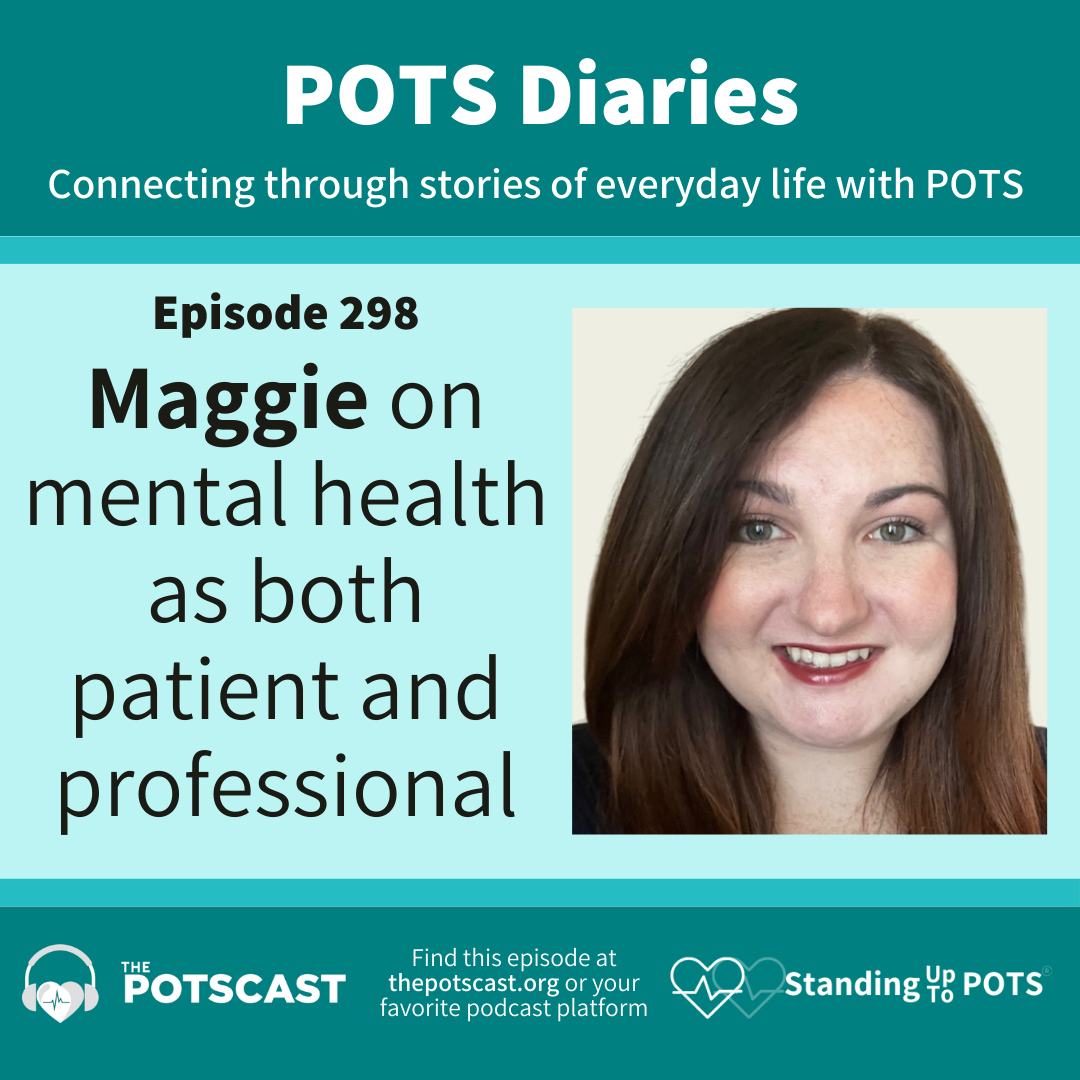
Maggie on being both patient and Mental Health Therapist
February 25, 2026
Maggie was 14 when she started passing out regularly, and she still does occasionally, but that didn't stop her from getting back to school, completing graduate work and becoming a Mental Health Therapist. Maggie shares how she helps others with invisible chronic illness and strategies she uses herself. Maggie also shares some statistics about living with disabilities and a recipe for cooking octopus! Maggie's website is here.
Episode Transcript
Jill Brook: [00:00:00] Hello, fellow POTS patients, and beautiful people who care about POTS patients. I'm Jill Brook, your horizontal host, and today we have an episode with Maggie. Thank you so much for joining us today, Maggie.
Maggie: Thank you. I'm so excited to be here and to be able to discuss, you know, so many different things with you all.
Jill Brook: We're excited to discuss a lot of things because you're a little bit special in that you are a patient, but you are also a mental health therapist, and so we are excited to hear everything that you have to say. But let's just maybe start off getting to know you a little bit. Can you tell us the basics about you?
Maggie: So, as you said, I am both a POTS patient and a therapist. So I was diagnosed about 14 years ago when I was 14, in fact. And it took me a really long time to get a diagnosis. I think it took, well, less than the average time for a POTS patient, but it took me about three to four months. I was lucky in the fact that I had a really great mom who's a nurse, who was able to kind of see some of the symptoms along the way and kind of push that along as far as [00:01:00] trying to get diagnosis.
But so, you know, having 14 years experience as a POTS patient as well as I have been a nationally certified counselor for the last year. I've worked in both the private school system, the school system in general, I've worked in private practice settings, so definitely a lot to draw from.
Jill Brook: Yeah. And I guess I wanna hear more about what your work is like, but I don't know if you wanna tell us anything more about you personally, like what you're into or what else you're passionate, or if your work is your main passion, tell us more about that.
Maggie: Yeah, I do love my work. In addition to being a therapist, I'm also going to start as a professor in the fall teaching lifespan development on the college level. So that's really cool. But besides being able to like, educate myself, educate others, I also love my dog who happens to be on my lap, 'cause otherwise he would've cried throughout this whole thing. I am very much someone who loves self-care. So like I listen to Harry Potter audio books frequently as a way to like ground myself, even though I've listened to them more times than [00:02:00] I can count on my hands and toes. So yeah, that's just a little bit about me. Enjoy long walks on the beach, you know, stuff like that.
Jill Brook: Ooh, nice. And what part of the country do you live in?
Maggie: I'm outside of Philadelphia, Pennsylvania, in Montgomery County.
Jill Brook: Okay, fantastic. And so can you tell us a little bit more about your work? You've said you've worked in schools and in private practice settings, so what kinds of stuff do you do?
Maggie: So I predominantly work with women and their health. I do a couple of different things. I have a few different certifications. I have a Gottman Level one certification and that focuses on couples. I have a maternal mental health certification through Postpartum Support International that focuses on perinatal and postpartum mental health. And then I also work a lot with those in the invisible illness, chronic disability world. So kind of trying to pull from different backgrounds, certifications I have, as well as my own personal experiences to mainly help women in their health journey, whether it [00:03:00] be mental health, you know, as well as allowing them to learn how to advocate for their physical health when it comes to some of the issues that may come up there as well.
Jill Brook: That's so interesting. Wow, so can I ask how similar or how different are the mental health challenges between women with these different issues, the postpartum, for example, versus the marital versus the chronic invisible illness?
Maggie: There's a lot of similarities that you wouldn't really realize would come up. So I think that advocating for yourself is so important. There's more research being done about some postpartum issues, but like chronic illness or POTS, like there's so much more that needs to be done and it's really only come up in the last decade, especially with POTS, the long haul COVID, now there's more research with postpartum. It's really been done in the last like seven years, or decade, like there's been more research, but there's so much more. So it's a lot of having to unfortunately do a lot of your own research or relying on those who have done their research and knowing when to advocate for yourself and say [00:04:00] like, hey, I need more help with this. A lot of the same treatment is used or at least I treat it in a similar fashion. So looking at what strengths do you already have and how can we use your strengths to build upon what you already have and continue to help you flourish throughout life.
Jill Brook: Oh wow. That sounds really interesting. So just to maybe like dive a little deeper into that, can you like, give an example of like maybe a person that you've worked with, with chronic invisible illness and like what were their strengths that they built on?
Maggie: Yeah, so one of my patients has diabetes and frequently struggles with making sure they're taking their insulin, making sure they're getting the right medication, making sure that doctors are really listening to 'em. They're, they're a teenage client. So, you know, trying to make sure they're also responsible for their own needs. So looking at, okay, so maybe you struggle with getting your insulin or [00:05:00] maybe you struggle with checking your sugars throughout the day. What are some areas in your life that you already are really consistent in? Okay, so every day you know that like you text your friend that you're going to school. What drives that in you?
Okay? The drive behind it is you wanna connect, right? So if you wanna also work on your chronic illness, how can we make that a priority to you as well? So just like you prioritize your friendships and your social connection, how can we make sure getting your and checking your sugars can also become a priority to you in that sense, because you have it in you to be consistent. It's just trying to draw out in different parts of your life.
Jill Brook: Oh, interesting, interesting. And so, do you tend to work with people long term or is it a short term in and out thing or...?
Maggie: So they typically say to give therapy about six months, you know, before you really start to see an impact. So I have had clients for over a year. I've had some after six months say I have done well. I've had some after four months say, you know what, this has been [00:06:00] amazing. I've learned a lot on this journey, and I think I have the coping skills and, you know, tools for what I need to continue to succeed on my own.
Jill Brook: Wow. Very cool. So what was your life like when you were 13 before you had all this come on?
Maggie: At 13, I was playing sports. I was really into basketball and lacrosse. I was your typical teenager just, maybe not typical 'cause I was a bit of a nerd. So like, I was really involved in school. I was, I say this because it's important later, I was a straight A student. Didn't really struggle much in school. Always worked really hard and felt like the, the hard work also paid off in the grades. So just enjoying life before that, and really had lots of friends, didn't have to worry about social connections, didn't have to worry about people understanding me. So I would just say like you're a pretty typical, average 13-year-old.
Jill Brook: And then what was your first sign that POTS was arriving?
Maggie: So, as I said, my mom's a nurse. So she was a bit of a stickler about us staying home from school. And so I [00:07:00] never tried to abuse that. And one morning I said, I know that our household rule is, you know, fever, vomit, diarrhea, like you have to have something serious going on. But I just have a headache and I don't feel well.
I just feel off. And she said, you know what, you can stay home today. I remember, you know, getting up, walking to go get myself a drink. Next thing I knew I'd passed out. And I called my mom at work and let her know what happened and she was like, okay, I'm coming home. You know, we'll take you to the hospital. They had no idea what it was. They couldn't really indicate anything at that point. My, you know, blood pressure and heart rate were back to what would seem as normal and they weren't doing any like tilt table or anything like that to measure it. So from there it was really just going to different specialists and doctors to try to figure it out.
And in the meantime, you know, my grades drastically changed. I wasn't able to go to school. It became very rapid where I was passing out more frequently. I was having some like shakes, some memory loss, just like a [00:08:00] variety of different symptoms, and it became really hard to be consistent with my social connections, my friendships. I could no longer play sports, so things became very, very different, very quickly.
Jill Brook: Yeah. And can I just ask, so when you would pass out, what would that be like for you? Would it be like very sudden, in slow motion. Did you feel it coming on? Where would it happen?
Maggie: Yeah, I would say there was, it was always, even to this day, because I do pass out to this day, it's, it still can be a bit different. So there are times where I feel it and I can get to the ground or do my best to get to the ground before I fully have a full syncopal episode where, you know, I'm blacking out. And there are other times where it comes on so quickly that I don't know it. So since I was 14, it's really been a variety of warning signs, not warning signs, full syncopal, pre-syncopal, you know, episodes.
Jill Brook: Okay. And so at that time, what did [00:09:00] you think was happening and what did your mom think was happening?
Maggie: I really had no idea what to make of it. I knew I was scared. My dad as well was, was scared. And I had a younger sister at the time. My sister's three years younger, so you know, she's even younger, not really understanding what's going on. None of us are really understanding what's going on. And I think our household at that time was upset and stressed.
You know, my parents take me to different doctors, you know, a neurologist, cardiologist, being like, please help us figure out what's going on. And it wasn't until, like I said, my mom started researching some symptoms and had emailed a POTS specialist at Johns Hopkins and said, hey, these are my daughter's symptoms and I think she may have POTS, can you give us a little bit more insight and, you know, help us have conversations with doctors about what it might be? And so he was able to do that, and we took it to a cardiologist who was like, oh, you know what, like, I've never really heard of this. But you're right, like this, this is very accurate to what she's experiencing.
And at first it was some basic like, increase your water content and eat a bag of chips. But then it [00:10:00] evolved over time to, you know, the right medication, salt tablets, electrolytes. You know, I've gone to PT, you know, done the Dallas protocol and whatnot. So it's really evolved over time. But at first there wasn't a lot of understanding, both medically and even like on the level of being at school with teachers not understanding when I had to miss more school or where my memory would go. I remember having a teacher, this is a bit off topic, but I remember when I would take tests, I had a teacher who said, you could just see a look in my eyes when I lost sight of what was going on. She said, you could physically see it during tests, and she was great, but not all teachers were unfortunately understanding at that time.
Jill Brook: Wow. And I just wanna say, go mom. That's just so wonderful that she figured out, or she knew someone or knew how to reach out to an expert to make sure that you got some help. That's fantastic. So you said it took about four months or so to get a diagnosis.
Maggie: It did. Yeah. It took from [00:11:00] the, I wanna say, spring, the, the start of like the end of summer, fall.
Jill Brook: Okay. Now my big question is once you had a diagnosis and you had a medical team that knew what you had, did you get very much help? Like I'm a little sad to hear that you're still passing out, 'cause apparently you're not like magically way, way, way better. Or maybe you are. Maybe you were just that much worse, but you're still passing out.
Maggie: Yeah. I would say I was significantly worse when I was younger. I was passing out on a, I would say, couple times a week basis as a kid. And the memory loss was significantly more severe and just all the other, I mean, POTS affects everything in your body. So like my, my GI like every, everything felt like it was being obstructed on such a high level. To this day, yes, I do pass out. It might be a handful of times a year. So I work with my cardiologist on it and I do have a really great cardiologist, Dr. Harper out of Main Line Health. But [00:12:00] unfortunately it's one of those things that hope he hopes I am able to grow out of one day, but, you know, there's no guarantee that that's gonna also be able to happen, but there has been significant change.
Jill Brook: Oh, that's good. Did you ever figure out, like, was there a trigger that you think was involved?
Maggie: Yeah. They think it was a concussion as well as like Ehlers-Danlos Syndrome. So like that combination, like getting a concussion playing basketball, and then also just having EDS. So they think that was kind of the magic combination that all set it off.
Jill Brook: Okay, so what helps you the most? What got you to this point where clearly, I mean, I guess at that point you were not even able to really go to school. You said it was hard to maintain your grades, but here now you've been able to work and get all these wonderful accomplishments. And so tell us about how you got back to functionality.
Maggie: Yeah, I think it was a lot of working with doctors and learning how to advocate for myself from a very young age. But I mean, I had my mom there to advocate for me [00:13:00] as well and really push that I was trying medications that worked for me but also knowing that I couldn't always count on her the older I got.
You know, when I'm 18 and I'm off to college and I pass out, I have to learn how to advocate for myself. So I think making sure I'm working with doctors who understand what I need as well as understanding what I need myself made a huge difference. I think just increasing fluids, you know, getting the right movement in, knowing what triggers my POTS. So for example, like heat intolerance, stress, fatigue. Those are probably my three biggest triggers. So trying to avoid being out in the sun for long days, or if my stress levels are high, what can I do to manage them and bring them down, or getting more sleep as needed. So really just understanding my body over the years because with that, it's helped me to be able to do things like go to school and as I said, also advocating for yourself. So I needed a 504 in high school and I would use that on the occasion, or getting accommodations in high school and college and [00:14:00] grad school. So just using them as I felt comfortable and as were necessary to also kind of help me along the way.
Jill Brook: So was that tough, for example, going off to college and you mentioned passing out on your own and having to wake up on your own, like how'd you deal with that?
Maggie: Yeah. I learned about the heat intolerance in a strong way by going to University of Tampa, and experiencing 90 to a hundred day degrees in September and having way too many of them. And after a year and a half, my parents said, you've had enough hospital visits to scare us, so we are going to, you know, ask that you come home.
And I said, you're right. I love the school. I'm having a great time, but my POTS is not. So I came home and ended up transferring so if I needed to come home and rest, you know, outside of being at school, I could, and, you know, I, I was grateful to really have the support of both my parents to really guide me in the right direction.
But it was scary, you know, passing out on your own. I had roommates that were like, what do we do? And trying to figure out like, okay, like [00:15:00] what can I do, you know? I think one of the best things that you can ask, or a friend who asks, what can I do if you pass out, is can you get on your knees and put my feet on your shoulders to try to get the blood flow, you know, going back.
So, you know, knowing that kind of stuff for yourself to be able to share with others is important.
Jill Brook: Yeah. Yeah. So did those experiences change you very much as a person, do you think? I don't know, did you have a different trajectory after getting diagnosed and dealing with that?
Maggie: Yeah, I think it made even trying to find a profession really hard. So I was originally in undergrad and advertising major and worked in advertising when I graduated. But having a nine to five in an office where I could be sitting all day was really difficult for me and also the fatigue part. And when COVID came around, I was working in a retirement home. And I was doing advertising and events for the [00:16:00] community and I just asked like, hey, we're not able to do events because of COVID right now, can I just call some of the residents and see how they're doing? 'Cause I know what it can feel like to not feel okay or just be scared in general and wanna be able to reach out and talk to someone about what you're feeling. And so, in reaching out I realized that I wanted to be a therapist. You know, obviously not doing therapeutic work with them. I wasn't a therapist yet. But just talking to 'em about how they're feeling really put me on this path to be more empathetic to what other people were going through and, and being a therapist, you tend to have a more flexible schedule and that's also really helped me as well.
Jill Brook: That is so cool that, that you took advantage of that time during COVID to think about them and then to discover your own passion for a career. Wow. That I, I bet they appreciated it so much that just their marketing person had taken it upon themselves to check on them.
Maggie: Yeah, so it was, it was like the, the kind of, I guess the [00:17:00] good positive note that came out of COVID was being able to connect with others and like learn from what was really a hard time for many people.
Jill Brook: So do you have anything that you have to do every day now, for example, to like kind of keep yourself going?
Maggie: Definitely water. I have it right here with me, my Eagles cup. And just drinking lots of it, starting the day with like lots of water, making sure I take my, my medicine that I'm prescribed. If I don't take my medicine that I'm prescribed that is not a good day for me. So I would say getting a little bit of movement in the mornings some water and my medicine are like the three biggest things for me.
Jill Brook: Yeah. Now, you had mentioned that you had some some statistics or some factoids for us about some of this stuff.
Maggie: Yeah, so one of the really cool things I did in graduate school was present at a counseling conference on the intersection of mental health and invisible disabilities. And, [00:18:00] and some of the research I looked over and found, I found some really interesting facts, so I'll kind of just like run through some of them if that's okay, and you can stop me as needed.
So Americans with disabilities tend to earn less than those who do not have a disability. So those with a disability earn a median of 28,438 in 2021 compared with 40,948 among those without a disability according to the Census Bureau.
Jill Brook: Wow. So, so half as much.
Maggie: Yep. Almost half.
Jill Brook: Wow. Did that count only people with jobs. So that's not counting the people who don't work and averaging them in. That's people who work.
Maggie: Who work earn a salary. Yeah.
Jill Brook: Okay. Oh, a salary. Okay. So it's not even like they're working fewer hours.
Maggie: Well, no, they may work less hours, they were saying,
as a result. So anyone with like a, any sort of income is what they were looking at.
Jill Brook: Got it. Okay. Oh, okay. Thank you. Go [00:19:00] ahead.
Maggie: Another interesting fact along with work is that research shows that 88% of employees with invisible disabilities chose not to disclose it at work to avoid stigma and discrimination. This showed long-term effects of lower morale and less productivity.
Jill Brook: Oh, interesting. So are they saying, okay, so, so the vast majority choose not to share it, and you're saying that by not sharing that reduced their morale and productivity.
Maggie: Yeah, and it often comes back to that social isolation piece because they feel like when they're so internal and not able to talk with others, it makes it harder for them to feel as part of a team or to produce because they feel like they're often hiding something as a result.
Jill Brook: That's interesting. Although I could also see that there might be a little bit of a chicken and an egg thing here, because the 12% who do choose to reveal it to their workplace might be doing it because [00:20:00] they feel a stronger connection and they don't worry so much about being stigmatized. And so it might be high morale making it okay for them to feel like they wanna share. I don't know.
Maggie: Yeah, no, I actually think that's a really great point for, for you to bring up as well, 'cause I think that there's a lot that could be said for that as well.
Jill Brook: But that is interesting because it does sort of suggest, I don't know, does it, does it suggest to you that to the extent possible, if you can get a job somewhere where you do feel comfortable sharing your kind of real situation, that it does help keep morale higher, maybe.
Maggie: Yeah. I will say in my own personal journey when I've been able to disclose and have it received well, because I think that's also like another caveat that needs to be thrown in there, I have felt closer with my coworkers. I've felt that if I was struggling with a project, struggling with the project because of POTS, like maybe I was having a flare up, I could talk about it and open up with it, then I was really, you know, driven to work really hard to show them that [00:21:00] I was committed to, like, their values. I think in times where I haven't disclosed and I've kind of kept it internal, it's been harder for me to feel like I'm completely connecting or, and I think to the piece of productivity, for me personally, this might not apply to anyone else, if I felt internally like I was slacking off because of my POTS, it made me feel like more discouraged in my work overall.
Jill Brook: Right, right. And you can also imagine that if you can just lay down for 10 minutes when you need to, or whatever it is you need to do and get back to work, that does make you more productive than having to hide it and just try to muddle through the day, but feel horrible all day.
Maggie: Yeah.
Jill Brook: Wow. Okay. Fascinating. What else?
Maggie: Okay, so other statistics to consider would be one in four adults with disabilities, 18 to 44 years, do not have a usual healthcare provider. And one in four adults with disabilities, 18 to 44, have unmet healthcare needs because of the cost in the past [00:22:00] year.
Jill Brook: Can you say the first part again? They said they do not have a primary care provider.
Maggie: Yeah. So one in four adults with disabilities, 18 to 44, do not have a usual healthcare provider. So that can imply that like maybe it's hard for them to have like a regular healthcare provider due to like, changes in insurance if they're working and then maybe like lose a job or they're already able to work consistent hours, and like a change in insurance for there as well.
Jill Brook: Wow. Wow. You know, that is, that is unfortunate because at least what I hear on the POTScast with everyone is that finally finding that doctor who understands you is such a huge piece of the puzzle. And so to not have any doctor who's a usual doctor, much less one who understands you, is probably devastating.
Maggie: Absolutely. And even talking about the, you know, one in four, also just having unmet healthcare needs because of the cost. You know, again, circling back to [00:23:00] one, like thinking about the copays that you have to pay for medications or specialists and the constant need to go to doctors to make sure that you're keeping up with your disability or your chronic illness. I know with POTS, like I have different medications, I have to go to the cardiologist every six months. And that's someone who is just trying to maintain, you know, not trying to necessarily constantly improve upon because I'm at a point in my life where it's a little bit more stable. So yeah, to know that one in four adults, unfortunately do not have regular healthcare, you know, needs met is also really like devastating.
Jill Brook: Wow. And especially in a place like POTS where it's so hard to get a diagnosis, I suspect that those are all people who, you know, if they had POTS, it wouldn't get diagnosed.
Maggie: Exactly. Yeah. And the last statistic I have is one in five adults with disabilities, 45 to 64, did not have a routine checkup in the past year due to like, just having disabilities.
Jill Brook: [00:24:00] So barriers, like it's just too hard to get in and do it.
Maggie: Yeah. Especially at that age where depending on other symptoms that may surface at that age. So whether it is, you know, you're not able to drive or you are having more chronic pain from different ailments on top of your disabilities, it's harder for you to have your routine checkups. I would also be curious too, and I don't believe they touched on this in the research article, at the higher end of the age, like when you're near retirement also, how much does that impact it as well?
Jill Brook: Right. Right. Wow, interesting. And I guess, I guess part of me is not that surprised because I knew that our system has some pretty big flaws.
Maggie: Yeah, it does.
Jill Brook: And I guess so the people that you tend to interact with, they probably, it sounds like they probably are more likely to have resources and [00:25:00] access to stuff. So, so the people that you work with personally, do they tend to to have more access to care? Or do you work with some of those people who don't?
Maggie: Yeah, I do tend to see people through insurance. And so therefore their needs are being met at a greater percentage because they're able to go through their insurance to seek other providers.
Jill Brook: So as far as what you see, what tends to be the biggest challenges that people have, like specifically. Is it loneliness from not getting out? Is it depression from not getting the life they thought? Like what, what tends to be the stuff that you see in the chronic illness patients?
Maggie: I would say isolation from others not understanding. I think that is such a huge piece of what they struggle with, and also how I approach how to help them. So oftentimes being able to take the narrative back for them and speak on their journey, speak on what [00:26:00] has caused them pain, and also being able to rebound and be perseverent, has been really big in trying to help 'em find ways to overcome some of the barriers of isolation.
Jill Brook: Wow. Yeah. Are there any sort of bits of advice or encouragement that you find yourself giving on a regular basis to those patients?
Maggie: Yeah, I think when people talk about the loneliness of it, the, the one thing I'll do is I talk about my own journey, like to a, to a minimal degree. Like, hey, like, you know, I've been there, I understand it. But it's so important to find your community, you know, within your own disability. You can find a Facebook group out there for almost anything nowadays and really connecting with those people in your community to, to help. You know, it takes a village for many of things and sometimes it takes a village to work through living with a chronic illness or disability. I personally have this great friend named Wilder who, you know, we keep touch on, you know, [00:27:00] multiple times throughout the week.
We both have POTS, and just kind of supporting each other and like, what are you going through this week? How can I support you? You know, it might not be, I am having a POTS flare up, so I can't physically get to you, but can I be there for you emotionally. Can I send you a funny video? Like what, what can I do for you?
So really talking to patients about finding their community and their people.
Jill Brook: Yeah. That's great. Are there any things that you know now about either POTS or just chronic illness or just mental health in general that you wish you had known sooner, like when you were a teenager?
Maggie: I think I wish I could talk to my younger self and say like, with time, it'll get better. Whether it's mentally, physically because for everyone it doesn't get better physically, but for me it did. But mentally, you know, with my own therapy, 'cause I'm a firm believer in therapy for myself as well, I found great coping skills and resilience and perspective.
And so really being able to know that with [00:28:00] time I would have a shift mentally and physically would be like a great thing to be able to tell my younger self.
Jill Brook: Yeah. Yeah, that's great. Are you up for doing a speed round where we ask you to just say the first thing that comes to your mind?
Maggie: Yeah.
Jill Brook: What is your favorite way to get salt?
Maggie: Chips.
Jill Brook: What is the drink you find the most hydrating?
Maggie: Water.
Jill Brook: What is your favorite time of the day and why?
Maggie: Morning, because that's when I have my self-care routine.
Jill Brook: Where is your favorite place to spend time?
Maggie: Anywhere with my fiance or dog.
Jill Brook: How many doctors did you see for what ended up being POTS?
Maggie: Probably close to six or seven.
Jill Brook: How many other POTS patients have you ever met in the flesh, face-to-face?
Maggie: Ooh. I attend a yearly POTS walk, so at least 50 to a hundred people that I've seen.
Jill Brook: Fantastic. What is one word that describes what it's [00:29:00] like living with a chronic illness?
Maggie: Challenging.
Jill Brook: What is some good advice you've heard that you try to live by?
Maggie: I think always try to just do your best each day, and that's all you can ask for.
Jill Brook: What is something small or inexpensive that brings you comfort or joy?
Maggie: My Harry Potter audio books.
Jill Brook: Who is someone that you admire?
Maggie: My, oh, both my parents. I can't even name one. Yeah, both of them.
Jill Brook: Do you wanna say why?
Maggie: I think that both my parents have worked really hard for my sister and I. And I appreciate all the love and support they've given us along the way.
Jill Brook: That's great. What is a food that reliably works for you?
Maggie: I love cooking duck, so like that brings down my levels of stress. So I feel like even just that, like if I'm feeling stressed, making myself some duck with like a mustard sauce.
Jill Brook: Did you say duck?
Maggie: Yeah, I know it's a bit of an odd choice, but yeah.[00:30:00]
Jill Brook: That is, that's so cool. Are you like a gourmet chef?
Maggie: My two favorite things to cook are octopus and duck. So I wouldn't call myself gourmet, but I like trying to cook different things.
Jill Brook: Okay, so now I'm picturing the scene out of Better Off Dead when they're like cooking and the tentacles are coming out of the pot. How in the heck do you cook an octopus?
Maggie: I put it in boiling water for about an hour and then grill it or pan fry it.
Jill Brook: I'm gonna have to Google that. That's so fascinating. That is really cool. And what does it taste like?
Maggie: I don't really know how to describe the texture. I think like there's like a crunch to it, depending on how you do it, but like, I like to do it with a lot of like citrus and herbs and olive oil to kind of like give it some flavor, like just like a very Mediterranean kind of vibe.
Jill Brook: Wow, that's so cool. Okay, well I had to take that little tangent. That's fascinating. What is something you're proud of?
Maggie: Getting my master's.
Jill Brook: What is the toughest thing about having POTS?
Maggie: That it's invisible most of the time.
Jill Brook: What is an activity that you [00:31:00] can still enjoy even when you're feeling your most POTSie?
Maggie: Mm. Time with my dog and fiance again.
Jill Brook: Do you have any tricks or tips to help you fall asleep?
Maggie: Definitely not using my phone an hour before I sleep just for good sleep hygiene. And if needed, putting on either an audio book that I find relaxing. I don't mean to keep bringing it up, but I, Harry Potter always helps me decompress.
Jill Brook: That's great. Do you have any tips or tricks for getting a boost of energy if you need it?
Maggie: Movement, I think is the best.
Jill Brook: What is a gift that you would give every POTS patient on earth if you had infinite funds?
Maggie: Mm, I would say electrolyte tabs and unlimited free therapy.
Jill Brook: Nice. What is something you're grateful for?
Maggie: I am grateful for all of my friends and family that continue to support me each and every day.
Jill Brook: Have you ever had to sit down or lie down, or in your case, pass [00:32:00] out in a weird place because of POTS? And if so, where was the weirdest place?
Maggie: Mm. I've passed out in a very nice restaurant, in a dress. So not the most comfortable way to pass out either. So yeah, I would say in a, in a nicer restaurant.
Jill Brook: Can you finish this sentence? I love it when...
Maggie: I love it when good people are rewarded.
Jill Brook: People might suspect I'm a POTSie when...
Maggie: I pass out.
Jill Brook: And I just have a couple more questions. What do you wish more people understood about POTS?
Maggie: I wish more people understood that it's such a complex issue that it affects so many different parts of the body. So many different organs, so many different parts. It's not just your heart rate and your blood pressure. It could be GI issues, it could be brain fog. It could be so many different things, and it could change on a daily basis as well.
Jill Brook: So if I can take advantage of your being a mental health therapist for one more question, what is the biggest [00:33:00] improvement you've ever seen in terms of mental health? Like, can somebody go from the absolute worst to really good? Or like what, what kind of, what kind of change is possible? What kind of change is probable if someone, you know, gets the right resources and works at it? What can people expect?
Maggie: There's so many different cases that come to mind. I mean, I've seen people walk away from abusive situations that they were really stuck in. I've seen people who were very depressed learn how to find hope and perspective and really learn how to give themselves grace through what they were going through and start to do things for themselves as opposed to feeling like they needed to like confide to their bed. And I've also seen those with, you know, some really severe postpartum issues come out of it and work [00:34:00] towards ways that they could support themselves, their partners could help support them and how to build a community as well for themselves.
Jill Brook: That's great. So what I'm hearing is that no matter how badly somebody feels, or no matter how bad their mental health is, there's really no ceiling on how good it could get to.
Maggie: Yeah, I think with the right support, the right knowledge and understanding and the willingness to try, anything's possible in therapy.
Jill Brook: That's great. And why did you agree to let us share your story today?
Maggie: I think that, you know, like I talked about with like the narrative piece of, you know, in therapy, like being able to tell your own story and help how that helps you really rebound. I think it's so important for people to hear other people's stories, to encourage them to share their own and be brave and say, hey, like I've gone through it too, and maybe I can get to the other side of this.
Jill Brook: That's great. Well, Maggie, thank you so much for sharing your story and all your insights and knowledge with us. We so appreciate it [00:35:00] and I love that you're out there helping people, a lot of people like us and others, and I know that everybody listening is just wishing you all the best going forward. So thanks a million.
Maggie: Thank you so much for having me. It really meant a lot to be able to share today.
Jill Brook: Yay. Okay, listeners, that's all for today, but we'll be back again next week. But until then, thank you for listening. Remember, you're not alone, and please join us again soon.