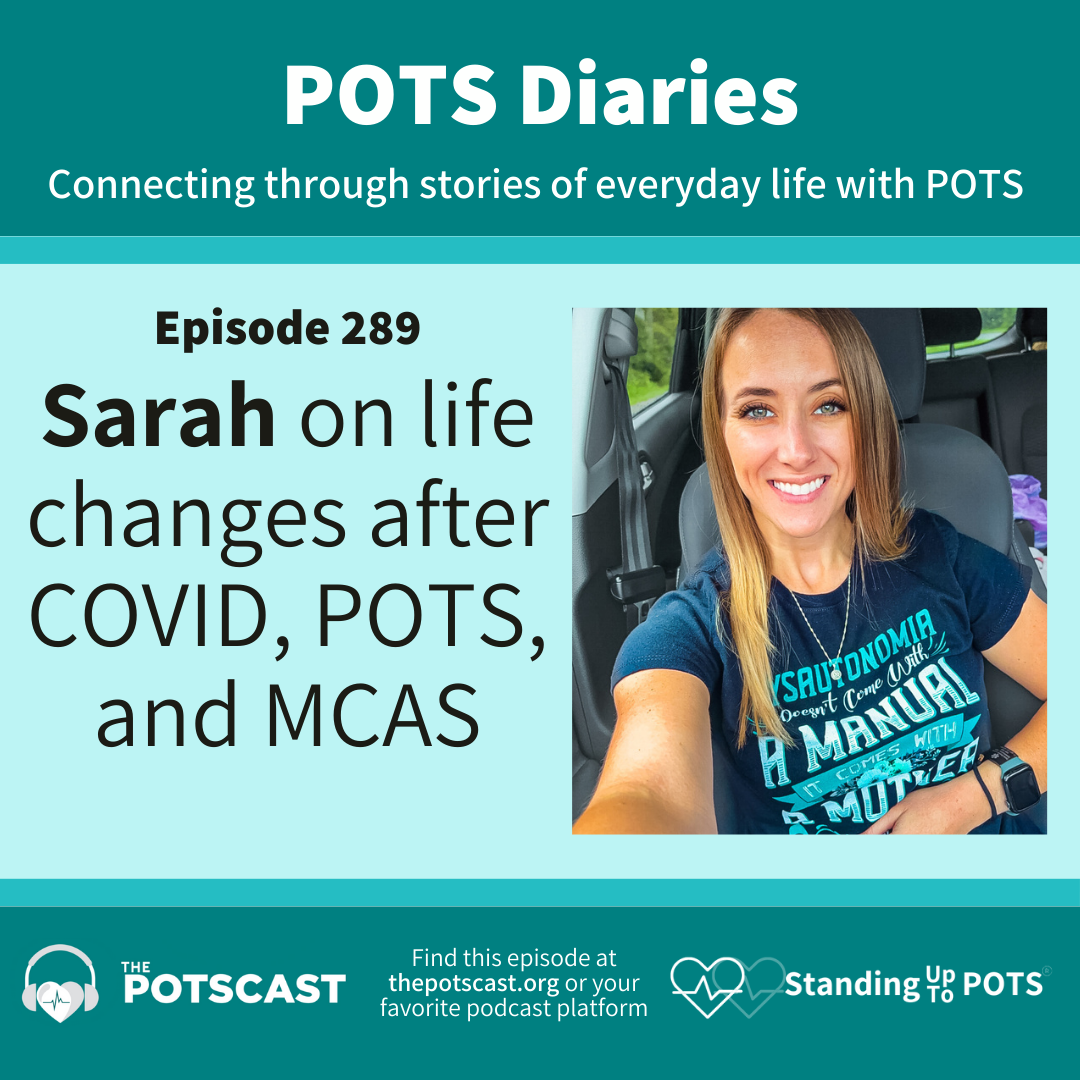
Sarah from FL on life after COVID/POTS/MCAS
December 21, 2025
Sarah loved her life as a busy mom an accomplished professional dog groomer, but after COVID left her with new symptoms suggestive of the 'Trifecta' (POTS, MCAS, hEDS) she is needing to make a new game plan....one that doesn't involve so many hours of standing and triggering fragrances. In this episode she discusses what she went through to get a diagnosis and how -- with the help of supportive family -- she is working through the challenges to design a new lifestyle.
Episode Transcript
[00:00:00]
Jill Brook: Hello, fellow POTS patients, and beautiful people who care about POTS patients. I'm Jill Brook, your horizontal host, and today we have an episode of the POTS Diaries with Sarah. Sarah, thank you so much for joining us today.
Sarah: Super excited to be a part of this. I've been looking forward to it for quite some time.
Jill Brook: Yay. Okay. Well, tell us the basics about you. Who are you, where are you? How old are you? All that good stuff.
Sarah: So I am from Orlando, Florida. I am 31 years old and I was diagnosed with POTS and mast cell at 30 years old. So I've been kind of battling with it for about a year and a half now. A little over a year and a half. I am a full-time mom to a five and a half year old, beautiful little girl. She consumes most of my time.
Currently I'm not working full-time because of my conditions, has been very life altering, but I'm hoping to enroll back into school and get some form of a degree to kind of help me find possibly a work from home [00:01:00] career that I can succeed at. And I have a wonderful mom who has been beside me through this entire ordeal.
I know a lot of people kinda struggle with that, so she's been a huge support system.
Jill Brook: Yay. Oh, yay, mom. Okay, so how would your friends or family describe your personality?
Sarah: I actually asked my sister-in-law the other day and one of my best friends how they would describe me, and she said, open, honest, friendly, lively, and courageous. At times I can be a little bit on the pessimistic side, but I think before POTS I wasn't truthfully like that. It, it's kinda given me a different perspective on life and chronic illness and learning to kind of find a new normal within myself.
But overall I would say I'm, I'm definitely very caring. I'm usually thinking about people before I think about myself. So that's, that's kinda a little bit about me.
Jill Brook: [00:02:00] Oh yeah, okay, and what are your favorite things to do?
Sarah: Well before I got sick with POTS I loved to rollerblade. I loved to be in the gym, spending time with friends, going to the beach. I'm very heat sensitive now, so I can't even really enjoy the beach as much as I loved to. Pretty much the basics. I'm pretty simple, I guess you could say, very kind of a relaxed personality, but still outgoing. So, I mean, I like to hang out with my friends when I can, but most of the time being a single mom, I'm kind of just focused on my little for now because she's still so young and starting kindergarten. So I have a lot on my plate to kinda work with, but I'm, I'm doing a lot better than I was in that aspect.
Jill Brook: So you mentioned rollerblading, which I had to laugh because I love roller blade too, or did love to roller blade. And it's funny 'cause not very many people do that anymore, but one of my last roller blade trips that I ever did was actually in Florida because when I turned 40, my [00:03:00] dear dad wanted to help me do something that I would like, sort of like a bucket list dream item.
So he helped me get to Florida with my husband. And then he we joined one of those tours in Florida that like, you know, rollerblades and a van goes and helps you go. And I have to say that the POTS was pretty bad and the heat was pretty bad. And I spent a lot of time laying on my back with my feet up in the air, including during my 40th birthday dinner.
I was laying outside, just wishing for it to be over, laying on the ground, listening to everybody be like, hey, let's have another round of drinks to celebrate Jill's 40th. So, I just have to laugh 'cause rollerblading, rollerblading just triggers all those lovely memories for me. But Florida has some cool rollerblading trails.
Sarah: Yeah, we do. And with the Florida heat too, I think growing up, I mean I was kind of acclimated to it anyway 'cause I'm born and raised here, so I spent most of my childhood, if, if people were looking for me, I'm on my roller blades. That's, that's [00:04:00] what I was doing. That's where I was. I had my little at the time, the little portable headphones I would put on and I would be gone.
Jill Brook: That's awesome. So, so can you give us a snapshot of what your life looked like before POTS entered? Like what was the day like for you? What was your, what was your jam?
Sarah: I would say, very consistent and routine like, but in a good way. Very normal. I would get up at 5:30, I'd be off to work, drop my daughter at daycare and pretty much just a busy mom. Trying to kind of navigate this new normal with a child has been quite the challenge. I would say emotional rollercoaster to be exact.
A lot of the, I've kind of faced a lot of stigma from certain friends and family. In the beginning they were like, you're just having anxiety. You need to just take anxiety meds. And I tried that and I actually got sicker and felt worse. [00:05:00] Not anything against anyone who needs medication to function. I absolutely believe that it can help some people.
It just wasn't for me. It actually made me worse and landed me in the ER a couple of times. So as far as my life goes then versus now, way different. I have to depend on other people a lot more than I used to, and I was extremely independent, financially as well. Now since I've lost my career, kind of in between a rock and a hard place, it has been. It's given me some mental health challenges for sure, that I'm still working through. I'm sorry if I seem anxious as well because I'm not as good at talking to people as I used to be, I guess. I feel like between brain fog and the chronic fatigue that I have, body pain, just everything I've experienced has been very, very different.
I feel older than what I am. And it's, I feel like I've aged because of the disorder. So I, [00:06:00] I just don't feel as sharp as I used to be mentally. I actually had got a work from home job after I got sick. I was out of work for a year and tried to work from home and my symptoms were so bad that sitting at a screen for eight hours a day I was actually getting sick doing that.
So, I'm kind of back to square one and trying everything my cardiologist is telling me to do. I'm like, okay, I'm determined to do this. And there was actually a time there when I started working out again. I started very slow. I have a rowing machine, so that's been a huge helper for me. There's some days where I can't do it. My body will definitely tell me, nope, not today. And I, I, I started slow and steady. I would start out, you know, five minutes at a time and I've worked my way up to a whopping 13 minutes of rowing.
Jill Brook: Huge. That's wonderful.
Sarah: So before I got [00:07:00] POTS I could row for an hour straight, no problem. I mean, I'm young. I was super healthy and fit when all this began anyway, so.
Jill Brook: Yeah. Can we, can we just make sure, I wanna make sure everybody gets to hear your whole story, right? And I wanna, I wanna make sure they kind of know where you started from. So is it correct that you were, you said you were a a pet groomer before? So does that mean that you were the person who would like take a really dirty shaggy dog and make it all clean and beautiful and fluffy and nice?
Sarah: Absolutely. And I started that, I started out as a bather for PetSmart actually when, it was 2014, and then I got promoted to go through a grooming academy with them, which was super cool. I actually got to be put through academy and I did over 800 hours of training and learning just all the ins and outs of how to cut dog hair. And it's not as easy as it looks.
Jill Brook: I believe that because every time that I [00:08:00] have decided that I was gonna try to like do my own dogs, any part of it, the cutting, the washing, the grooming, I've even like bought expensive shears. I fail so hard so fast every time. And I'm like, dang, there's obviously a lot of skill to this that is not appreciated.
Sarah: There is, and I will say groomers are a little bit underappreciated for sure. But we do, I mean, I, I've done it, I did it for 10 years. So, throughout the years I, I learned a lot. And I think as a groomer you learn something new every day. I mean, there's even the different breed standards and haircuts and stuff. It's a lot. It's a lot to, a lot of information to retain and people look at their pets as their children and their babies. So you have to be on your Ps and Qs and definitely on top of your game. And I will say I've been bit, a couple of times. I think the most stressful part of the job is just working with dogs that are more temperamental and they don't like to be bathed and [00:09:00] clippers around their ears or face. It's a, it was a learning process for me, but it, I flourished in it. I did really good. I built up a lot of clientele and it, it was a commission-based career, so you pretty much, whatever you're putting in, you're getting out of it. And I thrived. I actually had left my job with PetSmart at the end of 2023 and got hired on with a boutique out of Longwood, Florida.
And they were incredible to work with. It was a smaller salon, but it was more family based, which is kinda what I was looking for. I was trying to kind of get out of the corporate scene and just kind of focus more on being more personable with my clients and being able to take my time. I feel like in a corporate aspect, we were just very rushed and the atmosphere just became a little stressful for me.
So, ended up switching jobs and then I got sick, I wanna say about two and a half months after being there, is when all my symptoms started and I didn't know what [00:10:00] was going on with myself. I would call my mom panicking. And I'm like, I, I don't feel good. I feel like I'm gonna pass out. I mean, racing heart into the one sixties doing nothing, just standing.
Extreme fatigue, body pain, brain fog. I felt like I was having a stroke. It was weird. It was, it was like I was not myself at all. Struggled to find my words. I mean, pretty much every symptom of POTS.
Jill Brook: And and I think you had mentioned before that this was after having COVID.
Sarah: Yeah. So, a few of the girls that were working in the salon with me at my new salon, they all went down sick, and I was the last girl in the group to go down and I kept telling my coworker that worked beside me, I'm like, Erin, I don't feel so good. And I ended up catching COVID and I had it for, it was my second or third time.
I believe my second time having COVID. And I had a lot [00:11:00] of stomach symptoms as well with it, which the first time I didn't, so it was, it kinda hit me in a different way than it did the first time. And I started going to the bathroom so much and I couldn't keep anything down. I dropped almost 20 pounds in three weeks just from being so sick from not, I couldn't eat anything, it was like, I don't know, it was like a switch turned on in my body and nothing wanted to function.
Jill Brook: And did the POTS and fatigue come on right away, or was it a little while after the COVID ended?
Sarah: Looking back I feel like I've had a form of POTS throughout my life. Like I didn't know what POTS was before I was diagnosed. And the cardiologist is the one who diagnosed me in January of 24. And when I think back to it, back before I changed jobs, when I had COVID the first time at the beginning, I think it was beginning middle of [00:12:00] 2022.
After that, I started to notice different symptoms were slowly coming on, but I just chalked it up to mom burnout, being tired, stressed, things like that. So I'm like, okay, you know, I'm fine. And the last thing that I think really hit me was the tachycardia, 'cause I wasn't experiencing that and I wasn't experiencing the syncope and, and feeling like I'm gonna pass out.
I mean, I would, I would leave work and I remember I'd tell the girls before leaving, I'm like, I don't feel so good. You know, I feel super fatigued. And when you're grooming, when you're doing a haircut, after you do the bath and everything, you're standing in one area around a table for a long period of time.
And as we know, standing with POTS is hell on earth. At least it's what it feels like for me. I struggle with really bad adrenaline dumps in general from it, so I believe I have the hyper adrenergic type mixed with a little bit of the hypovolemia as well. And [00:13:00] my cardiologist is like, you're a tough one, because we feel like you have a mix of all of it occurring at once.
And I ended up seeing an allergist because when I was at work, I noticed that being around the dog hair and the smells, we would use colognes and bath soaps and stuff and I would feel sick after smelling any of those scents in those products. I would get hives and rashes all up my arms and skin. Things I had never experienced before.
So I'm like, okay, am I suddenly allergic to dogs? Like this was new for me. So, and I remember telling the girls too, I'd be working and I'd, I'd drink a small cup of coffee and instantly would feel sick. And I've drank coffee pretty much all my life. I mean, since 18, 20 years old. And one of the girls I work with, I'm like, hey, you know, I'm not feeling good.
I, I was actually forgetting my lengths and how to style different dogs. And I learned all the breed standard haircuts, like, [00:14:00] I mean the ins and outs of everything. And I had totally, it was like my brain had been wiped away from functioning. And I remember calling my mom and telling her like, I need you to come get me, I can't drive, I feel sick. My worst symptom would be the dizziness and the tachycardia. I mean, it's, it's like next level dizziness for me. I remember going home and telling my mom, I'm like, something is wrong with me. Something feels off. I'm gonna make a doctor's appointment. And I remember laying in bed and I'd tell her my heart is flying. My heart literally was flying. And I get symptoms laying, sitting, standing. I mean, you name it, every day I experienced some kind of symptom from it. And before I got diagnosed, I went to the ER and there was one night I got up in the middle of the night, I was getting adrenaline dumps at like two, three o'clock in the morning.
And now I've kind of tied in the histamine issues. So now that I've learned a little bit more about foods and triggers and [00:15:00] things that my body just doesn't wanna agree with, I've done better being on the high dose antihistamines, which has relieved some of my symptoms. But I have to have them every day.
Like I, I would not be able to survive without them. Once I realized that I actually, I would get really swollen, like my skin would get really swollen, I would get rashes, the tachycardia, I mean ear ringing, brain fog, pretty much every symptom. And then when I put two and two together, I was like, mom, every time I put on my makeup, you know, my heart's flying and I feel like I'm gonna pass out and die.
Like this isn't normal. When I'm on the toilet, when I'm taking a shower, when I'm driving down the road. I had a really scary episode driving down the road. I forgot where I was going. And I'm like, I'm 30 years old. This should not be happening to me, you know, and that's when I grew more concerned because even now I struggle with memory issues.
It's more short-term [00:16:00] memory. Someone can tell me something and I'm like, I have to write that down. I have to put it in my calendar or I will forget. I noticed my symptoms would get worse with different triggers, and I, and I ended up going and seeing an allergist per my cardiologist. He was like, I think you have something more going on because that doesn't, he, he was like, that doesn't sound super normal for POTS.
And I'm like, well, everything I've kind of researched on it mentions this mast cell, you know, activation syndrome, histamine problem. And then I noticed, I'm like, I was eating spinach, I was eating tomatoes, I was eating pickles, avocados, and every time, instant tachycardia, instant flushing and swelling and problems.
Jill Brook: Good detective work.
Sarah: And I've had to be my own advocate throughout this entire journey. I've been called crazy. I've been pretty much told that I'm insane, and I'm like, no, what I'm experiencing is very real.
Jill Brook: So who told you that? Who, who made you feel [00:17:00] that way?
Sarah: So a few of my, a few of my doctors, I actually, the first doctor's appointment I made with my primary care, and I love her, she's, she's a very nice lady, but the medical field is definitely a little bit behind here in Florida when it comes to long COVID and POTS and all that. I went and seen her, and I actually had an episode right there in her office. So that kind of justified things for me. I'm like, okay, I don't panic like this when I go to the doctor.
I'm a very laid back person. So when I started getting all these weird symptoms, I'm like, okay, there's no way I am just randomly this anxious. Like there's no way I feel like I'm dying every day for nothing. Like I'm, I wasn't doing anything to provoke that feeling. And I remember going in her office and my heart rate was like 1 53 just sitting. And she was like, are you okay? And I said, no, I don't feel okay. I, I'm blacking out. I would lose my [00:18:00] vision. Could barely even sit up and walk. And I get really bad blood pulling in my arms and my feet and my legs. So most of the time if you see me up and I'm crossing my legs, it's 'cause my feet start to hurt when I stand in one area.
And I started noticing, I would tell my mom too, I'm like, I can't stand in even going in like Walmart or Target. Fluorescent lighting would trigger me so bad to where I couldn't go in the stores. And I'm like, I, I felt crazy because I didn't understand what was going on. And the fluorescent lighting at my primary cares doctors was the same way.
And she checked my blood pressure and at that time it was super high with high tachycardia. And she's like, I'm gonna send you to the ER because I'm not sure what's going on with you. She's like, are you anxious? And I said. I don't feel anxious until my heart starts flying. Like I didn't feel that impending doom feeling until the symptoms came.
And she's like, [00:19:00] okay. And she couldn't figure it out. So she was kind of like passing me around to different emergency offices. And I ended up going to the ER. She prescribed me Prozac, actually. She gave me Prozac. She prescribed Xanax as well. And she's like, try these. I think you're just having panic attacks, like really severe panic attacks.
And I'm like, okay. And at that time, like I said, I didn't know what POTS was, I didn't know anything about POTS. So, I had all the symptoms of it. Now that I look back, I'm like, okay, all those panic attacks make sense. And I came home that evening and I started the Prozac and I was excited. I'm like, oh, I'm gonna try these meds and it's gonna take away all this panic feeling.
And I actually had an episode in my daughter's school parking lot, and I had passed out behind the wheel, going to pick her up. So I didn't drive for [00:20:00] almost four or five months when I first got diagnosed because of all of that. I mean, I was terrified and I didn't wanna put anybody in danger. I didn't wanna put my daughter in danger.
And, and coming from such, being a high functioning person to having to navigate so many small little things was really difficult. But, on the other hand, I tried the Prozac and I made it three days. I got to the third day and my tachycardia and my blood pressure was so bad. I'm like, I can't, I can't take this.
Like, it's not, it's not for me. It's not gonna work. And it actually made me feel really weird, just neurologically. I, I felt more off. And I'm like, okay, so we're not gonna do the Prozac. And I stopped it. And then the third night I took it is when I had my mom call an ambulance because I lost my vision and was just kind of sitting on the floor rocking back and forth with extremely high heart rate.
And I'm like, [00:21:00] I don't know what to do, mom. I feel like I'm dying. I feel like I'm having a heart attack. Like, please call an ambulance. And looking back, I'm like, was I dramatic? No. Like my symptoms were so valid and so real. Like it's so hard to explain this disorder to other people that don't have it because there's, there's such that stigma of, you know, just anxiety. You just have anxiety. And it's like, no, this is a real disorder that took me down for the count at 30 years old. But besides that, I, I ended up in the ER that night after taking the Prozac and the guy there left me sitting for a good two hours with a heart rate of 160 and he was like, just breathe, you're fine.
Everything's fine. And I get temperature dysregulation. I get really bad tremors. I know I'm overdoing it if my body starts tremoring and shaking and it's something [00:22:00] I can't control. At one point I felt like I was having, like starting to have like a seizure or something, like it was weird, like neurologically I haven't felt like myself since. Like I said, a lot slower. I can't even, word finding sometimes is hard for me. Like my brain fog is so bad that I, I, some days I can't function. And even with my job that I had got working from home, I lasted from February 3rd of this year to the end of April and I couldn't do it anymore.
I was like, people were yelling at me on the job and I just couldn't take the stress of being yelled at. It made me have adrenaline dumps even more, and I couldn't control that feeling either of sitting in one area for so long. Like I don't do well sitting still for a long period of time. I have to keep moving 'cause if I don't, then my symptoms are really bad. But not to, I feel like I'm jumping around. I apologize.
Jill Brook: That's okay. And [00:23:00] I'm sorry you've been through all this, and it sounds like up until this point that you're talking about, you still did not have an accurate diagnosis.
Sarah: No, no, the last hospital I went to, he also said, oh, you just have a really severe anxiety problem. Take the Xanax. And I'm like, so this is the second doctor that told me this was just panic and anxiety. So I, I started to believe it. I started to believe it and I'm like, okay, do I, am I really like that anxious?
Everything in my life was going so well for me and I was thriving and I just turned 30. So I'm like, my life wasn't bad. Like I was, I was very excited for the journey I was on. And I actually told my mom. She came and picked me up from that ER, and I was like, please don't ever bring, like, don't ever bring me here again.
I just feel like something more is wrong. And they just were very dismissive of my symptoms. They did some blood work and stuff and they're like, your blood work looks great, da da da. [00:24:00] There's nothing wrong with you. You're having panic attacks. Take the Xanax and you'll be fine. And I'm like, okay.
So then I tried the Xanax. Made me 10 times worse. Extreme tachycardia, couldn't sleep. And I have a family member actually who is diagnosed with anxiety and depression and she takes Xanax to help her calm down and it works for her. And I'm glad it works for her. But for me, it did the total opposite. So I ended up going to a different ER because I told my mom, I'm like, I wanna go somewhere else. This keeps happening. And I was having these adrenaline dumps, I would say, I mean, up to 20 times a day. Like I could not stand up out of the bed and do anything without having serious problems. And how do you function like that? You don't. You can't function properly that way.
So, she ended up driving me to a hospital in Sanford, Florida. And I think I got lucky because I know a lot [00:25:00] of people take a long time to receive a diagnosis. He came in and did an echocardiogram and did the NASA Lean test with me, and he was like, I believe you have POTS. And I'm like, well, what is that?
I had never heard of it. And he explained it to me and he was like, let's just put it this way. It's a life-changing disorder and you're going to have to kind of roll with the punches and figure out what works for your body. And that was that. So I'm like, okay, here's my time to research and figure out what to do. Because my first thought was, I can't live like this. Like I actually battled with, after my diagnosis I got really suicidal and I felt just very lonely. A lot of my friends and stuff like, kind of just separated from me and I think they thought, you know, she just has anxiety and I'm just kind of pouting about it.
Nobody really took me seriously until my symptoms [00:26:00] escalated so bad that, you know, I lost my career and I couldn't work and, and I'm living with my mom and my uncle now and they're having to kind pick up where I was at slack wise. So that has made a huge impact on me because I love to work, I love to be involved in society and just be a part of normal life, like other people, especially at, you know, 31 years old with a daughter as well who's looking up to me to, to be able to give her the best life possible.
Jill Brook: So you said that after your diagnosis for a while that you, you did feel suicidal. Did that change? And if so, what helped you out of that?
Sarah: So I've noticed that I'm still actually learning coping mechanisms for myself to get through those episodes because sometimes throughout the month I notice that I'll start getting those feelings come rushing back when I'm having a [00:27:00] bad day or when my symptoms are really extreme. I'm like, I can't do this.
You know? And seeing the normalcy of my friends and everyone around me thriving and working and eating and drinking, and just going out and doing normal things that I can't really do anymore, it got really defeating. It, it made me slow down a little bit. And I've noticed now that when I start to feel that way, I've been really big on reading like positive devotional books and being able to, I had joined a support group on social media as well for dysautonomia, and my cardiologist actually said, I recommend you join a support group to kind of help you do this.
And I'm like, okay. And I had tried to kind of fight through the feeling. And like I said, it comes back, but not as much. And I think working out, changing my diet, and learning to accept that this is my new [00:28:00] normal for now. My body has been incredible on its own trying to regulate itself, so I, I gotta give credit to my body because it's definitely trying.
It hasn't given up on me entirely, and I thought it did in the very beginning. It was, it was brutal. And I noticed too that with these thoughts the more research I did on Mast Cell Activation Syndrome, I'm like neurologically, when I ended up seeing an allergist June of last year, I explained all my symptoms to her and told her I was diagnosed with POTS per the cardiologist.
And she was like, I feel like there's a histamine issue at play here with some neuroinflammation going on in the body. And I'm actually on 40 milligrams of famotidine twice a day. And then I take an Allegra every 12 hours as well. And that has been kind of a good regimen for my body that seems to work. [00:29:00] Some days I feel like it doesn't work as good as it used to 'cause my body's gotten so used to it now. But it's what got me up and moving again along with the exercising. Slowly though, very, very slowly. I was more concerned because I couldn't eat. I had dropped, I've lost 40 pounds since I got diagnosed with POTS. And 20 pounds was in the first three months. I mean, I was just dropping weight and couldn't keep anything in me that that was feeding me nutrition wise. And I kept telling my mom, I'm like, I'm struggling to eat. I can't, I can't eat. It makes my tachycardia worse. And I started tying in the histamine and my allergist was like, what kind of foods are you eating?
And I had wrote a list out and I'm like, okay, so that's high histamine, that's high histamine. And I kind of, it's taken me a lot of work to know what my body likes and what I absolutely can't do. And I thank God for my allergist because [00:30:00] she has been absolutely wonderful in helping me navigate that.
And one thing that was really concerning to her was being so sensitive to the smells. And I can't, I can't tolerate the smell of gasoline. Even like the alcohol wipes that doctors use. I, I'm allergic to alcohol. Chlorhexidine. I mean, there's so many little things that just fuel that histamine problem. And I'm learning, it's not been perfect journey wise. I'm still learning. But I've gotten to a point now to where I know when I'm in a flare or I know when I'm going into a bad flare and I try to just extra medicate and take it easy on myself because I will say, I've mentioned the disorders to even just a couple people I know and family members, and they're like, that sounds insane. Like that's, that can't be. And I'm like, no, seriously, like I'm, my immune system is hypersensitive and I can't [00:31:00] tolerate things. I will be sick right here and it won't be good. So, I'm still learning to navigate with doctors too, because I'm gonna have surgery here on the 8th of August for my uterus, and they are like kind of, you could tell they're kind of unsure in a way because I told them my conditions and what I'm allergic to so far. I haven't been under general anesthesia since my diagnosis. And I'm a little nervous for that because from what I've heard, the stigma with mast cell is like, a lot of doctors are like, oh, that's not real. It's dah, dah, dah. Like, they don't really seem to have a lot of faith in the diagnosis itself.
And my allergist was like, just tell 'em you have really bad histamine problems and to avoid, she gave me a list of medications to avoid prior to surgery. So that is kind of something I'm working through now. My feelings towards all of it, I still have my [00:32:00] really bad days. I do. I haven't quite fully accepted what it is now because everything is so different.
I feel like I've had to reinvent myself and I don't even look the same. Like if you saw me a year and seven months ago, I looked incredibly healthy. Like I, I just, my skin was glowing. I had weight on me. I just, I felt great. And it baffles me that, and it's, it's opened my eyes to people battling chronic illness.
Like you never really know what somebody is, you know, enduring and going through. And even a lot of my friends that I don't, we don't really talk anymore. I don't even know if they could like begin to understand any of it because it's just, it's, it is life altering. It is very, very exhausting to go through.
And I think too, with, [00:33:00] with having a young daughter who has been by my side throughout all of this, she, in the beginning, she really struggled emotionally because she's like, you know, why can't mommy go sit out in the sun and, you know, play in the pool with me or ride the bike with me. And I'm like, honey, I can't do those things.
And I would cry. I would sit and cry and cry and I'm not really a huge crier, so it's, it's taken me a lot of patience and grace with myself as a person to just kinda someone who was on the go constantly to have to slow down so much. It's defeating. It was, it was very defeating and I've had wonderful support, like I said, from my mom.
My mom in the beginning, she didn't understand either. But we've been on the journey together and she sat with me through some doctor's appointments and she's like, okay, I, I understand it better now. I've printed papers and let her read about, [00:34:00] you know, what it is, what to expect because you kind of feel blindsided going into such a diagnosis that's so weird and can have so many comorbidities at the same time. You're, you're almost thrown into the unknown.
Jill Brook: Yeah, and you know what's going through my head is I know, I know that you feel like it's taken you a long time to make it as far as you have, but I think compared to a lot of people, you've actually made really quick progress. So good job advocating for yourself and good job, you know, continuing to see more doctors when the last one just said that, you know, you were fine. And good job finding what works for you and identifying your triggers and I mean, it probably is, you know, amazing to, to feel like you are the fast version of how this can go, but I think you actually are. So, so good job staying so strong and it sounds like you had to do so much on your own.
Sarah: I did. And I, I, think too, I'm, I'm a little stubborn when it comes [00:35:00] to my health. Like, I, I wanna know, you know, am I in good health? You know, I have a child to raise, like I wanna feel good and healthy. And there's some days where I, I know definitely that I have a sickness. My body will let me know, hey, like is, we're not gonna do this today.
This is not gonna work. And I, I'm determined. There was days I would get, I would force myself to get up out of the bed, even with the tachycardia, the dizziness, fainting, all the symptoms. I battle with chronic nausea as well. Learning to tell my body like hey, I'll give you rest, but we're still gonna try to do this and work through it.
And my cardiologist recommending the rowing machine has been life changing for me considering I was actually running two miles a day and doing weightlifting and resistance training before this happened to me. So that's what kind of spun me in a different direction, 'cause I'm like, wait a second, like I'm doing all the healthy exercising stuff. Like, I love [00:36:00] fitness, so why am I so sick? You know, and over time now, like I said, I was bed bound for like three and a half months and my mom pretty much had to care for my daughter that entire time. And I am super, super grateful for that. Being on the rowing machine, even though I could only go 12 minutes at a time on a good day, is huge for me because this is someone who couldn't stand up out of the bed without having problems. So I'm definitely way proud of myself. I'm proud that I can understand the disorder better. I think the hardest part for me is just getting other people to understand because they don't quite, quite understand as much as I would like them to.
And I know not everyone's gonna go, you know, I care about sickness and sick people, but it's really opened my eyes to other people's struggles and just being able to understand that you, you really don't know what someone is up [00:37:00] against. And every day is a battle with POTS. Every day. And my primary care, my joints, I actually dislocated my shoulder randomly and my kneecaps pop out, my wrist, and my ankles and my primary care and cardiologist, both suspect possible hypermobility issues, kind of fueling everything. So I'm actually going to see a geneticist in December for that. So, if so, and I get diagnosed with that, I have the lovely trifecta of all of it. And it's a challenge. It is a challenge. It's probably one of the hardest things I've ever had to work through, for sure. But I've listened to your podcast like quite a bit and it's gotten me through some really hard days. I told my mom, I'm like, I sit in here and I research stuff and I came across your podcast and I listened to quite a few episodes and I'm like, wow, like I can relate to these people so much. And it's so nice to [00:38:00] hear because in my immediate world, I have one other friend that was diagnosed with POTS probably about four months after I was. She started having the tachycardia and presyncope really bad. And she came to me and she was like, hey, I have symptoms that are similar to yours. I don't know what's going on. And thankfully she came across a doctor that was quick too. I said, mention POTS to them and ask them to test you. And they did. And she was positive. So she was so happy. She came to me and she's like, thank you so much for just, you know, throwing that out there because it's so, it seems to be more common post COVID, but nobody's getting like diagnosed, I guess.
So I feel for anyone who's having to navigate, I mean, I'm still navigating the healthcare system with it because it's, it, it was, it's been a tough ride and I, I tried metoprolol [00:39:00] in the beginning. Metoprolol actually helped to get me out of the bed. By like the fifth or sixth month, I was able to do more. But my fatigue and my weakness, like my muscle weakness got really bad with it, and my shortness of breath. So I ended up weaning myself off of that because I felt better being off of it than on it with certain symptoms. And then my cardiologist had me try midodrine as well, to see if that would help because my blood pressure does really weird stuff. I'll get super, super low, like I'm not alive, and then I'll get really high and then sometimes I get normal readings. So, on a good day, I'd say my blood pressure is like a hundred over 60. Sometimes I'll dip into the 90 over 60, and then on a bad day, like when I'm in the, the adrenaline part of everything I've been as high as like one 60 over a hundred and my [00:40:00] doctor's like, I don't like that.
So, on a really bad flare. In the beginning I was averaging, it was like 80 over 40 something, and it, it got, it was really, really hard to get myself back in the game. But electrolytes have changed my life too. Salt and electrolytes are my best friends.
Jill Brook: Oh, good job making so much progress all on your own. And I hope you get more answers and more help when you go to the geneticist. And it's so, it's so good to hear that you have kind of come through this and you're smiling. In our last minute or so, do you have anything that you wanna say to your fellow patients out there who are listening? Any advice or any message?
Sarah: Definitely don't stop advocating for yourself and don't give up. I reached a point to where I wanted to give up, and everyone around me was kinda like they could sense that I was giving up, [00:41:00] and I'm so glad that I didn't because there was days where I thought it wasn't going to improve or get any better.
And like I said, I still have bad days, but the good days are so much better than the bad days. And when I go through a flare, I'm like, okay, I'll get through this and I'll get another good day soon. And I, I just try to remain optimistic about it because it's such a syndrome, it's gonna come and go as it pleases.
And there's not really much I can do, but just let my body try, you know? And, and definitely just don't lose hope. Keep, keep going.
Jill Brook: Well, that's great. Well, Sarah, thank you for sharing your story and your insights. We so appreciate it and I know that everybody listening is just really sending you all the best vibes going forward.
Sarah: Thank you so much and thank you for having me on here. It means the world.
Jill Brook: Well, we love hearing from you. Okay, listeners, that's all for today. We'll be back again next week, [00:42:00] but until then, thank you for listening, remember you're not alone, and please join us again soon.