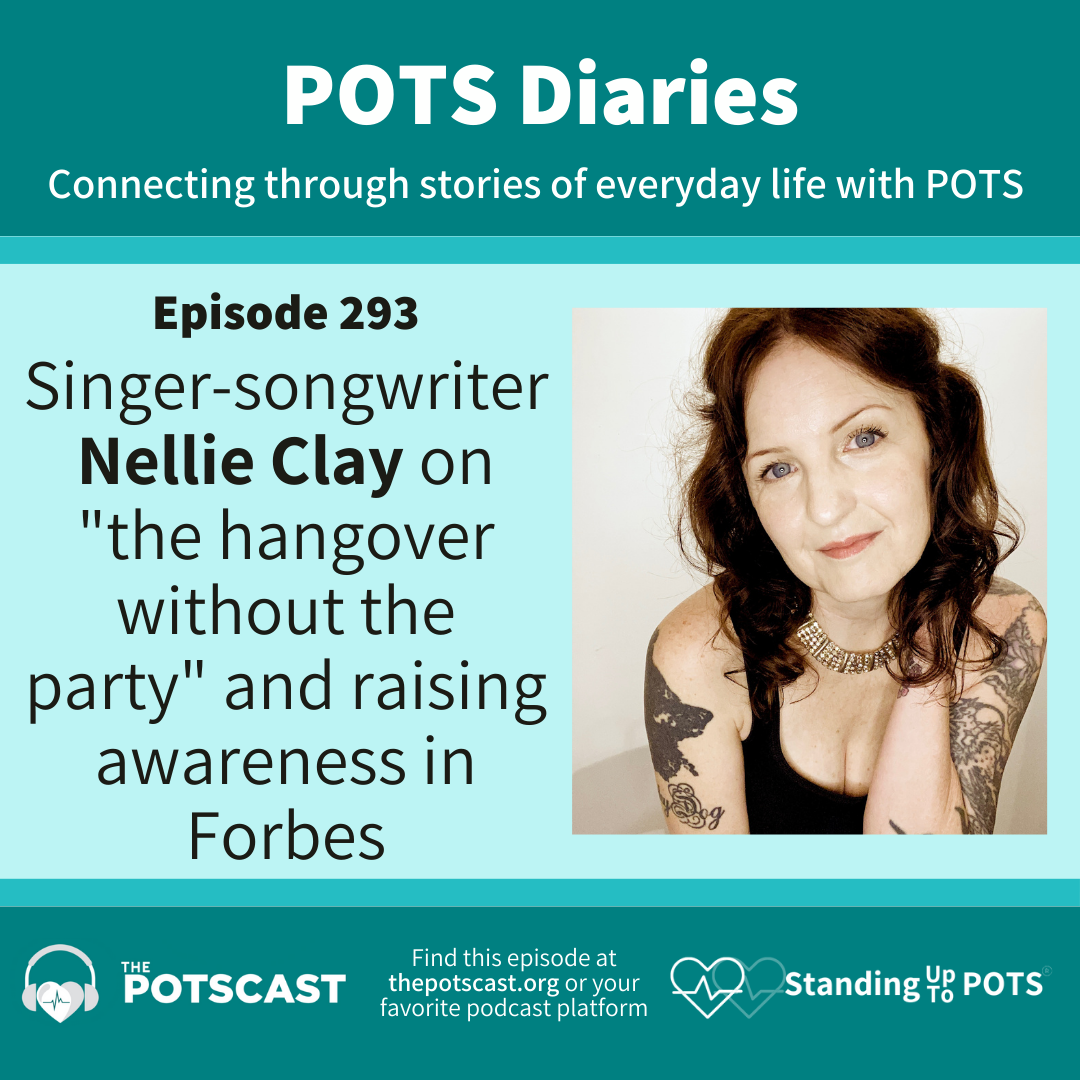
Singer-songwriter Nellie Clay on “the hangover without the party”
January 20, 2026
Western folk singer-songwriter Nellie has recorded multiple albums and EPs, toured nationally from Alaska to Nashville, appeared on PBS’s Songs at the Center, opened for Grammy-nominated artists, and become a beloved regular at the Woody Guthrie Folk Festival. Most recently, she was profiled in Forbes for her life as an artist living with postural orthostatic tachycardia syndrome, bringing huge mainstream attention to POTS in the process. In this episode she shares her thoughts, experiences and wisdom on living with POTS, adjusting to major life changes, staying strong, redefining oneself and much more.
Nellie's article in Forbes is here.
Nellie's "Freedom Song" music video is here.
Nellie's music is available for purchase here.
Episode Transcript
[00:00:00]
Jill Brook: Hello, fellow POTS patients, and marvelous people who care about POTS patients. I'm Jill Brook, your horizontal host, and today my guest is the incredibly talented western folk singer songwriter Nellie Clay. Nellie has recorded multiple albums and EPs, toured nationally from Alaska to Nashville, appeared on PBS's Songs at the Center, opened for Grammy nominated artists and become a beloved regular at the Woody Guthrie Folk Festival. Most recently, she was profiled in Forbes for her life as an artist living with Postural Orthostatic Tachycardia Syndrome, bringing huge mainstream attention to POTS in the process. They actually mentioned POTS in the subtitle of the article. So this was truly some powerful rare attention for POTS in the mainstream media. So I'm honored to welcome Nellie to the show and to thank her for using her platform to raise awareness for our community. Nellie, thank you, [00:01:00] thank you.
Nellie: Thank you for having me. It's an honor and privilege to be asked to speak about my life and this illness in the best way that I can. Thank you.
Jill Brook: So maybe for starters we could just get to know you a little bit better. Like did I hear correctly that you are from Oklahoma and your artistic career actually started in painting rather than music?
Nellie: It did. I'm originally from Oklahoma, though I've moved around quite a bit. A bit of a rambler. And I am a painter. That's what I started out with and still do today. And came into music, I guess later in life. Maybe not, I think maybe 29 or 30, which just goes to show, you know, I run into people all the time that say they're quote unquote, too old to start something or, you know, you run into all these people that say they've been on a piano since they were six years old or something. But I'm kind of living proof that it's okay to be a late bloomer [00:02:00] and that it's never too late or too old to start something.
Jill Brook: Okay, so speaking of that, so, so listeners will know that I moved to Alaska at one point because I was too heat intolerant for California. And I was not smart enough to just move from Southern California to Alaska. I moved like five times and I kept going up a little more north each time and finally said, okay, forget this. I just gotta go all the way. But I know that, that it really surprised my family when I moved to Alaska, but I think you moved to Alaska in an even more surprising way. Can you talk about that?
Nellie: Yeah, I mean, I was an artist, like we said, a painter, and I was really fortunate that I actually got a good job out of school and worked for the Museum of Russian Art restoring oil paintings, with much great relief to my family because I was going to be the proverbial starving artist that we're all relegated to be.
So I was very fortunate and had a great job that [00:03:00] I loved. Very personally fulfilling. And then went to Alaska for a two week paid vacation and fell in love and thought this place, this wild place, has things to teach me that I can't learn, you know, in a book. And I think maybe a streak of adventure in me. My dad was kind of an adventurer. Not kind of, very much so. I must have a little bit of that, of him in me. So I think, I think that I would turn my back on an unlikely great career quote unquote throw it all away, as some people would say to go live in the woods. You know, very rustically, I guess.
I think some people thought I was having early life crisis that was really insensible. I lived in a lot of places, but like, you know, some of them is not fair to call them a cabin, you know? Shack is really maybe a more accurate description of some of the dwellings, we'll say, that, that I've lived [00:04:00] in. Real character builders. You know, but I, I I took to the life, well, I, you know, I didn't, not having electricity or plumbing, it felt quite natural to me. I, I don't, I don't know. And also I think I couldn't have foreseen getting ill later in life. I took, you know, good care of myself was healthy and active and I'm sure glad that I climbed those Alaska mountains when I did and did sea kayaking, things that I can't, because of POTS, I can't imagine doing today.
You know, and a lot of, you know, a lot of people, people I talk to now that I knew when I was younger that kind of went a more pragmatic route in life and said that they would adventure later on in life and and then they got sick. And when are they gonna have their adventure? You know, I don't know.
We never know what's gonna happen. I'm for all those people that thought it was insensible and unwise of me to go and do all these, you know, wild, adventurous things, you know, knowing what [00:05:00] I know now that I, I've gotten sick and I'm unable to do any of those things, I'm so thankful that I followed my intuition. I followed my heart.
It's as if maybe I knew on some level, subconsciously, I knew something, you know, knew the future maybe wasn't guaranteed for me in that way. I'm so glad that I did what I did.
Jill Brook: Yeah. Yeah. So can you tell us a little bit about what your life was like, I don't know, like in the five years leading up to when you first got sick. What, what were you doing? And you know, I imagine you, you know, being a professional musician, like, what was that like?
Nellie: Yeah, I mean, it's, it's a different life. It's a different life. Obviously being a musician, it's you know, irregular schedules and and whatnot. And I was, yeah, in those years leading up to it, you know, I was in Nashville and had management and a booking agency and they sent me all over the country playing clubs and, and [00:06:00] whatnot.
And I was really culture shocked, actually, coming from Alaska. And just seeking experiences, you know, new experiences and growth, personal growth, musical growth. They kind of go hand in hand hopefully. But yeah, so it was a kind of a hectic and busy life, I guess. You know, back when I was really doing it, 600, 700 mile drives a day.
You know, because your booking agency has you in St. Louis one night and then Chicago the next night and Minneapolis the next night. And of course, these are not to me performing to large audiences. People must know, like this is the folk music world and in sometimes you drive 700 miles to play to 40 people. You know, and that's the reality of it.
But you do it because you love it, and those 40 people matter. And and it is a great privilege. So, but I think like everything like the Alaska days, the music days, I think I thought they'd last forever, you know? And and we [00:07:00] all have to learn that nothing does, quite literally. So I think, you know, the pandemic hit. My illness coincided with the beginning of the pandemic. And so, yeah, I guess I've just always been very independent and gone and done and traveled and never had a plan. The plan was to not have a plan, you know, so that when life presented me with something exciting and I was free to say yes to that, and I guess like every healthy person, like I never took, you know, I didn't even take a Tylenol.
I was never sick. You just don't expect it to come to a crashing, you know, end, kind of. But it does when you have, when you have POTS.
Jill Brook: Yeah. Well, and I always feel bad like asking about this part of the story but can I ask, yeah, so how did that happen to you? What was your first sign of POTS?
Nellie: Right, like the first thing was this like hangover [00:08:00] feeling, which a lot of people couldn't relate to. You know, unfortunately without the party. Like, you know, this terrible spongy feeling in my head, this pressure in my head. Pressure in my ears. And feeling lightheaded. I was becoming fatigued just going up a flight of stairs.
And I used to cross country ski and stuff, you know, and split wood. Like I, and I remember thinking like, you know, like I'm, I'm not in this bad of shape, like to be feeling this way. And I do remember sitting at the kitchen countertop, you know, kitchen counter and I, and I, and I said, I think I'm dying. Like, I felt that bad. Like I knew something was terribly wrong. I felt, you know, I was very aware that the systems in my body were not functioning properly. And it was terrifying. It was terrifying.
Jill Brook: Was there any obvious trigger, like was this right after COVID or, or anything, or just sort of randomly?
Nellie: It was the beginning of [00:09:00] COVID, pre vaccines. And I did test positive for the antibody. You know, so it seems, it, it seems that I may have had a very minor case of COVID that could have opened the doors and rolled out the red carpet for POTS to come in. That's a, an unprovable speculation.
Jill Brook: Oh my gosh. So, okay. First of all, everybody listening has to go listen to your music, and we'll put links in the show notes. But you speak so colorfully. I've already loved the hangover without the party, and then this rolling out the red carpet for POTS. It's just I really appreciate your songwriting and I see where I see where it might've been an obvious thing for you to be good at anyway.
Nellie: Oh, thank you. I love words.
Jill Brook: Can you talk about your diagnostic journey, 'cause some people have a really rough time figuring out what it is. Did, did you?
Nellie: Yeah. So, in some ways I feel fortunate when I, comparatively speaking, I had a very quick [00:10:00] diagnosis. My, my case was very severe and I deteriorated very rapidly from that onset of like, wow, something's very wrong to I, I got myself a doctor's appointment at a cardiologist because I was having chest pains and palpitations and blood pressure problems, and I actually collapsed in the doctor's office.
I could barely make it from the car across the parking lot. I collapsed in the doctor's office and they actually called the ambulance for me and sent me to the ER where I was losing consciousness and repeatedly, if I remember just going, I remember saying like, something's very wrong. And then I would sort of like go out and then back. And they admitted me. Thank God they didn't send me home. I had actually gone to the ER like a week earlier and they had, I was lying down so my symptoms improved and they sent me home or whatever. So this time they admitted me and it was terrifying because it was COVID time. People were dying. There was a [00:11:00] COVID wing of the hospital, you know, where it was, everybody said, don't go down that hall. You know, that's where the plague is, you know? I think the hospital was on lockdown. I didn't have any visitors. And I ended up being there six days. It was also during the, the, the storming of the capitol. So surreal to be watching that on a, on a, on a television and a hospital bed. But just to add to my nightmare of...
Jill Brook: Wow.
Nellie: You know, surrealism of like, what alternative universe am I in right now? And so they did so many times, you know, the cut where they inject dye into your veins and heart. And they say you're gonna feel worse than you've ever felt, you know, in your life. And so a lot of tests, very unpleasant tests and people saying, you're a very sick girl. We don't know why. You know, couldn't get out of bed, couldn't get to the bathroom on my own without almost collapsing and stuff. So, fortunately, and they, they [00:12:00] just kept saying that they thought I was in heart failure, was a word they were throwing around. You're in heart failure. You're probably gonna need a heart surgery.
And then fortunately, a, a cardiologist who was also an electrophysiologist came in, it must have been his days off prior. I don't know. But he came in and he kind of just took one look at me and was like, I think she has POTS. And of course I had never heard of it. It was five years ago. And I'm not sure that the other doctors in the room had heard of it either. But so thank goodness for this, this person, this doctor.
Jill Brook: Gosh. Yeah.
Nellie: As soon as he, yeah, as soon as he figured out what it was, you know, they prescribed blood pressure medication and a steroid to, I, I felt oxygen starved. That's another symptom I have of feeling like I'm suffocating. And so, they medicated me, watched me for a day and sent me on my way.
But I will say like [00:13:00] most people's experiences, what was disheartening, now that I have hindsight 2020, is that no one had a single, nobody had a conversation with me about, this is your illness. This is what it means. This is what is actually happening in your body. This is what the medications are gonna do that we're prescribing for you. This is what you could expect to feel in life. No one discussed even the really basic things that we all know now. They sent me home with some ugly compression stockings. But you know, there was never any suggestions about you should drink more water or any physical therapies or how this is gonna psychologically, emotionally, how this is gonna impact your life.
Nothing, just, you know, I think like a lot of patients left to my own devices to do research and to do it alone, basically.
Jill Brook: Well, that [00:14:00] stinks. Okay. What did you do? I mean, did it take you long to find the information and the community or what, what happened next?
Nellie: You know, I, I did, I had a doctor friend from Alaska. She was a traveling doctor, and, and she just said, oh goodness, good luck. That's really tough to manage. Nobody else of my thousands of people online had ever heard of it. You know, so you've won a bit of a booby prize, getting this weird thing that nobody's heard of.
And so honestly I just kind of went home to convalesce and suffer, which was, you know, building up a little bit of strength. And had made regular doctor's appointments, but, and I would complain about my symptoms of I'm, you know, and then, and which were met with, well, you have a serious illness.
You should not have an expectation to feel better than you do, was [00:15:00] basically, you know, they said, you know, a couple weeks ago you couldn't brush your teeth, or you couldn't walk across the room, and now you're sitting here talking to me, you drove a vehicle here. You should be happy.
So I quit going to doctors for like four years, after going back to my, going back to my car and crying in the parking lot, because I thought they were basically saying, we've given you the pills. They didn't even discuss side effects with me. I gained 25 pounds in like two weeks of water weight gain, you know, from the steroid.
No one discussed that with me. You know, and terrible nightmares that were from the medication. But it just seemed so clear to me that they gave, they gave the medicine, you know, and they kind of just said, we've, we've done all we can do for you, you know, good luck. So, that's really depressing to hear.
And so I kind of quit going to doctors and just kept taking my pills. And like a lot of POTS patients, I went through a period of [00:16:00] denial, followed by delusional thinking that I could cure myself because I'm, I meditate, I have had a strong meditation practice for decades, and so I thought, I'm just gonna Jedi master this stuff, you know? I thought so arrogantly, if anybody, you know, can, can write, you know, fix this in themselves, it's me. Like how arrogant, right? Because I'm that good of a meditator, right. It's true. Like, and looking back now, I, and, and, and also my friends who looked me straight face at the time and didn't question...
Jill Brook: Well, this is funny, we should ask around because I feel like I went through the same thing except that at the time I was a nutritionist and so I thought I was gonna nutrition my way out of it, and I thought I was just that good. And I also turned out to be arrogant and not able to do do that.
Nellie: Exactly. And my [00:17:00] friends, bless their hearts, the ones that were like right there next to me, going, yes, you can. Yes, you can, you know, encouraging the delusion, which, you know, I think maybe is a good segue into another point about what the difficulty that our, you know, friends and, and able-bodied people have the difficulty they have in, in accepting that yes, we're really, I'm really sick. We're really, we're really sick, you know. And I talked to a, I have a really good friend who's a therapist. She's one of my best friends. And she's not my therapist, but she's my friend who I try to not ever use for free therapy, but a great sounding board. And I, I posed this question to her, why is this, that friends have such difficulty, people that know us have such difficulty accepting that we're really sick. And it's happened over and over and over again, this failure to understand, or even people in my music [00:18:00] community that like, they think I'm still out there performing and I'm like, I maybe sing like three songs in five years. I laugh and, you know, to say like, it's sad that no one noticed that I quit performing.
Or at least I think more so I, I hate to think I'm that irrelevant. I think it was more so that they just, in their hearts so desperately wanted to believe that I was still out there performing. They don't, it's on this idea that Nellie Clay is in her bed being pathetic is unacceptable. Like, but it's, you know, but it's true.
And my, and so my therapist friend that I posed this question to, I'm like, because I find, you know, us human beings to be pretty fascinating and confusing and, you know, and she basically, it's a complicated thing that's happening right there. Which is understandable because you and I both expressed a period of denial, period of delusional thinking, and, and it's happening to [00:19:00] us in our bodies. So, if we can be you know, delusional about it, like I, you know, our friends can too, and, and it kind, what it is, is it speaks to, because so many people that get sick with POTS are people who are previously very healthy actually. Very healthy lifestyles, very active. And for our friends and peers, loved ones, it relates back to their own mortality is what is happening, the way it was explained to me. And that if your very healthy friend can be struck down suddenly by this thing that nothing they did brought this on, I'm not a smoker, you know, like I don't have any kind of habit, bad habit that caused this to happen to me.
So for, for healthy people to see their previously very healthy friend be struck down with something that has radically altered their life in a bad way. Then [00:20:00] on some unconscious, subconscious level, that means it could happen to them too. And they just like, they're not aware, is this something that's happening on, on a very subconscious level.
They're not aware that they're, that they're having this sort of problem of thinking. But because if it can happen to me, it can happen to you. And nobody wants to think that that's possible. You know, so, so they don't wanna believe that we're sick because it, it, it's, it's just, it's just more pleasant, you know?
And I, I get it. So it does help to understand where the disconnect or why the disconnect is happening, but I, I do wish that as far as like, you know, one thing that, that's something I think that there's so much room for improvement in our lives, actually. You know, there's the issue of medical care that we can talk about and and ways to deal with this, our own selves, which is so important.
But I think better understanding, you [00:21:00] know, from people around us if people had better information about how to actually be supportive would radically improve my life experience. And which is why I'm really grateful to you. I'm grateful to Standing Up to POTS for creating this platform because I, if I'm being so transparent here, I have not wanted to use my own platform to talk about my illness. And that's because I'm the type of person, I'm very forthcoming. I don't believe in presenting an inaccurate image of myself, but I will say it's been an incomplete image. I'm never gonna tape a video of myself sick in bed and post it. It's never gonna happen.
If anybody sees me do that, please call my closest friends and have an intervention. I mean, like if, and, and if other people wanna videotape themselves passing out, that's fine. I'm not judging. I'm just saying what's right for me. I'm never gonna do that. Probably some of that [00:22:00] might have to do with the fact that my online community, even though I consider them to be like true friends and like family, some of these people over the years, I think because our relationship was initiated as me being a performer where I was creating music that was meant to like, make them feel something human. That's me being a giver, you know, music is a community service in my mind.
And, it's not the audience's job to make me feel better. It's supposed to be the other way around. It's beautiful that it happens reflexively. That's a wonderful exchange. But I think there's a certain amount of social contract I have with an unspoken, unwritten social contract I have in which I wanna provide uplifting and positive, you know, content. I hate to say it, that sounds contrived now even to use the word content. But I've always wanted it to be positive. So I have [00:23:00] been really reluctant to speak to my illness on my own platform because I've seen, in my opinion, people with illness may approach it in a way, I don't wanna say incorrectly, 'cause what's correct for one person is not for another.
But I've watched the descent, like when people did share their illness in certain ways, I watched their supporters drop like flies.
Jill Brook: And I can also see where your platform is for your art. And I think there's probably plenty of artists out there who wanna keep their art separate from their personal life. And people may come, you know, it might not be the same audience that wants to see one or the other.
Nellie: Right. And you know, and it's not that I definitely, it's not that I wanna, even though it didn't make it, I did make it sound that way. Like, not that I necessarily wanna keep it separate. It more so was that I've been sort of sitting back and watching the way people reacted to [00:24:00] other people, sick people.
And it's sad. It kind of, it's an extension of what we were talking about earlier, about people being so uncomfortable with people having an illness. There is a psychological, emotional thing that's happening there that makes people really uncomfortable. And so I've observed, I've been observing that with other people. And kind of like, you know, note to self. Don't, you know, don't do that. You know, don't do that. And I don't want to bring people down, but I also don't want to pretend I that I'm well. That's an exhausting, you know, like life is not meant to be a performance. And for those of us who have spent time on stage, maybe we need more reminding of that than other people.
But I actually think everybody needs to hear that, that life isn't a performance, really. You know, I think there's, all the world's a stage. Not really. I disagree. I [00:25:00] really do. We have to be able to be ourselves, and that includes our sick selves. So, but I just, my reluctance to share was I've been, I think, quietly trying to figure out what was the right way to share.
It's not that I want, I think I would feel much better if I did feel like I could share more and that people wouldn't be repelled quite frankly. Because also you, you don't want your whole identity to be as this sick person, you know.
I hope that some of the people who are younger than me, I'm 49, and younger people who, oh, I, I have been hit with this which is the majority of POTS people are younger, younger than, than us. That they had, you know, getting hit was such a challenge before they've even had the chance to go out in life and try to figure out, discover who they are, you know, I can't speak to that. But those of you listening, I see you. As an, as an older gal, I've always looked at like the younger songwriters as a [00:26:00] sort of, I feel like a, I feel very big sisterly to to, to them. And I feel big sisterly to the younger POTS patients as well. For me, my experience was that, you know, I went through the hard tasks that we all have in life of finding out who we are. Who am I as a person? What are my passions? What are my joys? Who am I gonna be in this life? And those are, you know, questions we have to ask at any age. And so, and then when you find something that you love and then it defines you. For me, it was being a musician. It very much defined who I was.
It created the social community that I had. It gave me a sense of identity, a sense of purpose, a sense of belonging. And to discover that and to sort of barely be getting your, maybe hitting your strides and feeling comfortable in those shoes, and to have it mostly taken away has been [00:27:00] challenging, but an important psychological journey, I think, you know, for any person. I hope that there are non POTS people that listen to this and tune in, because that's really about our humanity and what affects one of us affects all of us. And I think that it was an important life lesson for me to realize. And so if the young people listening know that you're not defined by what you do. We are spiritual beings, beautiful human beings, complex with lots of things to offer. You are not entirely defined by, just by what you do. If I was defined only as a performer, then I would cease to exist today. And I'm not cool with that. So, so I think that's an important message. That was something really hard for me. I thought if I'm not a performer, then who am I? Who am I as a person, and not just a sick [00:28:00] person, certainly made me more compassionate. I didn't think I was in a person that was particularly in desperate need of a lesson in perspective. I got one. Did I care about autonomic illnesses before it struck me down? No. That's human nature. But I think, I think everyone could, could, could learn something from, from what ill people are forced to learn, you know? Because everybody talks about, oh, when, when you're when you get sick, some people will say, it's the best thing that ever happened to me.
I'm like, that's like a wildly positive statement, but what, you know, I think what people that say that is saying that is true when you are made very sick and you have things taken away from you, it forces a person to dig down deep inside their soul. And it does foster incredible personal growth that is a [00:29:00] gift. I wish we didn't have to go through this to get there, you know?
Jill Brook: Yeah, and I mean, I guess I so appreciate your sharing your experience with the world because you help show a few things, and I'd say like first many POTS patients get accused of faking their illness, like to get attention. But you already had the best kind of attention a person could have. You worked so hard, you had this amazing career. Your songs are incredible. You had the dream job. And so there's no way that you would be choosing POTS instead of that. And that helps bring credibility to other people who maybe didn't lose so much and have POTS. And then I think the other thing is like you obviously are so talented and motivated and ambitious and hardworking, and that makes it harder for people to say that POTS is just [00:30:00] laziness, 'cause that's another one that comes up. And I like to think that these misconceptions are dying out as awareness grows. But you definitely find pockets, or people who still think this. And I know that it makes a huge difference when they see a headline like yours in Forbes. And so I, I just am so grateful that you share this and you're so open and, and you're just helping so many POTS patients by doing this. But I have to ask, like it sounds like you have been just so amazingly mentally healthy processing all of this. I'm still excited to hear what happened in those four years without doctors. Did you find anything on your own? But I also am curious if you are thinking of like still writing songs if you don't perform them, 'cause you're such an amazing songwriter. Your songs are like unique. They're like, they're, they're just, I love them. There's so many of your songs that, that like just, [00:31:00] you know, the turn of phrase, it's, it's just, it's not like the regular stuff you expect. It's, it's just so good. I mean, I'm sure it's probably painful to write songs when you got to previously be the artist and sing them just how you wanted them to sound. But do, do you still write?
Nellie: Yeah, I do. In fact, the the Forbes, how I got the, you know, the feature in Forbes was that I did, I did record. I got into the studio this past year and recorded a song that I'd written. I still write all the time. Pick up my guitar in bed and, and play. Sometimes my fingers will go numb. As POTSies know, we get tingling, numb feeling our fingers. Another reason why I can't perform. And so sometimes I only play for five or 10 minutes a day or whatever, but I did, I wrote a song that was, that's supposed to go in a friend's adventure documentary and I managed to get in the studio in Chicago.
It's hard for me to get there. I have to pull over. Driving is difficult, [00:32:00] as we all know. I get motion sickness and so I had to pull over and take a lot more breaks and stuff. And was fortunate that day in the studio that it was a good health day for me, and which I, you know, kind of really hoped for, you know. Please let the stars align.
And so I recorded this song. It's called Freedom Song. And I put it out there very quietly into the universe, as I do. And it made its way organically, I don't have a publicist or anything, into the hands of this Forbes journalist who then wrote me through my Bandcamp page asking if he could hear more music.
So I sent him more music. And then he said, by the way, I, you know, I'm a journalist for Forbes. You know, could we talk? And, you know, there's the interview ensued and then the feature article. But he had asked me in the interview, 'cause he would wanna know when I'd be performing again. I had to then, you know, this, the, the dreaded question. It comes up where then you have to tell someone, [00:33:00] oh, I'm sick and I don't, you know, perform anymore, dah, dah, dah, dah, dah. But here's my recorded music. Please check it out. And, so he was writing the article and he had to come back to fact check some things, you know, and he said, wanted to know when I quit music and, you know, like the feathers or if I had feathers, you know, they, they could, like, they popped up or like, you know, or how do I, how do I say this?
Jill Brook: Punch to the gut.
Nellie: Yeah, like it, you know, it, it poured gas on my fire, I guess is what I wanna say. I thought I didn't quit music, you know? Just because I'm not physically able to perform anymore does not mean that I cease to be a songwriter or a singer or a guitar player. I'm not, you know, singing on all these, you know, some rare theaters, but most of them [00:34:00] dark clubs, bars, do you know what I mean? If that's what makes you, you know, legit, you know, they maybe people need to reassess that definition of what makes an artist an artist. Because just because I have POTS, I made it very clear, does not mean that the song stopped coming.
And I'm still a creator. Still relevant. You know, we have to, I realize that this, that again, it's one of these unconscious, subconscious things, but there is an unconscious bias towards able-bodied people, even though I look like one, you know. As soon as it was clear that I was not performing and, you know, could not be counted on for being the life of the party and, you know, bringing, you know, doing, performing to a certain standard or whatever.
It's shocking and sad how many, how you get left behind actually. And and [00:35:00] it's probably the case in a lot of professional environments. I mean, really if, if it seems, if you can't do the work, you're out. But I think there's a confusion in my world because music feels like family, you know? And so, that was really hard pill to swallow.
Everybody that's listening that has this, knows this, that your real friends will absolutely show themselves. And I'm not, and I don't wanna point a finger at folks that aren't able to show up for us. They have their own thing. You know what I mean? I think that it's an easy thing to fall into when you're sick, to be like, nobody's noticing, like nobody, you know, nobody's paying attention to my illness. Nobody's showing up for me. And to not take that personally. I've had my, you know, I've had my feelings hurt, certainly. I really wished more people had noticed that I wasn't performing, or reached out to say, [00:36:00] gosh I can't imagine how I would manage if that were me. How, how are you? You know?
But everybody's fighting their own battle, you know? And so, that's another, that's another hard lesson that, that you have to learn that, things don't revolve around, around us. And so there is, I think there's a fight to be seen and heard when you have a chronic illness that in many ways sidelines you, gets you out of the game.
That's what I'm interested in. Just because we aren't able to break our backs physically, which, you know, I so much respect for those who do, there's more than one way to contribute to the wheel, you know, than being that kind of a cog. You know, us POTS patients and other people with chronic illness have artistic and intellectual contributions that we can still make, even if we have to make them from our beds. [00:37:00] And, you know, I think we do have to speak up. I have had people in my own family that think I'm exaggerating and think I'm faking, and I should just, you know, go, go get a whatever, you know, when it's like you, no one would choose this. I really don't understand the psychology. And so honestly, I'm not gonna give, and I would encourage everybody else, to those that have that attitude towards you, don't give 'em any time. It's it's not a healthy point of view. I think it speaks to, to a person that's going to have that point of view, it says a lot more about them. It really, it really, really does. It's not any sick person's obligation to try to convince non-believers that we're sick. It's not productive, I don't think. So, those folks don't get to have an opinion in my wellness or whatever, you know. And other people have different [00:38:00] experiences. I see from reading their posts, some people are very fortunate and have a lot of support around them. But that's not the case for everybody.
So, some of us, you know, have to be our own support and have to look to places like Standing Up to POTS. You know, there's other POTS organizations online that can become, I think, toxic places of just sort of complaints, you know? And that's why I really, kudos to Standing Up to POTS. I'm gonna give you guys like, shout out because, you know, I've been paying attention for a while and seeing that you all are proactive and this not a, a gripe and wine platform, you know, it's proactive about awareness, visibility and, and making, you know, make the world a better place for POTSies. Why not, you know, 'cause we do have things to give.
Jill Brook: Yeah. That means a lot. Well, thank you so much. I [00:39:00] wanna make sure that we tell people where they can find you and your music online, so before I forget. And we'll put the links in the show notes. And I don't know, do you have any place where you'd like recommend people start?
Nellie: Come on Facebook and be my friend, and it's Nellie with an IE Marie Clay. Make sure you get the middle name in there. And and I keep things really positive there. So it's a, it's a, it's a carefully curated happy place. And then music wise, go to my Bandcamp. If you just Google Bandcamp Nellie Clay. They're a wonderful company because unlike others that I won't name, they give almost all of the proceeds to the actual artists. So if you wanna support musicians and songwriters then the best way to hear our music and to download our music is through Bandcamp. And I would start with my most recent work which is called Freedom Song, which is very much about the kind of freedom [00:40:00] that exists inside us, the kind that nobody and nothing can take away.
Jill Brook: I gotta go listen to it again knowing that. That's so cool.
Nellie: There's a video for it too. You can go on my YouTube and and find video for Freedom Song. That's a good one. And then also for POTSies, a song I wrote from my bed after being released from the hospital. It was called Climbing the Walls, and that's on my Bandcamp as well. And so it might be relatable for some folks.
Jill Brook: Excellent. Excellent. Well, it has been such a joy to listen and speak to you and learn more about you. I guess as sort of a, a final question, I'm wondering what do you wish more people understood about POTS and, or is there anything else that you wanted to share today?
Nellie: Sure, I think [00:41:00] my message to my message to POTSie, for other POTS people, I just, I am on, just got on the waiting list for the Mayo Clinic and it's the first bit of hope that I've felt in five years. And so I would, maybe my advice to POTS people would be to not, maybe not waste your time and money with the other doctors. Look on the map and find hospitals that actually have doctors that specialize in POTS. Like avoid the abusive dialogue. It's not necessary, you know, and the dismissals, and the condescension. Let just say, do yourself a favor and, and just go to the best of the best. Find the specialist. Don't suffer by yourself for five years like I did.
And then to to other folks that don't have an illness, I would say like, we don't bite. Stop avoiding us. You know, we're still beautiful people full of love to, with lots of love to give and maybe, you know, include us [00:42:00] and include us in your life and, and share your life with us.
Jill Brook: Well, Nellie, those are beautiful words to end on. And thank you so much, and I'm so sorry that you are in Club POTS, but thank you for using your...
Nellie: Right.
Jill Brook: Your fame and, you know, ability to bring attention to it. It just means the world to us. And and I, I'm excited to just go listen to that song again now that we know.
Nellie: I, I love that. I have to, I have to say I love that you said Club POTS, because as soon as you said that I, I instantly pictured like, you know, like a nightclub with like no lights and all of us POTSies laying on the floor, you know. Club POTS. You know, what a party. Which, I mean, we have to have a sense of humor. If we can't have, you know, if we can't, we lose our sense of humor about this, then we're really done for, right. [00:43:00]
Jill Brook: Well, I think you're amazing for keeping your sense of humor for all of this, and I am so sorry for what you've lost, and I think you're just amazing for being who you are. And anyway, we're just so, we're just so glad to have you share your wisdom, experiences and everything today. Thanks a million.
Nellie: Thank you. I'm proud to be a part of this community. And thank you for your work. Thank you for the work that you've done. Much appreciated.
Jill Brook: My pleasure. My pleasure. Getting to meet people like you just makes, it's just such a joy. So, okay, I'll wrap up. Hey listeners, that's all for today. We'll be back soon with another episode. But until then, thank you for listening. Remember, you're not alone, and please join us again soon.