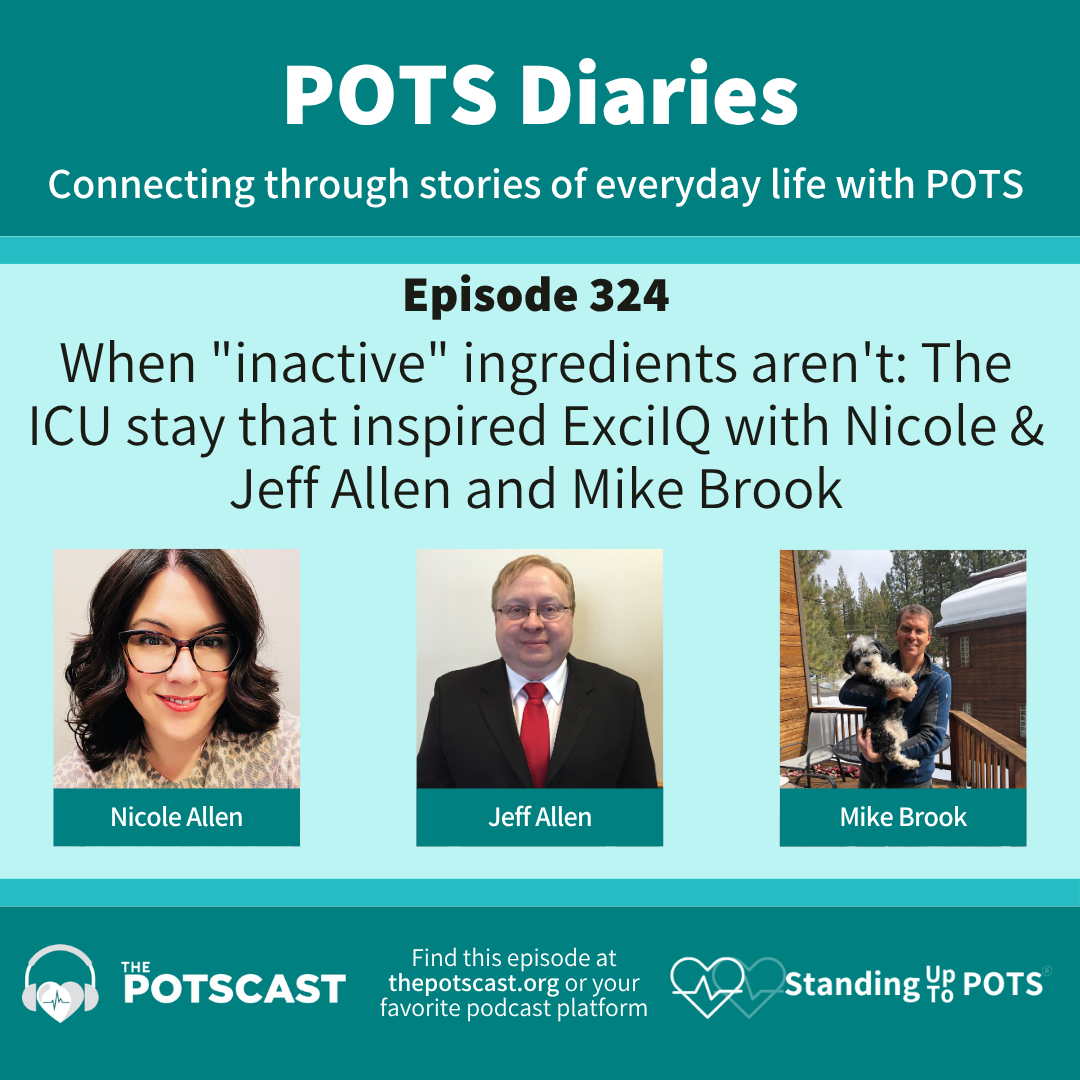
When “Inactive” Ingredients Aren’t: The ICU stay that inspired ExciIQ, with Nicole & Jeff Allen and Mike Brook
August 23, 2026
For patients with medication hypersensitivities, figuring out exactly what is in a medication can be surprisingly difficult.
In episode 247 of The POTScast, data scientist Mike Brook discussed research showing that the excipient, or “inactive ingredient,” lists in DailyMed drug labels were internally inconsistent in 39% of 100 commonly prescribed drug formulations examined. For patients who react to excipients and rely on these labels to choose safer formulations, inaccurate, conflicting or confusing information can have serious consequences.
Today we continue that conversation with Mike, along with Nicole and Jeff Allen. Nicole is a nurse who has MCAS and reacts to several excipients. Jeff brings 25 years of experience as a data solutions architect working with medical and pharmacy claims. Their motivation to solve this problem is deeply personal. After Nicole experienced repeated severe reactions to a medication excipient that landed her in the ICU for 6 days, Jeff set out to understand the problem and then build a better solution: ExciIQ.
Together, they discuss the real-world challenges facing excipient-sensitive patients, why current drug-labeling data can make avoiding a known trigger so difficult, and how ExciIQ hopes to help patients and healthcare professionals have better options for avoiding problematic excipients in their medications.
Learn more:
- ExciIQ: exciiq.com
- Previous POTScast episode: Drug Excipients and Label Inconsistencies with Data Scientist Mike Brook
- Published research: Inconsistent excipient listings in DailyMed: implications for drug safety
Episode Transcript
[00:00:00]
Jill Brook: Hello, fellow POTS patients, and beautiful people who care about POTS patients. I'm Jill Brook, and today we are continuing an important conversation about medication excipients, the so-called inactive ingredients in medications, and the challenges patients can face when they're hypersensitive to one of these ingredients.
Joining us today again is data scientist and my husband, Mike Brook, co-author of research that uncovered significant inconsistencies in the way that excipients are reported on drug labels. We're also joined by Jeff and Nicole Allen. Nicole is among those unlucky enough to have severe reactions when exposed to some drug excipients.
She is going to share with us what happened to her when she was given a formulation of medication that contained an excipient that caused a dangerous reaction. And her husband, Jeff, was inspired by this awful experience to do something about [00:01:00] it to help prevent this happening to others. With 25 years of experience as a data solutions architect working with medical and pharmacy claims, he used that expertise to develop ExciIQ, a platform that can help keep problematic excipients from harming patients who are sensitive to them.
So today we'll walk through why identifying the ingredients in a medication can be much harder than it should be. What can happen when that information is incomplete or inconsistent, and how ExciIQ is working towards being a solution. So thank you everybody for being here today.
Nicole Allen: Thank you for having us both here on your podcast today. We're so grateful to share this with you. Sharing a little bit about my background with Mast Cell Activation Syndrome, I was formally diagnosed about two years ago, but looking back, I can remember having symptoms for the past 25 years. It wasn't until recently that [00:02:00] it just became substantially worse.
What led me to pursue MCAS testing was I had been having allergic reactions over and over to a lot of the dental materials that were being used. I reacted to resin, composite etching, chlorhexidine, lidocaine, and even the dental gloves. Believe it not, it turns out that dental gloves are manufactured with chemical accelerants in them, and I'm very allergic to that, so, yeah.
Jill Brook: Oh my goodness. I did not know that.
Nicole Allen: Yeah. As a result of these allergies, my dental work had to be put on hold till I could find a solution. And then, so my allergist tested me for the local anesthetics I was allergic to, the amide group. And it turns out I'm allergic to everyone. So they say that's very rare. They ended up testing me.
I do have MCAS. They [00:03:00] put me on Pepcid and Allegra, brought me back in to test me for lidocaine allergy, and I had anaphylaxis. So, this left me searching for a way and a place that could help me get my urgent needs done. I found a dentist out of state. We met with her and she agreed to do my case in the hospital operating room.
But unfortunately, after traveling down in North Carolina, I had gone into anaphylaxis, in the Airbnb we were staying in. I had taken my generic Pepcid and had a bad reaction and attributed it to something possibly I ate, not the Pepcid. And then the next day when I took the Pepcid again, I went into anaphylaxis.
So that resulted in a trip to the ER after using both my EpiPens. My procedure got canceled because I was too [00:04:00] reactive and wasn't safe to undergo anesthesia. We waited a couple days, just allow my body to try and calm down. But after the 11 hour drive home, I went back in anaphylaxis again, spontaneously.
And so this led to a week long hospitalization in the ICU on an epi drip. During my stay in the ICU, they wanted to reintroduce oral antihistamines to help get me off the epi drip. I was given generic Allegra, which is what formulary they used there at that hospital. But at home I had only been taking brand name Allegra, and mainly because I did fine with it and I knew how reactive I was to medications and didn't wanna rock the boat.
So I just always stayed with brand name. While starting the generic Allegra in the hospital, I was still on the epi drip, but I [00:05:00] had two severe reactions. Both had to be treated with increase in my epi drip and then racemic epi for my airway. Jeff then did some research at the bedside and realized the generic brand of Allegra used in the hospital, had ingredients that the name brand didn't have.
It also had a couple ingredients in common with the generic Pepcid that I was allergic to. So we shared that with the care team, jeff's findings, and the allergist agreed to try me back on Allegra brand name and I did well. And so we got the epi drip off and I was able to be discharged. And to this day I'm still taking name brand and doing well with
Jill Brook: Oh my goodness. So how long were you on an epi drip?
Nicole Allen: It was for five or six days. Yeah. Yeah.
Jill Brook: What is that like?
Nicole Allen: It was, it was, [00:06:00] it was a little difficult being on the epi drip. It, you know, makes your heartbeat faster. I had some symptoms just from being on that for so long. They tried, they tried a lot to try to wean me off and they couldn't. I was reacting at that point.
I was in what they call a flare for sure. And at that point we had just, we had stopped all medications other than the epi drip just to kind of let my body calm down. But then, yeah, but then restarting the generic Allegra and then having both reactions while on the epi drip was a little concerning.
I think that was a little surprising to them.
Jeff Allen: Yeah, she was actually, so we started in the hospital here, close to the house. And she was reacting to Decadron. I believe it's a very powerful steroid. That seemed to be causing her, [00:07:00] but her, her flares as we were in the hospital and then we were transferred to a university hospital with higher level of care in the midst of all that. Her flares almost got on a cycle without introducing any new food, without any new drugs. It was like every 12 hours, then it was every six hours. It was like cycling where she was just starting anaphylaxis and having to have EpiPens.
Nicole Allen: And then it was down to like every two and three hours I was, I was going into anaphylaxis. I, I luckily had my EpiPens at my bedside. I had went through about five EpiPens of my own.
Jeff Allen: In the first hospital. Yeah. She was using her own EpiPens.
Nicole Allen: Yeah. And then, they decided to put me on a epi drip since I had to use so many of my pens because of anaphylaxis. It was cycling and staying on that helped. The epi drip.
Jill Brook: Wow. And, and you're a nurse, which I'm guessing is part of why you're staying so calm while you talk about all of [00:08:00] this, because I don't think too many people could, but, but wow. Wow.
Nicole Allen: Yeah. Yeah. That was, that was the first big ordeal I have ever, just after being diagnosed recently, within the past couple years of MCAS, experiencing anything like that. And you know, in the hospital when we brought this up, I, I think you'll always have people who maybe don't understand exactly the realm and the background of MCAS and just the fact of how important even excipients are in a medication, how people can react so badly.
But I felt like Jeff really felt like it was something that we had to explore because something was different for me to be able to have taken Allegra every, [00:09:00] you know, every day. And then it's, it's my passion now is to be able to help other people who are in this predicament and need help and don't know, you know, don't have the resources or, or don't know exactly what might be triggering a reaction from a different type of medication. I think that is our biggest, our biggest goal was to be able to really help those who, who need it.
Jeff Allen: And Nicole's was preventable, especially those extra days. You know, when she was taking the Pepcid, and that's what I've learned now after researching and learning more about it.
The excipient allergy isn't like, it isn't the same as like that active ingredient allergy where someone takes a drug of an active ingredient they're allergic, it seems to happen pretty quickly. Lot of the excipients I learned kind of build up in your system. So she had taken Pepcid for a week or so prior to us leaving, [00:10:00] outta that particular prescription. And it kind of build up to that point where it became a reaction.
And in this case it was a dye, so it was iron oxides. And the fact that that's what put us there. That's what caused this to start down in North Carolina. And then we were given, it wasn't anyone's fault, they don't have tools to know, but we were given another generic that had the same dye in it when there a white pill instead of a red pill in this case or a a, you know, a peach pill, would've not caused this secondary issue that she had. And just kind of laying there, that was, it was challenging to, I've been, I've been at the side of this for a long time, and MCAS to us was, I don't wanna call it an, it was, it was changing our lifestyle slowly. It's, you know, oh, we can't eat this anymore. You know, I'm afraid to try these seasonings, 'cause you know, something seemed to bother me last time. To now, that was the first time she [00:11:00] had ever used her EpiPen, like actually had to use her EpiPen is when we're getting ready to get her help done in North Carolina. And she used EpiPens for the first time and was having a serious reaction at home.
Jill Brook: Yeah, so it really went from like zero to 60 in like...
Jeff Allen: Exactly. It was a lifestyle change and I don't wanna call it annoyance, but it was at the annoying level of just, I wanted her to be able to try things and I knew she couldn't, to wow, this is life, life threatening now.
Jill Brook: Yeah, well, I was gonna say, you guys are being so calm about it, but re-anaphylaxing every three hours and being on an epi drip and still having it happen for six days. To me that sounds like you cut it close.
Jeff Allen: Yeah. One of her triggers is actually getting worked up and getting upset. So she's managed learn to mask and control that very, very well.
Jill Brook: Yeah. Yeah.
Jeff Allen: If she lets herself get emotional, that tends to trigger and she starts flushing and...
Jill Brook: Okay, well, I'll, I'll try not to get riled then, but I, I'm getting riled on your [00:12:00] behalf.
Nicole Allen: No, you're good.
Jill Brook: But I mean, obviously, okay, so let's just call it what it was. You had a near death experience because of excipients. And this kind of brings me back, I mean, to the work that Mike and I did. We had a publication in 2024, along with neurologist Laurence Kinsella and Pharmacist Michelle Briest and Mike, this is where you were kind of the technical lead on this paper.
The name of the publication was called Inconsistent Excipient Listings in Daily Med, Implications for Drug Safety. And boy, we were kind of worried about this. Can you, can you remind people briefly what was found there?
Mike Brook: Yeah, I mean, one thing is we had, we always had the hypothesis that this was dangerous and that this was hurting people. And it was only when Jeff emailed us a few days ago that we heard a firsthand account. And this just now is [00:13:00] the first time I heard all the details, and that's more harrowing than I even imagined.
So kudos to both of you for still having, still having your heads on straight after that. What we found was that product labels for both over the counter and prescription drugs, there's a labeling standard called SPL, it stands for Structured Product Labeling. And it's this big file format and it's what, what all of the packagers, what they call 'em, those that manufacture the drugs, they're obligated to, to report in this format what's in the drugs.
And so it's got, it's got all the stuff that goes into the, the big package inserts, but it's actually got more than that too. So it's this big ugly file format. And we were hearing anecdotes from some physicians that, that basically product inserts weren't right. So there'd be a patient who was reacting to something and had a, had a well-known reaction to an excipient, but it wasn't listed on the [00:14:00] label.
And so they thought, this, this can't be right. This has to be, this has to be missing for this. And maybe they'd find a different data source that actually did have the excipient listed or something like that. So that got us to dig into it. And where we found the issue was, was that these SPL documents, these label documents are internally inconsistent.
There are a couple of places in them where excipients are listed. There's a sort of a list version of them, and there's sort of a narrative version of them. And Jeff will talk more about this when he tells us about what he's been doing. But you'd want those to be in sync. I think that goes without saying.
Jill Brook: If they're not in sync, then you don't know which one to believe.
Mike Brook: You don't know which one to believe. And, and, and also it's just a bad sign when, when the, the people making your drugs don't get those two lists in sync. But nonetheless, what we did is we, we decided, okay, well we can't look at all the drugs in this database 'cause there's a [00:15:00] 150,000 or more of them, but let's take a sample.
So what we did is we picked 50 drugs, two examples of each of the top 50 drugs in terms of how often they're taken. So what we did is we wanted to make sure that we picked drugs that people actually took.
And so we, we randomly chose two, and then we went through by hand. There were four of us on the team and we each took a bunch and we went through. And we basically used DailyMed, which is a government website, to inspect the labels more or less, and say, okay, does this section agree with this section?
And we tabulated the results and we found that in about 40% of cases, I think it was 39 actually, they did not agree. So there was a discrepancy between those, those sections of the label that was more than just a triviality. It was something that would, that was downright wrong. Something was missing in one or the other.
There was a level of [00:16:00] specificity in one and not the other that would be meaningful, like saying starch versus corn starch. That would be an example.
Jill Brook: That somebody allergic to corn would care about that.
Mike Brook: Right. Somebody allergic to corn would care about that. Simple synonyms like water versus distilled water, we did not flag. So we, we weren't being so sort of hard-nosed about our audit that we were just finding all these kind of false positives.
It wasn't that. We were being somewhat sympathetic about it. And, so we found 40%. After we published the paper, I went and did a subsequent analysis of 1500 MCAS drugs. And that was all done with AI basically. But I spot checked hundreds of them to, to validate this. And we found a very similar rate of these things.
Since then, Jeff has actually looked at many, many more. In fact, you could say pretty much all of them, and I won't, I won't break the suspense, but he's found some similar [00:17:00] numbers, which is really very interesting as well.
Jill Brook: I would say they weren't similar. They were not better.
Mike Brook: They were not better.
Jeff Allen: It's not better. Yeah, they don't improve as it goes up. Correct.
Jill Brook: We were hoping that our sample of two products, each of the top 50 most commonly used drugs was an unusual sample that maybe we had found way more inconsistencies than would actually exist in the larger population of drug products. But Jeff, can you tell us, I guess maybe start with like, how did you get this idea?
How did this come about? What is your project and then how consistent is the rest of the database looking?
Jeff Allen: Sure. So, yeah, so the, the, the excipient problem, I came into the excipient problem, like Nicole said, I did the research there bedside. I knew something in those pills caused it. So understanding after, you know, dealing with pharmacy data, looking at these things, you know, it's, to me, it, I kind of think of it almost like pepperoni pizza.
[00:18:00] Let's, let's put it in layman terms. Like there you can get pepperoni pizza at five different pizza places, but the, the, the actual ingredients in them, the recipe is gonna be different at all the pizza places. So that's how drugs are. And that's how drugs are if you're taking a 20 milligram from a manufacturer and the 40 milligram for the same manufacturer right next to it on the shelf. They have different recipes.
So, you know, knowing that the same drugs and the same dose and different manufacturers, different binders, different dyes. Nicole's story was all about dyes is, is kind of what it came down to. Finding the culprit though, trying to figure out what that was for the one set of drugs, you know, looking at the four or five drugs, a handful of things for Nicole, that was pretty straightforward. But finding a culprit for a normal patient that's on five drugs or 10 drugs. Especially our friends in MCAS, POTS and the different societies, they're not just on one or two medicines in a lot of cases. So, [00:19:00] finding the culprit when I, I call it label archeology, is kind of the only, literally the pharmacist has to go and look at the piece of paper on the box.
Having that inconsistency, it's the paper that's missing things or that has things in less detail than what is if you go to like DailyMed, but DailyMed isn't easy to use. So, I figured there had to be a better way, and I've been doing this stuff for, you know, 25 plus years. I am, I'm like, I knew that there had to be a better way and I guess living next to it and, and seeing it. I had to help my wife.
So, you know, that was kind of really top of mind to me. So I started on this journey and we're, we're very new or we're still, we're very early on in the journey. So this happened this year in, she was in the hospital the first week of May of 26. We got her, you know, got her stable and stuff, came home, probably started researching how I would go about this, whether or not it was feasible I found your paper and the Rieker study that you [00:20:00] refer to in your podcast about your paper. I found those studies, brought myself up to speed on those and, and started pulling the data, picking platforms, probably started officially developing a platform in July, and now I am production pilot ready.
I've got my first pharmacist in, a compound pharmacist. I'm actually looking at professionals first, just to get the tool in their hands. Very shortly, I'm hoping end of September, not promising any dates yet. I, I wanna get that patient version out there. It's just a matter of figuring out and getting some doctor and pharmacist feedback kind of before we decide, you know, what is it that we should show the patients.
I'm hoping to have it as a sharing tool. I know that a lot of us do a lot of our own research, so having you be able to do your own research and then forward something over to your doctor. We'll invite them right into the platform and they can see what you found and they'll have a different view of it from a clinician perspective, obviously. But that has been a little [00:21:00] bit of a journey.
It's, it's in addition to my day job, you know, we, we have to keep that. But I guess I'm, it's that it's a passion project, I guess we'll, we'll say. And it's Nicole as well, we just feel like we can help so many people. This is such a difficult thing to figure out and having pharmacists say that it's just they can't, there's, there's no tools for them.
So the three that have actually seen the product firsthand have reacted very well and things that I never even thought of. They're talking about inactives and reminder pills and birth controls being a problem for, for, you know, some of the younger folks that are starting out in, in that part of their life.
And having to you know, pharmacies change brands. You know, one, one pharmacy may carry something and then depending on what their buyers negotiate, they'll change brands. And it's, it's not a silent change. It's not a shift. So I'm, I'm trying to bring, I think bringing attention to the, to the, [00:22:00] to the invisible half or more.
It's actually more than half in most cases. I think Rieker found more than eight excipients on average inside of each drug. So, it's, let's, let's get that invisible half out there so that we can know what it is.
Jill Brook: Yeah. And didn't they have a list of something like 27 excipients known to be able to cause anaphylaxis in patients?
Jeff Allen: Yes. And for that aspect I'm building a concept in this, in the application called badging, or we're giving it badges that will be research based. Whether it be a disease like POTS or MCAS or lactose intolerance or gluten intolerance. I can run everything through and, and identify research, it's all research driven, so I can identify research articles and stuff and associate those back to the excipient, and then that badging or tagging shows up and carries through up to the medication. The other things we're doing based on what you all did in your study, I'm actually taking and resolving the medications. When we're done, when, when [00:23:00] ExciIQ is, is mainstream after its pilot we'll have a cleaner version.
It won't be perfect. This is not good data. Mike can attest to that. You know, you, you always get a cleaner or a better version of what started with this bad data. So, but, but we're gonna know when it's different. I'm really making sure that honesty is the key in the ExciIQ platform. If there's honestly no differences, if every single drug that's in the coded list and the label tied to the same exact chemical identifier, there's these fancy identifiers and stuff, but if they both tie to those same IDs, then I'm gonna say, yeah, this, this looks like it's a good option for you.
If not, we're gonna let you know. We're not gonna hide anything. We're not gonna say, well, this looks pretty close. So there won't be any of that at ExciIQ. ExciIQ is just about presenting the data or presenting it a different way. It's based on FDA, the, the same SPL data that, that Mike and, and your team [00:24:00] researched and pulled.
We're just pulling it into a system and doing a little bit more engineering on it to go beyond just the study and actually have it available.
Jill Brook: Yeah, I really like how you made it easier to find what's in the drugs. You were kind enough to give us a little bit of a, a tour before we started recording. And there was one feature that I really liked that you had put in there, which kind of helps people figure out what are the potential bad guys, right?
So if somebody's on 12 different drugs, it can be hard for them to figure out which excipients might be a problem, right? So do you wanna talk about that feature? I thought that one was really exciting.
Jeff Allen: We call it Friend or Foe. So basically, if you think about it, we have a dose cup. We have all your meds that you take, that's your regimen. We take it over to the Friend or Foe screen. Think about dumping your dose cup in one of those little trays the pharmacists use to sort things. And then you just tell us which of these drugs do you tolerate?
Then you can mark anything you like and it's, it can be [00:25:00] changed as much as you need to. You, you mark something as a Foe, we're behind the scenes looking and figuring out what is being introduced in this Foe that's not in all these others. And, or maybe it's just introducing more of something. So some of our friends, like the ethyl glycol, you know, those, those known, known excipients. Some of the, some of the dyes. We're showing then this list of potential candidates or suspects that the physician or pharmacist can decide on. In Nicole's case, that suspect list was known after she went to the ER in North Carolina. That drug that started this reaction or this chain of reactions was known.
Nobody knew that when we were in the hospital in the ICU. So when they introduced the generic Allegra, it had two of the exact same new [00:26:00] excipients that had never been in her regimen before, the only two that cross-referenced back over to the generic Pepcid that she was taking, that started it all.
So that was in my mind, as a data person, as just as a logical human being I guess, that with the right tools that could have been avoided. There would be, there would be no reason to pick, let's, let's give her this, that we know has some of these things in that they got her here.
Mike Brook: I was really impressed with that too. I thought that was interesting. You've, you've done all of the hard work to get the data in, to process synonyms in an appropriate way, because that's a real challenge.
Jill Brook: Different ingredients that have, or the same ingredient that can have 20 different names.
Mike Brook: Right, and subtle differences. And then it's almost like it's got a bit of a logic engine in it to be able to say, okay, well if you do tolerate these and you don't tolerate these, and here are your candidate excipients that are maybe causing the problem, and it could [00:27:00] be, there could be one or two or more and and you're able to have multiple Friends, which are things you tolerate, multiple Foes, which are things that you don't, and it can kind of triangulate in on that. There was another feature that I really like and it was kind of this ability to find alternatives. So if you've got a drug that is an important drug for you to take, but you know you don't tolerate this formulation, can we find something else that's basically the same thing but just has different excipients?
Jeff Allen: Yeah. That's the safe excipient list and exactly what we're doing there, you start from a medication, I'm gonna show you what excipients are in it, in the platform. You pick the ones that you'd want to avoid, and we'll show you a list of, the honest list as I will put it, of, of which ones are safe.
And when I say safe, they will not have, and now you're always gonna have that possibility that something's listed, right, that's why it's, that's the lean towards, you know, the professional's [00:28:00] making the decision on these. But this is kind of guiding the, it's just making the information available. But when it's safe, it means that no guessing. So those, those ones that have it's got two different versions of some corn starch and starch. It, it's disqualified from being considered a safe excipient at that point. It's, it's a maybe, but it's, it's not as safe. It doesn't get our green. And we're taking that approach, we don't just look at you know, like I mentioned, the recipes, like the pizza recipes, the 40 milligram recipe, well the 20 milligrams have different ingredients in them. So where possible, when it's not some type of complex time released medicine, we'll recommend two 20 milligrams. So maybe it's, it's more likely to be available at your pharmacy is one of the reasons that I lean that way.
Pharmacies are a lot of times tied into certain manufacturers just based on what their buyers are negotiating and the source of their actual medication. So the fact [00:29:00] that you can take two twenties in this and avoid, you know, red dye number 40 or whatever. The other thing that's coming, and it's I don't want to put a gray cloud over everything, but there was a, I think it's red dye number three, I believe.
I'm going from memory. Red dye number three, I believe, has been banned and has to be out of all the drugs by 2028, I think. So you're taking this already kind of complicated mess that we found and you're like, I guess no better way to put it, you're shaking the snow globe.
So we're gonna have a lot of churn, a lot of change. So I look at this is being the right time for ExciIQ and the right time for, it's never the right time for Nicole to go through what she went through, but it's the right time to have a platform available that can try to help folks.
Jill Brook: Yeah. Yeah. And we're so, we're so grateful that you made your terrible experience means something for the whole community. And I'm really sorry that you had [00:30:00] to go through that, but, but ExciIQ really looks amazing to me. It looks wonderful. But now the big reveal. So now you have done the work to get ExciIQ to look at every drug product in the whole database. And you had mentioned, you know, Mike, Mike had done 1500 drugs at one point, and I think there's something like a quarter million drugs in the whole thing, but you tell us. But, but my, my main question is the big reveal. What percentage of the drug products had inconsistent excipient listings?
In other words, given that, given that each label has two places where it lists the drug excipients, in what percentage did those not match?
Jeff Allen: So we'll start with the, we'll lead with the good news. The over the counter medications. So there's a separation in the files and the sourcing over the counter and Rx. Over the counter is trending right around that 40%. Right? Where you guys found in your paper, [00:31:00] where Mike found in his follow-up study.
Jill Brook: That's the good news.
Jeff Allen: That's the good news. As of right now, and, and I'm being very fair about this, I'm excluding it all these ones that I haven't actually, if they've got like a name of something that I haven't tied to an actual chemical identifier, yet those are sitting aside. So there's about 30% of the 150 sitting here, so of 109,000 or so, right now, over the counter is around that 39-40%. Rx is above the 60% mark as of right now, having some discrepancy between the coded ingredients and the label, the text, and the insert.
Mike Brook: And to be clear, these are, these are prescription drugs.
Jeff Allen: That's the prescription drugs. Yes. The actual prescription drugs. The important ones. The heavier and the important ones. And I am working on getting that data. I'm, I'm working on that last 30%, just adding synonyms to the system. Just got my UMLS license earlier this week. So now I [00:32:00] have just some more complete documentation. When you get your license, you're able to get like the old information for, for some of the older retired drugs. Once I have all that, I, you know, plan to share that with Mike and have him look at it. For the most part, we're trying to repeat the same logic you all did so that we're sharing the same story, just on the, on the bigger corpus of drugs. On everything, instead of just the small amount. So as of right now, the score's not looking very good.
Jill Brook: Wow. So I see this really as a two part challenge to the patient with sensitivities to excipients. The first challenge is to figure out what excipients are causing you problems. And then the second challenge is to find formulations of drugs that don't have those excipients. And what you're telling me is that potentially 60% of prescription drugs have internal [00:33:00] inconsistencies in their drug labels for their excipients, such that you get a different version of excipients depending on whether you look in place A or place B. So what ExciIQ does is it gets rid of all those drugs with those inconsistencies, so you won't even consider those because you cannot trust them. And it would help guide you to something that A, is at least internally consistent, and then B has only excipients that you believe you, you would tolerate.
Jeff Allen: Correct. We guide towards those ones that are green or have, you know, that, that have a clean record. They're not all gonna have a clean record and it, it may very well be that we'll find at certain classes of drugs or certain sources of drugs. But what it does is it gets that information, the complete picture of the information on one screen for the pharmacist and the physician to help you out.
So we can lean you, you know, we can kind of guide you to it. We have our, one of [00:34:00] our first pharmacists in the, in the pilot is a, is a compounding pharmacist. So she's, she's not had information like this before. That's that whole, that whole space of reminder pills that are, you know, they have a lot of things, lactose and iron oxide or iron, like, almost like an iron supplement just to get, make it a different color.
You know, the level of excitement that she could help her patients with this, versus the work they do every day, you know, digging up the papers. But yeah, it's, it's more about just showing the honest truth and the detail. There may not be a, a version of the drug that you need that has a clean label both ways.
But in a lot of cases, these, these differences are, it's not that the FDA hasn't checked. The FDA has a, has a process to check these. There's like six different levels of tests against that coded ingredients list. I think that's been out since 2018. That FDA process for for, you know, like what has to be in there and making sure the [00:35:00] UNIIs are in the, you know, in that coded section ingredient.
There are no tests. There are six that check that coded list. It's more trustworthy. There aren't any tests that make sure the paper label matches the, the coded list. There are also different regulations, and I think you alluded to that in the other podcast. It's not necessarily people are doing anything wrong, just that the paper doesn't have the same requirement and rigor for that description as they have for the other, so.
The data's there. All these things are submitted. Obviously there's hundreds of thousands of submitted. There's no real way to check, I guess, whether or not the coded list is correct or we would assume the coded list is correct since it has some actually tests involved. But unfortunately there's nowhere to go to get that next level.
At least not that I found yet, but I'm still looking, you know, to kind of see whether or not those are right. So it's, it's really, I think, ExciIQ [00:36:00] is just trying to elevate it and make it important. You know, let's, let's show the invisible half. Let's, let's let the doctors and the pharmacists decide. If it says it's corn starch in one or the other, our friends with corn allergies, they're not gonna wanna take it. If it says that it's generic starch, and we couldn't find when we went into the label, 'cause a lot of times we can find that in the label text. I'm looking for that. That is some of the, that will be some of the badging and stuff that's available in ExciIQ is sometimes if you read through that whole label, which, who has time to do that, if you could even see it. I can't actually see the paper versions of it, but we're making a pass through that entire label when we start looking for, you know, for these types of, you know, like cornstarch, it's, it's most likely listed somewhere in some other section in a lot of cases. There are a lot of different warning sections, stuff like that.
I'm looking at other sources. The UK has a pretty complete list of, of drugs that they require [00:37:00] certain, basically certain, it's not like our black label warnings on our drug boxes, but it's similar for certain allergies. So that's, that's on my roadmap this fall to, to be including stuff like that.
And so any information I can get from anywhere in the world, if the drug can cause an allergy, someone in Australia or the UK, it's pretty likely we're all the same human being. So it's pretty likely that that warning's gonna be beneficial. So that's kind of like the, the longer term, you know, kind of looking, looking forward a little bit of what I want to get included in it, once we get the FDA stuff kind of tightened up.
Jill Brook: Well, Jeff, this is huge. I mean, do you ever think like, it's a little bit odd that it falls to you, right? You would think that some huge government agency that has a billion dollar budget would take care of stuff like this, but they're not. So thank you for thinking of doing something about it.
Jeff Allen: Doing what we can.
Jill Brook: I mean, I I I'm sorry that I keep laughing. It's one of those laughs so you don't cry [00:38:00] situations after all that you've been through. But I, I would love to hear, you know, Mike and Nicole, what, what are your kind of, do you have any thoughts after you, after kind of hearing this all put together in one place?
Mike Brook: I have a thought, I'll just, I want to turn it over to Nicole, but I have a thought that I just want to emphasize to people how, how rare it is and you, you're laughing a little bit, Jill, it's kind of, it's, it's almost a stroke of luck for the community. Both of you went through this awful thing and to have that happen in such an acute way of the intersection of these two excipients with these two things, and then having a, a data architect who has a background in pharmacy data sets and things like that, which is very, very rare. There aren't a lot of people that have that background. And then also to have the the, the motivation and the skill to be able to put this thing together, I think is huge. And, you know, if I'm, I'm glad that you found our paper.
It maybe convinced you that there was [00:39:00] something there to, to lean into that there was, there was something, there was something wrong here. Something wrong here. And so, but now I'm just, I'm just excited. I just want to cheer you on to, to be able to keep pushing this thing. I think it's a great service for the community.
I really do. It's, it's got a ton of potential. I can't emphasize enough how DailyMed, which is a perfectly decent search engine. It doesn't do what this does. You, you could spend the rest of your life trying to do some of these sort of data gymnastics with DailyMed and it would be just extremely cumbersome and, and in some cases impossible to do.
So I think that there are subtle benefits, but important benefits to being, being able to do these types of searches in the way that you guys are doing 'em. So I'm, I'm really, I'm very sorry that this happened to you. I'm very secretly happy, not even secretly, for the community that something like this is arising from it.
So I just wanna say thanks to both of you.
Nicole Allen: Yeah, you're welcome. I feel the same way. I feel like if anything [00:40:00] good can come from this, I'm thankful that, just that Jeff has the determination and the desire to want to be able to build a platform to help those who would really benefit from it as well.
And you know, it's, it's, it's, it's a journey. No matter what it is, if it's MCAS or POTS or whatever, you know, it's a journey that a lot of us are walking and something so simple that can kind of take the fear out of you know, taking a medication that you might react to or feel safer about taking because you know what's in it.
I think that helps. I mean, that really helps. I know I dealt with the fear of taking medication because of that. And so I hope this can make the patients feel a lot more comfortable and at ease and safer.
Jill Brook: Well, you guys have a really generous attitude after everything [00:41:00] that you've been through. So Jeff, what else? Can, can people go online and learn more about this?
Jeff Allen: The website's out there. So it's Exci like excipient, EXCI. IQ. So don't, don't miss that second I in there. So ExciIQ is the website. If you're interested in, you are an individual right now, I don't have a wait list up for individuals yet, but just send an email, you know, send an email to [email protected]. And then if there's any physicians or pharmacists, the pilot is active and live.
You can send me a message there as well, and we'll get an invite out to you. I'm doing a 60 day pilot with, with any professionals that are interested right now in exchange for their feedback. We'll get 'em into the platform for 60 days. I wanna build something that's gonna, I think it's got a chance to change a lot of people's lives and that's, you know, that's kind of the, kind of where we're at. And I think that the patient side of things is one that I've, I've kind of [00:42:00] struggled with back and forth, but there's definitely a solution we can come up for the patient that's simpler and we can't become a platform that makes medical recommendations 'cause I don't have the pockets for the type of regulation and testing and lawyers involved in doing that type of stuff.
We, we can remain an informational platform and let you send it, you know, ideally let's let you send it right to your right to your doctor and get, get in the hands of the folks that can help us out. And yeah, if you have any questions that emails [email protected] and we're definitely gonna keep you all at the POTScast in the loop here and hope to be back to tell stories about the the patient version of the platform. Maybe even show it, show it to folks here in the next couple months.
Jill Brook: Well, that sounds amazing. And I mean, speaking of months, I, I am just floored by what you have been through in the past few months. You're only a few months out from your whole experience. And so you guys [00:43:00] must have just been working so hard, so much at healing and figuring this out and creating a platform and I just feel really lucky that you're in our little community 'cause you guys are such special people.
And so I just wanna say thank you for everything you're doing and I hope your life gets so much easier from here on out.
Jeff Allen: Think your 2027's gotta be easier. There's no chance of it living up to 2026.
Jill Brook: Okay. Well thank you for being here and thank you for sharing and we can't wait to hear updates.
Nicole Allen: Thank you. It was our pleasure. Thanks so much.
Jeff Allen: Thank you.
Jill Brook: Okay, listeners, that's all for today. We'll be back again next week, but until then, thank you for listening. Remember, you're not alone, and please join us again soon.