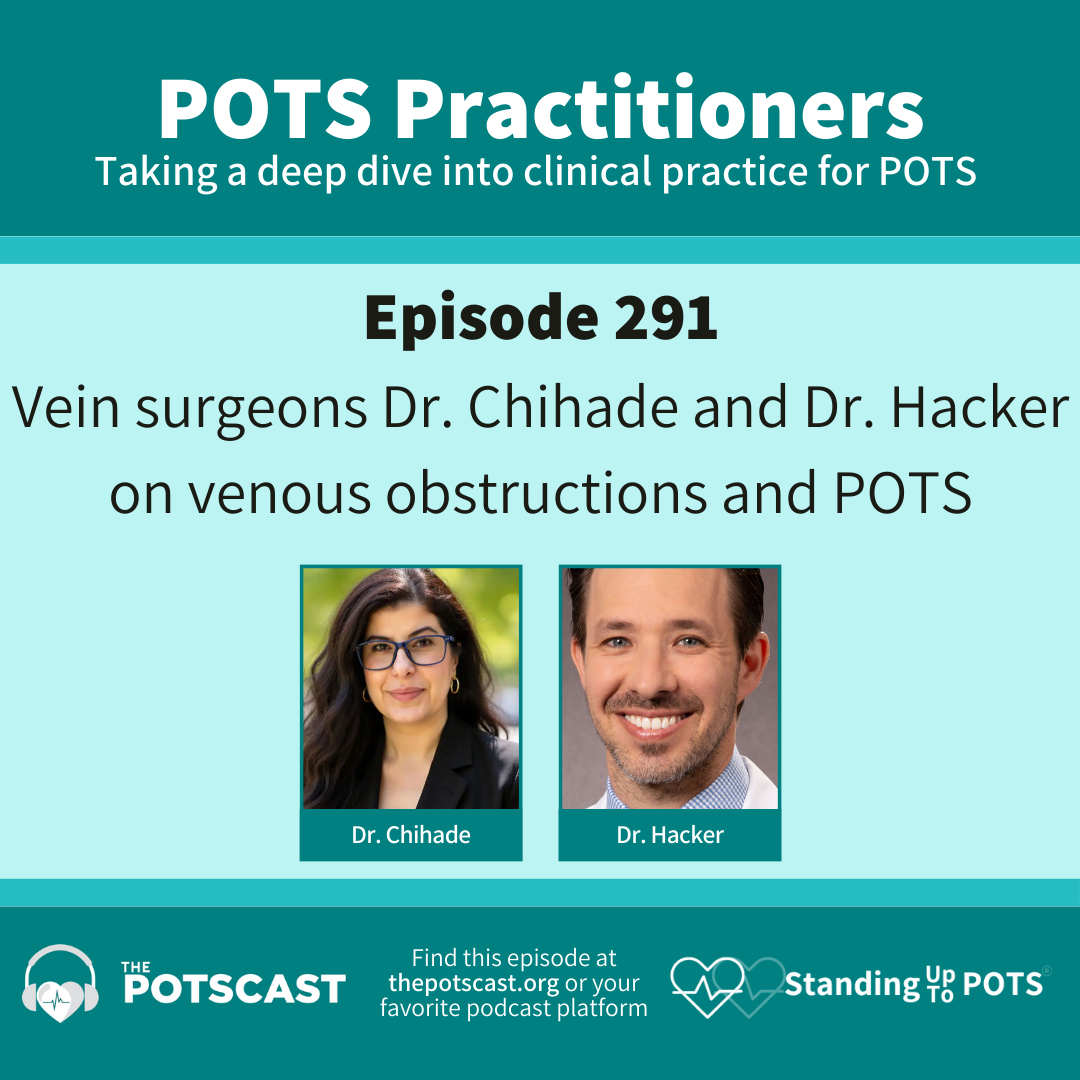
Vascular surgeons Robert Hacker and Deena Chihade on venous compressions, stenting, and POTS
January 04, 2026
Vascular surgeons Dr. Robert Hacker and Dr. Deena Chihade share their unusual path to POTS via looking at the venous system, and explain what they are seeing in patients before and after addressing venous compression syndromes such as May Thurner Syndrome and Nutcracker Syndrome. Dr. Hacker estimates that venous obstructions may play a role in more POTS patients than previously thought, and Dr. Chihade shares the research study she presented at the Dysautonomia International poster session. Both doctors explain how their clinic tests and treats patients for potential compressions and what the stenting procedure is like. Their website is https://stlvascular.com/.
Episode Transcript
[00:00:00]
Jill Brook: Hello, fellow POTS patients, and marvelous people who care about POTS patients. I'm Jill Brook, your horizontal host, and today we are interviewing our first surgeons on the podcast. In fact, they're just out of surgery now. Doctors Deena Chihade and Robert Hacker from St. Louis Vascular Surgical Specialists in St. Louis, Missouri. They are going to tell us what they are seeing at the intersection of vascular issues and dysautonomia. Dr. Deena Chihade is a board certified vascular surgeon and general surgeon with extensive experience treating all types of vascular issues. She has authored 58 published papers, abstracts, posters, oral presentations. She has contributed four book chapters, including textbooks. She's a member of 14 esteemed organizations, including the Society for Vascular Surgery, the Vascular and Endovascular Surgical Society, and the Society for Clinical Vascular Surgery.
Dr. Robert Hacker is a board certified general and vascular surgeon. [00:01:00] He's a fellow of the American College of Surgeons, a fellow of the Society for Vascular Surgery, a registered vascular technologist, a registered physician for vascular interpretation. He has numerous academic publications, poster presentations, and other research publications. He has too many accomplishments and volunteer activities to name, but his very impressive CV is on their website if you wanna check it out.
Dr. Chihade and Hacker, thank you so much for being here today.
Dr. Chihade: Happy to be here.
Dr. Hacker: Oh, it is such a pleasure to join you.
Jill Brook: So we don't normally hear from surgeons who are interested in dysautonomia. So can you tell us about your clinic, your work, and how you became interested?
Dr. Hacker: Absolutely. So I started this practice about two years ago. And it really was the kind of love child of wanting to get out of large academic centers and spin off to private practice. And it took about nine years of training to get to the point where we could launch it [00:02:00] ourselves. And that is when everything absolutely changed for the POTS community and everyone else. After about a year of practice, Dr. Chihade joined me and we just celebrated her one year anniversary. And the amount of just transitioned that has occurred since she started has been amazing in such a positive way.
And I really think that this community has done nothing but benefit from her accomplishments and her joining us.
Jill Brook: Well, we are so excited to sort of just like hear what are you seeing Dr. Chihade? Like what are the patients that you see? What symptoms do they have? What are you hearing?
Dr. Chihade: Yeah, so for just the gamut of vascular surgery, we take care of, you know, mostly arterial disease, so carotid disease or for stroke prevention, or aneurysmal disease, et cetera. But I did some light venous work in my fellowship. However, when I joined Dr. Hacker, he was doing some pretty heavy venous work, so I got to learn a lot from him. And then we kind of stumbled onto our [00:03:00] first patient that had this syndrome and it kind of took off from there.
Jill Brook: Wow. Okay. All right, so I'm dying of suspense. What is this syndrome and what has taken off? What did you see?
Dr. Chihade: Yeah, so basically we got a phone call from an out-of-state patient and you know, I took the phone call and this patient was kind of echoing symptoms of POTS. I don't remember if she was formally diagnosed or not, but she kind of had looked up everything and she was out of state but her family was here.
So she came in and we assessed her and I kind of relied heavily on Dr. Hacker 'cause I hadn't done a lot of venous work. So we got some ultrasounds and noticed that something was going on. So I did her first imaging study and found a compression syndrome and I relayed it to him. He decided to treat her, you know, kind of teaching me along the way.
And then we checked on her and her symptoms improved. And then we kind of just started getting more and more patients after that with similar symptomatology. [00:04:00] And after a certain number, you know, the academic side of me, you know, I was very, you know, wondering if we're actually tr doing the right thing, treating the right thing. So how are we gonna study if we're actually helping out? So, I kind of decided to get some validated questionnaires, have a kind of a pathway for these patients to go through where they're asked very direct kind of questions from head to toe, kind of to parse out where their compression syndromes are. And then our ultrasound techs are really well-trained in how to look for those on our non-invasive study. And then we proceed with a, a gold standard venogram with IVUS, which he also taught me to do in this practice. So once we started doing that before we even touch the patient, they fill out the questionnaire. I kind of guide what we do during that imaging study, which is an invasive study where I'm gonna interrogate what vessels are compressed or not.
We do our measurements and then we actually do not intervene in that [00:05:00] first setting, because it is not an urgent thing. We wanna provide as much information to the patient, their family as possible. And I actually leave it up to the patient and the family once I show them the imaging and the ultrasound, you know, intravenous ultrasound to actually make the decision for themselves.
And then we kind of go in a stepwise fashion about the intervention in a staged way. Very slow, very careful. And then after we're kind of done with the majority of their interventions, we do the repeat questionnaires and we found that a lot are responding quite well. And at that point you know, at the beginning I kind of got some blockage in terms of talking to other doctors about it. So I decided to look up online, you know, where do POTS people go and where are the societies, 'cause I had no idea. So I found the conference that was going on, put the data together, put this poster together with Dr. Hacker, you know, imaging, stuff like that. Presented that, and also invited a [00:06:00] local POTS specialist, Dr. Kinsella, who's part of that group, showed him our imaging, and then we got more people involved and it kind of swung from there.
Jill Brook: Wow, this is so amazing and I have so many pieces of that that I wanna pick apart, if that's okay. So can we start with the compressions that you're seeing? So we have heard that, for example, May-Thurner Syndrome might be something that is over prevalent in the POTS community. And so is that the main one you're seeing?
And do you mind kind of reminding our audience what that is and are you seeing other ones? And I guess, I guess I would just be curious, first of all, like what are the compressions like that you see?
Dr. Hacker: Yeah, so it's very interesting because I think up to now after talking to the POTS community, there's been a large focus on the medical management. So to a surgeon quote medical management close quote is basically pills and stretching and seeing other people and all the therapies that most people are comfortable with.
Surgeons are [00:07:00] obviously doing surgery. And so our life has been completely immersed in this. And so in the vascular community venous diseases are not heavily prioritized because they don't have the same sexy factor as a lot of the arterial work. So we know about it academically, but our understanding of it, I think, is still in the, in the beginning stages.
But it has a name, for example. So May-Thurner's been around since the sixties. If you read the original papers, you know you can find them on PubMed, it's been following and it's taught. When we started the practice I went from being a very arterial heavy practice in the hospital setting, fun and sexy, to veins.
That's what people in the community have. They have varicose veins, they have swollen legs, they have achiness, they have pain, in addition to the arterial work. So a lot of the original practice shifted to about 50, 50, 60% veins. During this time, we started noticing people with left leg [00:08:00] symptoms. The concern for May-Thurner started coming into a lot of these patients. And this is before Dr. Chihade came, but we would see them and we would work them up like we thought we would, and we would find compression. And what May-Thurner syndrome is, everybody is built this way, our aorta, which comes off the heart, comes down the left side of the body. But you have two legs. So at about the level of the belly button, the aorta switches its name to the iliac arteries, and it goes to the left leg and the right leg. Well, these vessels are stiff, they're hard, they're meant to have very high pressure, right? And they deliver your blood flow. Once your blood flow's delivered, it has to come back through the venous system. And the venous system starts very small, and as you get closer up, it gets bigger and bigger and bigger.
And we rely on our valves from our toes to our groin. So the blood gets up to your groin, kind of like a [00:09:00] rollercoaster goes up at the beginning. It kind of click, click, click, click, click, and every time you move, you push a little blood and then it starts falling back. The valves catch it. Once it hits the groin, it starts free falling into the heart.
And your lungs create this vacuum, and your heart creates a vacuum. And so there's a lot of flow from the groin up. And there's a very free flowing system. So that's the basics. But you have two veins that need to go to the return inferior vena cava on the right side. So if you go and you Google an image, aorta and inferior vena cava, or you go to our Instagram page, STLvascular, we have an image of this posted, there's a crossing event and that crossing event is the right iliac artery is going on top of the left common iliac vein. And if you look at normals, now that I've really paid attention to it, the vein and the artery kind of cross lower in the [00:10:00] pelvis and where the sacrum drops down, if you look at the S-curve of the spine. What we find though, there's a shifting where people are crossing higher up or the aorta is shifted over to the right, causing a compression between the artery and the spine.
And that's the May-Thurner compression. And there have been people who get left leg DVTs and you know, usually it's only treated when people are very symptomatic. So let's take a pause. That's what it looks like. I'm going through the practice, we're treating people for their veins and it just so happens we treated a few May-Thurners and they said, oh, by the way, I have POTS, and did you know I felt better after my stint was occurred? This was about August of 2024. Dr. Chihade joins in October, we treat a few people, I said, hey, there's this weird thing going on. We identify it and then in January we're like, this is definitely real.
You know, we're five, seven patients in. Then we started getting our first, like, I have POTS, I need this treated, as her story alluded [00:11:00] to. And so now we have this, what's going on effect, and that's when we started really paying attention. The interesting thing is there's another type of compression called the Nutcracker phenomenon, and that's where the left renal vein has to go between the superior mesenteric artery and aorta when it returns its blood flow. And in normal people, there's a very generous fat pad. In the POTS people, we often find no fat pad and a heavy level of compression. So this left renal vein struggles. It then has to drain down their gonadal or ovarian vein into their pelvis, and then tries to leave the pelvis through the iliac vein, which often they have May-Thurner, and then it hits that, and then they get cross pelvic collaterals and that's where the pelvic congestion comes in.
So we're seeing these patterns. And you say, okay, how often is this happening? Well, in the normal population, I would guesstimate off the top of my head, May-Thurner is prevalent in a symptomatic component 5 to 7% of the time. [00:12:00] With Nutcracker being symptomatic, I don't know, 2% of the time, 1% is the quote literature.
In the POTS patients 97% of them, I'm comfortable saying this, have made May-Thurner syndrome and 95% of them have Nutcracker phenomenon.
Jill Brook: Can you say that again?
Dr. Hacker: So in the normal population walking outside, I would comfortably say 7% of the people have May-Thurner Syndrome that's symptomatic. And maybe 1% has symptomatic Nutcracker phenomenon. In the POTS patients, or let's be more fair, let's call it dysautonomia, because we fully don't understand it. And I think that encompasses more people in our community. In the dysautonomia population, we're guesstimating without running the most recent statistics, 97% of the patients are presenting with the May-Thurner compression, and over 95% have the Nutcracker phenomenon.
Jill Brook: Okay, so this is blowing my mind either way, but [00:13:00] are you saying that you think that 97 and 95% of all POTS or dysautonomia patients or the ones that walk into your office with vein problems?
Dr. Hacker: Well, it's interesting because it used to be the ones who walked into our office with vein problems. Now it's the reverse, 'cause we're getting the referrals as people are realizing we're treating. So we're getting people who have been diagnosed with POTS, no vein problems. We do the screening and they had it.
Dr. Chihade: Yeah, and it's shocking because Nutcracker is definitely a question on our boards, but it's presented very differently. And, you know, POTS is not really in our textbook. But May-Thurner, Nutcracker is presented in two separate entities, you know, for different reasons. And when we do interrogate the patients about their symptomatology, 'cause the left kidney vein or the left renal vein drains the lumbar vein, so they get the headaches and the fatigue. And there's also some bowel issues that go on with this. And then the pelvic, you know, component all put together kind of makes them have, you know, all of [00:14:00] these symptoms. So if you have all these collaterals in the pelvis, they carry a lot of blood. So these patients stand up or they're in a humid environment and they try to move around and instead of the blood being efficiently returned to the heart, it just spills into their pelvis. So then they get the upstroke in the heart rate, their adrenals fire off, their heart is ready to go. They get dizzy, they faint, blackout. Then they have the pelvic pain and all that. An interesting component to this is there's four types of POTS. So the hyper adrenergic is kind of the one that I've most seen.
But you know, there's the syndromes of EDS and MCAS that come with it. And with Ehlers-Danlos, you can imagine if an artery is going over a vein and you have this weakness in vessels, that it's just way more pronounced. So I'm not really sure chicken/egg for this, but what I've kind of come to realize lately is we can treat the anatomic portion of this, but it really involves a lot of collaboration with, you know, the medical side of things, 'cause we do have some [00:15:00] patients that, you know, just recently, I saw one last week and she's doing great, but she's still having the medical symptoms and she doesn't have a dedicated POTS plan in terms of fluid and salt intake, et cetera. So I've just realized that synergistically we can really help patients cool down their symptoms. My statement to them is, I'm gonna give you the keys back to your car, which means give you a little bit more control over your own body. And that's my goal. So this all kind of comes together that way.
Jill Brook: Wow. Wow. So are you basically saying that it makes sense to you that the postural tachycardia could be the heart beating fast in response to having to work harder to almost like work to suck this blood up from the lower body because there's this compression making it harder than it should be.
Dr. Hacker: So again, we're bringing it from the perspective of surgeons. So we both have training experience at institutions that had lots of gunshot wounds, [00:16:00] lots of penetrating trauma, blunt trauma, and one of the fundamentals in surgical training is to better understand what we call volume resuscitation or fluid resuscitation.
It's a cornerstone in the first hours of treatment of anybody who's had a surgical emergency of this nature. The POTS patients behave like this. But then they get better. Then they stand up and they behave. It's like they're getting shot over and over again from a physiologic standpoint. And with the venous system holding 75% of the body's blood, it's pooling and waiting.
A majority of that is in your lower extremities, especially when you're standing. You can easily imagine how you're just not getting blood. So if you know anything about engines, if you were to run an engine lean or have a low gas to air mixture, it runs very fast and inefficiently 'cause it's trying to make up for what it can't do.
The heart is, we think, behaving in a [00:17:00] similar fashion and you can test it because if you lie someone down and raise their legs, you can transfuse between one to two liters of blood in about 30 seconds and most of the symptoms go away. That's why we feel that the patients respond the way that they do. When they lie flat and elevate their legs, they're auto transfusing, they're overcoming these symptoms and the heart's better. That being said, I wanna be very clear to the community. The surgical corrections that we're doing are only fixing a component, which is, I'll have Dr. Chihade talk about the paper. We still believe, and this is why I want to use the term dysautonomia, there is still something going on with the nervous system that we have not put our finger on, and that I think will be an excellent string for basic science research and physiologic research. But there clearly is a correlation between the compressive syndromes, the relief of the compression, and people's symptomatic relief.
Jill Brook: Wow. Wow. That is [00:18:00] amazing. Okay, so what are you doing that helps the compression? I think you mentioned stent.
Dr. Hacker: So you only have one option. You, you have to relieve the compression. So you, how do you relieve a compression? Well, you're dealing with organs. So you can, in the Nutcracker, you can do a kidney transplant and move the vein and move the kidney. You can do what they call a renal vein transposition, where you cut someone open, you disconnect the vein, you reimplant it in another location. Or you can stent it.
And in the May-Thurner you could do similar things. You could stent it, you could bypass it with a conduit or a tube, or you can reposition it. Now, these are all very morbid procedures. An auto kidney transplant is a big surgery. A renal vein transposition is a big surgery. But it's 2026 in just a few days. [00:19:00] Technology has really advanced, especially in the arterial world. If, if you were to go and see the amazing things that you can do minimally invasively in the arterial world, your mind would be blown. It is definitely 2026. In the venous world, putting stents in veins, we're we're almost pariahs. Like, what are you doing?
No one does this. But the technology is so good. Why wouldn't we do this? This technology is good. And you know, we've done over 160 iliac vein stents and probably over 45 renal vein stents and like almost no complications. The data's there. We just need to put it out there and say, listen, there are alternatives out there.
Dr. Chihade: Yeah. And they were putting in, you know, renal vein stents back in 2016, 2018. And that data was presented at the Eastern Vascular. But the stent that they were using at that time caused a lot of complications. And you can hear the audience kind of, you know, not be satisfied. They're full of vascular surgeons.
So they went back to kind of the old school, either [00:20:00] open surgery. Now they're doing robotic transpositions, but it's still a big surgery. So now we have stents that are a little bit more compliable. So the complication rate with us so far is zero. But back then it was, you know, we're worried about stents moving or migrating or perforating, especially in the left renal vein.
And the one that we're using now is actually pretty good. And we have kind of a good algorithm going on where we're able to use some equipment that's available in the hospital to do some of it. And then also we have in our office here, the suites that we, that we operate on these patients and place the stents as well.
Jill Brook: So if you place a stent for May-Thurner Syndrome, how long does that take? How big of an operation is that?
Dr. Chihade: Yeah, so the venogram with IVUS, the diagnostic is about 20 minutes. It's basically involves you coming in, you get in a gown, you know, we surgically prep you and then we access your groins. We basically put some IVs in the groins, then we take pictures with dye [00:21:00] of the vessels, and then we put that intravascular ultrasound, which is on a small catheter, in the vascular beds and we take a video. And then it does measurements for us. So we do that. That's about 20 to 25 minutes. You know, he's probably faster than I am. And then when we do, you know, the renal vein stent, that's usually about, again, another 20 to 25 minutes, a little bit more involved, and it's in the hospital. But the left iliac vein stent, so we're, again, we're, just to reiterate, the May-Thurner type is that artery going over the vein, right? So we're putting a stent in the vein to give it a little bit of strength under the artery, and we can do that. Basically, we just puncture the left groin, place a wire through that catheter that we've placed, take a picture, place the stent and then take another picture with dye to make sure that stent is in a really great position and that's sized according to three different variables. So a maximum, a minimum diameter, and an area that's calculated off the IVUS. That can take usually seven to 10 minutes. [00:22:00] So seven to 10 minutes. And we've had patients of all ages. You know, we have patients that are in their twenties, thirties, forties, fifties, and we've had two in their sixties. So they've lived with symptoms and they've shaped their entire life, including not driving, you know, not being able to participate in their marriage in a certain way for 40 years.
And we get those patients. And then seven minutes is, is what we do. We are very cautious about counseling, or I am, about counseling, and he is too, about these patients because we don't wanna make any promises. There's a lot of components that to POTS to not discredit all of the work done by POTS specialists, including neurologists and cardiologists to kind of simplify it into a stent or two is kind of, you know, that's kind of not the responsible way to say things or handle things.
So I do tell my patients, I'm just hoping that out of your 20 or 30 symptoms, if I can [00:23:00] improve a few by 20 to 30%, that would be great. So far we have never made anybody worse. We do have one or two patients, one of mine, she has a heart issue. Her heart keeps firing off 'cause it's now, so the electrical pathways are so used to reacting to her volume status that even though she's improved in other things, she keeps having tachycardia.
So, you know, by doing this, just, just, you know, I really tell them, you know, I want you to make these decisions. This is what I think you need, but it's up to you and I'm hoping we can help you. We do have a couple miracle patients where every single symptom is gone and I have a great letter that I think I shared with you and the patient told me I could share it, you know about how he changed his life and he's a male. The other thing is, is that I've told you about patients that we've improved, the miracle ones, and then we are getting some patients that are families with POTS. So I'm talking a mom, kids, and then [00:24:00] they look at their family history. And I have that family in particular that's in my head right now, they think their grandfather had it too. I have a couple of patients that are twins that have it. I have some patients that there's like three or four events that happen in their life that set it off and those are puberty, COVID, and actually their first or second pregnancy really tips it over into where I think they had the symptoms, but they were handling it fine and now it's kind of gotten out of hand.
Jill Brook: Wow, that's amazing. So are people under general anesthesia during this time?
Dr. Hacker: So we use an office-based lab. You walk into it, you wouldn't recognize it from anything other than a regular OR, but it's just an office in a building. For safety reasons, we don't use anesthesia. People are what we call in class two or class one anesthesia. So they're sleepy or twilight or just below, but they're always breathing for themselves.
They don't have an emergency airway. We don't [00:25:00] think you need it. So we just numb up the groins with lidocaine and then we give some medications that are very, very safe and even the most anxious patients with a little bit of premedication before we get start, and an IV have been able to tolerate this.
And speaking to the community, the most anxious patient I've ever had, had such a bad anxiety reaction that she became so hypo CO2, she blew off so much CO2, she went into muscular contractions and it took us 15 minutes to get her back to normal, to straighten her limbs up. And we've had patients who are in the medical field who have been awake the entire time, this is what's amazing about this, and have said as we are driving around the body, hey, do you feel this? We'll ask people and they'll be like, oh yeah, I've been feeling that for years. And it's right at clinical spots. And that's where it really [00:26:00] connected. So for example, this patient is in a radiology tech.
She saw us doing it in the hospital. She tapped me on the shoulder and says, I have that, will you do me in the office? I said, okay. We come to the office, we do the diagnostic angiogram. She's watching, I'm watching. We're driving around her blood vessels. She's like, that's my pain. She had right groin pain, even though it's May-Thurner on the left. What I've learned is the pains can be in in many various places, and it's not what you think it is. And that I think the community, if we were to talk to the dysautonomia community, has been one of the biggest challenges. Not only is it a disease of really women, again, there are six guys out of the 200 people that we've had.
Okay. So this is a we'll call it a syndrome of women. And we know that women aren't often listened to in medical clinics. It's a syndrome of lack of understanding of the medical community. So it gets [00:27:00] dismissed and the symptoms don't make sense to non-surgeons.
And even the surgeons who are interested in this are gonna say that doesn't make any sense. So how many of you out there have had all the blood work in the world? That's normal. The endoscopy. That's normal. The colonoscopy, maybe more than once. That's normal. Pelvic examinations. Uterine ultrasounds. Had a hysterectomy, but didn't improve your symptoms. Or about to have a hysterectomy. Painful intercourse. How about bloating? Left flank pain. What about your gallbladder being removed, but it didn't make it better. Okay. Headaches. Headaches that are really bad. I'm gonna use the magic word. You needed a blood patch and it didn't work.
But your symptoms get better when you lie flat. These are the constellations. I don't actually need to hear your story anymore, if you come in with more than one quarter of one piece of paper with symptoms [00:28:00] on it. So when you come in with the six book page, I know you got it.
Dr. Chihade: Yeah, and they've been like diagnostically worked up by multiple specialists and they are pretty dejected when they come into our practice because they've had such extensive workups.
And I'm talking what he was saying, GI workups, irritable bowel, all of 'em. We've unfortunately had a few patients that have already had their uterus taken out even though they were planning on a life that depended on them having a uterus. I've had a couple of patients that they've been diagnosed with really, really bad bladder issues, but it's because the bladder sits in the pelvis and they are not you know, appropriately emptying their bladder of venous blood. So they have a lot of issues. So we do try to interrogate during our history and parse out these things. Then we get our ultrasound and if they match kind of all those things and their questionnaires are, are pretty bad, then, you know, we start [00:29:00] to talk to them about next steps and go from there.
Jill Brook: So it sounds like you would think that a lot of dysautonomia patients would be candidates. So, who either is a good candidate to contact you, or if it's easier, who's not a good candidate? Like assuming these people have POTS or dysautonomia diagnosis already.
Dr. Hacker: So, so here's my feeling. We start slow. You date a little bit, which is a terrible analogy, but think about it. You go slow. So I think if you think you have it and you are concerned, it doesn't hurt to come into a doctor's office and answer a few questions and fill out a, it's a little bit of your time.
The screening ultrasound is a non-painful ultrasound. It's non-invasive. There is power to having knowledge. And if you're going down this pathway or you're curious, it's just as good to say, hey, you know what, you don't have it. [00:30:00] You look normal, you screen normal. So to your point is, I think if you're concerned, come see us.
I've developed guardrails because the most important thing is in the private practice setting, especially in surgery, you know, there's a lot of scrutiny that goes into private practice outside of academics, because there's a thought that you're chasing money. That's the kind of the elephant in the room.
And we go above and beyond to ensure that that is never the perception. We are here for medical treatment, first and foremost, patient-centric care. And that's why we, I really wanted to get this data out. When I noticed this, and I knew Dr. Chihade had this really robust background in research, I said, we need to publish this so that people don't think we're doing stuff for no reason.
And so we've developed guardrails. But that being said, I have the grandma, the mom, and then the two daughters, 16, [00:31:00] 13, 12, are getting symptoms and they're like, oh my god. You know what, I brought in a 12-year-old with mom, we've asked the questions, we've done the ultrasound, they screened in, and then we stopped.
And I said, hey, listen, looks like you've got what mom's got. We're not touching you. We're not stenting you. We are doing nothing to you. But you now know. You now have control over yourself because you know what's wrong. You're not crazy. I know it's uncomfortable. This is how we're gonna cope with it.
And I had an interesting interview with a psychologist, Dr. Stein. Having that information and then being able to talk through it and rationalize it and get yourself through a, a spell or a period is very, very important and very empowering. So, we try not to do anything, you know, if you're 60, we'll go kind of fast track.
If you're 40, we'll [00:32:00] go fast track. If you're 30 and have kids, we'll go fast track. If you're 20, 21, maybe we'll slow down a little bit depending on where you're at. Are you married? Do you have children? How's it affecting your life?
I have a couple people who are freshmen in college, not doing well academically. This is consuming them. We're treating them. Do you know why? If you drop outta college and you lose that opportunity for an education, your entire life is gonna be different then had you gone to college and had to be able to do things. So we've gotten people off of welfare, get back into jobs. We've gotten people off Medicaid, back into jobs. Back into school, earning good grades.
This has been life changing for people.
Dr. Chihade: They've lived with a stigma for so long.
Jill Brook: So, Dr. Chihade, did you have more to tell us about the research that you did and the data you collected? Like what kinds of improvements are people seeing? Like what kinds of symptoms tend to improve after the stenting?
Dr. Chihade: So basically, you [00:33:00] know, we've been kind of across the board for both their pelvic congestion and Malmo POTS. So those are the two surveys. So I mean, they each score, you know, sometimes I have them do the test or you know, the two questionnaires without me in the room 'cause they wanna make me feel better about things. But I just want their true, you know, scores and stuff like that.
But it's mostly like all the medical stuff that they were using to kind of keep themselves as functional adults. So drinking tons and tons of fluid and salt and taking medications to improve their blood pressure. So they kind of notice they're not passing out as much, or not at all. But they still get some dizziness from time to time, but it's very much more predictable and they can kind of control it better.
You know, I have had quite a few female patients and their first thing that they tell me is they're no longer having dyspareunia, which is pain with sex. And like that is the first thing that they're like, okay, I can be a woman now with [00:34:00] my husband. So there's that. You know, they're not having the pelvic pain. I don't wanna say it's gone, but it's not as bad as it was before. Just kind of the anxiety rushes, which is it anxiety or is it their heart rate? And, you know, all that is a little bit more controllable.
We do have a couple of patients that they've had this for 40 years, so that anxiety just doesn't go away. Now it's psychologically wired into them. So I have two patients that are kind of slowly unwiring themselves from that. So it's kind of a, they run the gamut. One patient, she's never had a full meal ever. And when after her husband said the night after we put the left kidney stent in, she had her first full meal. She ate the entire plate. And that's because her gut was draining a little bit better. We had to kind of open that up. So it's kind of, it runs the gamut and it's very, you know, I try to keep each patient in their own box, in [00:35:00] their own space. I try not to compare them to other patients because they're experiencing what's going on with their body in a very individual way.
But then you just notice that the things that were really controlling them are not controlling them as much. I do have one patient who wrote that letter and he goes, you know, you don't know this, but he would buy shirts and socks like in the dozens from Costco because he would sweat and pass out and he didn't wanna smell bad. So he had to change his shirt every, every few hours.
And he couldn't go to class. Like he was in college because he would pass out on the way to class or feel dizzy or you know, et cetera. It's all gone. So that's his experience, right? So he wasn't having pain with sex. He's a male. He was having these other issues and that's how we fixed him. So it's kind of different for everybody.
And then the headaches issue is a huge deal. You know, we have patients, it's usually a posterior headache, 'cause that left kidney vein really drains the drain the veins off the spine. So once we [00:36:00] open that up, some of their headaches go away, which is pretty cool. The pelvic stuff, their colon is emptying a little better because the colon is getting arterial flow, but it's backed up. It's not draining. So it becomes a very congested colon. So they talk about constipation or IBS type symptoms. Those improve. You know, so on and so forth. So there are a lot of spaces that I think that we don't know about yet. For example, how does this affect pregnancy? If the uterus is not draining blood efficiently, these patients get menorrhagia, which is too much blood during their period.
And that's one of our questions that we ask. And that happens with pelvic congestion. They'll talk about periods that they have to go to the ER for. So if your uterus and the lining are not happy, and then, you know, they're, they're wanting to conceive. That's, you know, probably a given. I'm not a specialist in that at all. But it's something that there's a bunch of spaces that this could be applied to [00:37:00] that, you know, the GI specialists can get ahold of us, the OB/GYN specialists can get ahold of us, you know, so on and so forth, to kind of see if this is participating in, in their symptomatology.
Jill Brook: Wow. So I wonder if I could maybe kind of like combine two questions. I'm, I'm glad that you mentioned the Mast Cell Activation Syndrome patients and the Ehlers-Danlos Syndrome patients, because I know that when they listen to all of this, they kind of say, oh, you know, but are they aware of those things? How do those patients do? And so I was wondering if maybe you could talk about how are those patients doing and maybe put it in with like, what are the risks of these procedures? So basically what, what, what do people need to worry about and how are the sensitive patients doing?
Dr. Hacker: So we're, we're actually very lucky that we have two very, as far as we can tell, prominent specialists in the area, Lenny Weinstock, who does MCAS .
Jill Brook: Friend of the podcast, we love him.
Dr. Hacker: Yeah, and he's about five [00:38:00] miles away from us. And we also have Dr. Kinsella, who is a neurologist who is doing a lot of POTS. So, Kinsella actually helped us define or start really articulating the headache component of all of this. Where Dr. Weinstock comes in and the MCAS is, we actually understand that people with a connective tissue disease have more friable mast cells because of the connective tissue and they, they will release faster. But we actually think the reason why the mast cell is occurring is it's more of the egg than the chicken, that all of the constant hypotension, the constant react of the body, primes the body to the stress response. And then after so much time, everything makes them allergic because they're basically little balls that are ready to pop, right? And so rarely have we seen people come in and say, I have MCAS, oh and then I develop this other. It's usually, if you really dig in, it's something along a dysautonomia prequel and MCAS follows.[00:39:00]
And so we haven't done a, what they call in the science, a univariate sub-analysis, only looking at those patients to see if they get better. We also don't have enough time under our, under our belt to really what we call in science longitudinally follow this. But I have a strong suspicion that if we continue to follow these patients, you'll see probably improvement in the MCAS patients, even in those with connective tissue, once we start getting the compressive syndromes fixed.
Now, I don't think that the Ehlers-Danlos is causing the POTS in our particular case. I think the fact that you have floppy, connective tissue, you would argue, oh, that makes the vein more pliable, right. I think where the Ehlers-Danlos is, it makes that group more susceptible to the dysautonomia, that neurologic component we haven't defined yet. Something going on with the nerve fibers. Something going [00:40:00] on with the, with the mast cells.
But by putting the stent in, and we can do stents in Ehlers-Danlos patients very safely. There's a big concern about surgery in the literature. You do not wanna make open incisions in patients with Ehlers-Danlos , especially the connective tissue type. But the percutaneous procedures, they do great on. And they also derive a relief.
And so I can't tell you how the two are connected, but it's, that's why we keep calling it a syndrome, right. We don't really fully know. But there's clearly a, a correlation. And so, it's very fascinating, but it, they're not excluded at all from this group. And, and the compressive syndromes, again, are following the patterns, but they're not following in the connective tissue group any different than the plain dysautonomia group. Because my initial hypothesis was that the Ehlers-Danlos was actually the thing. But as we started getting more and more non Ehlers-Danlos patients, we started getting more and more, they look like all [00:41:00] the other POTS patients. So normal in the POTS, abnormal to the general community.
Dr. Chihade: We did have, I reached out to a lot of POTS specialists throughout the country and a few of 'em, they're like, well, how can you stent them, they have MCAS. Well, yeah. So there's, there's this kinda, you know, trigger that they pull saying they have MCAS, so they can't have dye, they can't have contrast, they can't have stents, et cetera. So the stents that we use, the first one for the left renal vein is not only is the metal coated, but it's actually a covered stent with, you know, graft. And then the stent in the pelvis is a nitinol stent that's also, you have no exposure to actual metal in it, in and of itself. So they, all my MCAS patients or all of our MCAS patients have done fine. But that was the first question that I got asked from a MCAS specialist from Washington State, like, how can you do this? Now if they need coronary artery stents, you know, they're now in their sixties, seventies, and on, and they're having heart attacks, that's a different story [00:42:00] because those are bare metal stents. So they're, they're quite aware of that, but we do have a few MCAS, or we even have alpha-gal patients that they're very concerned about any exposure to any chemical. So we have an algorithm for that too, just to kind of ease their minds if they need that. So, you know, they, they have a steroid taper prior to any contrast. But honestly, we've never had a reaction.
Jill Brook: So not to the contrast dye or to the stent itself.
Dr. Hacker: We had zero reactions to the contrast dye. The dyes in 2026, they've been manufactured in such a way that the binding agents appear to be non-reactive. Used to be a real dangerous thing. I've seen no reaction. In the volumes we use, we're talking a typical CT scan to 125 milliliters. We're using 10 milliliters. So it's very, very light. 15 milliliters.
Dr. Cutchins has a patient in New York who we're currently talking about. [00:43:00] You know, says, oh, I have a nitinol allergy. We can't use a stent. You know, one of the things I really wanna share to the community is, I think one of the reasons why we're seeing success, and I've actually presented this data, and hopefully I'll be able to present it next year at our Society for Clinical Vascular Surgery meeting, is that the way that we've been deploying the stents is very different because of the stent that we use.
There's another stent out there called the Wallstent. It's very traditionally used Wallstent. We're not using that. That's a whole nother discussion on like hows and the whys. But the stents we use for the renal vein, the stents that we use for the iliac vein, the Abre stent. The renal vein is called a Viabahn stent by Gore, these are selected for a very, very specific reason. And I don't deviate because all the failures we've seen have been in other platforms, and we've seen failures from other deployment mechanisms, like how they've done [00:44:00] it at very prestigious locations by very accomplished surgeons. And so I think what we're using, why we're using it, and how we're doing it, the technique really matters.
And so, you know, we understand that people live all over the country and they might not want to come see us, but just because someone can deploy these things doesn't mean they're, they're gonna be the right match for you. And it's very, very important. And so how do we get around these MCAS, this allergy?
People really don't know how intravascular stents respond from an allergic reaction because the cells on your skin are, they're very different than the cells inside your body. And so, we still have these two patients. We're trying to figure out what the best pathway is, but we have 146 who have had no problems.
Jill Brook: Yeah. I mean, this is this is very encouraging to hear. And the other thing that's fascinating and encouraging is that we have heard kind of similar stories from interventional radiologists. So you guys are the [00:45:00] first time that we're hearing this from vascular surgeons. And I feel like it's almost as if we're getting a kind of a a second independent review of this phenomenon because it sounds like we're hearing very similar things from both sides.
I don't know if you know the answer to this or not. Do you know if you do a procedure in a similar way as a, as an interventional radiologist would do it?
Dr. Hacker: The sheath, or the IV, the same. The wire, the same, the contrast, the same. The x-ray, the same. It's the technique. And I'm pretty sure that the way that we are doing it is very different. From type of stent selected, to how it's deployed, to the sizes and the lengths. And I'll give you a very simple example.
We're all using the same things. We use the IVUS. We size our IVUS one to one, meaning we measure it at 16 millimeters, you get a 16 millimeter stent. That is not the [00:46:00] standard in the vascular and intervascular community. They want to upsize by 10 to 20%. So if you have a 16 vessel, you're gonna end up with an 18 or 20 stent.
Do you know what that causes? Debilitating pain. Lessons learned from here, but when we started downsizing and right sizing and recognizing, all we need to do is prop this open, everyone gets pain. Everybody gets pain post-op. But barring one or two patients, it's gone in a few days.
Dr. Chihade: I will add that I feel like the radiologists, you know, they're, we've learned a lot from them. They've really kind of been the ones to jump on this pretty early, like years and years prior to any vascular surgeon in my opinion, kind of tackling this. However, they're more of into the coiling space while we're more into the combination stent heavy than part maybe coil.
So I've seen the majority of patients who are still representing with symptoms that they have been coiled [00:47:00] but not stented. So their flow is not optimized to return back to the heart with the stent. They've just been coiled. And coiled just for the audience means that we take a blood vessel or that's been kind of overgrowing in the pelvis, for example. One of those big collaterals that's been kind of growing and growing 'cause that blood is now shunted from that blocked left side to the right. That's why you have that pain radiate across the pelvis. So those veins in the, in the pelvis really grow to, to have a huge volume. So radiologists really know how to coil that one, and then the one that's coming off the renal vein down back to the pelvis, which is your gonadal, that cause a lot of inflammation. It can do a lot of good, but if you don't stent or figure out kind of a combination of doing things, you're not gonna optimize the return blood flow that the venous system is trying to do.
So that's that's kinda, you know, where we could probably, you know, once this kind of gets more robust in the, in the data, really work in, in a collaborative way with [00:48:00] cardiologists, neurologists, GI doctors, OB/GYN, and then include IR in a particular way, and then us in a particular way so that everybody benefits you know, to help the patient.
Jill Brook: Wow. Well, this is amazing.
Dr. Hacker: Yeah. In fact, I would love if you could have a survey from your listeners and ask 'em if any of them have ever had their renal veins coiled and how many of them got worse and now they're afraid to have an intervention. I would love to know that answer. But I'll bet you everyone who says that they had their gonadal vein or their ovarian vein coiled, I will bet you that a vast majority, if not all of them, got worse symptoms, worse headaches, worse left flank pain. Because of a lack of understanding of actually the compressive component. But I would love this survey from your audience and then let me know what they say.
Dr. Chihade: He and I have done tons and tons of trauma, so we've been in the pelvis for patients that are bleeding. We've rerouted vessels all the time surgically. So we have a very, you know, hands-on experience with how these vessels work, how they [00:49:00] move, how they feel in our hands. So it just, that understanding really kind of has made us improve our approach to these patients.
Jill Brook: Yeah, I can tell how much attention you've paid to detail and how you really listen, and I am so grateful that you bring your research skills to this and that you are open to collaborating to help patients. This is just a really huge gift that you bring the community to look at this. So I know you guys need to get going. Where can people find you online?
Dr. Hacker: Oh, that's great. So we're the only private vascular surgery practice in all of the St. Louis metro area. The name of the practice is the St. Louis Vascular Surgical Specialists. There's a website you can review our credentials, see what's going on. You can email us at [email protected]. On the website is a form to fill out, and if you said, hey, I heard you [00:50:00] here actually all the emails come to me, and then we have the, the staff reach out to people. We have a very small Instagram page, STLvascular. It's got a little Michelangelo guy on it. But what I really say is if you're curious and you wanna visualize what we've been talking about today, we have Dr. Chihade's research poster on that, and we have a picture of both May-Thurner and Nutcracker drawn out to show you where these compressions are.
And on that posting, we actually have a patient's venogram, which demonstrates the actual flow around the spinal cord causing the headaches, the flow going down the ovarian vein into the pelvis, and then across her adnexa and her uterus, really showing you. It was a real classic angiogram that she let us post to really give people like a visualization of what we're doing.
Jill Brook: Fantastic. Well, we'll put those links in the show notes so people can find 'em easily there and just [00:51:00] be one click away. But Dr. Chihade, Dr. Hacker, thank you. Welcome to the POTS community. Thank you for coming to the POTS community. We are so grateful to have your expertise and your compassion. I really look forward to to hearing more, and we just can't thank you enough for your time today.
Dr. Chihade: Yeah. Well, thank you for giving us a voice and I wanna publicly thank my partner because he taught me how to do the majority of this, and without him I wouldn't be able to treat the patient. So he's been my mentor in this as well. So thank you, Dr. Hacker.
Dr. Hacker: I'm so glad to be here to help everybody, and we appreciate the honor to be on your show.
Jill Brook: Awesome. Thank you so much. Okay, listeners, that's all for today. We'll be back again soon with another episode, but until then, thank you for listening. Remember, you're not alone, and please join us again soon.